How a Desktop Amp can Expand your Guitar Playing
Unlocking the game-changing power of THR.
Robbie Calvo

I’ll never forget NAMM 2011. That’s when I first met these cool space-age tube amps with incredible stereo electric guitar sound.
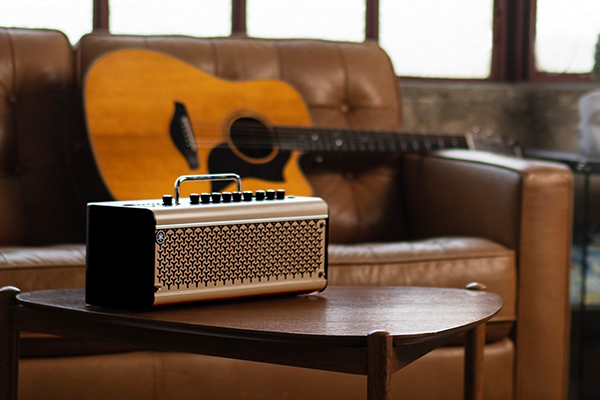
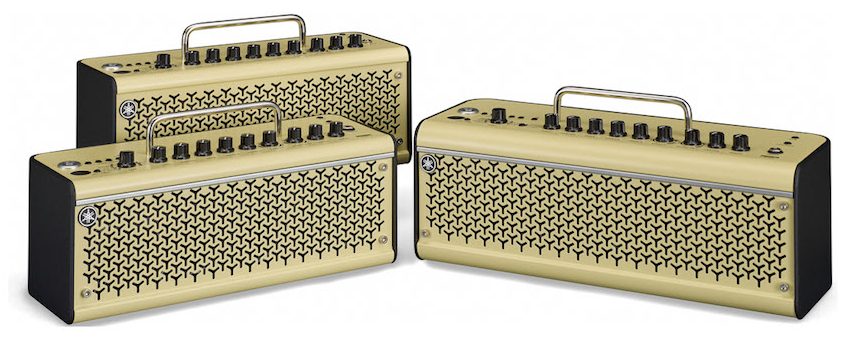
Lightweight and portable, these tan-colored terrors could literally sit anywhere from an office desk to a side table or studio. When Yamaha created this “third amp” category for guitarists, they defied conventional thinking. The THR reimagines the concept of a portable practice amp to offer a whole new level of functionality, design, and performance.
The THR delivers dial-in modulation, delay, and reverb effects with rotary controls and tap tempo, while the dedicated tuner keeps your intonation in check. USB connectivity supports recording and computer integration, with expanded editing via the THR app. An auxiliary input lets you jam along with tracks, while the headphone output makes late-night silent practice possible.
Over the last decade, the THR amplifier family has expanded. Now there

are various models for the electric guitar and bass enthusiast. Including a dedicated acoustic model that includes an XLR input for a microphone with its own volume control and dedicated reverb level.
Yamaha has expanded the connectivity, effects, and wireless capabilities in recent years to include Bluetooth®, charging wireless models, battery operation, and output ratings of 30 watts. These slightly larger models feature rear panel stereo outputs for live performance or audio recording.
The initial idea was that this innovation would be a third amp. Hence the name “THR”. At the time, Yamaha defined a player’s amp journey as:
Your first amp: A large tube stack for big stages.
Your second amp: A combo amp for small venues or rehearsals.
Your third amp: A dedicated desktop practice amp designed to give you the feel and tone of a professional rig at lower, living-room volume levels.
So how does a dedicated desktop amplifier enhance your skills as a musician?
Finding Flow
Quite often we end up practicing, recording, and writing in one convenient location at home. This can lead to a stagnation of creative energy.
When my students feel stuck in a rut or on a learning plateau, I advise them to practice in a new location. By changing the ambient energy around us, new ideas can flow.
The THR amplifiers let you shift locations on the fly, while staying connected to your favorite tones.
Getting Your Sound in Check
If you write and record music, you will likely have studio monitors for recording, playback, and mixing.
You probably listen to music on your smart device or laptop. This has driven creatives like myself to rethink how I produce and deliver music.
That’s why I now check my mixes on my monitors first, laptop second, headphones third, and phone speakers last.
The stereo audio playback on the THR amps is so good, it’s worth using the THR as another monitor source, letting you move around ambient spaces to check your mixes.
Jamming with Tracks
We all understand the power of jamming over backing tracks, especially when we define what we’re trying to achieve. More on that in a moment.
The tuner and tap tempo on THR amps let us stay in tune and dial in the tempo of what we’re jamming over. No detailed menus. Just tap the tempo button in time with the track a few times, and your effects sync right up. Of course, tap tempo also syncs modulation effects too. It’s that simple.
Press and hold the tap button to tune each string with visual ease and digital precision. Want a touch more reverb or delay when soloing? Just rotate the dials to taste and keep playing. Because the track and guitar tones both come through the stereo speakers, it’s easy to balance their volume and get a tight mix.
I also think this is a great way to audition tones when working on original music. Not sure whether chorus or tremolo works best for a rhythm part? Try both and find out in real time while playing along with your track.
Lunchtime Jams
Many guitar players are balancing full-time careers with busy personal lives. Having a desktop amp at work can offer the opportunity to “plug and play” during breaks, even if it’s just a few minutes at a time.
If you have the wireless-equipped THR model, you can use the YW10T Guitar Wireless Transmitter and connect to the THR without a cable!
For example, this focused routine should take about five minutes. Do it every day for a week on your lunch break, and you’ll have mastered the D7/D9 arpeggio in that position. Next week, add an adjoining shape.
- Define the topic: Playing one position of a D7 arpeggio.
- Play it slowly: Name the notes. Sing them as you play.
- Apply it: Play a lick that resolves to the root, major third, perfect fifth, and minor seventh. Four licks in total.
- Expand it: Add the ninth to create a two-notes-per-string D9 arpeggio shape.
The THR Models
The THR30II is now offered in black, white, and tan with Bluetooth connectivity, a built-in wireless receiver, the THR Remote App Editor, and a rechargeable battery.

There are fifteen guitar amps, eight effects types, and three extended stereo imagery patterns to choose from. Plus, there are settings for electric guitar, acoustic guitars, bass, and a flat response that work well for keyboards too.
THR amplifiers come paired with the Steinberg Cubase AI / Cubasis LE recording software for PC, Mac OS, and iPad.
The THR30IIA is the dedicated acoustic version of the THR and features an XLR input for microphones.
Both models also allow for driverless recording via the USB output or stereo outputs on the rear panel.
Find out more details by visiting the THR page.
See Demos
Watch me demo the THR30IIA for all three of the tones. As much as this is a dedicated acoustic version of the THR, it sounds excellent for clean electric guitars too, and features all of the effects you need. I chose the tube microphone setting and standard wide option for the imaging.
I added a modulated delay and reverb for each of the tones.
The initial guitar part follows the chord structure of the progression with nice “spread” chords. I then added more delay and reverb to a simple arpeggiated guitar part.
For the melody and solo, I added a touch of drive from one of my favorite tube overdrives, proving that the THR amps are also excellent platforms for pedals.
Watch the THR30IIA with a steel-string acoustic — then the THR30IIA with a nylon-string guitar.
Practice Mode
Here’s the backing track to jam over so you can try some of the ideas I suggested when streaming your device through the THR.
Here’s the chord progression and diagrams.
II: Fmi I Db9 C9 I Fmi9 I Db7 C7 :II
Pro Tip: Try using a capo at the first fret so that you can play the Fmi chord as an Emi open chord shape. (Like I did in the video) Check out the PDF diagrams.
Solo Suggestions
An excellent choice for a solo over this track would be the F minor pentatonic scale / Ab major pentatonic scale. If you’d like to add some exotic flavors into the mix, the F harmonic minor scale would spice it up and get you closer to the choices I made in the example solo.

One of Many — Or Your One and Only?
THR amps offer something special for every type of guitarist: The stereo tones are excellent, the effects inspire, and the auxiliary features negate the need for accessories, or even a cable.
For many, the convenience of these tiny mobile packages will let you play every day. Pair the THR with its dedicated carry bag, and you have the ultimate amp for a jam session or writing collaboration, anywhere, anytime.
For some, it’s a third amp. For others, it may be the only amp they ever need.
PHOTOGRAPHS COURTESY OF THE AUTHOR.
Keep reading