Tagged Under:
10 Things to Consider Before Starting a Guitar Class
Strengthen these 10 areas to create an inviting and engaging learning experience for beginning guitar students.
Many music educators don’t want to teach guitar because they don’t consider themselves skilled guitarists. Honestly, that is a valid fear. I had the same fear as a trombonist who had very little guitar education in my teacher training program. When I started my teaching career, I began to teach myself the guitar. Along the way, I went through many of the same struggles that beginning guitarists go through, which ended up being a blessing. Those experiences helped me relate to the challenges that my beginning guitarists face and made me a more effective teacher.
So, let me share with you the top 10 most common issues I had with teaching guitar and how I have worked through them.
1. Acoustic vs. Electric
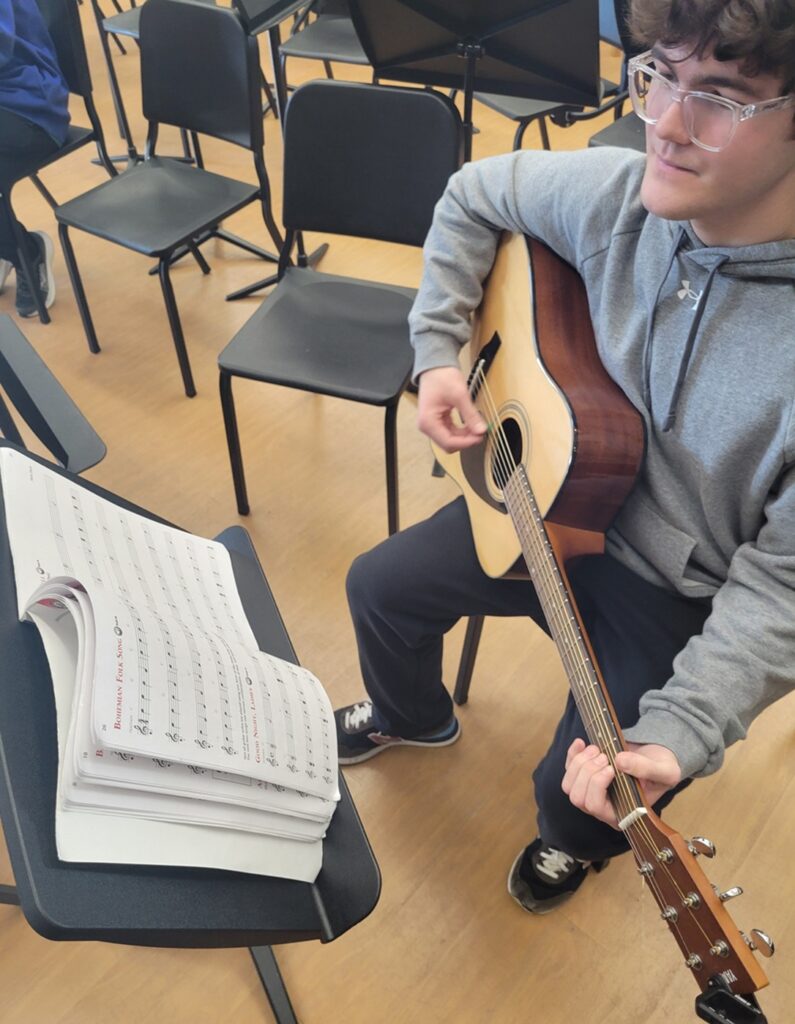
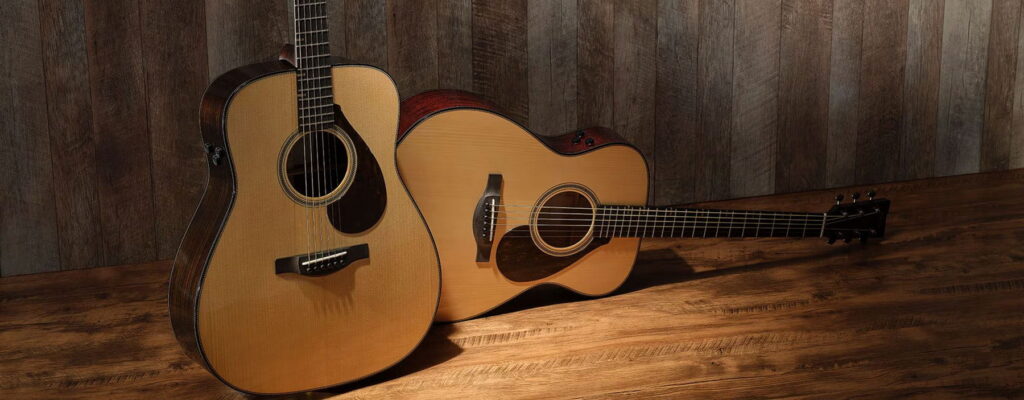
There are differing schools of thought on whether a beginner should start on an acoustic or electric guitar. I prefer starting students on acoustic because the string action is higher and the neck is usually wider, which requires students to develop better left-hand technique. They must have correct hand placement and press down on the strings with the proper angle. If students then transition to electric down the road, they will find it easier than switching from electric to acoustic.
Another reason I like starting on acoustic is because it is much cheaper and easier to set up a classroom set of acoustic guitars. Purchasing and setting up 30 electric guitars and amps is time consuming and expensive. With that said, if a student owns their own electric guitar and amp, I don’t fight it. Some students really want to play electric guitar. I don’t want to squash their enthusiasm by making them play on an acoustic.

2. Pick vs. No Pick
I don’t know how many times I had to stop a beginner guitar class because I had to help a student whose pick had fallen through the sound hole of their guitar and was stuck in the body. So, I made the decision to not hand out picks.
I have since changed my tune. Picks are now available for all. However, I emphasize the importance of finger style playing without a pick in addition to strumming. I also won’t stop a beginner from strumming without a pick as long as they are using their thumb and first finger together as if they are holding a pick as opposed to just using their thumb.

3. Kids Want to Learn to Play Their Favorite Songs
There’s no question that most students who want to play the guitar want to learn their favorite songs and classic guitar riffs. The teacher in me needs to make sure they build the correct habits and technique.
I used to begin my course with the method book and spent many sessions in the book before ever jumping into songs that students wanted to play. Granted, there were popular songs in the method book, but nothing by Green Day, Guns N’ Roses or Lynyrd Skynyrd. I found that students were developing great technique but were bored and losing their love for guitar.
Now, I jump into accessible songs as soon as I can, like “The Middle” by Jimmy Eat World and “All the Small Things” by Blink-182. Or, I teach iconic riffs like the beginning of Ozzy Osbourne’s “Crazy Train” or Metallica’s “Enter Sandman.”
I let the students choose songs as well. If they pick something that is too challenging, we’ll learn one part of the song or I’ll simplify it. This often motivates some students to practice because they want to learn to play the song. If you’re not sure where to find music for student song choices, check out Ultimate Guitar and Songsterr.
My current approach is a combination of techniques, habit building and students learning songs of their liking. It seems to go over really well!
4. Finding a Place for Guitarists in Your Program
When I first started teaching middle school band, the one ensemble that I needed a guitarist was in jazz band. In high schools, the options expanded to include the pit orchestra, pep band and show choir band, but that was about it. I soon found other opportunities for students to play guitar within my program.
- Find a song or two to do with your band, choir or orchestra that has a guitar part. This may be a choral piece with guitar accompaniment or a medley from a Broadway show or movie that includes a guitar part.
- Take a week after a concert and instead of sightreading new music right away, teach all your students beginning guitar.
- Start a modern band program where you have a popular music ensemble that plays rock, country, R&B, hip hop or any style of music that calls for guitar.
- Implement a guitar unit into an existing secondary general music class.
- Start an elective guitar class or a guitar ensemble.
- Offer guitar as a pull-out lesson or during resource/flex time if your school has this in their schedule.

5. Reading Music
Guitar players have a variety of ways they learn music. You may have heard the joke “How do you get a guitarist to stop playing? Put a piece of music in front of them.” Instead of looking at this as a roadblock, I see it as an opportunity to take a young guitarist from where they are to the next level.
Guitarists learn music in some form or combination of the ways:
- Traditional Western notation
- Chord sheets
- Tablature
- By ear
- Watching tutorial videos or mimicking another guitarist visually
I used to always start on chords with all my guitar students. If I have a class of beginners, I still do chords along with teaching riffs by tablature. However, if I’m working one-on-one with a guitarist or have one to two players in a modern band ensemble, I start with where they are. In other words, if they typically learn by ear, I’ll help them learn the first couple songs by ear.
Then, as they progress, I’ll teach them the names of the chords they are playing, the rhythms they are strumming, the names of the notes in the riffs, a scale shape, how to read tablature and so on. My goal is to expose them to the different ways to learn and communicate through the guitar. Some basic music theory and ear training never hurt anyone!
We don’t want to dampen the spirit of an enthusiastic young guitarist by focusing on just one way of reading music, but we also don’t want to cheat them of knowledge.

6. Coordination
I always tell my young guitarists that the most frustrating part of learning guitar is getting your hands to quickly listen to your brain. I think guitar is one of the most challenging instruments for beginners, particularly when it comes to developing the coordination needed to play consistently in time. Throw into the mix that adolescents struggle with coordination due to their growth spurts.
I have three activities I encourage students to do.
- First, look for patterns. Maybe it’s moving similarities between chords. For example, C major and A minor share two fingers in the same spot — only the ring finger has to move. Maybe it’s noticing a pattern in a riff. For example, the opening riff in “Sweet Child O’ Mine” by Guns N’ Roses only changes the first note in measures 3, 5 and 7. Recognizing these patterns helps the hands react faster.
- Second, before students practice specific etudes or songs, have them simply strum chords they know in any order. This allows them to practice transitions without attaching a “right” or “wrong” label to it. Practicing scales and scale shapes also fits into this category. Saying the chord or scale out loud as they play is also helpful.
- Finally, there is the TV trick. Do the same thing as the last example but do it while watching TV. This takes students’ eyes away from their hands since they are watching TV and allows them to get a feel for where everything is supposed to be instead of constantly watching their hands.

7. No Instruments
It’s difficult to teach guitar if you don’t have any instruments. Here are some ways to obtain guitars.
- First, if you need a small number of instruments, ask your students’ parents if they have a guitar they want to donate. There are many families that would love to purge their basement or attic to help the local school. Similarly, reach out to your PTO, local organizations and companies, or a district foundation if you have one. You can get a dozen acoustic guitars for $1500 or less.
- Second, apply for a grant. Guitar education is still considered innovative, which opens you up to many grant opportunities.
- Third, check out Music Will, an incredible educational non-profit. Not only can Music Will set you up with guitars, but it also offers training on how to teach guitar and modern band. The organization also has an interactive website that provides a variety of helpful resources. I just attended its annual Modern Band Summit in July in Fort Collins, Colorado — definitely a worthwhile experience for every music educator teaching or thinking about teaching guitar or modern band.
8. Physical Considerations
Teaching guitar to young students can be challenging because of their physical size, but practical solutions are available. For students under 5 feet tall, a ¾-size guitar is a great option. I have several available along with my full-size guitars.
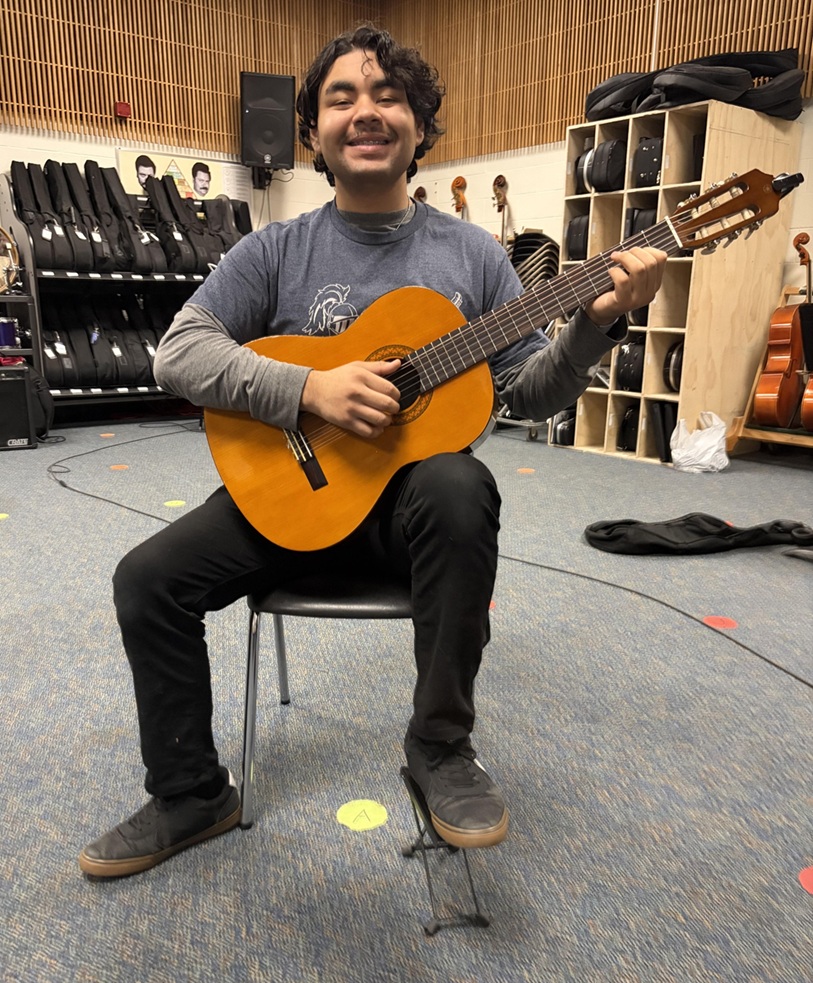
A nylon-string classical guitar is also good for beginners. Nylon strings are not as painful to push down, and they produce a more mellow sound. The fretboard is also wider, which makes it easier to press just the string you want without touching the one next to it. Although the wider fretboard can be more challenging for small hands, it’s a great option for developing good technique.
I also simplify chords at times. For example, barre chords can be very challenging for younger students even after several months of playing. I’ll typically teach the small, barred F chord where students use their index finger to press down on the first two strings and then add the second and third finger.
9. Method Books I Recommend
I have been using Jerry Snyder’s “Guitar School” method for decades. It’s a great mixture of chords, tabs, traditional notation and styles of music. “Yamaha Guitar Method” by Morton and Ron Manus is also terrific.
As I mentioned in #3, don’t rely only on a method book for instruction. However, it is important to find a book that teaches multiple ways of reading music, covers proper technique, has interesting songs and moves at an appropriate pace for learners.

10. Just Play!
I used to spend the first two to three lessons, and the first few minutes of each lesson after that, focusing on technique, fingerings and other basics. These basics are essential, especially for beginners. But how about finding some instant success?
Instead, try this for a first lesson: teach students the one-finger chord for G7 (index finger on the first fret of the first string) and C (index finger on first fret of second string). Then throw in Em7 (index finger on second fret of the fifth string).
Songs like “I Gotta Feeling” by Black Eyed Peas or “Is It Over Now?” by Taylor Swift feature a G7-C-Em7-C progression. Don’t worry yet about how they are strumming, how many strings they are playing, or the fact that these are simplified chord shapes. Add in those details after they have the progression down.
Next, try a similar lesson with a common basic riff like “Smoke on the Water” by Deep Purple or “Seven Nation Army” by White Stripes. Teach it by rote or put tabs on the screen. Don’t worry about what fingers students are using at first. You can fix that a few minutes in after they have it.
Note: I’m not saying technique should be ignored or delayed. It’s important to address those issues before bad habits are created. However, getting students playing and feeling successful right out of the gate is very important.
This “do-before-explain” approach is core to Music Will’s pedagogy. Check out its website, which has many other songs you can access that work great for teaching students at all levels.
__________________________
Guitar is such a wonderful part of music education in our schools, but it is often given lower priority than our large ensemble programs. Hopefully, my experiences will help you and your students have success right away. Don’t wait until you have it perfected to try it with your students. It’s okay to learn with them — actually, it’s best to succeed with them.
Keep reading