Tagged Under:
Teaching Students With Special Needs
Routine and accommodating students’ interests are at the heart of the music program at The Deron School of New Jersey.
For Meghan Mulligan, her job as a special education music teacher comes with a bonus: Her students advocate for themselves and have no problem making known what matters to them. If they come to her with a request or gripe that she can’t solve, she suggests talking to the principal, which they do without hesitation. A change in the Mister Softee truck delivering ice cream treats? Uh, that won’t happen again.
Mulligan works at the Montclair campus of The Deron School of New Jersey, a private school that serves students with special needs from 7th grade to 21 years old. The school functions on a nine-period day, with classes up to 44 minutes long with five to 12 learners in each.
She teaches general music, choir and world percussion. At the high school level, students have music class twice a week; middle schoolers take music class once a week. Mulligan curates the curriculum based on student interest, but the goals and objectives are decided upon based on National Core Arts Standards for general music. “If they say ‘Madonna, Madonna,’ then it’s Madonna,” she says.
There are two concerts per year and all students perform at least one song at each concert. “That’s my hard line. Everyone must do at least one song. We’re here to learn, here to try,” she explains.

Finding Her Path
A saxophonist, Mulligan previously wanted to teach high school band. While earning her bachelor’s degree in music education with a minor in autism spectrum disorders at Kutztown University of Pennsylvania, she saw space for including the savant autistic, which she found all good and well, but wondered, “Where’s the space for my autistic brother?”
She soon decided that she wanted to focus on teaching special education students as her career path. Mulligan earned her master’s degree in special music education from Wichita State University, one of a handful of schools that offer that field of study. Far from the ivory tower associated with academia, Mulligan brings practical and proven tips, tools and techniques to her classroom — all of which have a common element.

Routine is the Key
“Routine is the only way to get things done in my class,” she says. “I can’t get through most classes without somebody asking to sing the ‘Hello Hello’ song. I simply cannot skip it because we ran out of time or because we’re running late. We must sing the Hello song!”
She goes on to say, “That’s the first thing we do in every class. I’ve tried to skip a bit or do an alternate song, and then my students will ask, ‘Oh, Miss Meghan, what about the Hello?’”
Along with keeping a routine and accommodating students’ interests, the following are some of the techniques and tools Mulligan employs in her classroom.

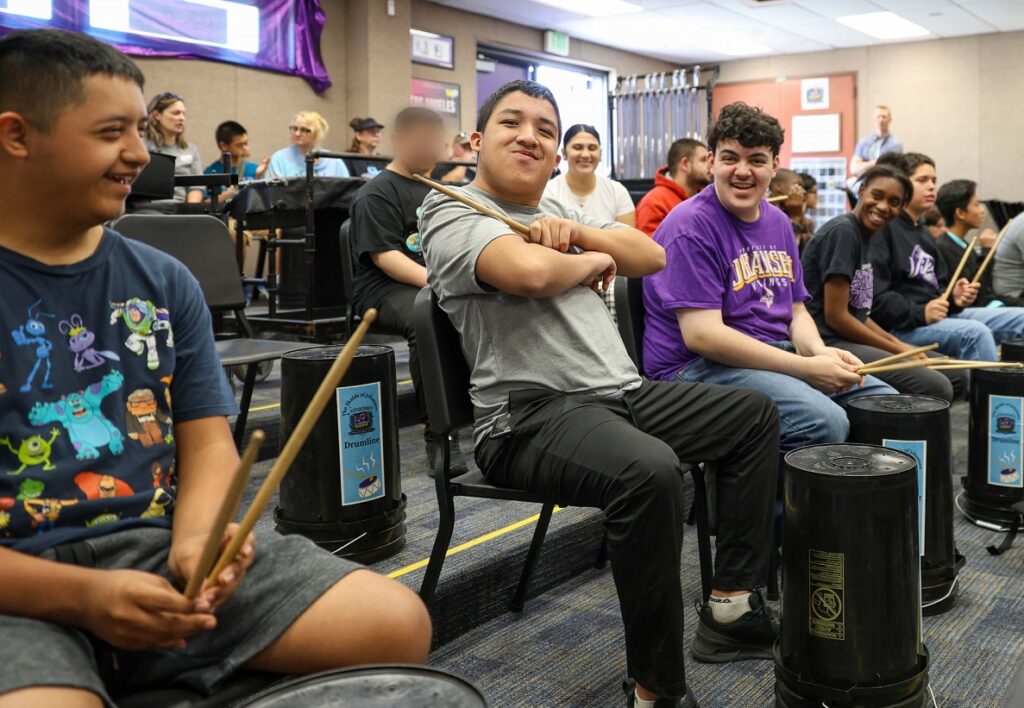
World Percussion: Mulligan was introduced to world percussion, the wide range of traditional and folkloric rhythm-making instruments, while student teaching. She was wary of teaching it because she’s not a percussionist, but today, she describes it as awesome.
“World percussion is quite accessible because all a student has to do is hit a drum,” she says. “It’s never taught using notation. It’s scaffolded — it starts with the basic ‘I play it, you play back what I just played.’ Then you build from there into call and response, expanding from two beats to four beats to eight beats, and adding solos.”
Mulligan’s students think the shekere is really interesting. “By including the shekere and the more advanced rhythms that it requires, some students are able to demonstrate how well they get rhythm and beat even though they don’t understand the written language, English or music. It’s innate in them,” she continues.
Movement Based Activity: Her students also “just eat up movement,” she says. Mulligan uses a lot of scarf dances and body percussion with visual instructions that students follow. For example, she’ll use a PowerPoint that shows a circle with arrows around it for one section of a song. For the next section, the slide will show hands waving back and forth. Then the next section will be back to the circle.
“My students follow the direction on the screen, so it’s a pre-reading skill because the kids are looking at the board and learning to go from the left to the right,” details Mulligan. “But the course is all movement based. It’s kinesthetic. They’re hearing the music, they’re moving to the music, they’re moving to the form, the contour of the melody, the beat or the lyrics.”
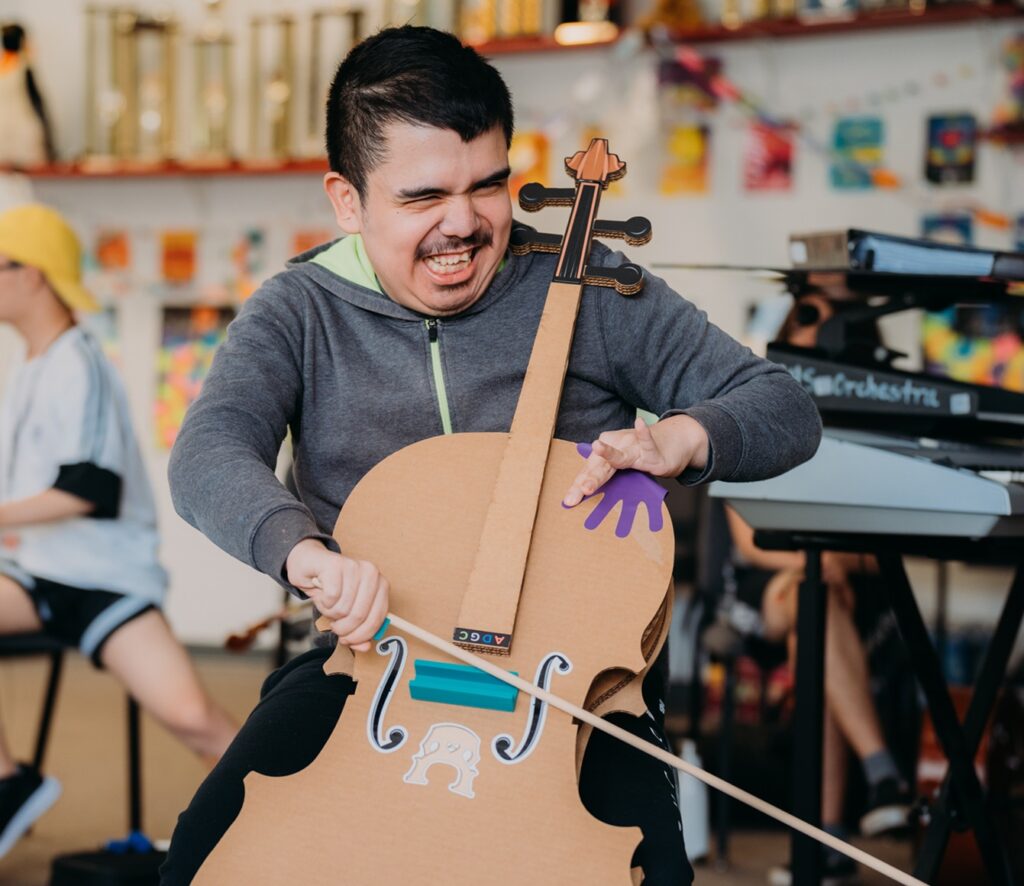
Music Manipulatives: For these lessons, Mulligan prints three-dimensional Lego-like pieces that students can click together to show measures of time and to give a physical and visual representations of music. For example, the “brick” of an eighth note is half the size of a quarter note.
She also uses magnetic blocks to transform musical theories into visual aids — her students first learn about rests and notes then build them into rhythms and chords. “With my kids, just being able to feel and see exactly what I’m referencing has made a world of difference for explaining certain rhythm and pitch concepts,” says Mulligan.

Printed Lyrics & JTouch: For choir, Mulligan prints out lyrics for students who want them. She creates her own karaoke-style videos, projecting them on an interactive touchscreen JTouch monitor, so students can follow along. Many students can’t read, but they like to look at the music notation and lyrics. “I don’t know how much of the language that they interpret it on their own, but they are looking at the words and the timing, and they’re seeing how the song is flowing in front of them,” she explains.
Color Coding: Another effective tool in Mulligan’s arsenal is the ChordBuddy, a device that attaches to the neck of a guitar, featuring four colored buttons that press down on the strings to form standard chords. The idea is for learners to focus on rhythm and strumming rather than the often difficult hand positions required to make chords.
She also uses color coding with reading music. “Most people don’t want to put stickers on their pianos or other instruments but stickers really work for a lot of our kids who are visual learners. You can get a lot of performance out of putting colored dots above the words or color coding the words themselves instead of trying to force your kids to read traditional notation,” Mulligan explains.
Sensory Cart & Noise-Canceling Headphones: Because music class can get loud, Mulligan has four sets of noise-cancelling headphones on hand. Students know they can get up at any time to use them and/or the different items on a sensory cart that help accommodate student needs such as headphones, fidgets, stress balls, pop-its, pop tubes, flexible seating options, squishy toys, etc.
Noise can be the biggest trigger, Mulligan says, and if you can see something’s happening, usually it’s too late. It could turn into a crisis.

Classroom Structure and Expectations
Mulligan, who was recognized as a 2026 Yamaha “40 Under 40” music educator, also credits working on her classroom structure and expectations for paraprofessionals for her successes. Previously, chairs were moved willy-nilly, and it was difficult for wheelchair users to enter, participate and exit the space. Now, she keeps an aisle open to accommodate wheelchair users, and class chairs are arranged over colored dots on the floor that matches the color of tape on each chair.
“Ideally, it’s a cue for the paraprofessionals. They know that they sit in the same color as their student in the pod with them. That way, they are always there to prompt and correct behavior,” Mulligan explains.
____________________________
The techniques and tools that Mulligan uses not only help her do her job, but they also help the learners. Just as they have no problem letting their feelings known about the Mr. Softee truck, they let their teacher know how they feel about music class. “I have students begging to come back to music or ‘Ms. Meghan, can we start the music club again? When can I sign up for choir again?’” she reports.
And there are the notes she received during Teacher Appreciation Week, telling Mulligan that she makes school fun, she is patient with them, she celebrates their success, she inspires them and encourages them to try their best.
Keep reading