Tagged Under:
Jazz Guitar for Beginners
Start to turn rock guitarists into jazz guitarists by following these tips.
Guitar can be a tricky instrument for band directors to incorporate into their existing jazz programs. You may have some very talented players in your school who are not part of your bands because they don’t know that they can audition or join. With the success of youth music programs like School of Rock, online and YouTube guitar lessons, and free apps and tab sites, these students might be some of the best budding young jazz musicians on your campus. Here’s how to get them involved.

Auditions
If your school requires auditions for jazz ensemble, encourage your guitar and bass players to audition on anything they can play well, including rock, blues or pop songs. This will give directors a good idea of each guitarist’s overall musicianship and skill level. These students may be new to jazz, but they can usually pick it up quickly based on their experience with rock and blues soloing and improvisation, and they can adapt the chords they know to fit your rhythm section.
Learning Styles: Playing by Ear vs. Note Reading
Many guitar players (including the teachers!) are ear players or are mostly self-taught. This means they learn by hearing the music. They most likely have strong memorization skills and are great improvisers. However, they may not be great note readers.
Allow for some flexibility with note reading. Most guitar and bass players learn by ear or from tab (using fret numbers), so give them time to learn traditional notation. Offer to work with them individually or help them memorize note-reading.
Because of their strong playing-by-ear skills, they will greatly benefit from listening to any recordings you can provide of the specific arrangement you are working on, as well as classic examples of famous musicians playing that tune or composition. Above all, encourage your guitar and bass players to use all available tools — reading, listening and playing with peers — to master the material.
Guitarists who are strong soloists and improvisers will push your other soloists to perform at a higher level and play bigger and bolder. Most can jam over a standard 12-bar blues progression using the minor pentatonic scale. They will already know a handful of Stevie Ray Vaughan– and John Mayer-inspired licks. Ask these players to tear it up on the A minor pentatonic scale and move it up one fret, and they’ll be ready to rip over a Bb jazz blues. Small adaptations like getting familiar with jazz band keys (Bb, Eb and F) and incorporating “jazzy” sounding notes like adding the 2nd and 6th of the scale to their pentatonic runs will make them shine.

The Guitar’s Role in Jazz Band
It’s important that your students understand the role of the guitar in the jazz rhythm section. The guitar doesn’t step on the piano, and it doesn’t play the bass notes especially when the bass is walking. The guitar sits right in the middle — not too high, too low or too much. I call the guitar the “meat in the sandwich.” It’s not the bread or the mayo, but it holds everything together in the middle. A good ear and the ability to listen to the other chord instruments (piano, vibes, organ, synth, etc.) is essential. It’s also perfectly fine for a guitar player to stop playing on solo sections or when the improvised sections become too dense. Horn players spend a lot of time during a tune counting bars of rests and not playing. Often the most musical choice is to play nothing and listen!
Jazz guitarists should stay on the neck pickup for a fatter, warmer jazz tone and use a clean amp sound with a little bit of reverb. They should use a jazz pick (Dunlop makes them) or their thumb for a darker sound. A semi-hollow or hollow body guitar with a humbucker will yield much better results than a solid-body or a heavy metal-style guitar. Save the whammy bar tricks, distortion and pyrotechnics for later — right now, we are looking for a clean, natural guitar sound that’s not too bright or punchy but still cuts through the band.
You will see many big band jazz guitar charts reference Count Basie’s rhythm guitarist, which is often called “Freddie Green style.” Green was known for “chunking” quarter notes through most of the jazz tunes and provide the pulse and swing for the whole band. In big band settings, the guitar and bass players are often driving force of the band and in keeping time. Drums keep time as well, of course, but guitar and bass players are the metronome and need to work hard to develop their sense of time. A quick YouTube search will turn up plenty of videos of this style. Here are a couple of my favorites: 1) Jazz at Lincoln Center’s guitarist, James Chirillo, explaining Freddie Green’s comping style and 2) Nick Rossi’s description of Green rhythm playing.

From Rock to Jazz
One of the major differences between pop/rock/blues and jazz guitar songs lies in the keys in which these styles are played. Guitarists mostly play in sharp keys due to the tuning of their instrument — E, A, D, G, Em, Am, F#m and Bm are great keys for rock and pop songs. They use the easiest chords on the guitar and incorporate the open strings (E, A, D, G, B, E). These are difficult keys for young students improvising on brass instruments. Likewise, horn keys (Bb, Eb, F) are the most challenging for young guitarists. They require stronger knowledge of the guitar neck and use a lot of bar chords, which are difficult and require more strength and stamina. A level 1 jazz chart for your horn players in Bb concert will be a level 3+ for your guitar players based on the key alone! For comparison, try asking a horn player to jam a blues tune in E, A or B. Simply getting your guitarists and bassists used to playing and reading chord changes in flat keys can do wonders for their playing.
Bass notes on strings 5 and 6: For new jazz guitarists, I start them on learning their notes on the neck and blues changes. All guitar chords in the included lesson are built off string 6 (open low E) or string 5 (open A). Having your guitar and bass players memorize the top two strings is crucial for chord reading and comping because that’s where we find the roots of our chord voicings. Learn the two top strings chromatically from the open string (E – F – F# – G, etc.) and memorize which notes correspond to the fret marker dots. For the low E string it’s open E, then G (3rd), A (5th), B (7th), C# (9th) and E again (12th fret, double dots). Do the same for the A string, and your students will be able to find any note quickly by using the dots and adding or subtracting a half-step.
There are apps that can help. I use Tenuto, which has a fretboard quiz. Finding the root of the chord is crucial, but we will see below that it commonly gets left out to provide more room for the bass. In other words, guitarists will build a Bb7 chord on the 6th string Bb and then leave out the Bb root on string 6 when strumming the chord.
Start with the blues: Blues is the common denominator between rock and jazz, and most guitar players are already familiar with the 12-bar form and improvising over it. I start students playing the blues in A, then raising it a half-step to the more common “jazz” key of Bb. Chuck Berry’s masterpiece, “Johnny B. Goode,” is in Bb, and a lot of rock guitar players know how to play this song. YouTube has plenty of great play-along and backing tracks. Search for the key and style you want, such as “Bb jazz blues play-along” or “chameleon backing track” to find some decent options for generic progressions and standards, usually with changes included in the video. Beginners can slow down the playback speed (click the settings gear) to be able to play along. Remind students to watch the original masters perform these tunes as well! Two of my favorites are Miles Davis’ “Freddie Freeloader” and Kenny Burrell’s “Chitlins Con Carne,” which was also covered by Stevie Ray Vaughan.

Jazz blues progressions and 7th chords: Teach students some basic bar chord voicings for Bb7, Eb7 and F7. Later, add Fm7 and C7 to create a couple of ii-V progressions and you’ll have a very simple jazz blues progression (see the sample lesson below). Tell students to memorize these chord grips so they can play other chords using the same shapes. For example, Ab7 is the same as Bb7 — just move down two frets. It’s vital to tell your guitarists to leave out the bass notes — that’s what bass players do, and we want to stay out of their lane, especially when improvising.
Have guitarists ignore strings 5 and 6, the top two strings of the guitar, when comping with the picking hand. Their guitar chord grips can still use the same shape, just avoid picking the bass strings. I also tell students to avoid string 1 on the top of the chord. This note is usually not necessary and gets in the way of the horn parts, vocalists and soloists, and it can conflict with the melody. My rule is to stay on strings 2, 3 and 4. You can still play the same chords in the left (fretting) hand but leave those low notes out when you pick. Eventually it will be possible to simplify these chords down to just the three strings needed in the fretting hand.
Three-note chord voicings: Once a player gets used to “seeing” the root of the chord shape, they can begin to leave it out entirely. Sometimes these are called “rootless voicings” — think Bb7 without the Bb or Cmin9 without the C root. Essentially, the bass player provides the chord root and the ear hears the chord in that context, so if the bass player is playing Bb, the guitar player can leave it and play the other notes in the chord (3rd, 5th, 7th, etc.). Since we only have six strings on the guitar, three-note chord voicings that are missing the root and the fifth will give us the best results and still outline the rest of the chord (3rd, 7th, 9th, etc.) and allow for some very hip extensions and alterations down the line.
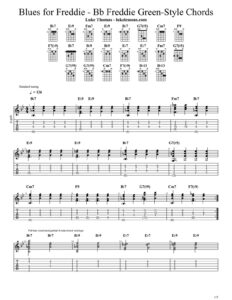
Download the “Blues for Freddie” sample lesson
Sample Lesson
Some easy and usable three-note chord voicings and a few hip and common substitutions are included in my Bb jazz blues study, “Blues for Freddie,” a tribute to Freddie Green. I included chord examples in chord grids, standard notation and tablature. The tab is very useful because it shows exactly where to put each finger for each chord voicing. Standard notation can give guitar players too many options. Tab says play this exact string on this exact fret to get this exact Bb, while standard notation just says play a Bb and the guitar has at least three ways to play that same note!
Thirds and Sevenths: A standard 12-bar blues in Bb would usually use Bb7, Eb7 and F7, or the I, IV and V chord in Bb. All of these are dominant chords and use the major 3rd and flat 7th of the chord. The simplest and clearest notes for chord players to outline when comping are the 3rd and 7th of the chord. In my guitar voicings in “Blues for Freddie,” these are the voicings I’ve notated, with the bass note of the chord in parenthesis for reference. This note should not be played by the guitar because the bass and other low instruments should outline the root of the chord. Often on guitar we end up with voicings using the 7th, 3rd and 5th of the chord. For Eb9, I added the 9th of the chord to the 3rd and 7th to give the chord more color and because it’s an easier grip for guitar players to get to than the regular 7th chord. It is very common for chord players to swap out 7th chords for 9th chords and your ear (or your band director) should tell you if it’s usable in context.

Chunk the Quarter Notes: The guitar part is written comping quarter notes on every beat in the traditional Basie big-band style. High school jazz players should have this down because it is the most basic pattern and approach to chord playing. It leaves room for the piano and other rhythm section instruments while the guitar still provides a strong sense of tempo. To make it even more consistent, cut each chord short by lifting the fretting fingers just enough to stop the strings — this will give us the “chunk-chunk” sound that we are looking for.
Accent the Backbeat: Finally, add emphasis by playing harder on beats 2 and 4 while beats 1 and 3 are softer and quieter. This makes the guitar part feel bouncy because the left hand is lifting between each quarter note and soft/loud sounds alternating in the right hand. Every jazz rhythm player should know that emphasizing the backbeat is essential for groove and to make the music swing. Think 1 – 2 – 3 – 4 (say 1 and 3 quietly and 2 and 4 loudly), and you’ll see what the guitar chord accents should be. It’s essential to get your guitar players familiar with these techniques, and once they know how to do it, they will also start to hear it in big band recordings and performances.
Keep reading