


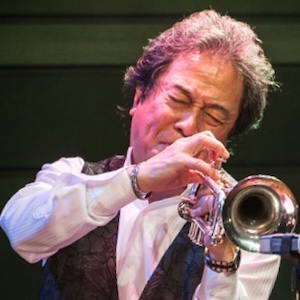
Toru “Tiger” Okoshi was born just outside of Osaka in 1950, the year of the Tiger. As a child, he was devoted to painting, but at age 13, a friend took him to see Louis Armstrong, who was touring in Japan. “He hit me too strong,” recalls Okoshi. Inspired by the experience, he took up the trumpet and immersed himself in jazz.
In 1972, after graduating from the prestigious Kwansei Gakuin University with a Bachelor of Commerce, he married and came to the United States for his honeymoon. “We took Greyhounds all the way across the country from Los Angeles to Boston,” Okoshi recalls. “The beauty of it all gave me energy and fire. I knew I couldn’t go back.” Upon arriving in Boston, they sold their return tickets, paid tuition at Berklee College of Music, and found a studio apartment. He began practicing by the Charles River, hoping someone would hear him and invite him to join a band—and that happened.
Okoshi graduated summa cum laude from Berklee in 1975. Word of his talent spread quickly. In 1974, he performed with the Mike Gibbs Orchestra at Carnegie Hall in New York; in 1975, he toured the U.S. with the Buddy Rich Orchestra; and from 1976 to 1978, he taught at Berklee. He has appeared in numerous jazz festivals around the world, and his fusion group, Tiger’s Baku, performed aboard the Queen Elizabeth 2 in August 1998 for the Newport Jazz Festival at Sea.
He has performed and/or recorded with Gary Burton, Tony Bennett, Dave Grusin’s LA-NY Dream Band (Grammy nominee in 1982), the Buddy Rich Orchestra, George Russell’s Living Time Orchestra, Bela Fleck, Branford and Delfeayo Marsalis, Joe Lovano, Mike Stern, Bill Frisell, Pat Metheny, Dave Holland, Jack DeJohnette, and many more.
In pop music, he has worked with Teddy Pendergrass, Aimee Mann’s Til Tuesday, The O’Jays, The Four Tops, The Stylistics, Little Anthony and the Imperials, Frankie Avalon, Bobby Rydell, and rock star singer Brad Delp of “Boston.”
In 2014, Tiger received the Ministry of Foreign Affairs Award from the Japanese government for his distinguished contribution to strengthening relations between the U.S. and Japan.
In 2016, he represented Japan at the UNESCO World Music Festival in Hamamatsu, delivering a 30-minute solo performance and collaborating with the Kitanodai Gagaku Ensemble to present traditional Japanese music known as Gagaku.
Tiger has also performed the National Anthem at Fenway Park in Boston four times during Red Sox playoff games.
Tiger is currently a Professor at Berklee College of Music and plays the Yamaha New York model trumpet.