


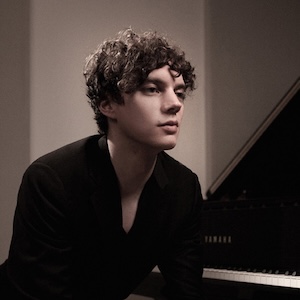
In the spring of 1928, George Gershwin visited Paris and met Alban Berg, a towering figure of European modernism. Though Gershwin had already conquered Broadway, he admitted to feeling inferior next to a revolutionary like Berg. Berg, however, offered this reassurance: “Mr. Gershwin, music is music.” That simple phrase—emphasizing the unity of all music, highbrow or popular—beautifully reflects the ethos of Luxembourg-born pianist, composer, and producer Francesco Tristano. Tristano’s career defies easy classification. He performs baroque and contemporary repertoire on world stages, releases electronic tracks for dance labels, and continues a personal mission to record the complete works of J.S. Bach for piano. His projects blend influences as diverse as the rhythmic power of Detroit techno, the harmonic richness of French impressionism, and the radical experimentation of Cage and Ligeti.
Much of this artistic fusion traces back to his time at Juilliard, where he spent his days immersed in classical theory and his nights exploring New York’s electronic music scene. Inspired by the energy of artists like Danny Tenaglia and the hypnotic pull of Detroit techno, Tristano began to envision a musical world without stylistic or temporal boundaries. At Juilliard, he laid the foundation for his Bach explorations—recording the Goldberg Variations and concertos with his ensemble, The New Bach Players. Soon after, French label InFiné released his first genre-blending albums. Not for Piano (2007) reimagined techno tracks like Jeff Mills’ The Bells on acoustic piano; Auricle Bio On (2008) treated the piano as a sampler; and Idiosynkrasia (2010) fused virtuosic playing with electronic programming—ushering in what he called “Piano 2.0.”
In 2011, he joined Deutsche Grammophon, further expanding his vision. His first project, Bach/Cage, explored the sonic space between these two seemingly opposite composers—both united by an interest in texture, silence, and structure. Recorded at Detroit’s Planet E studios, it gave acoustic resonance to their shared spirit of innovation. Long Walk (2012) was inspired by the legendary journey young Bach took to meet organist Buxtehude. Tristano revived forgotten keyboard works by Buxtehude, performing them on piano for the first time. His third DG release, Scandale (2014) with Alice Sara Ott, featured transcriptions of Ravel, Rimsky-Korsakov, and Stravinsky, evoking the spirit of Diaghilev’s Ballets Russes. The album ended with Tristano’s own composition, A Soft Shell Groove, a work bridging Stravinsky’s rhythmic experimentation and the pulse of 1980s Detroit techno. That same modernist spirit led Tristano to projects like Aufgang and collaborations with electronic music label Get Physical. His album Surface Tension (2016) included a direct collaboration with techno pioneer Derrick May.
In 2017, he began a new chapter with Sony Classical, releasing more personal works. Piano Circle Songs (2017) revealed a gentler, lyrical side, influenced by French impressionism. His latest album, Tokyo Stories (2019), is a tribute to Japan—its landscapes, culture, and the experiences he’s gathered during frequent visits.
Still, at the heart of his journey lies one enduring project: to record Bach’s complete piano repertoire. For Tristano, Bach is timeless—transcending genre, era, and form. As Berg once reminded Gershwin, “music is music,” and for Francesco Tristano, that truth continues to shape a career defined by fearless innovation and reverence for tradition.