


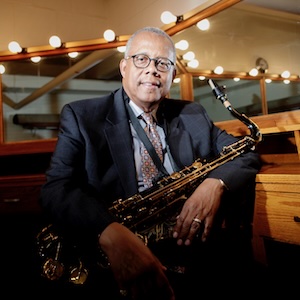
Dr. Willie L. Hill Jr.’s career has run the gamut — from sharing stages with musical icons like Dizzy Gillespie to advocating for arts to leading workshops for public school children. Through it all, Hill provided exceptional time and dedication to providing services for the communities with which he was associated.
A jazz saxophonist, Hill has appeared in concert with artists such as Liza Minnelli, Johnny Mathis, Sammy Davis Jr., Lou Rawls, and Lena Horne. With over 45 appearances as a guest soloist with iconic big bands and as a guest conductor at over 35 venues, he continues to inspire the national jazz scene. But it’s offstage that Hill’s impact reaches even further. He has received numerous awards and accolades, which include induction into the Colorado Music Educators Hall of Fame (1998), induction into the Grambling State University Hall of Fame (2008), induction into the National History Makers Organization (2018), the Benny Golson Jazz Master Award (2003), the Lawrence Berk Jazz Educator of the Year Award (2000), the DownBeat Magazine Achievement Award in Jazz Education (2000), designation as a Lowell Mason Fellow in Music Education (2002), founding of the Rick Matterson/Clark Terry Telluride Jazz Academy (1995), and founding of the Mile High Jazz Camp in Boulder, CO (1988).
Hill gave generously of his time throughout his career, first serving as a teacher with the Denver Public Schools and later as a professor and Assistant Dean at the University of Colorado Boulder College of Music. As director of the CU Jazz Summer Camp, he inspired generations of young people in high school and college. This was only the beginning of an impressive trajectory of impact. As president of the National Association for Music Educators, Hill led an organization of music educators and college student chapters of over 125,000 members. Similarly, as president of the International Association of Jazz Educators, he led 15,000 members from over 35 countries. Most recently, Hill retired from his position as director of the Fine Arts Center at the University of Massachusetts in 2019. In this role, he made a profound impact on communities by developing outreach initiatives that provided children with access to and supported participation in music, dance, theater, and the arts. Through his engaging personality, drive, energy and optimism, his participation made significant progress in the Fine Arts Center’s efforts to build community and develop the strategies and initiatives that break down cultural and societal barriers while promoting arts and culture.