


Scottie Baldwin, FOH
From CL/QL roots to mixing icons like Lady Gaga, Prince, and JJ Lin
Summary Scottie Baldwin, FOH for Lady Gaga, Prince and JJ Lin, among others, honed his craft on Yamaha CL and QL consoles before stepping up to Rivage PM – delivering clarity, flexibility, and creative control for some of the biggest stadium productions worldwide.
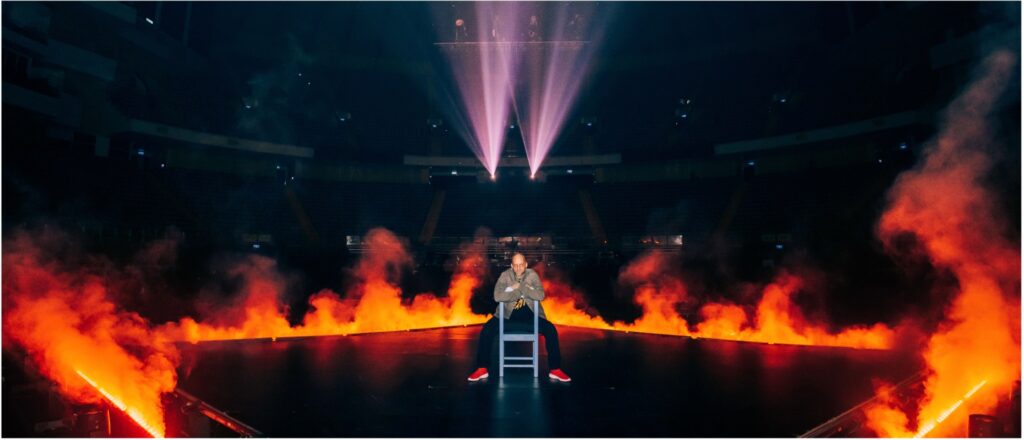
Scottie Baldwin is a world-renowned front-of-house engineer whose career spans global tours with artists including Prince, Lady Gaga, JJ Lin, and Jolin Tsai. Known for his precision, creativity, and deep musical sensitivity, Baldwin has built a reputation for turning complex live productions into immersive sonic experiences. His workflow merges technical precision with musical intuition, and his long relationship with Yamaha consoles – evolving from the CL and QL series into the Rivage PM platform – shows how foundational tools can shape a philosophy, and how innovation in talented hands can unlock new frontiers in sound design.
Laying the Groundwork: CL and QL as Sonic Stepping Stones
Before Rivage PM, Baldwin’s approach was built around Yamaha’s CL and QL consoles. These systems, with their Dante networking, onboard Premium Rack effects, and intuitive layout, became the scaffolding for his sonic identity. Early in his career, he mixed an entire stadium tour on a CL console – a decision that raised eyebrows at the time. “I mixed a stadium tour on a CL, which everyone didn’t think was even possible,” he recalls.
Those consoles gave Baldwin the confidence to take on virtually any gig, even under tight budgets or demanding expectations. For one tour with The Revolution, he even downsized a CL show file to fit on a QL console, turning skeptics into believers when they heard the result. He laughs remembering stage crews asking where his console was, only to see it roll in a compact road case: “When you can get a big sound out of a tiny console, it’s even more impressive.”
CL and QL introduced Baldwin to Yamaha’s scene management, onboard processing, and workflow logic – tools that made him faster, more consistent, and ultimately more musical. He learned to work almost entirely in the box, saying he’s “never used outboard gear with Yamaha – maybe auto-tune, but that’s it.” That minimalist, efficient mindset became the foundation for everything that followed.
The Leap to Rivage: Expanding the Horizon
When Baldwin transitioned to the Rivage PM5, it wasn’t just about more channels or processing – it was about expanding visual control and creative space. “I did it live without a net,” he recalls. “New country, new artist, new console – and Rivage made it possible to think in big terms. I said, ‘OK, I can do this.’”
A self-described visual thinker who values order and clarity, Baldwin immediately appreciated Rivage PM’s larger screen real estate and configurable interface. His layout typically places inputs and DCA groups on the left, scenes and dynamics in the center, and EQ and overview data on the right – giving him instant visibility across hundreds of parameters.
“You can feel comfortable moving over to Rivage the day of show,” he explains. “That’s how familiar it is – but it’s not the same. It’s just better in every way.” And when it comes to sonic impact, he adds, “When you want to move up that notch and really get into clarity, depth, focus – everything is wider, deeper – Rivage delivers.”
Technical Expansion: What Rivage Adds to the Equation
Rivage PM didn’t just expand Baldwin’s workflow – it fundamentally redefined it. Moving from the CL5’s 72 input channels to Rivage’s 288 opened up the ability to manage complex multi-input sources, broadcast feeds, and parallel effects chains simultaneously. The 72 mix buses and 36 matrix outputs give him the routing flexibility to design both stereo and immersive configurations without compromising DSP resources.
At the core of that performance is Yamaha’s TWINLANe network – a proprietary coax or fiber system capable of carrying up to 400 channels of 96 kHz audio with sub-millisecond latency. Baldwin describes the difference as “insanely small,” adding that it’s “powerful and reliable – you just have to bring good cables.” Combined with RPio racks, the platform provides modular I/O flexibility and even supports legacy MY cards. “I can still use MY cards I’ve had for 20 years,” he says. “That’s insane in today’s day and age.”
In-the-Box: Plugins That Perform
One of Rivage PM’s biggest advantages for Baldwin is its fully integrated plugin suite. The Rupert Neve Designs Silk circuit in the RPio Stagebox, for example, has become a staple of his mix template. “The Rupert Neve Silk emulation is stunning,” he says. “The more red I dial up, the less EQ I have to do. It’s musical, not just technical.”
He also calls the Dynamic EQ 6 “the most versatile, most beautiful EQ” he’s used, explaining that it lets him respond to vocal intensity dynamically, keeping the tone consistent whether an artist is whispering or belting. With tools like these running on Rivage’s FPGA-based DSP at 96 kHz, Baldwin is able to mix fully in the box – even for stadium-scale productions – without latency or compromise.
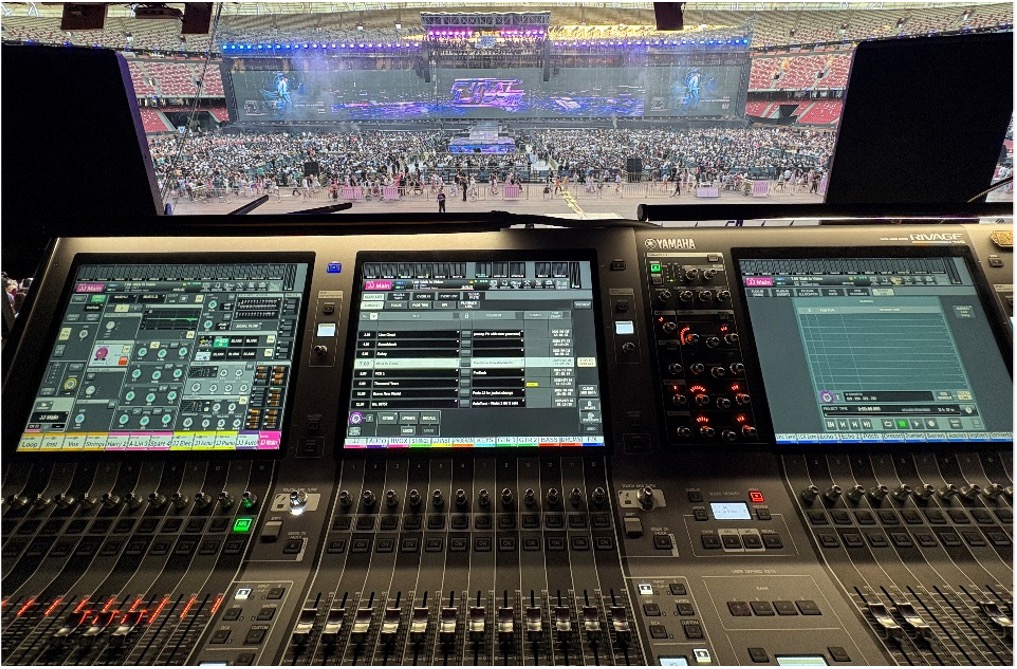
Scottie Baldwin’s Rivage PM5, JJ Lin tour, Bird’s Nest Stadium, Beijing
Engineer and Artist Collaboration
Baldwin approaches each show as a collaboration between engineer and artist. “There’s no console before or since that has locked it in like Rivage – I feel completely at home,” he says. “I always feel like I’m standing in front of a musical instrument.”
For Baldwin, Rivage isn’t just a control surface – it’s a creative partner. “Yamaha puts the musical things forward,” he explains. “You only look at what you need to work on the most musical aspects of each mix.”
On one tour, he used the PM5 to create a 12-channel immersive mix in which reverb physically moved through the venue. “It sounded like one long reverb,” he recalls, “but it traveled from front to back.” It’s this kind of real-time artistry – using technical flexibility to deepen the audience’s connection – that defines Baldwin’s work.
Real-World Impact: Value for Production and Touring
Baldwin’s approach to Rivage PM also brings tangible value to production companies and touring operations. “I can go anywhere with a USB stick and make shows that sound spectacular,” he says. “You’re saving the tour, the church, the black box theater money on rental. That money should go to you – not the gear.”
That level of portability and consistency makes Rivage an asset across scales – from major stadium tours to regional festivals – proving that sound quality and efficiency can coexist at the highest level.
Familiarity Meets Mastery
Despite Rivage PM Series expanded architecture, Baldwin says the transition felt natural. While he initially experimented with Yamaha’s console file converter to migrate CL show files, he ultimately rebuilt everything from scratch to take advantage of stereo aux sends, expanded mix buses, and the console’s advanced dynamics engine. “It’s a mistake to say Rivage is just a CL on steroids,” he explains.
“It’s a whole different system, but it feels familiar – it’s part of the Yamaha family.”
That familiarity, combined with Rivage PM’s deeper toolset, allowed him to approach mixing with fresh creative intent rather than treating it as a technical upgrade.
A Platform for Sonic Excellence
Scottie Baldwin’s evolution from CL and QL to Rivage PM reflects Yamaha’s core philosophy: to design tools that inspire engineers to make music, not just mix sound.
Baldwin sums it up simply – Yamaha, he says, “listens carefully and responds musically.”
When he steps behind a Rivage, Baldwin doesn’t see a console – he feels an instrument. And with that, every show becomes an act of performance, precision, and sonic storytelling.
Ready to connect with our B2B sales team, discuss system needs and Request a Quote? Click here to get the conversation started: Request a Quote