
Travel Guitars vs. Full-size Guitars
I think most guitar players would consider a dreadnought or concert body acoustic guitar to be a full-size instrument ideal for performance, recording, and writing music … but perhaps not the best choice for travel.
There are, however, smaller types of steel-string acoustics, such as parlor size guitars, and even more style variations and sizes when you start to consider classical nylon-string guitars. There’s even an entire sub-category of “travel” guitars that come in both nylon- and steel-string varieties.
Which of these options has the best tone, playability, portability, size, and weight … and which would also be the perfect travel companion to take with you on tour or on vacation? In this posting, we’ll answer those questions by making some first-hand comparisons between several acoustic guitar options offered by Yamaha.
Comparison Overview
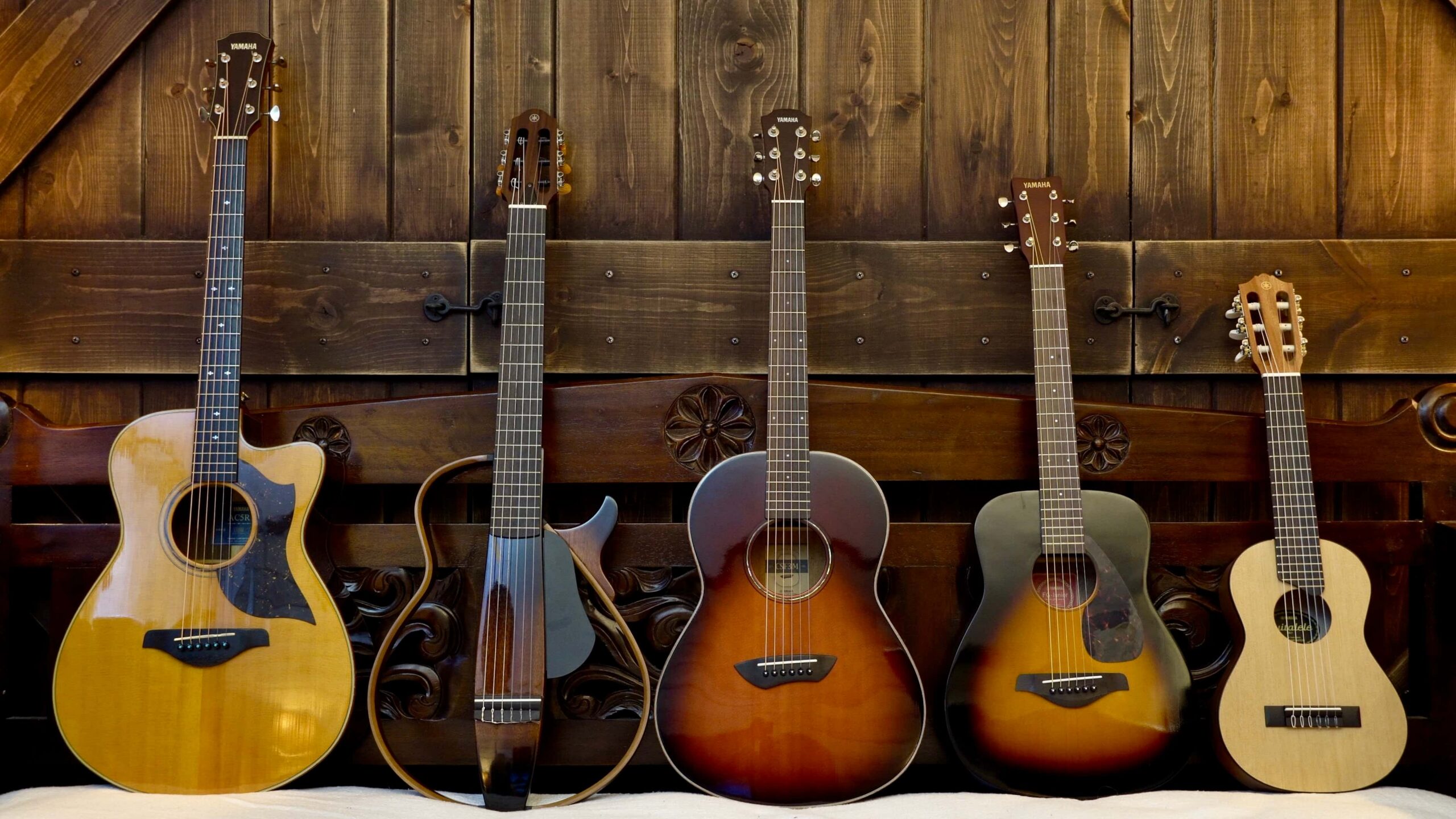
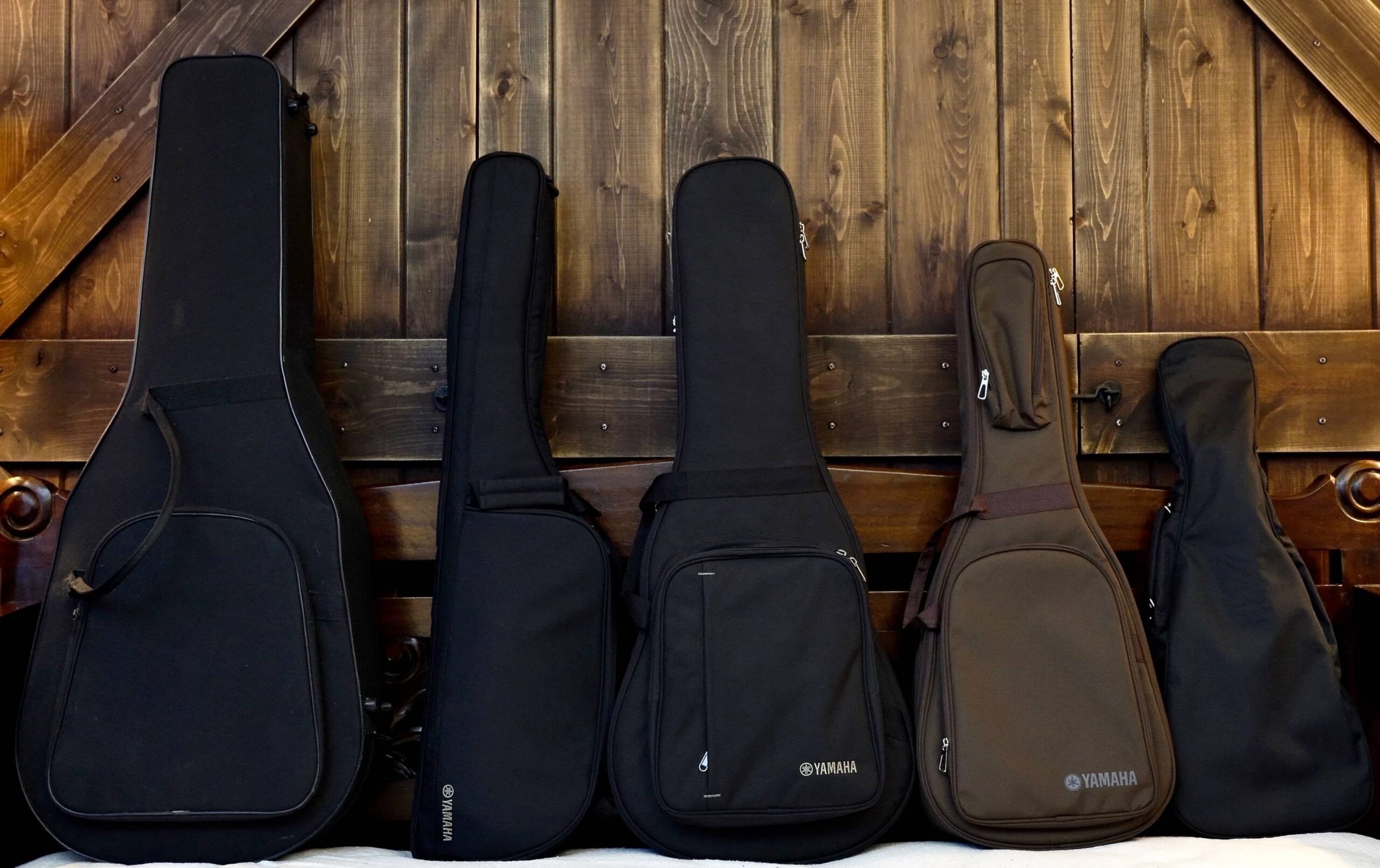
Our full-size test model will be the Yamaha AC5R concert body steel-string acoustic guitar. The AC5R is a professional-grade instrument, and we’ll be comparing it to the following four Yamaha travel guitars:
- CSF3M parlor size (steel-string)
- JR2S 3/4 size (steel-string)
- GL1 Guitar Ukulele (nylon-string)
- SLG200N SILENT™ Guitar (nylon-string)
AC5R
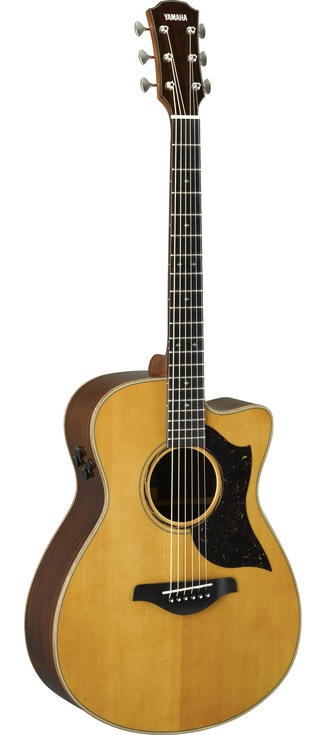
The Yamaha AC5R is hand-crafted in Japan, and features top-notch SRT2 electronics, with realistic microphone modeling for studio quality tones when recording direct or performing live … although we won’t be using those here since the travel models we’re comparing it to don’t have that feature. (Trust me, it sounds great, and you can hear that aspect of this guitar here.)
The solid sitka spruce top of the AC5R receives Yamaha proprietary A.R.E. (Acoustic Resonance Treatment), which essentially relieves stress in the materials for a more “played-in” tone. The back and sides are solid rosewood, and the mahogany neck and rosewood fretboard have hand-rolled edges to allow for a delightful playing experience all the way up past the cutaway to the “dusty-end” of the fretboard.
As you’d expect, this guitar sounds incredible when played acoustically. Strummed passages are warm and full, and create a lovely platform of harmony for vocals and other top-line instrumentation. Fingerstyle performances are clean, articulate, and retain separation between each of the six strings. Single-note passages are easy to play and always sound smooth across all frequency ranges.
The AC5R’s slim, almost electric-style neck is perfect for the predominantly electric guitar player who likes to play acoustic guitar too. What’s more, the AC5R cascades perfectly on a strap — important when standing during live performance — and is also a great physical size for seated playing.
For all these reasons, the AC5R is a go-to guitar for a lot of acoustic players, as you can see in this video.
CSF3M
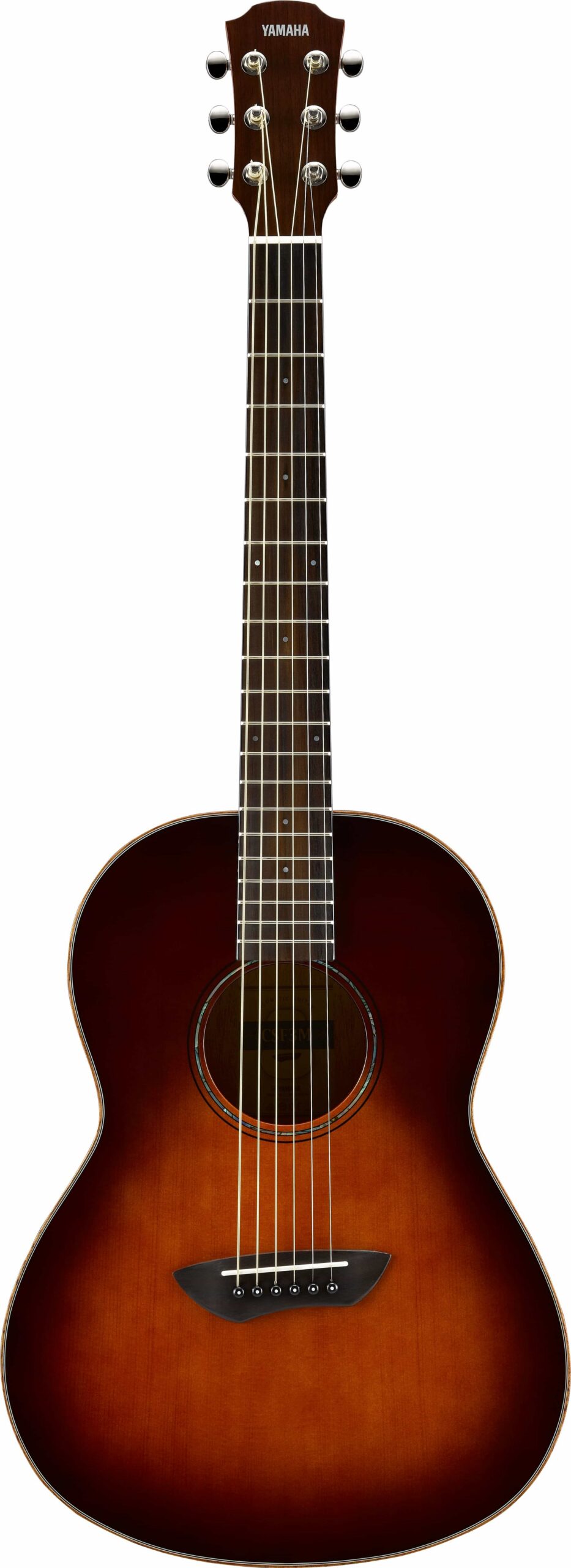
Anyone who’s read my postings here will know that I am a huge fan of the Yamaha CSF3M, and have traveled extensively with this powerhouse guitar throughout Asia, Europe and beyond.
Combining the portability of a travel guitar with the focused tonal characteristics of a parlor guitar, the CSF3M has a solid sitka spruce top with scalloped bracing for a fuller sound, along with a solid mahogany back and sides. There’s also a passive under-saddle piezo pickup that sounds great for plug-and-play situations. Its neck is obviously smaller than the AC5R, but I think most players will find the string spacing manageable with a little adjustment.
The lightweight CSF3M is a lovely little acoustic for almost any application. It’s loud enough to hold its own in an acoustic ensemble, and sounds incredible for any style you can throw at it. Strumming passages are bright, breezy, and have an air of excitement to them — a sweet jangle, if you like! Single notes jump out of this guitar with ease, and the tone of each string is warm, defined and perfectly poised within a mix of other instruments.
As you can imagine, finger styles really shine on this petite offering, and picking hand positions can yield warmer tones when played closer to the neck joint, and a detailed “zing” when played closer to the bridge. If you use nails, like I do, you’ll be rewarded with everything this guitar has to offer in the picking department. In some respects, I prefer the sound of the all-solid tonewood CSF3M to the AC5R, but I think it depends very much on the musical situation.
This guitar also comes standard with a deluxe hard-bag. When traveling in the U.S. you’ll find that most airlines will allow you to take this onboard and stow it away in the overhead bins. (In Asia, airlines have a mandatory policy that even a smaller guitar like this has to be checked in; however, the staff will hand carry it to the aircraft, so it won’t be subject to the rigors of the conveyor belt.)
JR2S
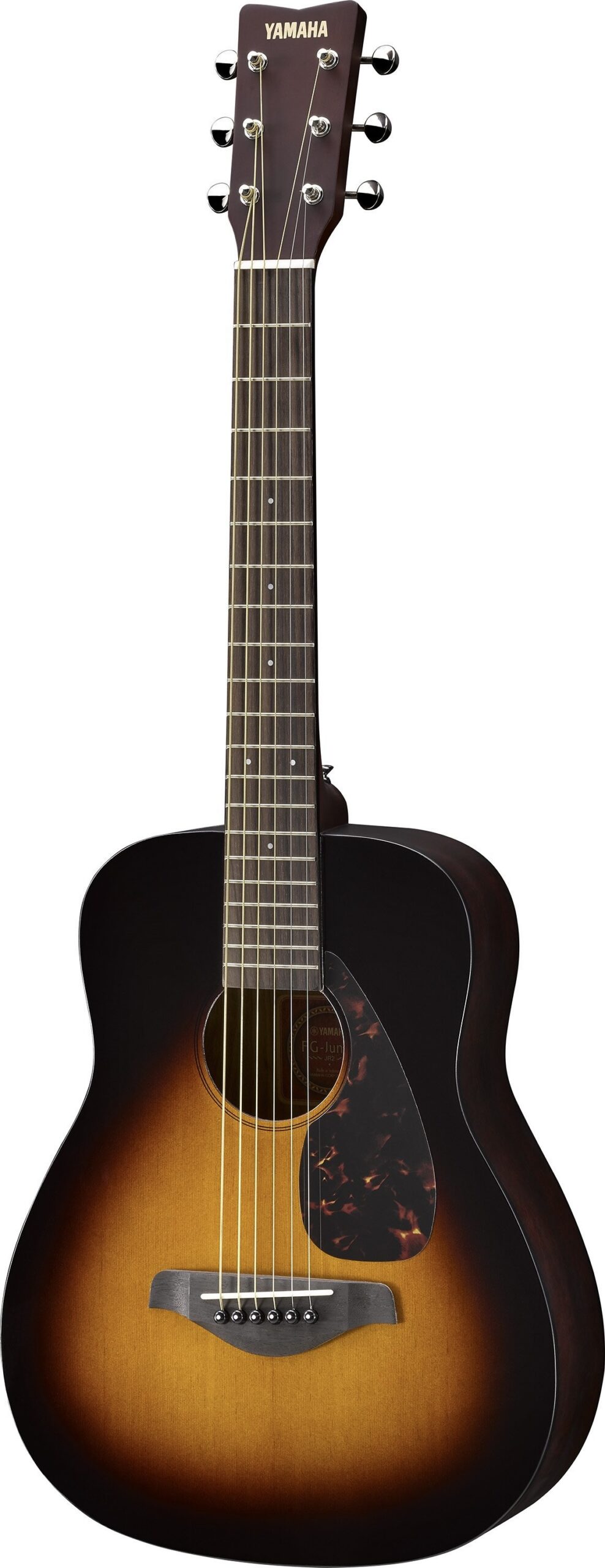
The Yamaha JR2S is a 3/4-scale mini folk guitar, modeled after the popular Yamaha western body style FG Series guitars. It’s smaller than the CSF3M, but retains an authentic acoustic tone, with even greater portability. And despite being super lightweight, it still packs a punch, perfect for an acoustic jam or providing a supporting role to vocals.
The JR2S sports a spruce top and UTF (ultra-thin film) mahogany back and sides. Strumming passages retain detail across all six strings, while the harmonic structures sound lighter in body, yet still resonate nicely.
Finger-picked parts spring to life from this petite provocateur, but you will have to watch how articulate you are with your finger shapes on the fretboard, and picking hand patterns, due to the smaller space between frets and the individual string spacing. It’s an adjustment for sure, but one you’ll likely appreciate when you dial-in your dexterity.
Single-note lines are detailed, and sit nicely in a recorded ensemble. Again, you’ll need to make sure your fingerings are precise to get the best results without buzzing. There’s nowhere to hide on this instrument, and it may just make you a better player as a result.
I think this dynamite steel-string, which comes with a handy gig bag, could go just about anywhere without raising eyebrows … until you start playing it!
GL1 Guitar Ukulele (Guitalele)
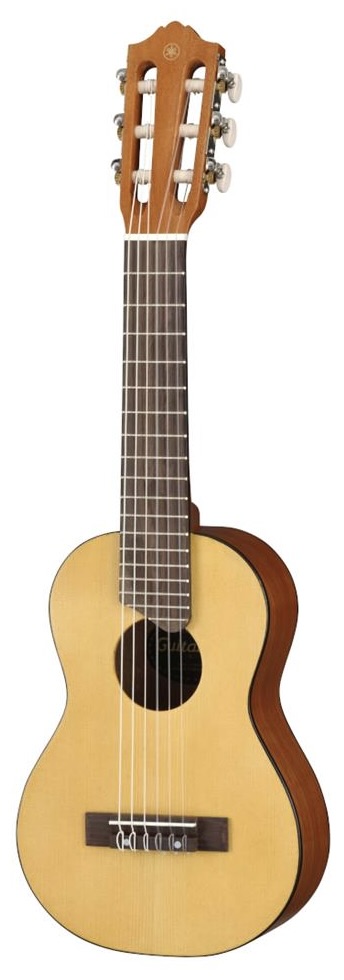
If you have a smaller frame, or are buying a guitar for a young child, the nylon-stringed Yamaha GL1 may be an excellent place to start your guitar journey. As a bonus, the supplied gig bag will easily fit into the largest section of most backpacks when traveling.
The top of the GL1 is spruce, and the back and sides are a variation of indigenous mahogany. Its tones are warm and less defined than a steel-string guitar, but could be perfect if you want to fly under the radar in quiet sound settings like a park or in your hotel room. The tonal shift to a smaller nylon-stringed instrument will be obvious if you usually play a full-size steel-string, so be sure to take that into account. It won’t sound anything like the instrument you’re used to … and that’s a plus sometimes.
Note that the GL1 can be tuned up a fourth higher than a standard guitar, similar to that of a baritone ukulele (A/D/G/C/E/A, from high to low). However, I preferred playing it in standard tuning, which reduces the string tension dramatically and also reduces the risk of strings breaking when “on the go,” which can sometimes happen easily. In the video below, using standard tuning also allowed me to place the GL1 in the composition alongside the other guitar examples without modifying the voicings. (Remember that if you decide to jam with fellow musicians with the GL1 tuned to A, you’ll have to transpose all your parts.)
I found the GL1 to be fun to play, but it took some serious finger adjustments, and the parts I played in the video below had to be modified to allow me to articulate them. If you have large hands, this instrument will be a challenge, and the intonation of some chords and single notes may suffer due to hand strength on the softer, lower tension nylon strings.
SLG200N
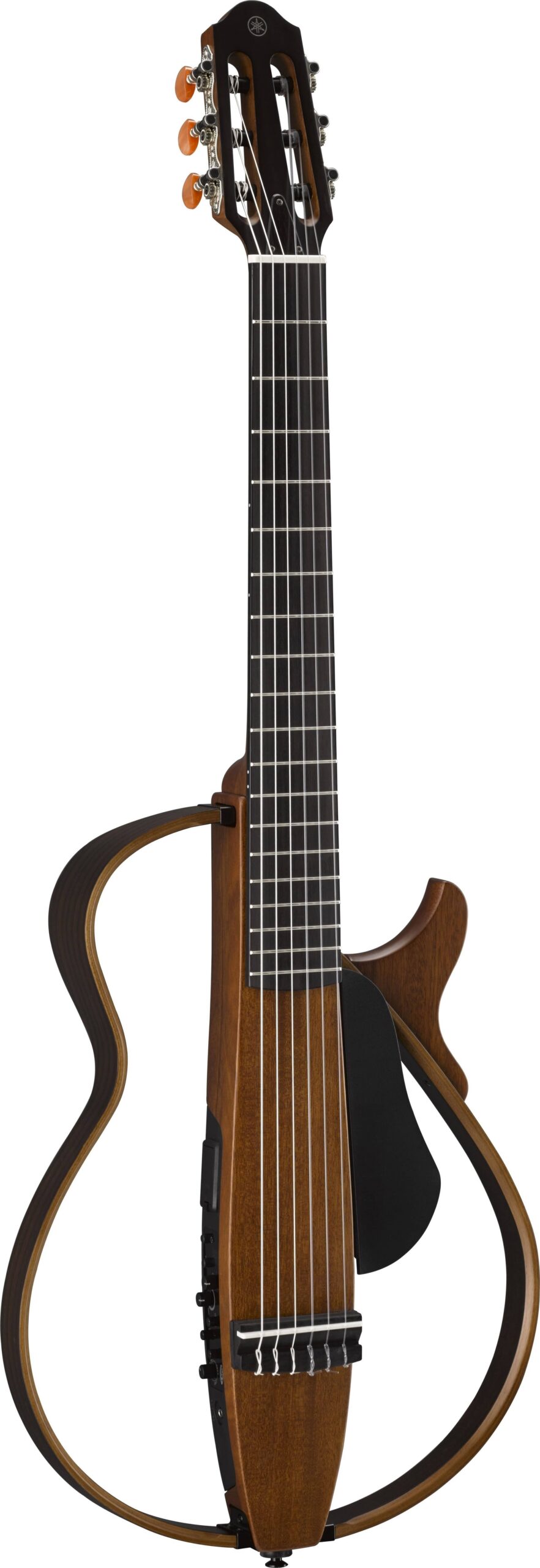
SLG200 Series SILENT™ Guitars are innovative instruments that utilize proprietary Yamaha technology and come in both nylon-string (SLG200N) and steel-string versions (SLG200S). These guitars don’t have a body chamber, so technically they aren’t acoustic guitars, although you will hear the strings subtly when you play. These guitars are standard size; however, the upper bout can be removed so that you can store the guitar at almost half its width in the supplied gig bag, making it a great travel companion.
The benefit to this space-age design is that the instrument is lightweight and comes with a ton of features, including an onboard tuner as well as reverb, chorus and microphone modeling, along with a piezo pickup, a mini 1/8″ output jack for the supplied headphones, and a mini 1/8″ input for auxiliary devices like a smartphone or MP3 player.
The neck is quite chunky on the nylon-string version, but that is typical for full-size nylon-string guitars with a flat radius. But adjusting to this guitar will be easy for most players, and it will feel more akin to an electric guitar due to the thin line dimensions of the frame and body outline.
The microphone modeling and piezo pickup can be blended to your own personal taste, and the output volume (to both the headphones and output jack) can be adjusted via the onboard volume control. The plugged-in tones are authentic to a nylon-string guitar, and the effects add a touch of dimension, especially when listening through a pair of headphones … and how cool is it that you can jam along to your own backing tracks via the auxiliary input!
As its name implies, this is a great guitar for travel, practice or other times when you need to play silently, or for live performances where feedback is an issue. (SILENT Guitars won’t suffer from acoustic feedback because they don’t have a body chamber in which the feedback would occur.) The SLG200N sounds pretty good when recorded direct to DAW, but I have to admit that I did miss hearing, and feeling, the resonance that you get from a true acoustic guitar with a body chamber.
The Video
This video was designed to make it easy for you to compare the five guitars. It consists of eight bars of just three simple parts: one strummed, one fingerpicked, and a melody. There are two measures of strumming, to which I overdubbed two measures of finger picking, and then four measures of top line melody that sits on both rhythm guitar parts.
Each of the five guitars are played in order, with the first four from largest to smallest (AC5R, CSF3M, JR2S and GL1), followed by the SLG200N. It’s a great way for you to not only hear what they sound like, but see them too, side by side.
You’ll notice that I use my nails when strumming the nylon-string instruments. This is because I’m a bit of a purist, and don’t think a pick should be used on a nylon-string guitar.
All the guitars in this video were recorded using a supercardioid dynamic microphone into a discrete microphone preamp and DAW software, with one exception: As mentioned above, the SLG200N is not really an acoustic guitar, so I instead used the onboard preamp for a direct recording capture of that instrument. You can obviously play this guitar acoustically, but you won’t have the volume that an acoustic body chamber affords.
The Wrap-Up
Any of these four travel guitars would be a great companion on a road trip. All will fit easily in overhead bins, and most importantly, they will be right there for you when inspiration hits in the hotel room.
Tonally, I think the CSF3M and JR2S sound absolutely amazing, and would work well for anybody who appreciates great guitar sounds. In terms of playability, I think you’ll have to consider whether your fingers would fit comfortably on the fretboard of any travel guitar, and whether the string spacing would work for your playing styles.
If space, a quieter output volume, and a low string tension is important, the GL1 would be a great choice for a person with small hands, or for a child. SILENT Guitars may be better suited to someone who wants to enjoy more of an electric playing experience, jamming in private, and likes all of the onboard accoutrements, without the need for accessories. But the bottom line is that travel guitars fill an important need for any musician who needs to tour or simply wants to take their music with them wherever they go.
PHOTOGRAPHS COURTESY OF THE AUTHOR.
Keep reading