Tagged Under:
My Guitar Program: The Prework
Patience, a solutions-oriented mindset and a student-centered focus are required to get the support you need to start a guitar program.
Whenever I’m asked about the progression of my guitar program at McQueen High School in Reno, Nevada, a line from John Lennon’s “Beautiful Boy” comes to mind: “Life is what happens to you while you’re busy making other plans.”
If I told my undergraduate viola-playing self that in 2025, almost half my students would be guitar players, I wouldn’t have believed it! The motivation for me to teach guitar was initially based on selfishness — I began my career at McQueen and split my time between teaching high school orchestra and elementary general music. I wanted to teach at the high school full time, but my orchestra enrollment alone was not enough to allow this to happen. So, I began making plans to add a guitar program well before it came to fruition. I cannot stress enough how important patience is during this process.

Keep the Conversation Student-Centered
Students are the reason we are educators. Therefore, we must prioritize their educational needs, aspirations and objectives.
If I focused on wanting to start a guitar program at McQueen with the goal of being able to teach at one school, the conversation would have ended before it even started. Instead, I centered the discussion around what the entire student body was missing out on.
It is well-documented and researched that students who are involved in music have better attendance. It is also widely acknowledged that student attendance directly impacts performance. So then, a guitar program would essentially increase student achievement.
I also use additional data from sources like Music for All, NAMM Foundation and Save the Music Foundation to make my case for adding a guitar program to your school’s course offerings.

Identify the Problem
When I began teaching at McQueen over two decades ago, the music department consisted of our band, choir and orchestra programs. The music program was for students who had participated in music in their middle school years.
At times, the instrumental programs would have beginners, but this was not the norm. It was difficult for a student to start the cello in their sophomore year without any previous experience. This meant we were not serving the needs of a vast majority of our student body.
I had to ask very difficult, self-reflection questions, which I shared with the administration:
- Does our school’s music department allow entry points at any grade?
- Is every student able to access instrumental performance ensembles?
- Am I interacting with the entire student body or just a specific subset?
- Is guitar a class or is it simply a fun class period for students?
- Do I have the proper training to teach guitar?
- Are there current scheduling issues preventing a guitar class?
- Do we have the funding to support a guitar class?
- Is our school offering similar opportunities compared to other schools in the district/region/state?
The answer to all these questions was a resounding “no.” I wanted to address each question before talking with the administration and presenting a viable solution.

Solve Small Day-To-Day Problems on Your Own
The dialogue between you and the administration about adding a guitar course is not a one-and-done situation. It will take multiple conversations over a long period of time, and adding a guitar class will not happen immediately. Conversations with my administration started over five years before a guitar program was implemented at McQueen.
Since I started my career, I have made it a point to only show up at my administrator’s door — unannounced or for a scheduled dedicated meeting — for something important. I do not waste admin’s time making my pitch and then walking away for them to solve the problem. The relationship with my principal is based on trust, so when I would show up, they knew it was something that required their immediate and full attention. If I identified a problem, they trusted that there was a legitimate issue that I had already attempted to resolve on my own.
Solve Scheduling Issues
I came up with a timeline of when I would be able to teach guitar during the school day. For my specific situation, I had to build the orchestra program, so one specific orchestra class could be split into two sections. Then, I could teach guitar in another period. This would ensure the overall enrollment necessary to justify additional funding.
Gain Support of Students and Parents
The administrator who eventually oversaw the creation of the guitar program at McQueen used to say, “Treat every student like they’re special … because they are. The parents don’t keep the good ones at home.”
Parents love when their kids want to participate in something positive like athletics, music and other extracurricular activities. To garner the support of students and parents, I included them in the process, and they were also on our problem-solving team. It’s easier for the administration to say “no” to a single teacher than to a group of students and their parents.
Of course, I didn’t want this to turn adversarial, but I had to find students who were passionate about including guitar instruction as part of our curriculum. Some were already in other instrumental music programs, but the majority were not. I held lunchtime meetings where interested students put their names on a list, which I then showed to the administration to prove there was sufficient interest.
I asked students and parents to write notes to the principal explaining why they wanted to take a guitar course. It spoke volumes when, in response, so many students echoed the same sentiment: “We WANT a course where we do a difficult thing.” It is rare for students to advocate for a course or instruction that challenges them, so the need to follow through with the implementation of a guitar program was undeniable.

Determine How the Guitar Program Will Be Funded
When we began our guitar program, I enlisted the help of my orchestra boosters who were some of the initial supporters of adding guitar. The boosters agreed to pay for my flight to participate in the GAMA Teaching Guitar Workshop if the administration paid for my hotel. I was able to pay the affordable registration from my orchestra budget. This was an easy sell to my administrator — a training workshop in exchange for a $400 hotel bill.
While having a set of classical guitars was not financially feasible for the first year, I received a private donation to purchase 10 guitars for the school. I then worked with a music vendor who offered a discount to students who wished to purchase their own guitars. Other students brought in guitars they already had at home. The first year was a mixture of classical and steel-string guitars, but it was a start.
The other materials — tuners, footrests and picks — were paid out of a small budget the school provided to start the program. This funding restriction did not come as a surprise to my administration because I was transparent throughout the process. I had already informed them that we would need financial assistance to purchase other items to provide a better experience for the students.
Lastly, we purchased method books that the administration paid for using textbook funds. At $10 each, it was easy to secure $250 for the inaugural class to have textbooks (the cost of two math textbooks, at the time). I made sure to write a justification for the books linked to state standards to ensure the administration knew the course was curricular and serious.
A year into teaching the course, I was given the opportunity to apply for a $5,000 grant. Due to my extensive discussions with administration over the years, I already had the justifications and the foundation necessary to complete the application. I was fortunate to earn the grant, which funded more than a full class set of guitars and other essential equipment for the program.
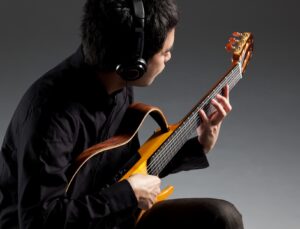
This guaranteed that any student who wanted to play guitar would have the opportunity, regardless of their family’s financial situation. Since this grant was awarded, every student could use a school-owned guitar. In fact, students are encouraged to use a school guitar, and during the school year, students are exposed to different types of guitars. Over the years, McQueen has accumulated steel guitars, Yamaha SILENT Guitars, electric guitars and a 12-string guitar. This allows students to be informed consumers, so they can feel confident purchasing a guitar on their own that is suitable for their budget and aspirations.
Looking Toward the Future
In the middle of the second year of the guitar course, several students from the first year of the program expressed interest in taking another guitar course. These students had already completed something challenging, and they wanted to continue to advance. I spoke to the current class … they also wanted a second year of guitar instruction.
This created another “problem” to be solved, but the addition of a second year of instruction was a much easier process. There was already a blueprint for establishing such a program, and administration had already seen the benefit and success of the first program. They were excited to add a second guitar course
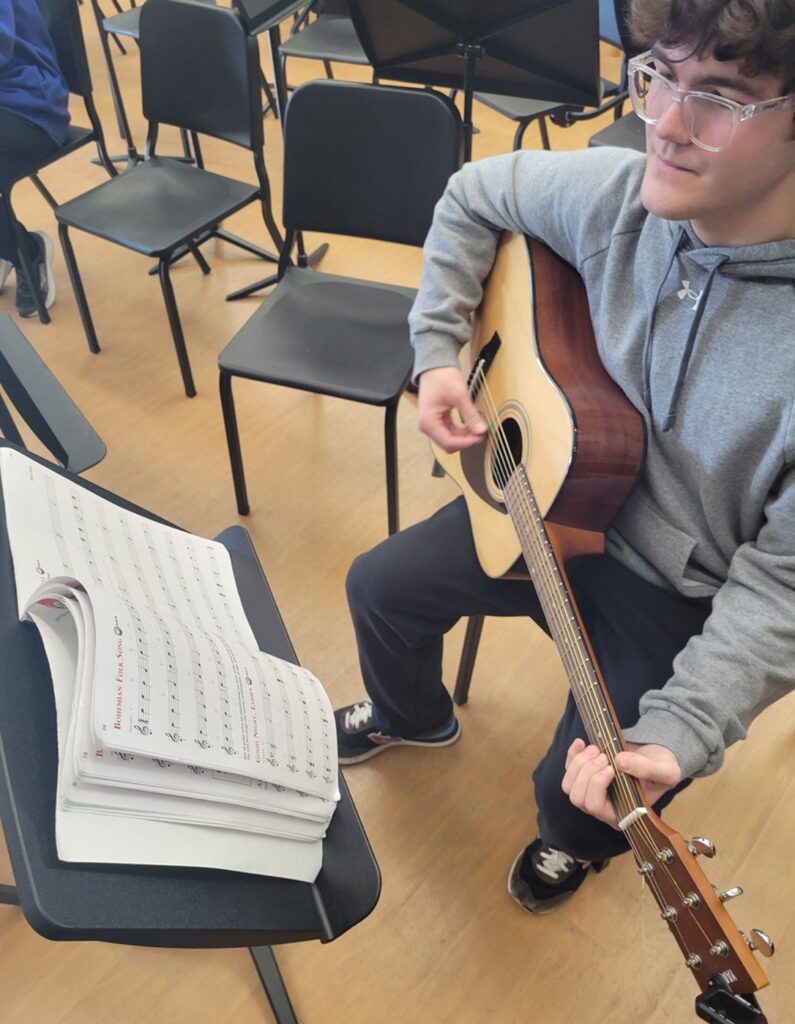
The guitar program at McQueen has been around for over a decade now. I have grown as an educator and have thoroughly enjoyed watching students come into the program with no guitar background, and by the end of the first semester, perform in concert, in front of their families and friends.
Being a part of that transformation is special, and I do not take it for granted. I know everyone’s teaching situation is different, so I hope this gives you a framework for starting a guitar course of your won.
Keep reading