Tagged Under:
A Framework for Healing-Centered Music Classrooms
An Oregon educator’s curriculum takes a holistic approach, blending social-emotional learning with artistic rigor and student-led leadership.
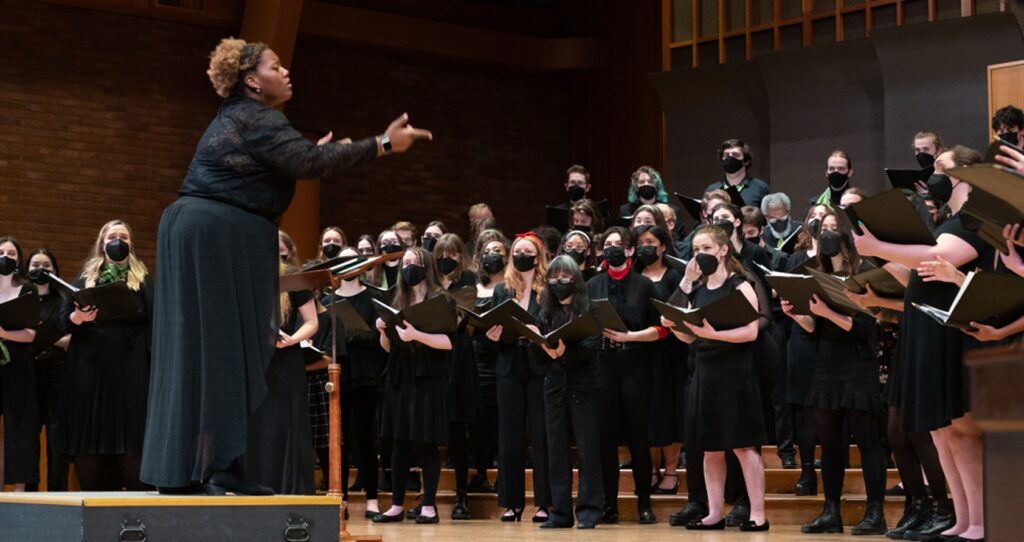
The secret to building a people-first curriculum starts with the heart, not the sheet music. That’s what Coty Raven Morris strives to do in her classroom at Portland State University in Oregon. The Hinckley Assistant Professor of Choir, Music Education and Social Justice builds her curriculum around the idea that music is a vehicle to better understand yourself and each other.
“Social-emotional learning (SEL) must be woven into the lesson, not pulled out as a separate thread,” Morris explains. “So, when I plan, I’m not just thinking, ‘I need to teach blend and vowel shaping.’ I’m thinking, ‘How can this piece help my students practice self-awareness or build better relationships?’”
To illustrate her point, Morris points to “The Violet” by Mark Patterson. “On the surface, it’s a beautiful choral piece. But in my classroom, it becomes a self-awareness lab,” Morris says. “We analyze the character’s emotions in the text and then make personal connections, like ‘When have you felt overlooked but still strived for bravery like the violet?’ Suddenly, we’re not just singing notes; we’re exploring our feelings and identities while building our emotional vocabulary — all through the music. The musical technique serves the human connection.’”
What SEL Looks Like in the Classroom
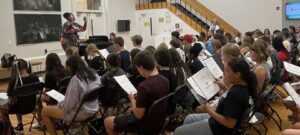
Morris explains that an SEL-rich curriculum means that the classroom is less of a lecture hall and more of a workshop to practice life skills through music. “It looks like a classroom that hums with humanity!” she says.
She finds the following tactics helpful for her students, and uses them regularly:
- Wellness checks as warm-ups: “We might start with a quick emotional temperature check — a ‘how-are-you-really-feeling?’ journal prompt or just holding up fingers on a scale of 1-5. This immediately honors where they’re at,” Morris says.
- Breathwork as a tool: “Before a rehearsal, we don’t just dive in,” she explains. “We might do a minute of intentional breathwork, framing it as our most fundamental musical instrument and a way to manage performance anxiety. The breath powers the voice! Whether students are having a stressful day or even if the energy is just getting a bit overstimulating, this helps re-center the room.”
- Student-led everything: “You’d see students running sectionals, leading discussions about the ethical ideas in a piece, and even helping to set the classroom expectations,” Morris explains. “It’s their community. In Andrea Ramsey’s ‘Three Quotes by Mark Twain,’ it says, ‘If you tell the truth, you don’t have to remember anything.’ This text provides a catalyst for critical thinking and discussion of why and when telling the truth is important. Repertoire that invites critical thinking helps students to be more independent and have better problem-solving and solution-oriented abilities.”
Strategies to Heal and Empower Students
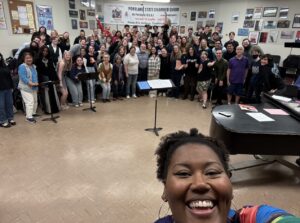
Instructors regularly encounter students with a wide range of backgrounds, including those who are dealing with current or past trauma. Morris knows firsthand how the impact of trauma can affect learning because she was houseless from the age of 15 through her undergraduate studies. She offers these tips to help educators heal and empower students who are undergoing trauma.
- Make it predictable: “People need routines, and kids dealing with trauma need to feel safe, and safety comes from predictability,” Morris says. “Start every class with the same ritual — a specific song, a breathing exercise, a check-in. That consistency is a gift.”
- Give them control through choice: “Trauma takes away power, so we give it back in small, musical ways,” she says. That could be asking questions like: “Do you want to sing this phrase piano or forte?” “Should we clap this rhythm or stomp it?” “What informs that choice?” “These tiny choices are hugely empowering,” she says.
- Use music for co-regulation: “If the class energy is chaotic, put on a slow, steady piece and have students just breathe with the pulse,” she suggests. “If they’re drained, do a silly, energizing call- and-response. Use the music itself as a regulating force.”
- Focus on the process, not just the product: “Celebrate the messy middle! Praise the effort of collaboration, not just the final, in-tune performance,” Morris exclaims. “The goal is the journey and the joy of creating together.”

Seeing the Fruits of Her Labor Outside the Classroom
Morris, who was recognized as a Yamaha “40 Under 40” educator in 2025 and a three-time nominee for the GRAMMY Music Educator Award, says that it’s fun to watch her students use the social-emotional skills they’ve learned in choir out in the real world. “Students talk about using the breathwork we practice before a big test,” she says. “I’ve seen a student gently mediate a conflict in the hallway using the ‘I believe’ language we use in songwriting.”
The goal, she says, is to help her students internalize the concepts and use music as a personal tool for well-being. In this way, they’re not just choir students; they’re becoming more empathetic and self-aware people.
“One of my favorite moments was during ‘The Gift to Sing’ by Reginal Wright,” Morris shares. “The text is all about how singing can lift you out of sadness, and it serves as an excellent tool for self-awareness. While rehearsing this song, a student said, ‘I finally get it. On my rough days, humming in the car on the way to school is my way of ‘singing the gloom away.’”

How to Be Guides, Not Gatekeepers
“Forget the top-down model!” Morris exclaims and suggests that educators need to be guides, not gatekeepers. “Your job is to set the stage and provide the tools, then step back and let your students create. It’s about trusting them to lead the way.”
One of the ways educators can do this is by getting comfortable with silence. “Ask a question like, ‘How should we express this line?’ Then, just wait. Let them problem-solve. The first person to talk shouldn’t always be you,” Morris says.
She added that waiting for students to respond is also a way to keep yourself from becoming overwhelmed with the need to talk — and sometimes ramble — all the time. “Don’t feel the need to fill the air with words. Pause, reset and begin again. Your students will admire you for practicing self-awareness and giving them clarity,” she explains.

Developing and Refining Curriculum
A social-emotional approach to learning wasn’t always the basis of Morris’s curriculum. When she first started teaching, her curriculum was more product-oriented. “My main question was, ‘Will this sound good for the concert?’” she explains. “Now, it’s completely flipped. My central question is, “How can this music serve as a vehicle to my students’ well-being and the betterment of our community?”
This night-and-day shift is why Morris is so passionate about the SEL framework. “I don’t just teach a song; I teach a song for a reason,” she says. “We sing Kenny Potter’s ‘O Sing!’ not just for the mixed meter and theory lessons, but to practice social awareness — interpreting beyond the text to understand different perspectives. The setting of the text discusses carrying on stories and lessons of ancestors for generations — something that all our cultures have in common. It presents an opportunity for us to discuss and share how we all elevate our loved ones differently. Music is the means, and the end result is their growth as human beings.”
Putting People First
If there’s something that Morris wants people to take away from her approach to an SEL-rich curriculum, it’s that she wants everyone to know that this isn’t “touchy-feely” fluff. “Social-emotional learning is rigorous, meaningful work that, when executed correctly, results in enriching, meaningful and even playful experiences,” Morris says. “We are literally building brains and building hearts at the same time. When a student analyzes a score to connect it to their personal history, that’s critical thinking. When they collaborate to solve a musical problem, that’s real-world teamwork.”
Morris explains that this approach doesn’t replace musical excellence — it unlocks it. “By tending to the well-being of the musician, we get more beautiful, connected and courageous music,” she says.
Keep reading