10 Steps to Better Intonation (That Actually Work)
Use these tips to teach your students what in tune really means and what it sounds like.
Your group sounds off. Not painful — just not quite right. You tuned, you balanced, you begged them to listen, but it’s still muddy.
Remember your undergrad years? You probably took the ceremonial tuning pitch and then went on with rehearsal, adjusting as you heard something. But chances are, you didn’t start that way. You developed that skill over time.
The students in front of me may not be music majors, but they can handle playing in tune. They just don’t know what “in tune” sounds like yet. Your job? Show them, one step at a time.

1. Fix Tone First
First, you can’t tune a bad tone. So, if you have trumpet pinching, airy flute sounds, thin violin tones, stuffy clarinets, etc., work on tone first. I know you want to get right to playing in tune, but we cannot skip this step. It will only lead to frustration for everyone within a five-foot radius of your group. That means long tones, breathing work, mouthpiece or headjoint exercises. Whatever gets you to a clean, focused sound.
In my room, we do tone work every day. It’s not always fun or interesting, but it’s the core of our foundation. Occasionally, I have skipped this at the beginning of rehearsal. After 15 minutes, I realized the errors of my ways, and we do what we should have done at the beginning of class: long tones, lip slurs and chromatics.
Reminder: The more characteristic the tone, the easier it is to match. You cannot tune a bad tone.
2. Start With Unison. Period.
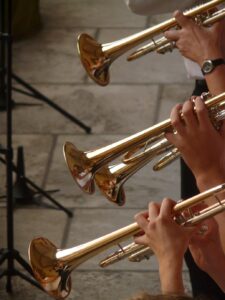
Okay, now our trumpets sound like trumpets — we have a good tone. So, let’s move slowly. Don’t start with chords. Don’t start with intervals. Just pick one pitch and get the group to match it together. For bands, concert F and concert Bb are solid choices — familiar, stable and all over your repertoire. For string players, pick any of your open strings.
If it sounds like chaos, it’s not an intonation issue — it’s a control issue. Stay here until it locks in. Some days this takes two minutes. Other days, it takes 15 — and I fight the urge to move on because when we stay here and it clicks? It changes everything.
Goal: A consistent pitch students can hold, hear, and match. Blending comes before balance.

3. Use the Tuner
“You use tuners? Ever heard of ‘listening’?” I heard this from a band director as we sat in a director’s lounge at a conference. This director clearly did not approve of any tuner use. The kids should simply listen and adjust. He was very clear that his kids did not use tuners. And I hate to say this, but when you listened to his group, you could tell.
If you’re reading this, chances are you have something in common with me: You have a music degree or two, and chances are, none of your students have a music degree. And this isn’t to say that a degree automatically gives you great ears, but it does assume some level of experience. What I’m trying to say is that your kids probably don’t even know what in tune actually is, and a tuner can help them experience this.
For beginners all students, the visual helps. They can’t fix what they can’t hear, and a tuner gives them something concrete to react to. I provide a clip-on tuner to every single student the first week of school. We then tune a unison pitch, usually concert F, so we can hear what in tune actually sounds like.
Tip: Pair a tuner with a drone. Eyes + ears = better results.

4. Stick to F, Bb and Open Strings
I mentioned this earlier but want to emphasize: Don’t overcomplicate tuning. Keep your tuning notes grounded in the keys your music actually uses. Focus on concert F, concert Bb or open strings — they’re everywhere in concert band and orchestra literature. I’ve seen tuning routines bounce between six pitches with no connection to the music. Keep it simple. Tune what your kids play every day.
Think: What do my students play every day? Tune that.

5. Teach Mouthpiece/Headjoint Pitch
For brass, we do quite a bit of buzzing to help students adjust pitch. All students, including percussion (timpani in particular), hum to help internalize pitch. For woodwinds, you can do mouthpiece “buzzing” as well, as long as you have them play to a specific pitch.
Quick references:
- Clarinet (mouthpiece + barrel): concert F#
- Flute (headjoint): concert A
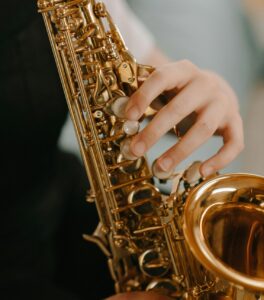
- Alto sax (mouthpiece): concert G or A (depending on experience)
The first time we tried this, it sounded like a bad New Year’s Eve party. Many students had difficulty adjusting their air, mouthpiece angle or embouchure to get the correct pitch. But after a few weeks, pitch was becoming solid, and students were stabilizing sustained pitches much easier.
Reminder: A good mouthpiece pitch sets the tone for the rest of the horn.

6. Teach Them to Disappear
Every time I tell a kid to “lose yourself” for good intonation, I think of the Eminem song, “Lose Yourself.” I can’t put the lyrics here because it has bad words in it. This is just one of the things that goes on in my head during rehearsal (I’m sure you have your own idiosyncrasies …).
Anyway, kids may ask, “If I can’t hear myself, am I playing?” The answer is “Yes, and it probably means you’re doing it right.”
The goal of tuning isn’t to hear yourself better. It’s to blend into the group sound so well that you’re not sure which part is yours. It’s uncomfortable for kids. Some think if they’re not cutting through, they’re doing it wrong. But remind kids often that if it sounds weird, like you’ve lost yourself, that’s good!
Teaching line: “If you’re hearing everyone else more than yourself, that’s a good sign.”

7. If It’s in Tune, Don’t Touch It
Sometimes, things will just be in tune. Not always, and maybe not even that often, but when this happens, leave it alone. If the pitch is solid, leave it. You can acknowledge it, praise your students, but if ain’t broke, don’t fix it just to feel useful.
Rule: Only adjust if you’re sure it needs adjusting. Otherwise, let it go.

8. Try Player Adjustments Before Moving Equipment
After making sure that the tuning slide or headjoint is in the right place, try these fixes:
- Adjust space in the mouth — spread the teeth
- Raise or lower the tongue
- Adjust the embouchure shape
These micro-adjustments give students control and help them learn to self-adjust by feel. You can also incorporate these in the warm-ups. Try a descending concert F Remington-style warm-up. Go from F to E natural, but instead of fingering for the E natural, have students (brass players in particular) bend the pitch down. This is a great way to work on adjusting for intonation.
Quick guide: Pitch is flat? Raise your eyebrows up. Pitch is sharp? Frown. Simple but surprisingly effective.
9. Move to Fifths
Once unison is locked in, start building interval awareness. Perfect fifths are stable, forgiving, and fairly easy to adjust in tune once you have a solid unison foundation. Ultimately, we’re trying to eliminate any waves in the sound. For fifths, you can tell students to raise their eyebrows up, and this is often enough to get this the 2 cents sharp it needs to be in tune with the root.
Remember Step 7. Why? Because a lot of instruments play sharp. If your root is in tune and a student plays a fifth a little bit sharp? Leave it alone.
10. Then Teach Chords and Harmonic Roles
Once your ensemble can match pitch and blend intervals, you’re ready for chord tuning. Start small:
- Identify roots, thirds and fifths
- Assign roles clearly
- Balance around the root
- Explain how the third may need to sit slightly lower (and be about 20% quieter).
If you don’t spell this out, students will just guess, and guessing leads to waves in the sound, which leads back to a muddy sound. Use a drone or keyboard to model it first. Let them hear what “in tune” sounds like before you ask them to create it.
Say this: “Let’s hear what the chord could sound like. Then we’ll try to match it.”
Bonus Tool: Use a Harmony Director
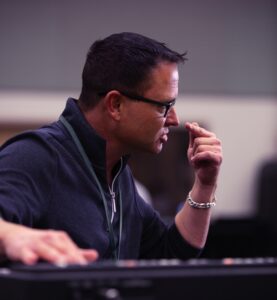
The Yamaha Harmony Director (or any drone keyboard) makes tuning real. Use it to:
- Sustain reference pitches
- Demonstrate just-intoned chords
- Train inner voices to adjust
- Confirm your own chord analysis
The first time I used one, I had no clue what half the buttons did. It still made a big difference. I played a pure chord, had the group match it, and they could feel it lock in. That made me a fan. If you’re unfamiliar with the Harmony Director, take a look at the various YouTube videos available demonstrating its uses.
One Note at a Time
Your students won’t magically “get” tuning. Neither did you. And yes, they need reps, but most importantly, they need a system. So, start small. Pick one pitch. Get it stable. Build from there. Ultimately, intonation is about helping students care about what they hear and giving them the tools to change it.
Keep reading