Tagged Under:
Motor Skills in the Modern Classroom: Expanding Circles
Perhaps a better title for this article would be “How We Ended Up Surprised that Children Have Hands.” Why? Because many elementary music teachers notice something that’s difficult to quantify but impossible to ignore: Students arrive enthusiastic and eager to play, but their hands tire quickly. Fingers collapse on strings, writing stamina fades halfway down the page and coordination that once seemed automatic now requires visible effort. Unless you’re reading a printed version of this article, you’re almost certainly looking at the prime suspect.
Research and public consensus point to the same things — a sedentary lifestyle (World Heath Organization, 2019) and/or an excess of screen time. Tapping on screens does not require quite the same physical force as pushing computer keys, which require less force than pushing typewriter keys, which demand less strain than longhand writing. We can keep going, but at some point, we would be looking at a 9-year-old chiseling symbols into stone and developing forearms like a competitive lumberjack!
Such an observation is not a criticism of students, it’s merely a reflection of the world they are growing up in. Simply put, children move differently than they did a generation ago. Their environment has changed, so their hands respond accordingly.
Emerging research reflects what many teachers have been noticing for years. Longitudinal studies (McArthur, 2022 and Madigan, 2019) and a systematic review (Bakht, et al., 2025) both noted patterns linking increased screen time with lower manual dexterity scores in early learners. None of this proves that screens are villains lurking in the night, but it does suggest that when hands spend fewer hours gripping, twisting, pressing and manipulating physical objects, endurance and coordination may develop differently.
For music educators, this matters because music is unapologetically physical. If we want students to later pursue instruments with confidence, preparation cannot begin the year they first hold a trumpet, flute or violin. In regards to dexterity, we begin much earlier. We begin with rhythm.
The First Circle: Whole Body Rhythm
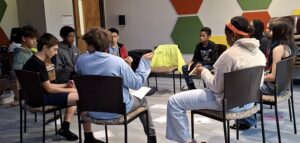
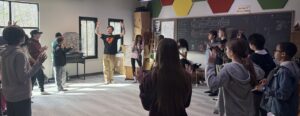
Gross motor work starts with the body and applies to all grades from kindergarten through 8th grade. In my classroom, students stand in a circle facing inward so we can hear one another better. The circle also gives us something else: a shared pulse. Every year you will have students who did not experience the foundation you laid in earlier grades. Thus, the circle becomes equalizing. Returning students reinforce what they know, and new students absorb it through repetition. No one is singled out, and the rhythm becomes the norm.
No matter the grade level, when the class steps together on the beat while singing, something interesting happens. Students who struggle to match pitch when standing still often begin to regulate themselves once movement enters the picture. Attention is redirected, the ear settles in, and the body organizes the sound.
We might move the circle one step at a time to the left or the right, or we might lift one foot at a time in succession as the beat travels around like the second-hand on a clock. Sometimes I tell a story about a mouse that is trying to stay dry beneath that second-hand during a rainstorm. The class becomes deeply invested in the mouse. I do not question this emotional commitment — I simply allow the rhythm to do its work.
Large movement establishes internal timing, and timing stabilizes coordination. These are not merely engagement strategies, they are neuromotor preparation. At this stage, it can appear deceptively simple, but it is not simple, it is foundational.
The Second Circle: Timing Through Play
Once the body shares a pulse, the hands can begin to take on more responsibility.
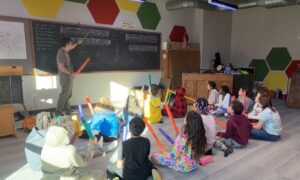
One of my favorite exercises involves an invisible ball. I toss it into the air, and students clap when it “lands” in my hand. I test its bounce on the floor and treat it as if it has weight and texture. Incidentally, this exercise offers excellent sense memory training for the teacher as well! Eventually, a student will inform me that I am holding nothing, and I’ll talk about how we follow with our mind. This is usually the moment when their focus sharpens.
This exercise builds anticipation and timing. Students must watch, wait and coordinate movement with an external event. Later, I will bring in a real ball and repeat the exercise, then follow this by bouncing the ball on the floor to set a steady beat as we add words or a song while maintaining the bounce. We may even try to move the circle, tying the hands to the established whole body rhythms.
The point is not the actual ball; it’s layered coordination. Tasks stack and the brain adjusts, thus strengthening coordination. The hands are beginning to act independently within a rhythmic structure. These first two circles work together for all grade levels with a more immediate sense of reward for invested effort.
The third circle is more progressive over the course of many years for students in your stewardship.
The Third Circle: Train the Fingers to Think
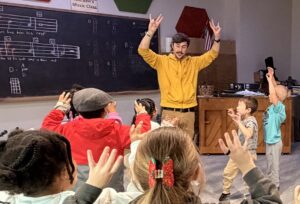
In kindergarten we begin with finger taps. Thumb to first finger, thumb to second, thumb to third, thumb to fourth. Slowly at first, then in patterns: forward, backward, in pairs, in sequences of three and finally in sequences of four.
These fine-motor patterns are simple, but they require focus. I introduce one set at a time over a few weeks. In the months that follow, the taps become smoother. We speak while tapping, we sing while tapping and sometimes we use exaggerated articulation. Other times, we whisper while tapping to bring the room into focused quiet before transitioning to the main activity.
The fingers begin to separate in the brain, as well as on the hand — sequencing strengthens and recognition follows. Some students will insist this is boring, and I assure them that I would not waste their time with it if it wasn’t significantly good for them. I understand — sometimes I don’t like to do things that I don’t absolutely have to either.
The tapping exercise is early fretboard training disguised as warm-up. It also has the added benefit of getting their internal pulse aligned with existing time signatures.
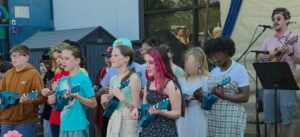
By 4th grade, the taps evolve into number combinations because students will begin their strings journey fully in 5th grade at our school. Students work through 24 permutations of one, two, three and four. At first it feels like codebreaking and later becomes a gentle competition to see who can go fastest without messing up. Occasionally, we map those numbers on to scale tones (I tend to favor F, G, A and B) and sing them while tapping. Later on, when we map those numbers onto fretted instruments, the transition feels familiar. Their fingers have already rehearsed independence and recognize the terrain.
None of these exercises are dramatic on their own. Their power is cumulative because music is physical. Before it is expressive, before it is interpretive, music is mechanical. Fingers must press. Hands must coordinate. Breath must regulate. Rhythm must stabilize the body before it can stabilize tone whether you are playing a stringed instrument, a breath-based instrument or exploring the many expressive tones of percussion.
None of this removes challenge. Learning an instrument is demanding. Yet there is a difference between productive challenge and preventable frustration. A student whose hands have been taught to work rhythmically since kindergarten approaches technical difficulty with a different kind of confidence.
There is also the very real possibility that discomfort will show up in instrumental study or there will be pushback from students who find the work difficult. For instance, when beginners first encounter stringed instruments many are surprised by the amount of pressure required to produce a clean tone. That discomfort is not a flaw, it is information — students understand that muscles strengthen through use, and the small calluses that form over time are subtle evidence of growth. Persistence and determination yield results.
Expanding and Returning: The Long View
The circles are not separate lessons. They overlap.
In practice, I often introduce all three circles at the beginning of the year. Sometimes they occupy different segments of a lesson, sometimes they rotate week to week. The sequencing is flexible, but the layering is intentional and elements of them should be present in every lesson.
Life for most modern children involves more sedentary time and more interaction with glass than with textured materials. Music classrooms can help rebalance that equation. Music teachers are uniquely positioned to provide consistent, rhythmic and tactile experiences. We do not need to shame technology — we can simply widen the range of physical experiences students encounter.
Over time those experiences accumulate. The circles close and somehow the hypothetical child chiseling their letters into stone is relieved. The student who looked betrayed by a pencil in September may confidently notate rhythms by March.
If we think developmentally and expand the circles early, our students’ hands will be ready when the music asks more of them.
References
- World Health Organization (2019). “Guidelines on physical activity, sedentary behaviour and sleep for children under 5 years of age.”
- McArthur, B.A. et al. (2022). “Screen time and developmental and behavioral outcomes for preschool children.” “JAMA Pediatrics.”
- Madigan, S. et al. (2019). “Association Between Screen Time and Children’s Performance on a Developmental Screening Test.” “JAMA Pediatrics.”
- Bakht, et al., “Assessing the Impact of Screen Time on the Motor Development of Children: A Systematic Review” (2025). Systematic review of screen time and motor development in early childhood. “Pediatric Discovery.”
- Further Reading: Hillman, C.H., Erickson, K.I., Kramer, A.F. (2008). “Be smart, exercise your heart: Exercise effects on brain and cognition.” “Nature Reviews Neuroscience.”
Keep reading