Tagged Under:
Fighting Absenteeism with the Arts
At Annandale High School, where Annie Ray is the Performing Arts Department Chair and Orchestra Director, more than 96% of students are classified as economically disadvantaged by the state of Virginia. A few years ago, the school had some of the lowest scores in the giant Fairfax County Public Schools district, the ninth largest school district in the country that serves more than 180,000 students.
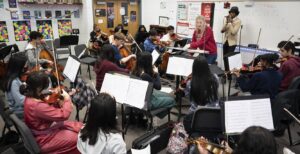
Now, thanks in part to the “involvement intervention” and individualized student support program that Annandale High School implemented, Principal Shawn DeRose says that Annandale High is the top overperforming school in the district relative to its poverty rate. The key to the program is to incorporate the relationship-based approach that is common in the performing arts, where students in music and drama often have the same teacher for all four years of high school. This relationship keeps students connected to performing arts even when they are struggling academically, Ray says.
“Arts educators are often the first ones to notice that students are missing. We have these deep relationship ties with students, which create this huge sense of belonging in the school,” she explains.
As Ray gets to know her students and who they are over four years, the kids look more forward to coming to school. “Of course, those students are much more likely to open up to me about the struggles in their lives,” she says. “They’re comfortable enough with me to admit that they don’t understand something.”
Looking at the Stats
Both the strong student-teacher relationship and what is taught between the notes and rhythms on the page of performing arts motivate students to attend these classes, Ray says. In fact, a 2024 study called “Chronic Absenteeism and the Arts in Virginia Public Schools: A Statistical Review” conducted by Robert B. Morrison, Annamarie Bollino, Kelly Bisogno and Patrick McCormick, found that students involved in performing arts showed significantly less chronic absenteeism (defined as missing 10% or more days, excused or unexcused, in a standard 180-day school year), along with higher test scores, better grades and a greater sense of belonging.
The researchers reviewed data from the Virginia Department of Education from 2018 to 2023, and identified students as “no arts” (students who did not take any arts courses) and “any arts” (students who took one or more arts courses). They further organized the data to look at just seniors based on “career arts” (students who have taken four years of arts instruction) and “non-career arts” (students with less than four years or no instruction).
The findings consistently showed that students in the performing arts had lower rates of chronic absenteeism. This report demonstrates a significant correlation between career-arts students and improved chronic absenteeism rates. Career-arts seniors from each year since 2020 show between 32.3% and 50.8% lower chronic absenteeism rates than those who are not.
Additionally, every senior class for each year shows a significant statistical advantage for the career-arts students. These findings held when comparing the data across multiple key variables such as race/ethnicity, gender, free and reduced-price meals, and English language learners. This indicates a strong correlation between career-arts students and lower chronic absenteeism rates.
“Seeing a student as an individual is foundational to Annandale High’s approach to engagement and inclusion,” Ray says. “The goal is to build the infrastructure that allows it to grow and become a sustainable model for other schools as well.”
In addition to DeRose, Ray credits the following for their work: Attendance Dean Cass Haynes, Dean Jacquie Blair, Dean Christina Licciardi, Pyramid Intervention Specialist Dannielle Causley and Assistant Principal Hanna Langstein.
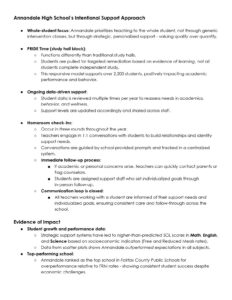
Download Annandale’s Intentional Support Approach
Keeping Students Plugged Into School
At Annandale High School, the students who are in performing arts are less likely to skip school on the days that they have their performing arts classes. With this fact in mind, the school stopped pulling struggling students from electives to focus on remediation with extra science or math. Instead, students continue attending performing arts classes and music lessons, which motivate them to keep coming to school.
“Any student who is behind in learning and skipping school — all of that improves because they are staying in lessons. We are keeping students plugged into school via what makes them want to be at school,” Ray says.
Annandale High School also includes hosting monthly activity days for all students, who sign up for sessions to do something fun of their choice, ranging from knitting, Black Student Alliance and Future Business Leaders to basketball shooting practice and even playing Dungeons and Dragons.
“In one year with six sessions of the monthly activity days, the school saw a significant increase in students’ reported sense of belonging,” Ray says. “It works!”
The Key: Relationship-Building
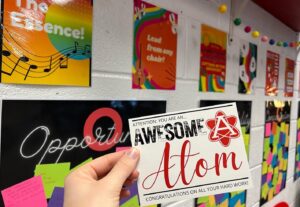
The program is all about relationship-building with students as individuals as well as meeting students where they are and encouraging them to find ways to grow. Sometimes, Ray will have struggling students come to her music classroom during math or science class so she can check on them periodically and ask other students to help them.
“Once you have a kid in the habit of coming, and they are seen as an individual and see people invested in them, they want to show up,” Ray says. “Relationship is the essential and fundamental super key to what we do in performing arts.”
One of the benefits of teaching music is that in an age where kids are often glued to a screen, playing music is very hands-on and requires a student’s full focus. “When I’m working with a student, I get to know them without any technology in the way,” Ray says. “If a student is engaging in the arts, they’re not reaching for their phones.”
The Data
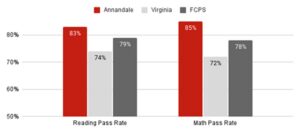
The Virginia Department of Education recently released Standards of Learning (SOL) scores from this past year, and the results speak for themselves. In reading, Annandale posted an impressive 83% pass rate, well above Virginia’s average of 74% and the Fairfax County Public Schools (FCPS) average of 79%. In math, the margin is even greater, with Annandale students achieving an 85% pass rate, compared to 72% statewide and 78% across the district.
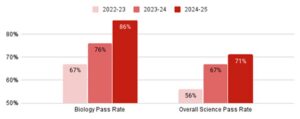
In addition to strong performances in reading and math, Annandale has made significant gains in science over the past three years. Our pass rate has grown from 56% in 2023, to 67% in 2024 and now 71% in 2025. Biology in particular has been a standout success story. Over the past three years, our pass rate has climbed from 67% in 2023, to 76% in 2024 and now an incredible 86% in 2025, besting both the state and FCPS averages.
Moreover, we continue to expand our advanced course offerings. This year, we are partnering with Northern Virginia Community College to offer dual enrollment in World History and Auto Technology. In addition, for the first time in school history, we are offering Advanced Placement Seminar, an interdisciplinary course for sophomores that develops critical thinking, collaboration and academic research skills. This is in addition to our full array of International Baccalaureate courses.
These results are no accident. They reflect the “hard work of our students, dedication of our staff and support from families and the community,” Ray says. “You can continue that support by staying curious — ask your student about their learning, connect with teachers, attend games and performances, and help us share Annandale’s story.”
From Practice to Policy: Why This Matters Statewide
As this evidence has grown, policymakers have started to ask how Virginia can better recognize and encourage the kinds of student experiences that keep young people connected to school. One response currently under consideration is House Bill 478, known as HB478. The bill would establish a Diploma Seal for Excellence in Fine Arts. Like existing diploma seals in areas such as STEM, civics, career and technical education and biliteracy, the fine arts seal would formally recognize students who demonstrate sustained achievement in music, theater, dance or visual arts.
HB478 acknowledges what schools like Annandale are already showing. When students feel seen, valued and engaged through the arts, they are more likely to attend school consistently, persist through challenges and graduate prepared for college, career and life beyond high school.
By elevating fine arts achievement to the same level of recognition as other diploma distinctions, HB478 aligns state policy with both research findings and real-world outcomes highlighted in this article.
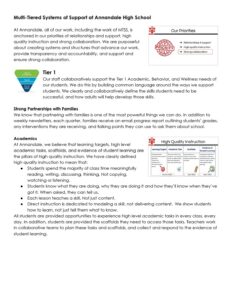
download Annandale’s Multi-Tiered System of Support
How You Can Support Arts-Based Student Engagement
Parents, educators and community members all have a role in supporting policies that strengthen student connection to school. Readers who are interested in advancing the work described here can choose to contact their local delegate or senator to share why arts education matters for attendance, belonging and graduation outcomes. National Association for Music Education members can take 5 minutes to complete this form to show their support. Sharing this article with school leaders or community groups can further elevate data-informed conversations about chronic absenteeism and student engagement.
As Virginia continues to address challenges related to attendance and disengagement, policies that recognize proven, relationship-driven approaches like sustained participation in the arts can help ensure that more students show up, stay connected and succeed.
Ray has accumulated many awards for her dedication, including the 2024 GRAMMY® Music Educator and as a 2025 Yamaha “40 Under 40” music educator. Her accomplishments are varied and far-reaching. In addition to being an advocate for the fine arts at the state and national level, she founded an orchestra for students with disabilities, a parent orchestra (so parents can learn to play instruments like their children), and co-launched Motherhood and Music Education, which provides resources and support for caretaker/music teachers on leave.
Keep reading