
Method Books for Beginner Guitar and Ukulele
By combining method book lessons with individualized instruction, students learn the basics of music theory and how to read music.
Many of the students in our Beginning Guitar and Ukulele elective course at Springfield High School in Pennsylvania want to learn to “comp” along with popular music. So, we teach playing by ear, using chord charts and reading tab. However, we also feel it is critical for general music students in a performance-based class to learn to read music and develop a fundamental understanding of music theory.
Balancing all this was central to planning the curriculum for our beginner course. Learning to read and share music through notation provides a more complete music education. Additionally, traditional music reading in guitar and ukulele has fostered an interest in music theory and other elective courses. How do we teach traditional notation reading and melodic playing in our entry-level course?
One-Week Crash Course in Music-Reading
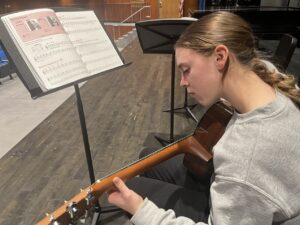
Before starting the method book, the class spends a week on basic music-reading. While many students have some knowledge reading music from previous music courses, this preemptive unit assures that everyone is on the same page. This one-week crash course focuses on pulse, rhythms and note-reading in treble clef. I use a variety of free resources like musictheory.net to provide direct instruction and rely on worksheets and online note-naming and rhythm identification activities to give students ample practice before applying their skills to the guitar or ukulele.
Method Books
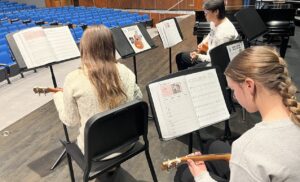
For the beginning course, we use the Alfred Method books for guitar and ukulele. The books mirror each other in form and structure and allow for an easy transition when we swap instruments at the quarter. When choosing a method book talk with others who specialize on the instrument. Guitar pedagogue, performer and recording artist David Cullen recently recommended the Hal Leonard series to me. There are dozens of great method books out there and I encourage you to find one that best suits your needs.
The Alfred books are well-structured, beginning with instrument care, playing technique, tuning and general knowledge before introducing a brief tutorial on reading music. Students identify note names on the staff and their rhythmic values in small chunks (usually one measure at a time). The book introduces new notes on one string at a time and gives four to six exercises on those notes before moving to the next string. There are pink highlighted reference boxes at the top of each section that show the note on the staff, a fret diagram and a photo of someone playing the note. Just like for chord teaching, photos are extremely impactful to student learning.
Throughout the book there are pages that introduce new musical concepts, such as different meters, music symbols, repeat signs and more. The book also integrates chords as students’ playing ability progresses. For our course, the chord integration sections are usually the final points we teach in the course.
Teaching from The Book
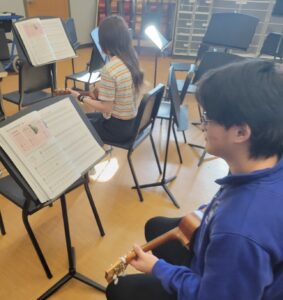
When introducing a new section, I begin by showing students the note on the fret board. Then, students fret the note, pick it and say the note name aloud. I encourage them to look at the note on the staff in the reference box at the top of the page as they play the note. (Note: it is critical to get students fretting close to the top of the fret with a rounded left hand as they learn to play.)
After playing through and identifying the new notes, I walk students through exercises, or “book songs,” using the following steps:
- Note naming: Have students identify the note names on the staff and their rhythmic values in chunks (one measure at a time usually works well).
- Chunking: Have students play small sections of the selection together while saying the note names. After students have mastered a small section, they can play another small section and then link those together.
- Call and Response: Play small sections of the selection for the students and have them play it back while tracking the notes on the staff.
- Finger Names: One thing that really helps some students is saying the finger number/fret number instead of the note name. Just make sure that students track the notes on the staff as they say the finger/fret number so they learn to read the notation.
As I deploy these steps, repetition is the key to success. Students must be given the opportunity to succeed by allowing opportunities to make errors.
Individual Work
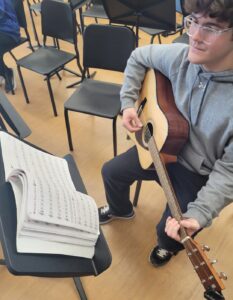
Group instruction from the method book is brief compared to the amount of independent melodic practice that students do. Students working independently can work at their own pace and self-reflect on their performance. I walk around the class and provide direct feedback and instruction to students — I think of these as mini one-on-one lessons.
Students are assigned two to three songs a week. The songs in the method book are original educational etudes as well as standard folk songs that you find in many beginning instrumental books. Each day during class, students are allotted time to practice, ask questions, collaborate with a peer and perform their selections. I help students with everything from technique to dynamic contrast depending on the ability of the player. I really enjoy this individual work because it better serves students then a one-size-fits-all group approach for every song.

Learning Management Systems in Guitar and Ukulele Teaching
One of the most unexpectedly valuable tools is the assignment record feature in Canvas, our school’s learning management system (LMS). While I am more than happy to listen to every student play their selections, having students record and submit selections in Canvas has many benefits.
First, it creates a learning artifact. Recorded videos allow me to give specific feedback that students can observe and note in their videos; something not possible in a real time performance. The artifacts can be shared with parents, administrators or used for peer reviews. I have also found that having students record themselves creates a natural cycle of self-reflection because they must review videos for submission. Often students will even leave comments in their recordings, noting things they think they did well or incorrectly.
As a teacher, using the LMS to capture, grade and provide feedback on weekly song performances creates a lot of flexibility in my classroom. I am able to target students who need assistance during class time, and monitor and encourage all students. It also facilitates the different work and learning styles of students.
Learning to read and play from a method book may not seem exciting at first, but student feedback has been overwhelmingly positive. Most students appreciated the opportunity to learn to read traditional notation and some expressed interest in continuing to learn through a music theory class. One student said she was able to use her skills to play out basic melodies for her church worship group.
Do you have a great method book or instructional idea for teaching students to read traditional notation on guitar and ukulele? Feel free to share it with me.
Keep reading