Tagged Under:
Bonus Lessons
Add small-group instruction on different instruments, songwriting and other topics through bonus lessons.
When I started teaching nearly 30 years ago, I started a 7th-grade jazz band. Many students were interested in the jazz ensemble for the first couple years, but then I had a hard time finding bass players. I also discovered that students who wanted to play piano, guitar and drum set had a hard time learning jazz because the chords, rhythms and technique were so different from what they already knew.
A few years later, I started other bands — rock, country, bluegrass, hip hop and mariachi — and had si0 milar issues. I also had to introduce instruments like a DJ controller, banjo and guitarron and ended up spending a lot of rehearsal time helping these students. However, what they really needed was some focused time without the rest of the band around.
THE ADVENT OF BONUS LESSONS
Our school district offered pull-out lessons for students to have small-group lessons on their band instrument once a week for short amounts of time. These lesson times were highly beneficial for teaching students technique, embouchure and skills specific to their instrument.
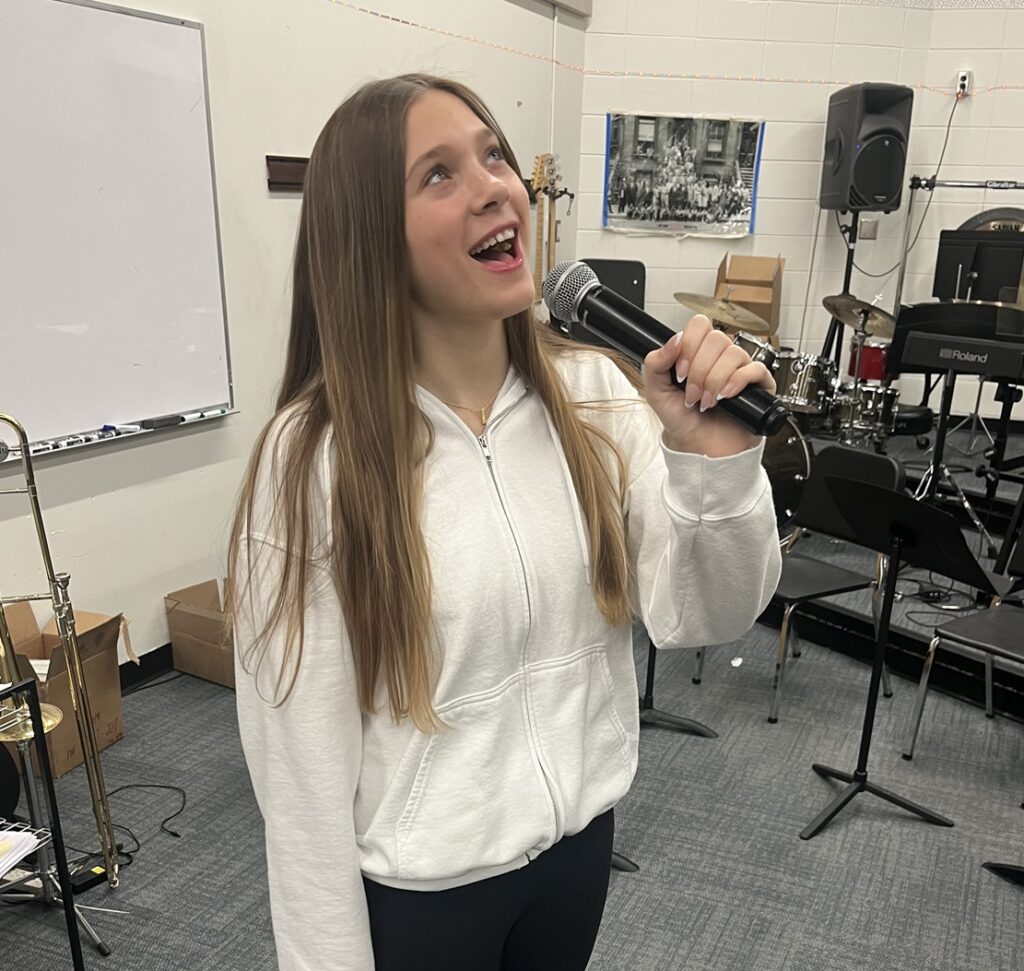
I decided to add another element to these pull-out lessons — on occasion (every other week or once a month), students could receive a lesson on drum set, bass, piano, guitar, guitarron, DJ controller or banjo in what I called “bonus lessons.” Students received lesson time on their band instrument two or three times a month, but they would also receive a lesson on a secondary instrument once or twice a month.
OTHER BENEFITS
I found many other benefits from bonus lessons. Students who were losing interest in band were now engaged in music again, and they were developing new skills and passion.
- Students who could not participate in after-school classes like jazz band, rock band and mariachi for whatever reason could now participate in learning these genres and the instruments associated with them.
- Bonus lessons expanded beyond instruments. Other topics that we began to offer included improvisation, songwriting, production, theory and history.
- These lessons provided opportunities to work with students who were very advanced on their band instrument, struggling on their band instrument, new to their band instrument or had special needs.
LOGISTICS
Our pull-out lesson program has changed over the years, and districts across the country have many different systems from very extravagant to nothing at all. Here are some ideas on how to fit bonus lessons into your schedule.
If you already offer pull-out lessons, make two or three of them meet the needs or interests of your students. For example, have a bass guitar or drum-set lesson once every other week. The week that students have a bonus lesson, they do not go to their regular pull-out class. In this way, the students’ schedules do not change.
- Some schools have flex or resource time where students have periods of time each week where they can choose what they need. Our school calls it “WIN (What I Need) Time.” This time can be used for getting extra help in a class, study hall or learning a new skill like a new instrument. Depending on how often students have these flex/resource times, you can offer a guitar session every week. Or, maybe alternate it with a ukulele session. There are schools that form clubs during this time where students have a weekly session for two months. A perk of a schedule like WIN Time is that any student in the school can take bonus lessons, not just students in an ensemble.
- Find parents, private lesson teachers or high school/college students to teach these instruments as a pull-out lesson during the students’ band hour. This takes a little more effort because you will need to get administrative approval and possible background checks as well as financial backing of some sort to have visitors coming in to teach, but it’s possible. Along these same lines, you could have peers mentoring same-age peers.
Next, let’s dive into the areas of study that bonus lessons can explore and some ideas on their viability considering that regular attendance may not be possible due to the pull-out and flex/resource time setup.
BASS GUITAR
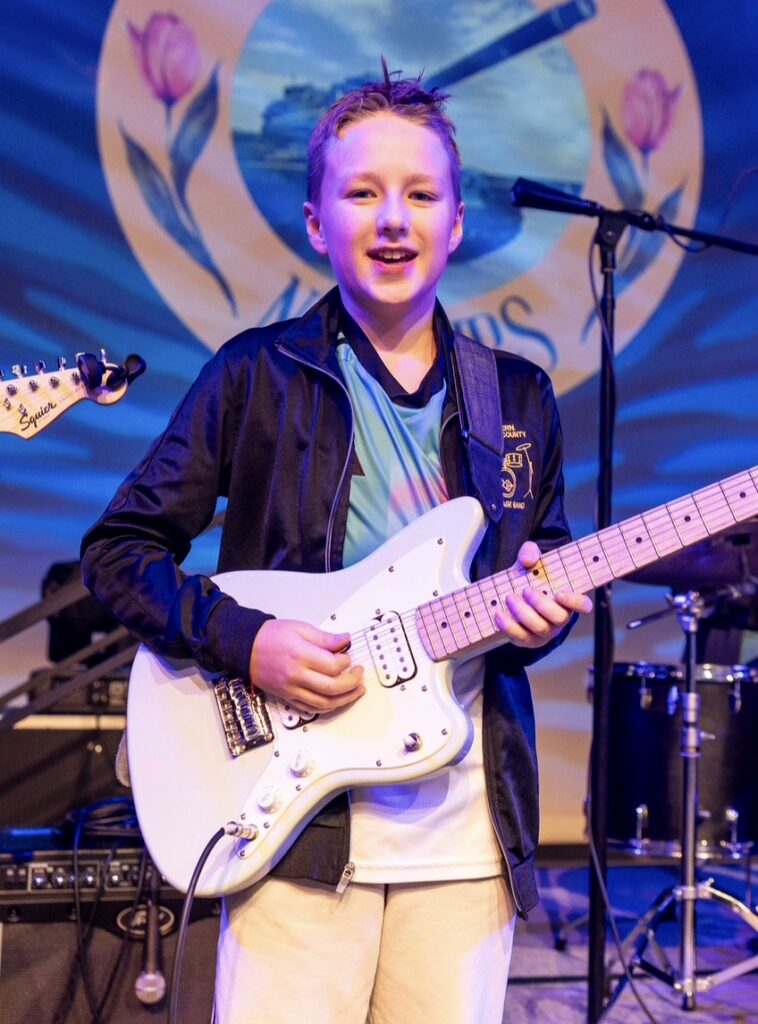
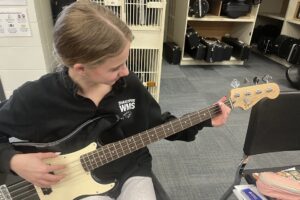
Let’s begin with the instrument that I started with — bass guitar. At every bonus lesson, I teach or review holding position, hand position, string names and basic technique. Then we learn a song — well, usually it’s just a portion of a song, but it’s the best part. We’ll learn the song with notation and tablature. A couple great rock songs to start with are “Seven Nation Army” by White Stripes or “Don’t Stop Believin’” by Journey. You can find tablature on Songsterr. A great site for both tablature and traditional notation is GuitarInstructor.
When learning jazz songs, I’ll usually skip the tablature portion because jazz charts usually don’t have tabs. I love using “Jazz Ensemble Method” books by Dean Sorenson because it explains technique and has great beginning-level jazz charts.
After a few lessons, we will get into reading chord charts. You can find chord charts for songs on Ultimate-Guitar.com. This gets students to think in terms of harmonic structure and it forces them to use their ears. Because chord charts don’t spell out every single note that is played and don’t show how many beats or bars a chord lasts, it helps the student pick out those notes by ear. This is typically more advanced, but some students take to ear-training more quickly. From a jazz standpoint, this also is a good time to teach walking bass lines. A great book to assist with this is Hal Leonard’s “Jazz Bass Method Book.”
Another way to engage students is through YouTube videos. Students already search for song tutorials on YouTube where a bass player goes measure by measure through a song. These videos are hit or miss, of course, based on the musician’s ability to teach. However, if you preview some suitable YouTube tutorials before the lesson, give the links to your students so they can watch the videos at home to reinforce the lesson.
GUITAR AND UKULELE
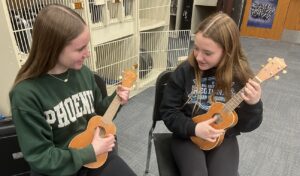
Bonus lessons for guitar and ukulele can follow a similar format as the one described above for bass guitar. Start each lesson with a review of the basic holding position, hand position, string names and basic technique. Then teach students a song. My go-to rock songs to start with for guitar are “All the Small Things” by Blink-182 and “Smoke On the Water” by Deep Purple. For ukulele, I like “Riptide” by Vance Joy and “Hey Soul Sister” by Train. Introduce chords, tablature and traditional notation using those same sites listed for bass guitar as well as the Dean Sorenson book for jazz guitar. Introducing a song every one or two lessons will keep students’ interest and show them that they are going to have to practice to be successful.
Two other resources I recommend are Music Will and Bob Habersat’s ShedtheMusic. These sites have so many great ideas and interactive playing and learning opportunities.
PIANO
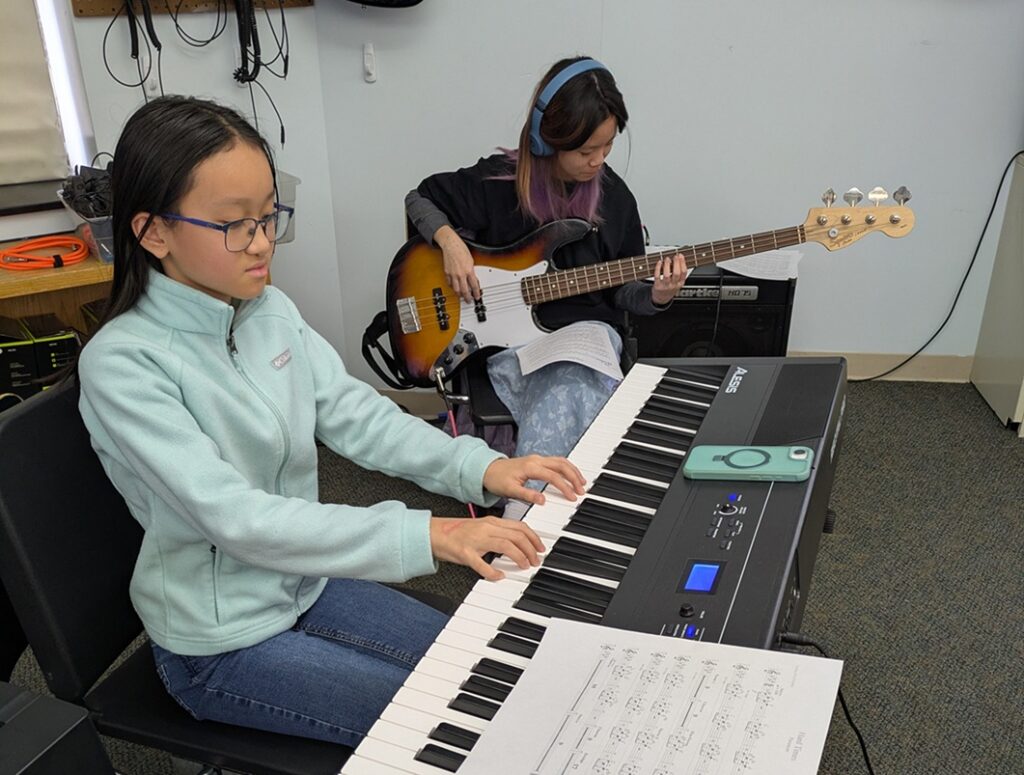
There are a variety of approaches to take with bonus lessons for piano. It really depends on the students who are interested in learning it and what your intentions are for teaching piano. I usually look to help students who could play piano in our jazz and modern bands. For both of these bands, I put a lot of focus on chord recognition. So, I start with teaching note names and proper hand placement. Then, I move to scales, major and minor chords, and inversions. I’ll then introduce embellished chords like dominant, major and minor sevens, and their inversions. I like using Frank Mantooth’s “Voicings for Jazz Keyboard.”
Next, we jump into teaching songs. For jazz, I use the Dean Sorenson book, and for pop, I use the Ultimate-Guitar and GuitarInstructor sites as well as MuseScore and MusicNotes. This is where I get into reading notation like traditional piano lessons. If a song doesn’t have many or any piano riffs, it’s nice to use a chord sheet. However, if it’s a more elaborate part, I might encourage the student to read a completely notated part.
DRUM SET
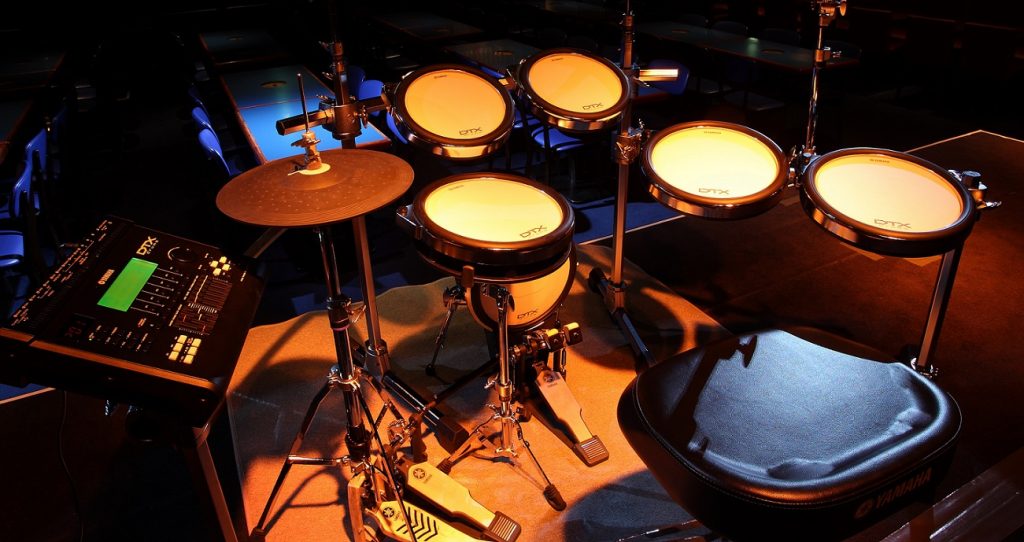
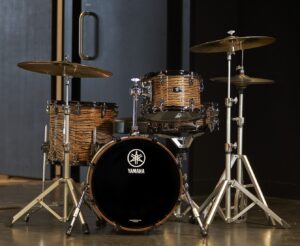
My most popular bonus lesson is for drum set. I usually start every lesson by having students play body percussion because I only have one drum set in the room and typically have five to 10 students. Students start by tapping their right foot at a steady tempo representing the kick drum. Then, they will tap their left hand on their right leg on beats 2 and 4, modeling the snare drum. Next, students will tap their right hand on their left leg in a straight 8th-note pattern to model the hi-hat. I rotate students on the drum set during this process and have them start combining two and then finally all three patterns, which result in a basic rock beat.
For a swing beat, students will alternate their feet as quarter notes on bass and hi-hat. Then I’ll have students add their right hand on their right leg playing the swing pattern. Through this entire process, I try to give every student a turn on the drum set where I can teach them proper stick and hand placement and where the stick should strike the drums and cymbals.
Next, I teach them another groove. I use Tommy Igoe’s “Groove Essentials,” which is also great for teaching how to read notation. Lastly, like the other instruments, I put on a song so students can try to figure it out by ear. Start easy with Queen’s “We Will Rock You” and White Stripes’ “Seven Nation Army.”

SONGWRITING
There are many ways to approach songwriting. I start by asking students for a song that has great lyrics. We pull up the lyrics and analyze — we look at the story it tells, the rhyming structure, words/syllables per line, literary devices and overall song form. Then, we compare it to other songs and see what similarities and differences we find. Next, students try writing their own lyrics.
After a few lessons using this approach, we create some melodies and chord progressions and use some of the student lyrics. We discuss common chords used in popular music (I, IV, V, vi) and play around with them in different orders. I like to play Axis of Awesome’s “4 Chords” video, which demonstrates how many songs use the I-V-vi-IV progression.
I also recommend SongWritingForMe by Sarah Gulish and Kat Reinhert, and the book “How To Write One Song” by Jeff Tweedy. You will encounter so many great ideas on how to teach songwriting through these two resources.
I have offered composition from a classical or orchestral angle as a separate bonus lesson, but sometimes I will include it in songwriting lessons.
IMPROVISATION
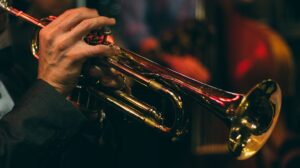
I start improvisation bonus lessons by playing some examples of great soloists on different instruments in different genres. Some great examples include:
- “So What” by Miles Davis, trumpet
- “That’s A Plenty” by Benny Goodman, clarinet
- “All Along the Watchtower” by Jimi Hendrix, guitar
- “Downtown” by One 2 Many, piano
- “Just Friends” by J.J. Johnson, trombone
- “All The Things You Are” by Charlie Parker, saxophone
We listen and talk about what we like, and we might even transcribe a riff or two. Then, we discuss coming up with a toolbox of ideas that we can use in our solos. Because many ideas come from listening to a variety of solos, I give students a list of songs and artists they should add to their playlists.
Then I break down some of the basics of improvisation, starting with call and response. Students will use the first three notes from a concert B-flat blues scale and play along with a B-flat blues backtrack on YouTube to make it sound better. We follow up with a Q&A where students can make up their own response, using the same three notes. Then they try a solo all the way through the 12-bar form. The class discusses concepts like creating melodies, using common rhythms like quarter notes and eighth notes, using space, repeating riffs that are cool and building a solo (“tell a story”) — by starting simple and progressively playing faster and higher.
I then incorporate music theory and introduce chord progressions. Students learn that each chord comes from a scale and these notes sound best in each measure. Have students play with a recording and play only the bass note for each chord. Then introduce guide tones (the third and seventh of each chord) and have students play them with the recording. Students can also play patterns like the first three notes of each scale for each chord with the recording.
The next and most important connection is telling students to incorporate the theory (what’s in their head) with what they are feeling (their heart). This is where the magic happens!
PRODUCTION
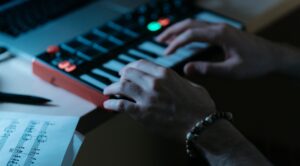
I wrote about music production in my article about Band AND, a new concept I started in my band class. In bonus lessons, I demonstrate how to use a digital audio workstation (DAW) like Cubase or BandLab. If you need a demonstration yourself, both sites have tutorials or check on YouTube.
A good first lesson is to show students how to use the beatmakers and on-screen piano keyboard to create music as well as recording their voice or live instrument. Then show them how to use the pre-programmed loops — how to loop and split tracks, as well as control volume. Finally, teach them to save and export a file.
During class discussion, point out that songs of virtually any genre have a beat, bass part, harmonic content or hook, and vocals — so they should have at least these four tracks.
If you want to go further with music production, check out ShedtheMusic.
DJ
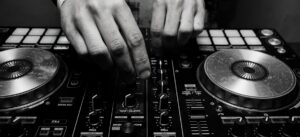
DJing is a very cool bonus lesson that might be out of your comfort zone, but it’s definitely doable. Purchase a DJ controller with two jog wheels with Serato software. You don’t have to obtain the most expensive model; you can purchase some for under $300. Download songs onto your computer and drag them into Serato. Then, drag one song each into a jog wheel, press “play” on your controller, and use the fader between the jog wheels to transition from song to song. That’s all you need to do to start!
Now it’s time to experiment with tempo controls, effects and, of course, scratching. Your students will love it. It won’t be long before you have students DJing at lunch, school pep fests and assemblies, and dances.
ADAPTIVE MUSIC
One of the highlights of bonus lessons is adaptive music for neurodivergent learners and special needs students. There are many ways you can set this up. I use a system developed by Ruth LeMay where I remove the highest three strings on acoustic guitars, drop D tune the low E string. Then I place colored tape on the frets creating open fifth chords that are taught by color instead of pitch. You can put corresponding colored tape on a piano keyboard or a bass guitar (or better yet, a bass ukulele) with just the E string. Add in a singer and a drummer, and you’re ready to jam! Have your band students help so they can learn leadership skills.
I make slide decks for the songs. Each slide is divided into quadrants with each square representing a measure. I use colored triangles as quarter notes with the words below the triangles. Some songs we have had a lot of success with are “Party in The USA” by Miley Cyrus, “Dancing In the Streets” by Martha and the Vandellas and “Baby Shark” by Pinkfong.
If you are interested in learning more, check out LeMay’s 3Strings.
HISTORY AND THEORY
Two final topics that I offer occasionally through bonus lessons are music history and theory. Usually, I have more success at the middle school level to include history and theory into teaching an instrument, songwriting or improvisation.
__________________________
Bonus lessons are a highlight of our music program. They give students a new area of music to become passionate about, and they increase creativity in your program. Students who can’t get enough music love all the new opportunities. Students who are losing interest, bonus lessons just might be the spark they need. And a possible bonus of bonus lessons? You might just find that bass player for your jazz band.
Keep reading