Parent Orchestra Gets the Whole Family Involved
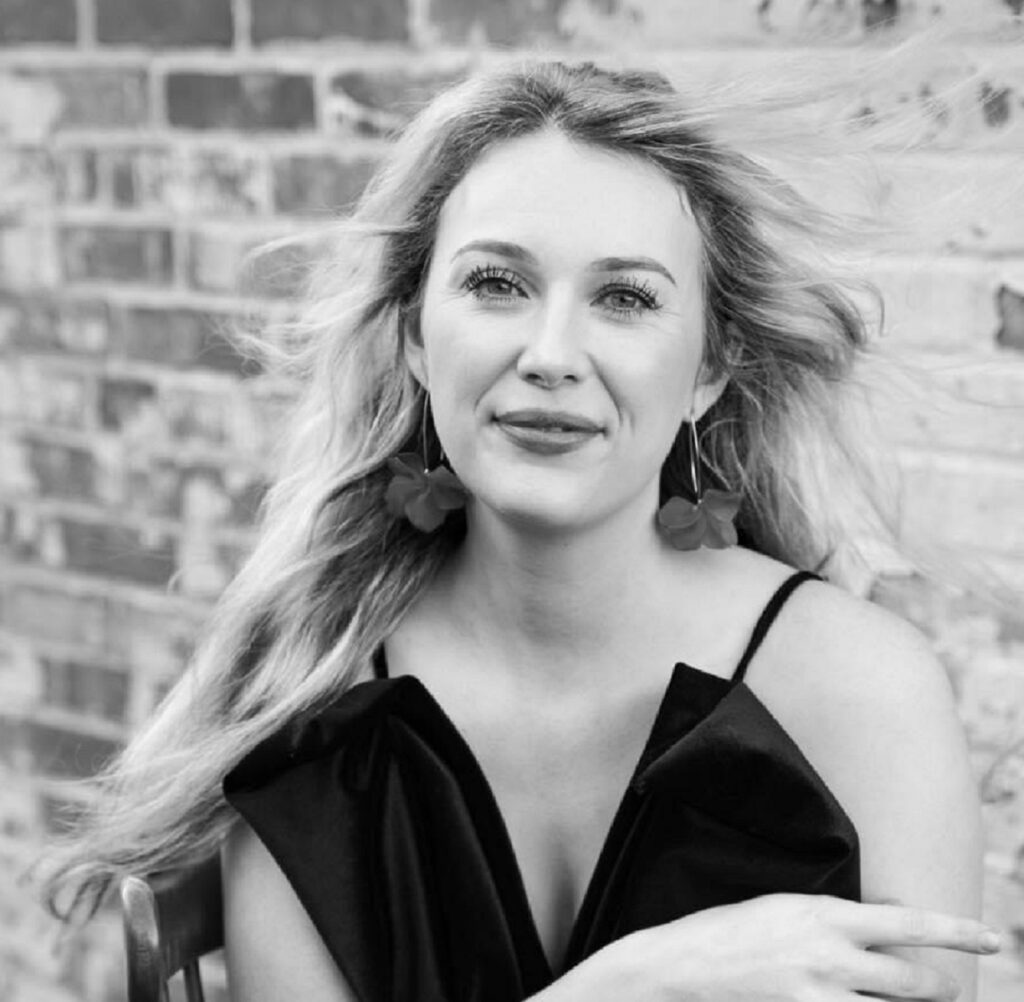
As the Performing Arts Department Chair and Orchestra Director at Annandale High School in suburban Washington, D.C., Annie Ray has a passion for teaching students. But she doesn’t stop there: She teaches music to the kids’ parents, too!
Back in 2018, Ray drew inspiration from her mentor, Brian Coatney, a fellow music educator from her home state of Texas, who had developed a simple but powerful idea: create a community orchestra specifically for the parents of music students in Fairfax County Public Schools. There would be no kids allowed, and no experience required. This would be an adults-only orchestra, where music student parents — many of whom have never played an instrument before or haven’t picked one up since childhood — can have their own creative outlet.
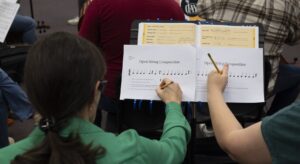
Over the past half decade, the Parent Orchestra that Ray directs has grown to more than 225 mothers and fathers and 15 teachers who volunteer to teach it twice a month. The Parent Orchestra, which meets to practice two Thursday nights a month, is so popular that Ray has a waiting list of more than 100 adults eager to participate.
“It sprung up into this beautiful thing,” Ray says. “A lot of these caregivers are people who have never touched a musical instrument in their lives.”
Getting the Parent Orchestra off the ground took equal parts creativity, persistence, and community trust. Ray began with a simple Google Form and the support of her co-founder, Dr. Michelle Keenan, sent out to the families in her school pyramid and quickly grew year after year. Because the project aligned with Fairfax County Public Schools’ goals around family engagement and access to the arts, administrators quickly offered their support.
There was no start-up budget and a small participation fee. Every aspect of Parent Orchestra was built through shared resources and volunteer spirit. Instruments were easy – play your students instrument, even if it was tiny! Teachers across the district volunteered their time to coach sections and design lessons. Ray and her co-director, Austin Johnson-Stawarz handled logistics with scheduling rehearsals, organizing music, and ensuring each caregiver had a place to start, whether that meant holding a bow for the first time or relearning fingerings from decades ago.
What began as a grassroots experiment soon grew into a districtwide collaboration. The simplicity of the model inclusive and community-driven has made it sustainable. “We wanted to remove every barrier possible,” Ray says. “If you can show up, we’ll put an instrument in your hands and make sure you feel welcome.”
The Suzuki Triangle
The Parent Orchestra, Ray says, is an expansion of a music education concept known as the Suzuki Triangle, which promotes a collaborative environment involving three parties –— students, teachers and parents — in the learning process for success. Parents often can help their children with math or reading homework, but unless they play an instrument themselves, they can’t help much with music lessons. In the Parent Orchestra, parents get to experience what their kids do as student musicians, and it helps parents understand the hard work involved. It also leads to fun parent-child bonding over a shared activity: playing the violin, viola or cello, Ray says.
“They have said over and over again that they are doing something just for them and connecting with people,” she says about members of the Parent Orchestra. “A lot of them have said the big thing they get out of it is understanding what their child is actually learning. It’s a way for them to connect with their kid.”
Parents learn empathy about the huge learning curve involved with playing musical instruments, Ray says.
“They get to model resilience to their own child,” she says. “You’re not going to be great at this right away. It is a process — a long process. You’re going to sound really, really bad before you sound good.”
The Parent Orchestra runs during the school year, with an end-of-year performance. The most advanced members of the Parent Orchestra performed in a session at the Midwest Band and Orchestra Clinic in 2024.
Connecting Parents
In a YouTube video from Fairfax County Public Schools about the Parent Orchestra, with the title “It’s Never Too Late,” parents describe how participation has enriched their lives and helped them bond with their sons and daughters.
“When I heard about this opportunity, my husband and I were like, ‘We’re signing up,’” Karen Reiley, a mom, said in the video. “For my son, I think, as he watches us struggle, he finds out that struggling through a process is just part of the process. It’s what’s normal and it is what you have to go through to get to the other side, where you can be accomplished.”
Ray says that the Parent Orchestra draws participants from a geographic area with a wide range of income levels, and people who normally wouldn’t meet and befriend each other are connecting as they learn to make music together.
“You have some incredibly affluent parents who are becoming friends with parents who are having a much more difficult situation in terms of finances,” Ray says. “These cultures that would not have crossed are … not just bringing the students together, but their parents across Fairfax County.
“We’re an open door,” Ray says. “We’re a community.”
District-Wide Camaraderie
As for the 15 teacher volunteers who teach Parent Orchestra, they, too, get a chance to get to know each other and learn from their teaching styles, Ray says. Student teachers learn from watching more experienced teachers instruct the Parent Orchestra.
“Normally … we don’t get to see each other,” she says. “Now, we’re watching each other teach.
“It doesn’t just benefit the parents; it benefits us as well,” Ray says. “You’re watching your colleague teach and you’re learning how they approach things.”
Key leaders in the school district — like school board members, principals and even the superintendent — sometimes attend rehearsals. This gives them an appreciation for the performing arts, Ray says.
“It’s an activism piece for community when the parents are right there in front of the superintendent,” she says. This sends the message to decision makers: “This means so much to us, and the arts are important,” Ray says.
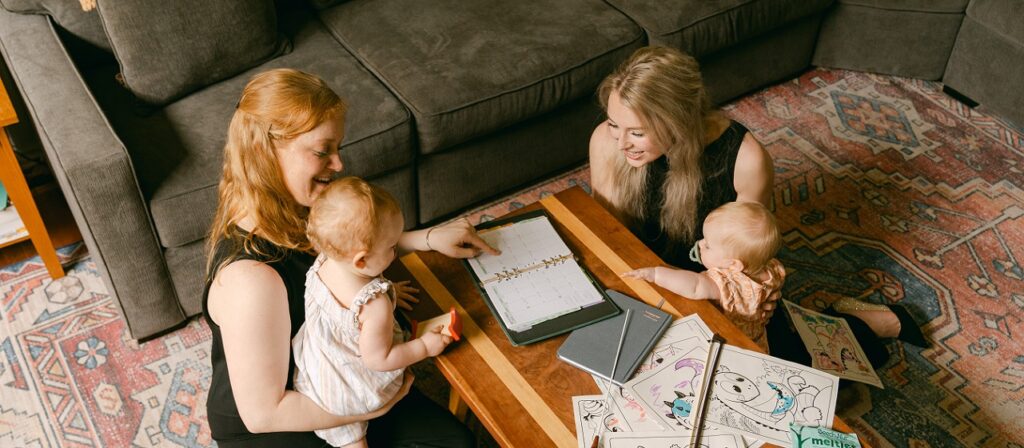
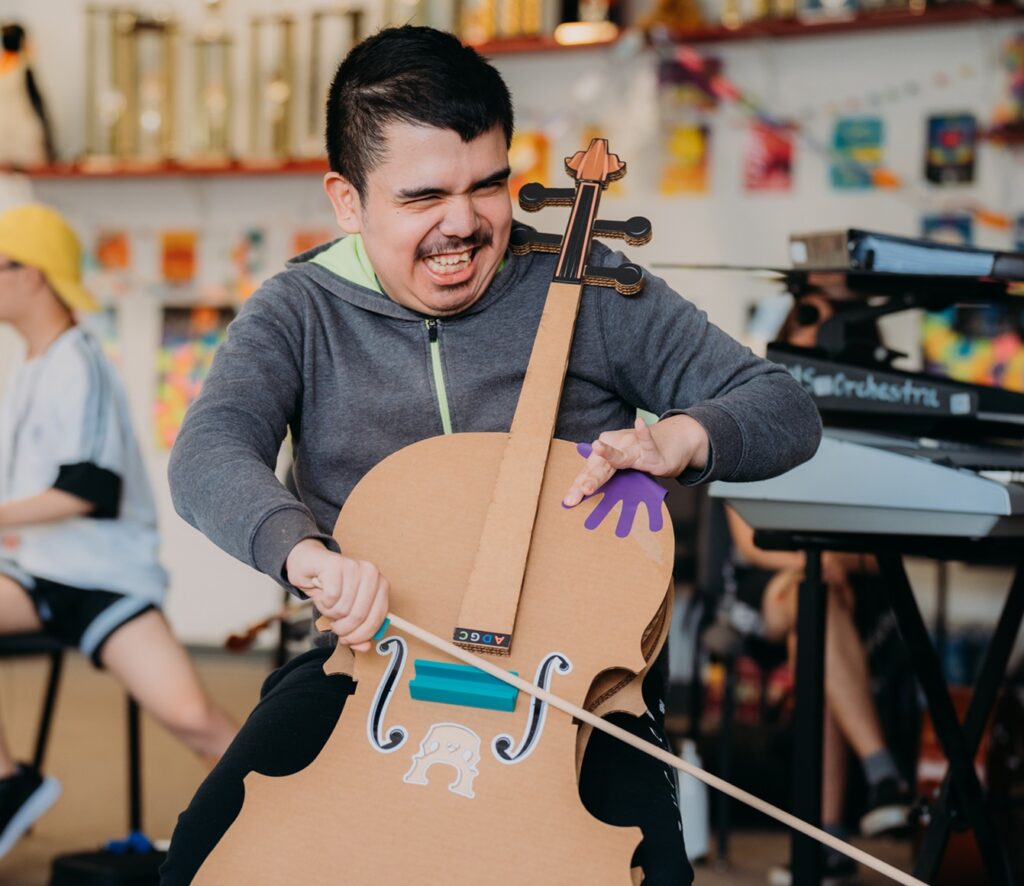
Ray has earned recognition for leadership in several areas, including winning the 2024 Grammy Music Educator Award and being named a 2025 Yamaha “40 Under 40” educator. Her accomplishments are varied and far-reaching. In addition to the Parent Orchestra, Ray also founded an orchestra for students with disabilities, implemented an arts-based, anti-absenteeism program and co-founded Motherhood and Music Education, which provides resources and support for caretakers/music teachers on leave.
Photos by Alene Boghosian
Keep reading