Tagged Under:
The Basics of Teaching Classical Guitar
Try these fun teaching tips, which emphasize proper guitar-playing technique from the start.
As I was preparing to teach my first guitar class, I spoke to many experienced guitar teachers who all had the same advice: You only need to be one step ahead of your students.
Thankfully, I took this advice to heart because my first couple of years were a train wreck in slow motion, as I learned to play guitar alongside my students. Then, I started to improve. Eventually, instead of reacting to issues, I was anticipating them, but most of it was trial and error.
With any music class, the first month of instruction is critical. During this time, you must set up habits that will be foundational for your students’ success.
I teach classical guitar, and here are some things that worked for me.

Setting the Tone of the Class
The time you spend working on basic techniques will pay off. Reminders and remediation will be required as the year goes on — that’s normal and to be expected. Students physically change throughout the course of a school year, which will require adjustments to technique as well.
I am upfront with students from the beginning. I tell them I am not a formally trained guitarist and that I’m learning just like them — only later in life. I share with them my failures and what that failure has taught me. This demonstrates that learning to play guitar is a lifelong journey, and it takes away the pressure on students to feel that they need to do everything perfectly.
YouTube plays an important role in my guitar classroom. There are unlimited videos of guitar professionals using correct technique. Conversations in class no longer focus on me (“Mr. Baker keeps bothering me about my thumb”), but on the professionals on YouTube (“The guitarist in the video plays with their thumb that way, and Mr. Baker is helping me to play that way”).
I support the usage of various styles of guitars and guitar playing because I want students to discover their own unique preferences. This is a great opportunity for them to determine what works for them and what doesn’t.
For students who have never played guitar, all information in class is new. But for students with some guitar experience, we work together to build upon what they already know, not tear it down. My goal is to acknowledge their experience and make them more receptive to learning how to play classical technique. By showing different styles, students can differentiate — “I play a steel string guitar this way, and I play a classical guitar this other way.”
Learning classical technique makes students more versatile guitar players. We watch videos of various classical guitarists to observe solid technique, which we then compare to other styles. I highlight the physical differences between the guitars and how adjustments can be made. I lead the students to the answer rather than just telling them. This creates student buy-in and fosters a positive classroom experience.

Posture
I rely on videos of professional classical guitarists with impeccable posture to emphasize its importance. I specifically look for videos of guitarists playing on piano benches to illustrate how the back of a chair is not used or needed when playing guitar.
Students’ feet should be about shoulder-width apart and flat on the floor, so they can easily stand without using their hands for support. I have students take note of where their left foot is because this is where the footrest will be placed. I find that boys have a more difficult time sitting tall in chairs. I believe because boys grow so quickly, once they reach high school, they are not used to sitting tall because they are unable to keep up with the pace at which they are growing.
Footrests
The headstock of a classical guitar should be roughly at eye level. To accomplish this, a footrest is essential. Most footrests have adjustable heights, and I encourage students to experiment to find the right height for them. As a student grows, I remind them to adjust their footrest accordingly.

Guitar Placement
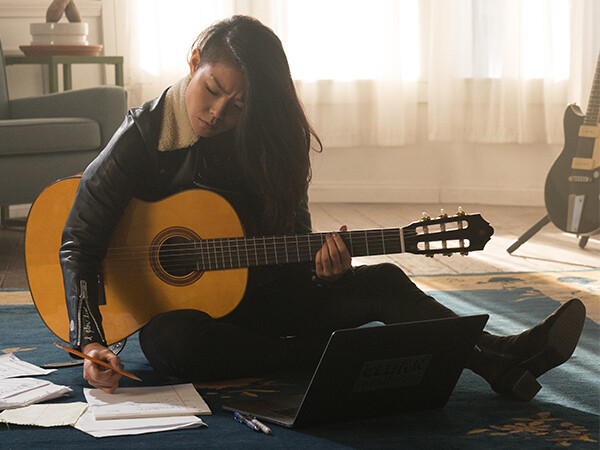
How a student holds the guitar will be a constant work in progress because the hold changes as they advance, grow and develop preferences. One challenge is that students who have played electric or steel-string guitar tend to rest the waist of the guitar on their right leg. The proper instrument placement is for the waist of the guitar to rest on the left leg and the lower bout of the guitar rests between the student’s legs. The back of the guitar should be held firmly against the player’s body.
To show how close to hold the guitar, I do something silly — I hug my guitar and rock back and forth, side to side, telling the class how much I love my guitar. I instruct them to do the same, and they really get into it. This demonstrates not only how to hold the guitar close, but that there is full range of motion while holding the guitar when seated properly.

Right Hand and Arm
The contact point of the guitar with the right arm is the forearm, not the bicep. An easy check for understanding this is to have students point to their forearm and then their bicep.
Because many students tend to slouch while playing the guitar, both their hands and arms are thrown off. So, I tell students to sit with good posture and hold their guitar. Then, I have students draw an imaginary line from the bridge of the guitar upward toward the lower bout of the instrument. When their finger moves to the area where the face of the guitar meets the lower bout, I tell them to stop. This is where their forearm should be placed.
To demonstrate proper forearm placement, I wave my right hand up and down and have them do the same. This shows that the right arm and hand are free to move at this pivot point created on the guitar. I also demonstrate what not to do by having students place their bicep on the guitar — which causes them to slouch, and their arm is locked in place.
Once students set their forearm in the correct spot with good posture, it’s time to place the right hand on the guitar. At the beginning stages of playing guitar, the easiest place to play with the best sound is the middle of the sound hole.
I have students sit tall, place their forearm correctly on the instrument, make a fist instead of waving to me, and then place their fist in the center of the sound hole by moving the contact point on their forearm as needed. Some students get it immediately, while others will need reminders about forearm placement and good posture (i.e., no slouching).

Rest Stroke
I begin with rest stroke or “alternating I and M.” This gives students a more confident sound to begin with, and it’s much easier to learn than free stroke, which is introduced later in the year. I will tackle free stroke in a future article.
Before teaching rest stroke, make sure students understand PIMA by being able to identify the Spanish words for the fingers: Pulgar (thumb), Indice (index), Medio (middle) and Anular (ring). I have students hold their right hand in the air and wiggle the correct finger as I call out their names. I mirror which finger to begin with and then call out another finger. To keep things fun, I will often show them how using the wrong finger can trip them up. Once students have a working knowledge of the vocabulary for their right-hand fingers, it’s time to place the fingers on the guitar.
At this time, discuss the names of the strings and the corresponding numbers. This is generally an easy step for students to understand, but they will need regular review during the beginning stages.

To reinforce PIMA, proper posture and forearm placement, I have students go through the motions of getting into a good seated position, checking the pivot on the contact point with their forearm and placing their fist over the sound hole. Next, I instruct them to keep their fist steady, stick out their pulgar (P) like they’re hitchhiking, and place that finger on the sixth string. Then I have students place their indice (I) and medio (M) on the first string. I demonstrate how to play using both I and M, then encourage them to experiment on their own. We then discuss how they alternate between their I and M, and they discover — with some help from me — that they’re playing “alternating I and M,” which is a core classical guitar skill.
I use the word “pull” rather than “pluck.” This is paired with further instruction on alternating I and M, which is a vertical motion, not a horizontal one. I demonstrate the different sounds made by pulling and plucking the strings. Most students prefer the pulled sound.

This leads to another discussion of what makes the plucked sound unappealing. Students see that when they pluck, they create a hook with their fingers and the string is pulled away from the fretboard, making a slapping sound rather than having the sound resonate freely. I help students understand this concept further by using a set of tongue depressors. I have students hold the depressor in their right hand and make a sound on the guitar. If a student moves the depressor along the top of the string, it creates a resonant sound — which is what pulling on the string sounds like. If a student places the depressor under the string, they have to pluck the string away from the guitar, which creates a slapping sound.
Another way I reinforce pulling is to have students think of pulling through the string adjacent to the string they are playing. For instance, if a student is playing on the second string, they must think of playing the second string by following through to the third string. Students cannot do this if they pluck the string by making a hook with their finger. This is also an easy technique to use by connecting with the athletes in the room. To properly throw a softball or football or shoot a basketball, the athlete has to follow through on the motion.

Left Hand and Arm
In classical technique, the left thumb is positioned behind the neck, which reduces hand strain. Students who have played steel-string or electric guitars will often have a “hitchhiker” thumb. I regularly tell students that I shouldn’t see their left thumb while they are playing.

One trick I use is to place silly putty on the top of the guitar neck where a student’s “hitchhiking” thumb usually wanders. The putty sticks to the neck without damaging the instrument. When a student’s thumb creeps up the back of the neck, it will hit the silly putty, resulting in an “icky” feeling.
The left forearm and back of the left hand should be relatively straight. I emphasize that the left hand should touch the guitar in only two places: the pad of thumb and the tip of whichever finger is on the fretboard. Some students collapse their wrist and rest their palm on the guitar neck, which creates tension. To correct this, I place an egg shaker in their palm and hold it in place with a rubber band around their hand to create a rounded hand shape.


To help students keep their wrist as straight as possible, I place a ruler on the back of a student’s hand and forearm with a rubber band around their palm and another rubber band on their forearm.
Shoulders must be relaxed. I tell students to stand and shrug their shoulders a few times. Then, I have them shrug as high as their shoulders will go and release the shrug as quickly as possible. Afterwards, they describe how their shoulders feel. If it feels like their arms are heavy, they have done it correctly.
Students do the same shrugging exercise while seated, first without and then with their guitar. The elbow should be low, feeling the weight of the entire arm in the shoulders.
The fingers on the fretboard should always be curved, and the tip of the finger is used to press down on the strings. This is challenging for students who have long fingernails. I show videos of professional female guitarists highlighting that if they had long fingernails, they wouldn’t be able to play the way they do.
The final step in the left hand and arm lesson is teaching students the finger numbers: 1 for the index finger, 2 for the middle finger, 3 for the ring finger and 4 for the pinky. Similar to the right-hand PIMA game, I do the same with the left hand finger numbers. Students who play piano may be thrown off by how fingers are numbered for guitar, however, this generally isn’t an issue with the students.

Picks
I teach students how to use a pick, even though they are learning to play classical guitar. To get a fuller sound with a pick on a classical guitar, students must use the leading edge or the long side of the pick. I point out that on steel-string and electric guitars, you use the pointed part of the pick. To ensure that they use the proper side of the pick, I have students hold the pick between their right thumb and index finger with the point of the pick toward their palm.
When playing chords with a pick, I show how the hand will pivot on the forearm, just like when the right forearm was initially placed on the guitar. This allows the arm and hand to move freely. For melodies, I have students place their right pinky on the face of the guitar, which gives a physical reference point for the pick and increases accuracy.
________________________________
The techniques and tips covered in this article aren’t magic. Students need constant reminders and plent of practice — so be patient. As always, rely on the advice of successful guitar teachers. Find a mentor who can help you. Teaching guitar can be isolating at times, and you can feel like you are the only one having certain technique issues with your students. I promise you, you are not. Keep creating guitarists and have fun doing it!