First Look: TAS3 C TransAcoustic
Last year, I had the pleasure of recording, filming and reviewing the Yamaha TAG3 C dreadnought TransAcoustic guitar, the first of its kind featuring an onboard looper, delays, reverbs, chorus and tuner.
As you’d expect, an acoustic guitar that packs a dynamite punch like that — without the need of an amplifier — received a lot attention and well-deserved accolades.
I’m pleased to announce that the same space-age technology is now available in a smaller concert-body package … enter the TAS3 C. In this posting, we’ll take a deep dive into this remarkable guitar.
Physical Attributes
The only difference between the TAS3 C and the TAG3 C is the physical size and shape. The tonewoods, technology and finishes have been replicated on the smaller version: a testament to how well the TAG3 C was received by the guitar-playing community.
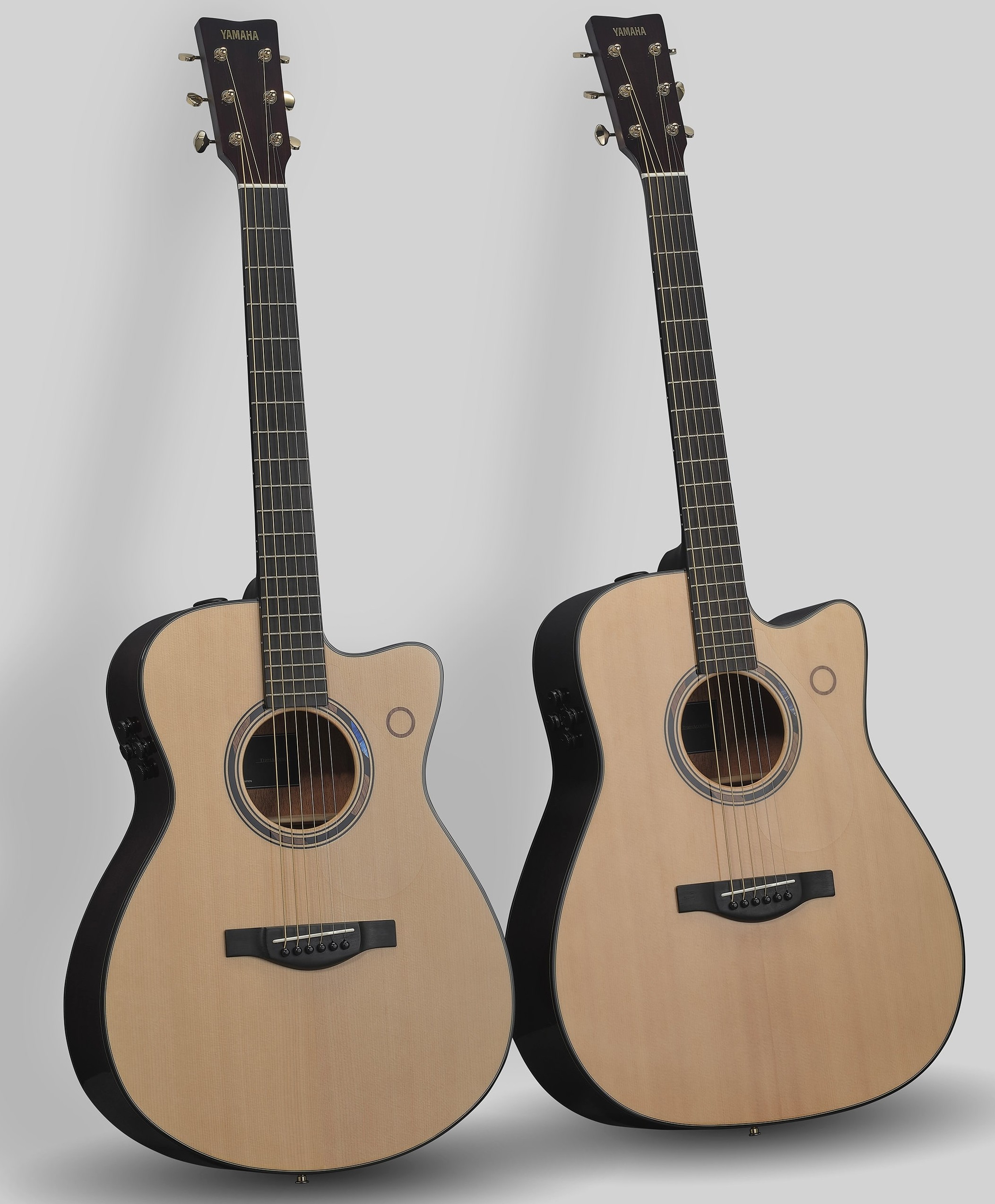
The TAS3 C has a concert body with a solid mahogany back and sides, a solid Sitka spruce top with your choice of a natural finish or a stunning caramel sunburst finish; both have a clear pickguard.
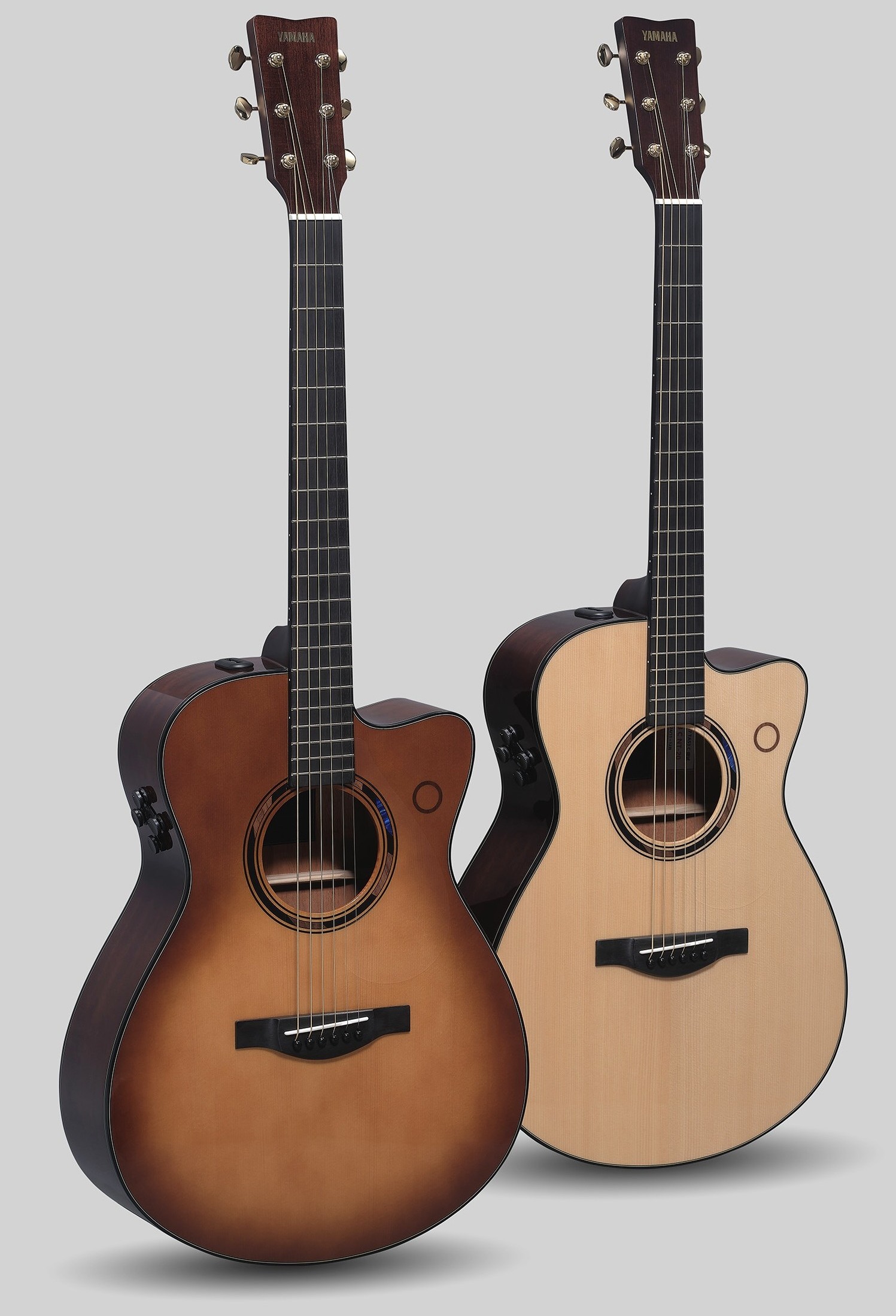
The cutaway allows for easy access to the upper frets when soloing. The mahogany neck boasts a smooth satin finish, and the fretboard and bridge are both ebony. The sound hole rosette, in particular, is quite stunning, with lovely marquetry inlays and blue accents. Tucked inside the top of the sound hole resides a micro rotary dial for the output volume of the built-in piezo pickup and preamp when connecting the TAG3 C to an amplifier — a nice touch for live performance.
The guitar also comes with a hard gig bag for protection and transportation.
Sound Quality
Not only is this a great-sounding guitar, Yamaha has also done an amazing job with the audio quality of the effects, as well as the clarity of the loop playback. If you orchestrate your parts with care, the separation is exceptional — easily on par with a standard loop pedal. Careful blending of the effects will also reward you with incredible-sounding guitar parts for singer-songwriter performances with vocals. Again, no pedals needed!
Looper
The onboard TAS3 C looper works the same as many pedal-based loopers, except you use your hands to activate the controls instead of your feet.
To arm it, simply press the loop knob on the control panel, then press the reverb knob. (See below.) The center ring of the display will flash red indicating that the looper is ready for you to start playing. Once you’ve completed your idea, just tap inside the wood circle below the sound hole, and the guitar will go into playback mode. This circle is the looper sensor and can be used to either arm the looper or end the loop recording process.
To add further overdubs, just tap the sensor again (or you can press the reverb button). The TAS3 C will save your loop even after powering down the guitar. You can also save and recall up to ten of your favorite loops with the use of the free TAG Remote app (see below).
The Control Panel
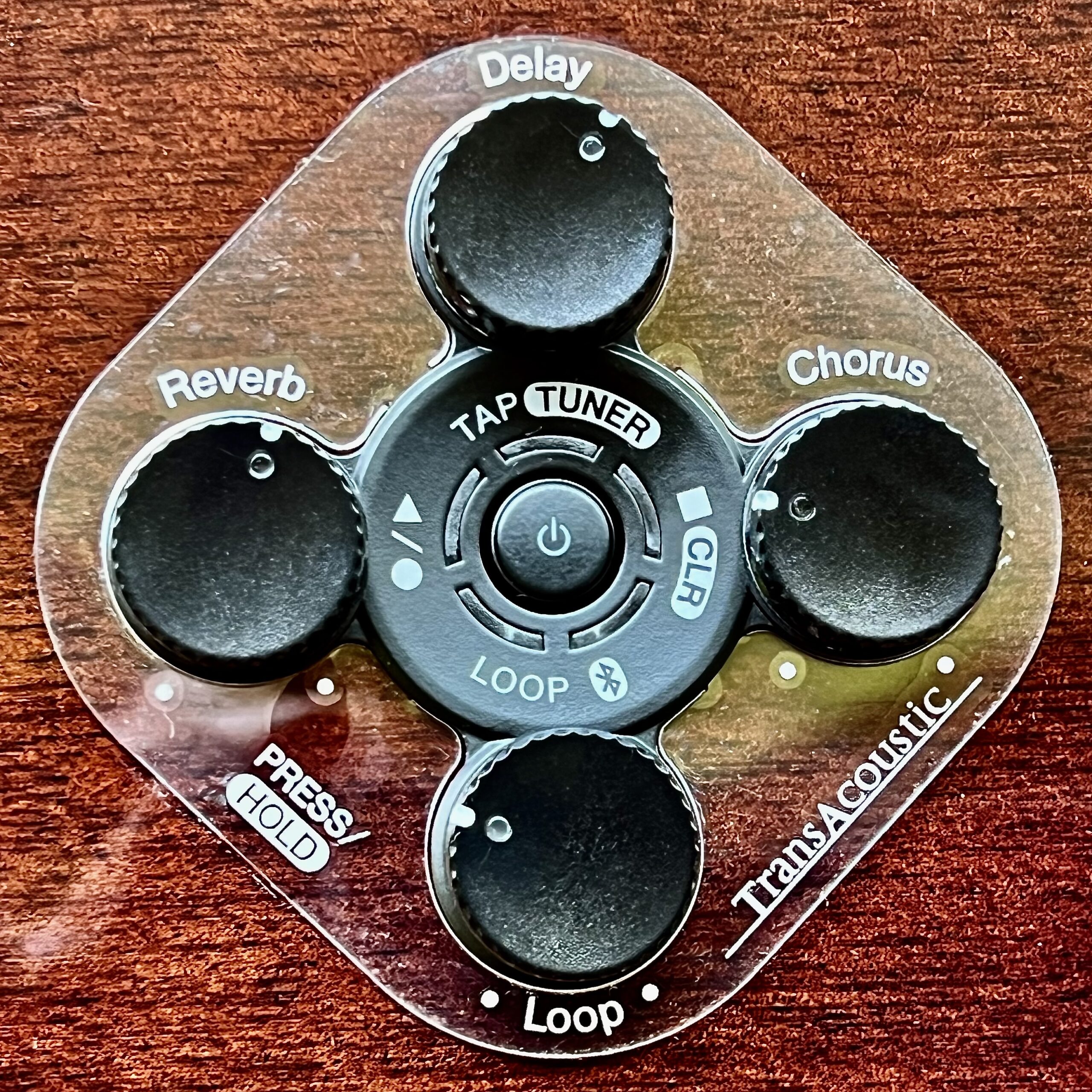
To activate the main control panel located along the top of the guitar (facing the player), simply press and hold the center power button for three seconds; this will cause the unit to light up, showing that it’s ready for action. The “On” button lights up white when in acoustic mode, and green when a cable is plugged into the end-pin jack.
Each of the four rotary knobs in the control panel have multiple functions, as follows:
Chorus Knob
This sets the output mix of the chorus you’ve selected in the app. When this knob is depressed, the last loop part is erased. (Think of this as the looper’s undo function.)
Loop Knob
Pressing the loop knob activates the looper, causing a white LED to illuminate. Pressing and holding the loop knob also allows the TAS3 C to connect to the TAG Remote app via Bluetooth.
This dial also controls the output volume of the loop. I suggest experimenting with this for a while to perfect the looping playback volumes between parts.
Reverb Knob
This sets the output mix of the reverb you selected in the app. Pressing the knob activates the looper “ready” mode, causing the lights around the power button to flash red. You can also press it to end recording instead of touching the looper sensor.
Delay Knob
This sets the mix level of the delay you selected in the app (or the default setting if not connected). You can sync the delay time with your playing or track by tapping the delay knob in time with the music. (This is known as a “tap tempo” function.)
Chromatic Tuner
To activate the built-in chromatic tuner, simply press the delay button and hold it down for three seconds. Then, all you have to do is to watch the LEDs around the center power button: Red indicates that the note is out of pitch (either sharp or flat); when the green center LED is lit, the string being played is at the correct pitch. The default setting is A440Hz.
Onboard Effects
There are seven onboard effects in three different categories: chorus, reverb and delay.
Chorus
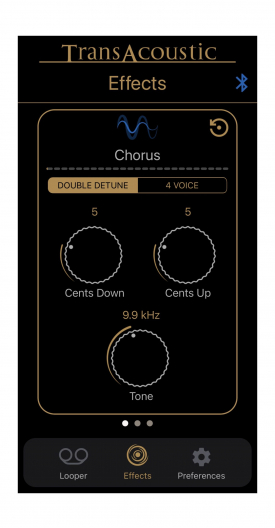
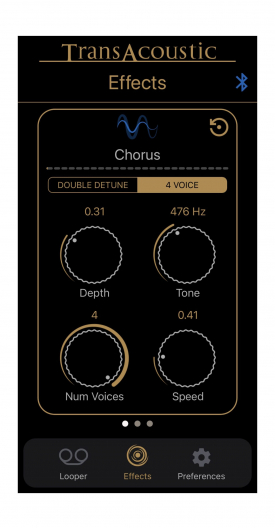
The TAG3 C offers two chorus types: Double Detune and 4-Voice. Double Detune allows you to create mild to wide fluctuations of pitch above and below the original notes or chords. 4-Voice provides an extremely musical and smooth modulation effect.
The app allows you to freely select and audition the two, then dial in depth, speed, tone and number of voices. The chorus knob in the control panel can then be used to blend the effect into the acoustic guitar sound.
Reverb
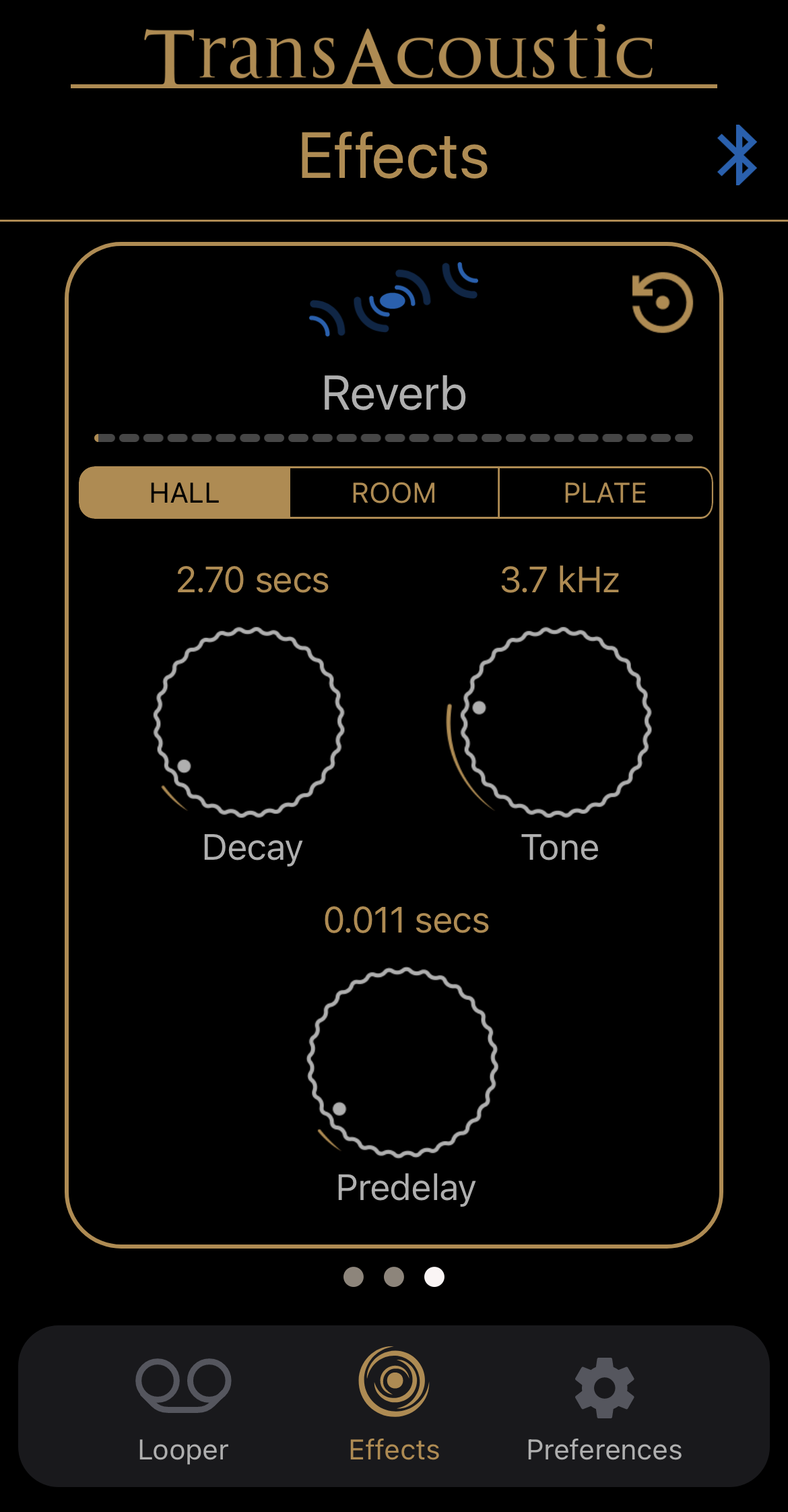
There are three reverb types available: room, hall and plate. Reverbs replicate the size of an ambient space and the reflection of sound created in those spaces. Room reverb creates the ambient sound produced in a small space like a room, while hall reverb replicates the ambient sound in a large space like a concert hall. Plate reverbs replicate the sound created when audio vibrates a large steel plate. Think of room and hall reverbs as an emulation of natural spaces, while plate reverbs are contrived with mechanical components.
The TAG Remote app allows you to modify the selected reverb’s decay, tone and pre-delay. As described above, the master mix output for the reverb is in the guitar’s control panel.
Delay
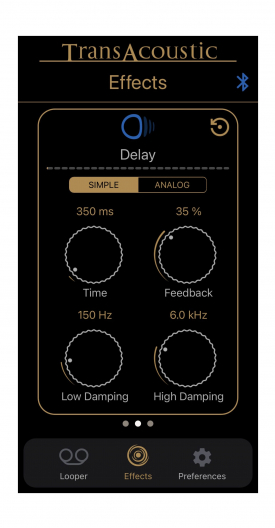
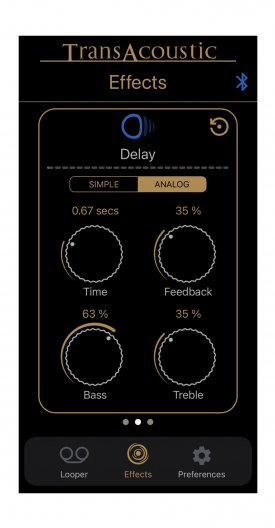
There are two onboard delay types: simple and analog. Delay times can be dialed in using the time control or via Tap Tempo. As described above, to use Tap Tempo, simply depress the delay knob a few times in time with your loop (or at the tempo you’ll be playing your parts), and the TAS3 C delay will sync quarter notes to the tempo of the tap.
Simple delay provides a standard mono digital delay with tonal shaping via high and low frequency damping controls, while analog delay provides a nice replication of a tape echo. This kind of delay tends to have a warm tone with a characteristic (and sonically pleasing) degradation of audio quality as the repeats fade away.
In the app, feedback determines the number of repeats, and the high damping/low damping and treble and bass controls fine-tune the brightness or warmth of the delay tones. As mentioned above, the delay knob in the guitar’s control panel determines the delay mix level.
The TAG Remote App
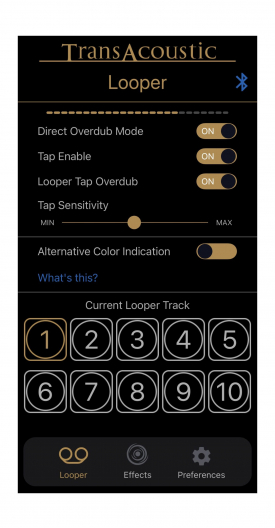
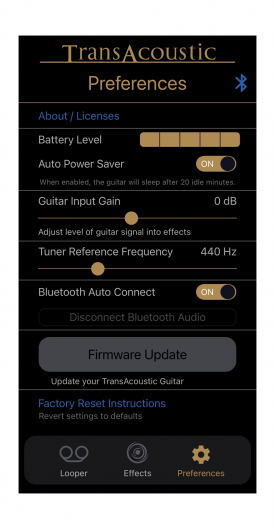
The ultimate way to use the TAS3 C is to harness the full power of editing and loop storage (up to ten loops) provided by the free downloadable TAG Remote app. You can also play your backing tracks, favorite songs and playlists through the guitar sound hole using your mobile device.
The screenshots below show the app’s looper and overall preferences displays. Note that the latter even includes a helpful battery level meter.
Charging
Yamaha has chosen not to use standard batteries to power the TAS3 C effects, looper and preamp. Instead, there’s a built-in rechargeable lithium-ion battery, with a magnetic power connector on the upper shoulder of the guitar. This gives the player some five hours of playing time without recharging — long enough for a live gig or songwriting session. The supplied USB cable comes complete with interchangeable plug options for charging the guitar anywhere in the world.
The Video
The key to creating a successful loop is to think like a composer, arranger and mix engineer.
This video shows me capturing a seven-layer performance on top of a four-bar phrase being looped. Each of the parts are carefully orchestrated to work well together for a complete composition.
You’ll notice that I’m adding and subtracting effects depending on the part that I’m playing. For example, the kick drum and bass guitar parts are completely dry, but I added a touch of Hall reverb to the pseudo snare part. The single-note “bubble” part bounces around nicely with the addition of delay, while the double-stops also have a touch of reverb, as do the lead fills.
It took some time to get the dynamics, effects and volumes just right for this performance, especially since I wanted to capture this all-in-one take for the video. I hope you agree that the effort was worth it!
The Wrap-Up
As you’d expect, there are sonic differences between the TAG3 C and the TAS3 C, given the size of the body chamber. In my opinion, the dreadnought-sized TAG3 C is a touch louder acoustically, produces a little more bass, and has a little more detail in the sound hole playback. But the smaller concert-body size of the TAS3 C will appeal to those of us that prefer a softer sound, smaller body bout, and compact size for travel.
Acoustically, the TAS3 C excels for fingerstyle, strumming, and those fun percussive parts, due in part to its more controlled bass response. The TAS3 C preamp also sounds excellent when recorded direct to DAW, and of course the provision of onboard effects and looper alleviates the need for a pedalboard and dedicated looping device.
The evolution of the guitar has taken a dramatic turn in recent years by leveraging technology without sacrificing tonality. There’s never been a better time to be (or become) an acoustic guitar player!
PHOTOGRAPHS COURTESY OF THE AUTHOR.
Keep reading