Tagged Under:
Five Ways to Instill Care-Based Instruction
Teaching “by the book” works really well … until it doesn’t. When I arrived at Mount Vernon High School in 2017, I taught the way I had been trained to teach: Plan meticulously, stay organized, build routines and keep musical outcomes at the center of every decision. Teach the fundamentals well, establish consistency, use backward design, and soon, growth will follow. Right?
Wrong.
My students were unengaged and uninterested in taking the next step. They completed the daily routine, but I didn’t feel the investment, curiosity or shared ownership that strong ensembles need. Each day felt like we were falling short of carefully planned progress.
Eventually, I found myself asking, “Why don’t they care about this?”
The answer was uncomfortable: I had built structures for music-making before I had built structures that helped students feel cared for.
Don’t get me wrong. I cared deeply about what my students could eventually do as musicians, but I was not always demonstrating that I cared about who they were and how we were going to grow together. I focused on notes, rhythms, posture, tone and technique — all things that mattered, but none of which were enough by themselves.
So, I went back to the drawing board and asked a new question: What if I modeled care as intentionally as I modeled my musical outcomes?
The results changed my teaching. The more I focused on creating an environment of care, the more musical progress I saw. Students became more willing to take risks, more invested in one another and more prepared to engage deeply with the music. Care did not replace fundamental skills. It made them better.
Here are five ways I use care-based instruction to build stronger musical outcomes in my classroom.
1. Press Pause on the Playing
I get strange looks when I tell colleagues that my students do not play for the first two weeks of school and even stranger looks when I tell them that we have a concert at the end of October.
In music, we ask students to do something genuinely demanding: Engage with the music on a deeply personal and emotional level in order to create fantastic art. In other words, we ask them to care deeply about their craft and the music they are playing.
But why should they? This is not a rhetorical question. It’s something we must teach.
A student may walk into the music room dealing with any number of difficult challenges that we know nothing about. We then ask them to sit down, tune, focus, listen across the ensemble, respond musically and invest emotionally in the work. That is a huge ask, especially if the classroom culture has not yet given them a reason to trust the people or the process.
Before students can fully engage with the music, they need to understand the environment. They need to know that their teacher cares about who they are inside and outside the classroom. They need to see that their classmates are invested in their shared success. They need to feel that the ensemble is moving toward something together.
When that foundation is in place, the musical work changes.
Warmups are no longer just warmups. Scales are no longer just scales. Technical exercises become tools for expression. Historical context becomes a way to understand people, places and stories. Rehearsal becomes more than correction; it becomes a shared act of growth.
Pausing the playing at the beginning of the year may feel risky, especially when concert deadlines are real. However, in my experience, the time spent building trust, routines and shared purpose will result in better focus, stronger ensemble awareness and deeper musical investment.
2. Learn Some Handshakes
I am originally from Cleveland, Ohio. When I was 12, I had the chance to meet LeBron James, an experience that I’m pretty sure has shaped just about everything I have done ever since. When the Cleveland Cavaliers made their historic 2016 NBA Finals run, overcoming a 3-1 deficit to win the championship, I became fascinated by what helped James and the rest of the team thrive under pressure. One detail stood out to me: the handshakes.
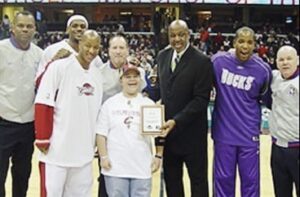
Players had unique handshakes with one another across the roster. Some had multiple. Win, lose, success or frustration, these handshakes gave players a personal way to connect.
That made me think: What better way to help students learn about one another than by creating their own?
In my classroom, we talk about that Cavaliers team, and we brainstorm the qualities that strong teams possess — trust, connection, resilience, accountability and care. Students then break into small groups, share things about themselves and look for commonalities. Do they like the same food? Do they play the same sports? Do they enjoy the same games, movies or music? Those commonalities become the foundation for their handshake.
A fist bump might turn into someone miming eating a sandwich, using a video game controller and ending with a shared foot tap. After each group creates its handshake, they teach it to other groups and explain the meaning behind it.
Chaos and laughter usually follow. But so does connection.
Months later, I still see students greeting one another with those handshakes. What began as a team-building activity became part of the ensemble’s language. Students have a small but meaningful way to say, “I know you. I see you. We are part of this together.”
That matters musically. Students who feel connected are more willing to listen across the ensemble, support one another through mistakes, and commit to the group’s success.
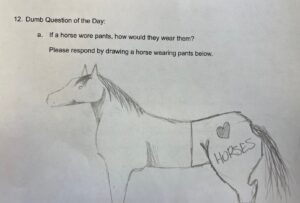
3. Ask “Dumb” Questions
I tell my students all the time that curiosity is important and that no question is dumb.
Then I make it my personal goal to ask the dumbest, most absurd question I can think of. This became our “DqotD,” or Dumb Question of the Day. The process is simple: Get students talking, laughing, sharing and connecting. The questions might be ridiculous at first, but more often than not, the conversations become more thoughtful than anyone expected.
Once the routine is established, we make it musical. Students might go around the room sharing their answers while working through silent vibrato exercises or bow technique drills. Between each answer, I call out “switch,” and students move to the next repetition or variation. The technical work continues, but the atmosphere shifts. The focus is lighter, more connected and less tense.
That matters.
When students are physically tense, emotionally guarded or afraid of making mistakes, their playing reflects it. However, when they are relaxed, connected and willing to participate, they are more likely to develop the physical freedom required for expressive playing. They feel comfortable enough to try difficult things.
Is it more effective to build vibrato while debating whether a boneless chicken wing is really just a chicken nugget in disguise? Sometimes, it is.
4. Learn the Four Hs
As music educators, we all want to create incredible musical moments. Those moments do not happen by accident. They require hours of practice and an encyclopedia’s worth of knowledge and skills.
The same is true of meaningful classroom relationships. Care does not happen just because we say we care. We must create structures that help students know us and one another more fully and responsibly.
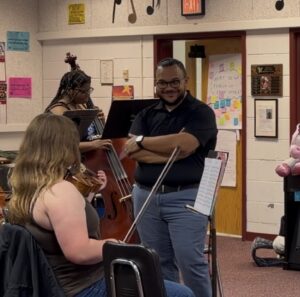
One activity I use is called the Four Hs: History, Heroes, Heartbreaks and Hopes.
Students work in small groups and share what they feel comfortable sharing in each category. They might talk about a part of their history, someone they admire, a difficult experience that shaped them or something they hope for in the future. The most important part is not just the “what” but the “why.”
This activity requires trust, so student agency is essential. Students should never feel pressured to disclose more than they want to. The goal is not forced vulnerability; it is to create a space where students can understand one another with more depth and care on their terms.
These conversations are not inherently musical, but they can do as much for an ensemble as an intonation drill.
Any great ensemble is only as strong as the people within it, and I teach that we have a shared responsibility to uplift one another. Activities like the Four Hs help students practice trust, communication, empathy and accountability.
Those happen to be the same skills required for high-level chamber playing and musicality.
When students understand one another better, they listen and rehearse differently. They respond to mistakes differently. They begin to see ensemble success not as an individual achievement, but as a shared responsibility.
5. Prioritize the Pedestrian
Music teachers have limited time, endless to-do lists and deadlines that never seem to stop. Because of that, we become very efficient.
Come in. Attendance. Unpack. Tune. Warm up. Rehearse. Announce. Dismiss.
That structure is useful. But if we are not careful, efficiency crowds out the small human moments that build the culture we need.
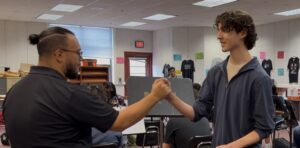
Care-based teaching requires us to prioritize the everyday, ordinary interactions that are easy to overlook.
Spend five minutes at the beginning or end of class talking with two or three students. Ask about their day, but also ask about their lives beyond the music room. Follow up on the game they mentioned, the sibling they were worried about, the college application they submitted or the job interview they had.
These conversations do not need to be long to be meaningful. Over time, they show students that they are known.
Ten minutes in a rehearsal can feel like a lot. But it is a small investment when the return is a classroom where students feel safe, seen and empowered to become the best versions of themselves as people and musicians.
That kind of environment does not lower musical expectations. It strengthens them.
When students know that they matter, they are more willing to work. When they trust the people around them, they are more willing to take musical risks. When they feel connected to the ensemble, they are more willing to pursue excellence together.
Building a Foundation of Care
The word “care” is often treated as a synonym for relationship-building. If students like your class, if they see you as their go-to teacher, or if they say music is their favorite part of the day, then they know you care, right?
Not necessarily.
Relationships are an important first step, but they are not the final destination. A care-based music classroom goes beyond being liked. It asks students to care for themselves, care for one another, care for the ensemble and eventually transfer that care into the music itself.
Educational philosopher Nel Noddings wrote that caring for ideas, such as mathematics or art, has much in common with caring for people. She argued that we can become deeply engrossed in ideas as we do with other people, and schools should make that kind of engrossment possible for students.
That is the heart of care-based music education.
Students need technical skills to succeed in high-level music making. There is no shortcut around that. But students also need trust, belonging, purpose and support. Without those things, we lose the opportunity to turn the technical into the meaningful.
Care is not a checked box or a kind gesture added on top of the “real” work. Care is the foundation that allows the real work to happen.
The call to action is simple: Make care visible in your next rehearsal. Pause before playing. Learn the handshake. Ask the strange question. Follow up on the conversation. Build the conditions that help students feel known, trusted and responsible to and for one another.
When we do that, we do more than produce technically adept musicians. We help students become thoughtful, connected and genuine people who understand that music-making is not just about playing the right notes. It is about learning how to listen, respond, risk, support and care together.
Keep reading