Key Centers vs. Tonal Centers
Parent scales and their musical offspring.
What is the first question most musicians ask each other before playing a song, or starting a jam? It’s usually “what key are you playing in?”
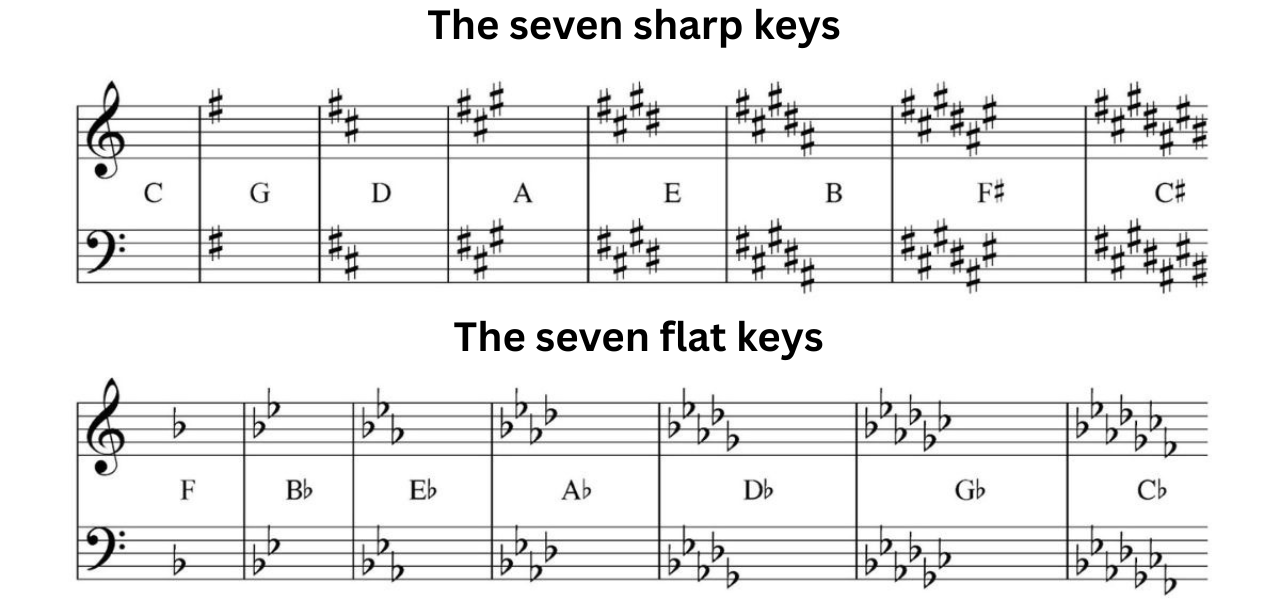
Establishing the key of a song is paramount to working together as a band, and there are 15 keys to choose from: One natural key, C (which has no sharps or flats), seven sharp keys, and seven flat keys.
The seven sharp keys are as follows: G, D, A, E, B, F#, C#.
The seven flats keys are: F, B♭, E♭, A♭, D♭, G♭, C♭.
The key center is the overall key that a musical piece is written in, and will contain some, or all of the seven single notes and chords found within that major or minor key. Key centers are sometimes called the parent scale.
In addition to understanding the key of a musical piece, we also need to identify the tonal center of the harmonic progression within the song. This is the resolution point of a chord progression or melody within the overall key of the musical piece. It’s where we hear (and feel) the musical movement naturally coming to rest … and where it finds a resolute conclusion. The tonal center is usually the first chord in the progression, and, as we will see shortly, there are seven possible tonal centers within each key center.
Now that we’ve defined them, let’s dig into each of these terms in greater detail.
Key Centers
The seven-note major scale is represented in formal notation by a key signature that appears after the treble clef and before the time signature in the first measure of music. These key signatures tell us what key the musical piece has been written in. This allows the composer to designate the key without writing sharps or flats as “incidentals” throughout the entire manuscript. We simply apply those sharps or flats to the notes they apply to throughout the musical piece.
Here are the seven sharp and flat key signatures:
Another important aspect of key signatures is that they allow us to retain the major scale formula of intervals when we transpose harmonic structures and melodies into alternative keys. (For more information, check out this blog.)
That interval formula is a set sequence of whole steps (two frets on the guitar) and half-steps (one fret) between the seven notes. The interval formula used to create every major scale in music is:
Whole – Whole – Half – Whole – Whole – Whole – Half
The whole step is often represented as a W, and the half step as an H.
As an example, here’s how the major scale of A defines the intervals between the notes and chords.
W W H W W W H (Interval Formula)
I (Tonic) 2 3 4 5 6 7 (Scale Position)
I II III IV V VI VII (Roman Numerals)
A B C# D E F# G# (Note Name)
Ama Bmi C#mi Dma Ema F#mi G#dim (Triads)
Ama7 Bmi7 C#mi7 Dma7 E7 F#mi7 G#mi7(♭5) (Sevenths)
This shows us a complete set of melodic tones, as well as the chords that are built from the root of each of those tones. Once we have this information, we can determine the key of a chord progression or melody by simply looking at the score or chord chart.
As you can see, there are only two places where a semi-tone interval occurs: between the third and fourth degree, and between the seventh and eighth degrees (the octave). In addition, major triads occur on the first, fourth, and fifth degrees of the scale, while minor triad chords occur on the second, third, and sixth degrees of the scale. A diminished chord occupies the seventh degree.
Armed with this information we can easily determine the overall key of a musical piece, and the overall key center. It also helps us visually identify the interval relationships between the melodic tones and the harmonic structures within every key.
Tonal Centers
As previously mentioned, the tonal center of a chord progression is usually the first chord of the sequence. As an example, let’s take a simple chord sequence in the key of A, and assign a modal name to that resolution point. (The modal name is simply another way of telling us what scale position the tonal center occurs on within the scale.)
The first modality of the major scale (Ionian mode)
I 2mi 3mi 4 I
Ama7 Bmi7 C#mi7 Dma7 Ama7 = The A Ionian mode
Ima7 IImi7 IIImi7 IVma7 Ima7
Here we have a chord progression in the key of A major that starts on the first chord of the scale, sequences through the next three diatonic (i.e., from the same scale) chords, and then resolves nicely back to Ama7.
This first mode of the major scale is called Ionian mode. This is a Greek name that we use to identify the first mode, and the tonal center of the major scale.
Next, let’s invert this progression to change the tonal center.
The second modality of the major scale (Dorian mode)
2mi 3mi 4 I 2mi
Bmi7 C#mi7 Dma7 Ama7 Bmi7 = The B Dorian mode
IImi7 IIImi7 IVma7 Ima7 IIm7
This progression has been created using the same four chords in the A major scale, but the first chord in the progression is now the second chord in the scale, Bmi7.
Not only can you identify this tonal center shift visually, when you listen to it, you can also hear that this new sequence resolves nicely to the Bmi7 instead of Ama7.
Now let’s invert the progression again to shift its tonal center.
The third mode of the major scale (Phrygian mode)
3mi 4 I 2mi 3mi
C#mi7 Dma7 Ama7 Bmi7 C#mi7 = The C# Phrygian mode
IImi7 IVma7 Ima7 IImi7 IIImi7
Here, the progression starts on the third chord of the major scale, and likely ends there too. On listening we can confirm this tonal center shift to what’s known as the Phrygian modality within the key of A.
Let’s invert the chord sequence again to further illustrate the point.
The fourth mode of the major scale (Lydian mode)
4 I 2mi 3mi 4
Dma7 Ama7 Bmi7 C#mi7 Dma7 = The D Lydian mode
IVma7 Ima7 IImi7 IIImi7 IVma7
The first chord of the progression is now the fourth chord within the parent scale. On listening we can further confirm the tonal center of the progression to Dma7 … the fourth chord in the key of A. (This is known as the Lydian mode.)
Let’s complete our study of tonal center modalities using the remaining three chords built from the A major scale: E7, F#mi7, and G#mi7(♭5).
The fifth mode of the major scale (Mixolydian mode)
5 6mi 4 5
E7 F#mi7 Dma7 E7 = The E Mixolydian mode
V7 VImi IVma7 V7
The first chord is E7, the fifth chord in the key of A major. This is the tonal center of this progression, known as the Mixolydian mode.
The sixth mode of the major scale (Aeolian mode)
6mi 4 3mi Iimi 6mi
F#mi7 Dma7 C#mi7 Bmi7 F#mi7 = The F# Aeolian mode
VImi IVma7 IIImi IImi VImi
Here, the first chord is F#mi7, the sixth chord in the key of A major. This is the tonal center of this progression, known as the Aeolian mode.
The seventh mode of the major scale (Locrian mode)
7mi7(♭5) 5 6mi 4 7mi7(♭5)
G#mi7(♭5) E7 F#mi7 Dma7 G#mi7(♭5) = The G# Locrian mode
VII V7 VImi IV VII
Finally, the first chord of what is called the Locrian mode is G#mi7(♭5), the seventh chord in the key of A major. This is the tonal center of this progression. However, diminished and half-diminished chords are dissonant in nature, and therefore unlikely to sound resolute or rested … so this tonal center won’t sound and feel like a strong resolution point.
Tonal Center Recap
- A Ionian Mode: A chord progression built from the A major scale that resolves to the first chord, A or Ama7.
- B Dorian Mode: A chord progression built from the A major scale that resolves to the second chord, Bmi or Bmi7.
- C# Phrygian Mode: A chord progression built from the A major scale that resolves to the third chord, C#mi or C#mi7.
- D Lydian Mode: A chord progression built from the A major scale that resolves to the fourth chord, Dma or Dma7.
- E Mixolydian Mode: A chord progression built from the A major scale that resolves to the fifth chord, Ema or E7.
- F# Aeolian Mode: A chord progression built from the A major scale that resolves to the sixth chord, F#mi or F#mi7.
- G# Locrian Mode: A chord progression built from the A major scale that resolves to the seventh chord, G#dim or G#mi7(♭5).
Melodic Confirmation
Why is determining the tonal center of a progression so important? Well, when we can determine the key, and the tonal center within that key, we can apply the correct major scale modality to improvise and resolve correctly over the tonal center chord.
To further illustrate this point and prove its value melodically, let’s try an exercise. Start by playing an Ama7 chord, then play the A major scale from A up to A. This is A Ionian Mode and works perfectly because the chord was built from that sequence of notes.
Now play a Bmi7 chord, then play the A major scale from B up to B. This sequence of notes (B Dorian mode) works directly over the chord that’s built from those tones.
Continue with this sequence through the remaining five chords and scale sequences, and you will hear why improvising towards the tonal center is so effective and powerful.
Check out the video below to see and hear the full sequence of chords and scale modalities in the key of A.
The Video
The video above features a cool E Mixolydian chord progression and solo. I’m making sure my scale, arpeggio and double-stop lines all resolve nicely to the tonal center chord and chord tones of E7.
The Guitar
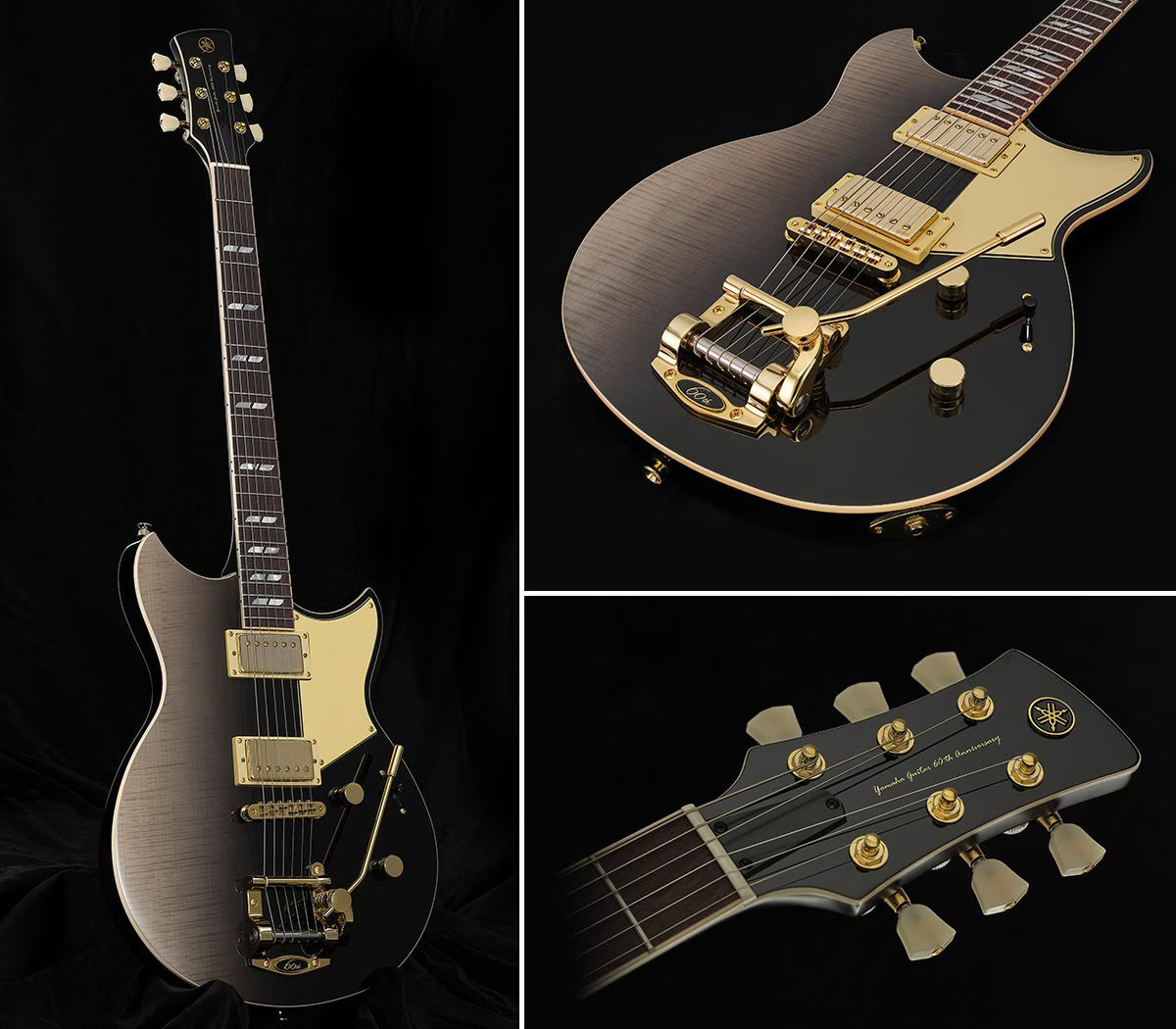
The guitar I’m playing in both of these videos is the exciting new Yamaha 60th Anniversary Revstar RSP20B, crafted to celebrate six decades of excellence. This superb instrument offers a perfect blend of visual appeal and musical performance, featuring a Göldo tremolo unit and Gotoh locking tuners that deliver excellent tuning stability, dynamic range, and expressive playability. The bone nut further enhances the guitar’s natural and balanced resonance.
Like other Revstars, the RSP20B features a chambered body designed to sculpt tone and reduce weight, with carbon reinforcement in the body and neck to improve vibration transfer. The push/pull tone control of this model also functions as a Focus switch, activating a passive boost that emulates overwound pickups for darker highs and enhanced mids and lows for more aggressive tone. In addition, the five-way pickup selector introduces a subtle phase shift in positions 2 and 4 by slightly delaying the opposite pickup, offering a fresh take on classic “in-between” sounds.
The RSP20B has a flame maple top and comes in a gradient Noble Black Burst finish, blending luxurious aesthetics with unique character. The headstock and tremolo unit feature a commemorative logo, while the back of the headstock is stamped with a special 60th Anniversary hanko (a traditional Japanese personal seal stamp).
The Wrap-Up
When we understand that there are seven possible tonal center resolution points within each key center, we can write chord progressions with unique moods and modalities, and then apply the major scale in its correct sequence to resolve perfectly over those resolution points within the key. Understanding key centers and tonal centers really is the key (pardon the pun) to musical mastery over your guitar.
For more information, be sure to check out my blog postings Major Scale Modes, Part 1: Ionian Mode and Major Scale Modes, Part 2: Dorian Mode.
PHOTOGRAPHS COURTESY OF THE AUTHOR.
Keep reading