How to Make General Music Classes Fun!
My sixth year of teaching was like my first year all over again. For my first five years, I taught band and small-group lessons, but in year six, our growing district expanded to two middle schools, and I was asked to travel between the two. The most stressful part of this change, however, was teaching a general music class.
Like many band directors, I only wanted to teach performance-based ensembles. I didn’t have any interest in a classroom music class, and I was worried about working with “non-band” students. Luckily, I was able to choose the curriculum as long as I covered the standards, so I included elements of popular music, technology and creative student projects. After I got my feet under me, I fell in love with teaching general music.
There are so many different music classes that middle schools and high schools offer. In my district, there are at least 10 different secondary general music classes including Guitar, Music Technology, Music Theater, World Music and Audio/Video Production. I plan to discuss some of these different classes in future blog articles, but for now, I want to touch on many of these to give you ideas on how you can build a general music class that includes a little bit of everything.

For Starters
I like to start every class with two activities. The first is Song of the Day where I play a song, we rate it using fist-to-five, and then we discuss it. The song could be a current hit or a classic jam. It might be a song from another country that has crossed over to have success in the U.S. or one that is unknown in our country. It might be a movie theme or a video game theme. It could be anything from a Bach fugue to a TikTok meme.
Regardless of the song, the students rate it, and then the discussion begins on why it is great or not so great. I put music terminology on a word wall and students must use these in their answers. So, they can refer to the song’s rhythm, lyrics, timbre, blend, dynamics, harmonies, chords, hook, melody, instrumentation and tempo just to name a few. Their answers can’t be “wow-oriented” where they say “this song is so good” or “this song is terrible” — they have to give reasons. They can also make non-judgmental comments like “this song sounds a lot like another song” or “this song has no words.” After a few days, I encourage students to start observing if there are certain components of the song that they like or that annoy them. Students love this and it makes them much smarter musicians.
The second activity is showing the students the Billboard Top 10 songs of the week. I am a huge chart watcher, and I have found that students love it! Every week they predict and hope for certain songs to jump to the top. Students are intrigued by the debuts and interesting chart facts that I roll out like when Teddy Swims broke the record for number of weeks on the Hot 100 with “Lose Control” or when Drake set the record a few weeks back for most songs on the chart in one week. Some of these songs become Song of the Day. It also leads to discussion about how songs are ranked and become popular, similarities and differences between hit songs, and how there are charts for different genres and countries around the world.
I also have students make “fave posters” where they share one of their favorite musicians. They write the artist’s or band’s name in a font or style that their name typically appears. Then they either draw or print out a picture of the artists. They then list a few favorite songs or albums followed by some biographical information and/or favorite song lyrics. Then students include a couple of reasons why they love that musician. Finally, they include some more drawings or artwork. These posters are hung around the room and can be presented in class. Sometimes one of the songs featured on a poster become Song of the Day.

Production and Songwriting
One of my favorite general music projects to do early on is song writing. It’s super creative and helps students realize that although there are tools to make this project very accessible, it’s a challenge to create a masterpiece.
I start by introducing them to an online digital audio workstation (DAW) website such as Cubase or Soundtrap. These DAWs are user friendly and fun to create music on even if you don’t have any experience. There are tutorials on YouTube and on the sites themselves to help you out.
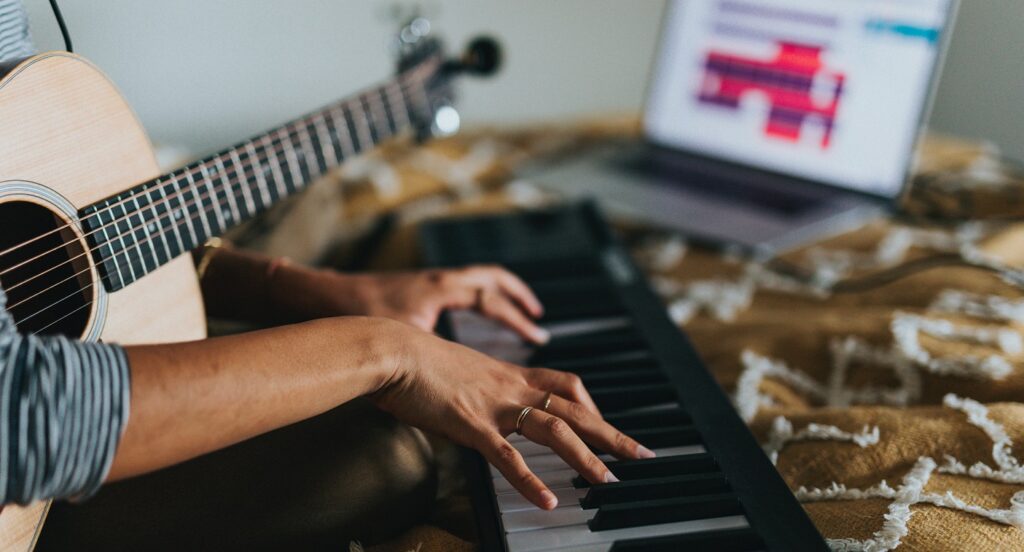
The first assignment is to create a 30-second song with very little guidelines just so students can experiment with the DAW and with the process. Consider requiring them to use at least one of each of the following: their own voice, a drum machine generated beat, the online MIDI keyboard and a loop. This gives them an opportunity to learn about the main features of the DAW.
A second project is for students to create a song in verse-chorus-verse-chorus-bridge-chorus form. Students can choose to use whichever features of the DAW to create their song. Encourage them to start with the drum machine or drum loops to establish a beat throughout the song. Then they can use loops, the MIDI keyboard or real instruments to create hooks and chord progressions. In a more advanced class, discuss the use of the one through six chords from a diatonic scale to help this process. Otherwise, simply ask the students to use different loops or hooks in the chorus compared to the verse.
Lyrics can be tricky. The verse, chorus and bridge should each have four lines with a basic rhyme structure. Students come up with a theme for their song and start writing without worrying about what section is which. After writing a few lines, they can see if any jump out and can be used as one of the sections. Nonsense/skat syllables/words work really well. The bridge can be substituted by an instrument solo. I highly recommend Bob Habersat’s ShedtheMusic for some great production ideas.
I also challenge students to write rap and blues lyrics. For example, when we write the blues, I’ll have students pick a topic that makes them sad or mad. The first two lines should end with the same word, and the third line ends in a rhyming word. The first three lines should state the problem
I don’t want to get out of bed today
Yeah, I don’t want to get out of bed today
I just wanna sleep the day away
The second three lines should show what we try to do to solve the problem:
I try to go to bed earlier at night
You know I try to go to bed earlier at night
If only going to sleep before 10 felt right
The last three lines show the light at the end of the tunnel:
When I wake up, I think about seeing my friends
So, when I wake up, I think about seeing my friends
That makes me want to get up in the end
After the students write their songs, they have the option of singing them in front of the class while I play guitar or I will sing them while playing guitar. Every now and then, a student wants to play guitar, ukulele or piano while one of us sings. When this happens, it’s usually a very fun day in class.
Many students write songs about siblings and homework. Look for some amazing ideas and songwriting resources and activities on MusicalWonders by Stephen Cox.

World Music
I used to teach a course where over the course of a semester we would cover 10 countries around the world making sure I selected at least one from each continent. For each country, I gave a brief summary about history, language, culture, climate and politics. Then I cover the folk music from the country and other unique or intriguing facts. If possible, bring out instruments for students to try. For example, when we studied Ghana, we brought out world drums. For Mexico, I showed students guitars and the guitarron and played some mariachi. Another fun activity is to bring in a guest artist. When we studied India, I had a veena player come out and perform. And for Australia, didgeridoo musician visited the class.
After learning about traditional music from each country, we look at what music is currently popular by looking at the Billboard chart for each country. Then we play recordings and discuss. Sometimes you will find that their pop chart is quite similar to ours. Other times it’s quite different. Students can express their knowledge of each country in the form of a poster project like the “fave” posters.

Multimedia Projects
Music’s role in culture pops up all the time in multimedia, and this is a great way to get students’ creative juices flowing.
Music Videos: Making music videos can be a blast, and there are many ways to do this. An easy and fun activity is a-ha’s “Take On Me” video project. In 1985, this was one of the first videos to combine animation with live action. After we watch the video a few times, students draw a scene from the video. I scan the drawings and using iMovie or WeVideo, I take the “Take On Me” video and superimpose students’ sketches over the actual scenes in the music video. Each drawing stays on screen for two seconds, so even though most of the music video remains intact, each student drawing has its moment. The students love the final showing!
A much more involved project is to give the students a camera and have them create their own music video to an existing song. This involves many steps:
- choose a song
- create a storyboard where each scene is planned out using timestamps from the video indicating where each scene starts
- film of the video after a discussion of camera angle options and some basic acting skills as well as finding props and deciding on locations
- edit the video in an app like WeVideo or iMovie.
This is a multi-day project that combines many skills and techniques, but it is an amazingly rewarding project for students that teaches teamwork, creativity, problem solving, technology skills, music, theater, video production and more. If students are stuck for ideas for their video, I suggest re-enacting a video like these guys did to Journey’s “Separate Ways.”

Music Scene Scores: The second multimedia project is scoring a movie scene. I use the Pixar opening — where the lamp comes into the scene and jumps on the letter I — which is short and has virtually no music. Students can use a DAW to create music and then export it and the Pixar intro into WeVideo. To add to the fun, turn down the volume of the actual video and record some original sound effects or dialogue on WeVideo.
This project can lead to a discussion on the importance of music’s role in movies as well as sound effects and Foley art.
Video Game Scores: A third multimedia project is scoring for video games. This is very similar to scoring for movies but instead of a movie scene, pick a video game scene. If you want to be authentic, use a coding site like Scratch so you can actually play the game with the music. I haven’t gone to this level in my classes, but it’s a definite possibility in the near future.
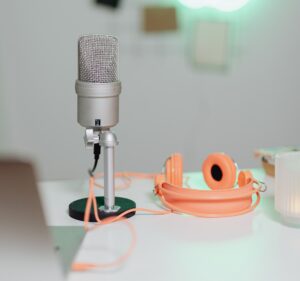
Podcast: Creating a podcast is a fun and relevant activity where students can have a conversation on a subject that they have an interest in. Before recording students should:
- choose a topic
- title their podcast
- choose a format — solo, conversation, interview, storytelling, etc.
- have three talking points. You don’t have to stick to these but it gives you a place to start.
- aim for 5-15 minutes in length
- add a music header and footer and maybe as transitions in the middle. Use loops, drum machine, keyboard or real instruments to create these.
Once students are done you can post these on Google Classroom to share or check with your administration to see if the school can host a place for all students to hear the podcasts.
Instruments
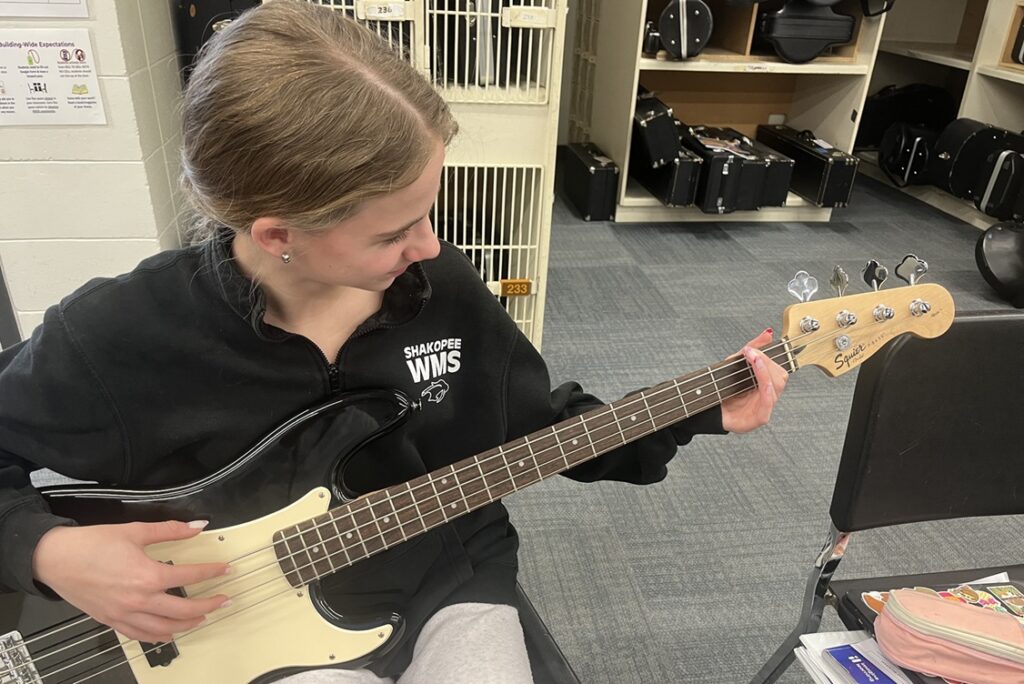
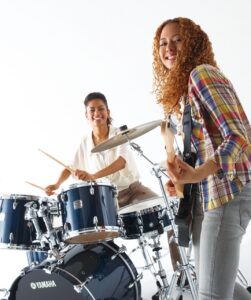
Classroom music classes can definitely have a performing aspect if that is a direction you want to go. I lean toward rhythm section instruments because they are different than band, choir and orchestra. If you have a classroom set of guitars, ukuleles or bass guitars, I highly recommend MusicWill. The website offers resources for teaching these instruments with a wonderful variety of songs to try.
I also love re-enacting this scene from the 2003 movie “School of Rock” where Jack Black’s character pretends to be a substitute teacher when in reality he’s an out-of-work wannabe rocker. He teaches students to play Deep Purple’s “Smoke on the Water.” My students take turns trying drum set, bass guitar, keyboard, guitar and singing. They get a great idea of the challenge to be in a popular music group.
_______________________
I plan to go into further detail about some of these curricular areas in future articles. However, this gives you a taste of what your secondary general music classroom can look like. I have had students who had no desire to be in a music class begging for more at the end of the semester. I’ve also had students who enjoy music but not in the traditional sense who find their people and their voices in these classes.
You can create a special culture in these general music classes. Visit my website, SongerStudio, for more ideas. Don’t be surprised if secondary general music becomes your favorite class to teach!
Keep reading