What To Do When You’re Not Ready for a Performance
It’s the last week before the concert. You run the closer, and it falls apart in the same three places it always does. You stop, fix one thing, run it again — somehow, it’s worse. You wonder if that really smart kid in the oboe section could build a time machine to get another week of rehearsal in exchange for a free homework pass. But time machines aren’t real, and that oboist is one of those kids who actually likes doing homework.
That’s when you realize: We’re not ready for our performance. You start mentally rewinding the last three weeks and ask yourself “Why didn’t we catch that earlier?” or “Why didn’t I rehearse that section more?” or “Why did we spend so long on that other piece?”
If you stay in this space, your mind will continue to spiral. If you move on too quickly, nothing gets better. The more useful question: What are we actually going to do?
You start panic-rehearsing. Run everything, fix nothing, talk more, conduct bigger, and hope that it will magically come together on stage. I have a few performances in my past that prove that this doesn’t work. Here’s what helps with the time you have left.

Redefine “Ready”
“Ready” sounds like perfection. It’s not. Late in the process, “ready” really means functional.
- Can the group stay together?
- Can they start and end together?
- Can they recover when something goes wrong?
Remember, audiences are not hearing what you’re hearing. They hear “a song.” Pulse. Confidence. They don’t hear the third clarinet note in measure 62 that you’ve been obsessing over for three days. They don’t know that the horns missed a partial in second movement last Tuesday. They’re not tracking individual errors — they’re reacting to the big picture.
You’ll discover that this is true when you walk off the stage thinking that the performance was rough, and someone in the audience says, “That sounded great.” They’re not being polite — they’re being genuine.
So your priorities have to shift.
Together > perfect
Clean starts and releases matter more than note accuracy at this point. If the group looks and sounds unified, the performance will land. If they’re individually accurate but disconnected, it won’t.
It’s that cliché many of us know: Good groups start together; great groups end together.
We’re not lowering the standard. We’re choosing the most effective goal with the time we have. It’s harder to ignore small errors that you’ve trained yourself to hear. It feels wrong for a day or two. Then you realize that the group actually sounds better.
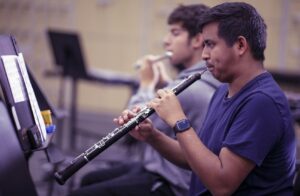
8 Things to Do in the Last Rehearsals
The week before the concert, we’re tempted to run pieces top to bottom because it feels productive. This feels good because it sounds like a concert. It fills time. Kids feel like they’re “doing it.” You feel like you’re checking a box. But nothing actually gets fixed.
Groups don’t usually fall apart in the typical 8-bar musical phrases — they fall apart between them. When one section hands off the melody to another section. A tempo change that never quite locks in. An entrance after a long rest where kids have their horns up and are looking to others on when to come in.
1. Rehearse Transitions Only: Start 8 measures before the problem spot. Stop 4–8 after. Loop it. Then do it again. Then do it one more time after it feels “OK,” because that’s usually when it actually sticks. You can spend an entire rehearsal just on transitions and get more out of it than three full run-throughs (in fact, I plan one “transition-only” rehearsal one week before each performance). It doesn’t feel as satisfying in the moment, but it makes a big difference in the ensemble’s comfort level.
2. Simplify Unstable Moments: Tempo changes are another common failure point. When things are unstable, simplify. Subdivide out loud — even if it feels elementary. Have them physically “bop” the pulse. You’ll get some eye rolls depending on the age group. Do it anyway. Strip it down to just rhythm — attack points only (playing only the articulation of each note and not sustaining but keeping in rhythm and tempo) — then rebuild. You’re not chasing musicality in that moment. You’re building coordination.
3. Go Back to the Basics: If a passage keeps breaking, reduce it to the scale it’s based on. Find the pattern, run the scale, then plug it back into the music. A challenging rhythm? That’s your warm-up for the day. Instead of a scale in half notes, play the scale with each note repeated using the challenging rhythm.

4. Focus on One Thing At a Time: Melody and bass only. First note of each measure. Rhythm-only runs. These are usually the reps where things start to line up, and you can feel the group settle a little. When students feel like they are able to just focus on one musical element, they’ll pay more attention to that concept and become less overwhelmed. Build from there.
5. Choose Functional Conducting: There have been times where I’ve conducted a whole lot of stuff that the ensemble wasn’t actually playing. Functional and clear is the goal. Where are you going to cue more than usual? Where do they actually need you — and where are you just used to conducting everything? Where are you going to let things go? If you try to react to everything in the moment, you can end up helping nothing. “Floor-door-wall-ceiling” conducting patterns are nothing to be ashamed about.
6. Cut It Out: If something truly isn’t going to come together — cut it. Drop a movement. Pull a piece. Shorten something. You may have some parents complain about the concert being shorter. My response? “Thank you! Sounds like we did so well you didn’t want it to end!” Better to end a concert too soon than overstay your welcome.
7. Rehearse Recovery: What happens when it falls apart? Not if — when. Where do they come back in? Who do they watch? You can rehearse this. Bigger cues on rehearsal marks. Conducting smaller. More eyes up in transitions. Also important — your face. When something does go wrong, do your best not to make any faces. On the other hand, if something sounds great, show your face. Both of these can have an effect on an ensemble during a live performance. If you’re like me and you have “Resting Band Director Face,” this can be difficult, but it is necessary.
8. Clean the Non-Musical Stuff: Practice how they walk on and off. Who stands first. How long does it takes to get set? I often know how well a group is going to perform based on the way they walk into the performance space. Rehearse how pieces start so there’s no talking, no extra movement, no guessing. This helps to keep focus and heighten awareness.

Day of the Performance
This is where a lot of over-teaching happens. You’ve spent weeks giving feedback. Now is not the time to add more. Instead, give your students a simple job. Just a handful of things:
- “Watch and breathe together.”
- “Don’t rush tempo changes.”
- “Stay with the pulse.”
That’s it. At this point, more information usually makes the performance worse, not better.

Don’t Apologize
No disclaimers. Don’t say, “Thanks for being here, folks. We had three days off for snow and one day off for locusts. After that, the crocheting team took a field trip during our last rehearsal, so we only had this music for about ten rehearsals. Some of the kids don’t have music because a few trumpet players emptied their water key on some folders and the music just POOF disintegrated. Anyway, enjoy the performance, and I’m sorry for my very existence.”
The audience doesn’t know your rehearsal history — and now you’ve told them to listen for problems. You and your students don’t need that right before they play. Just play.
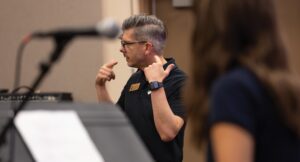
After the Performance
Don’t Blame: Not the kids. Not the schedule. Not the circumstances. Those things might be real, but they’re not useful if that’s all you focus on.
Say What Went Well: A section held together. Some tones improved. A transition worked. Due to the “fix this, now fix that” nature of rehearsals, it’s important to highlight the positive.
Get Specific About What Didn’t Work: Not “that piece was bad.” Instead: “Tempo change at m. 42 was unstable.” “We rushed releases.” “That transition lacked clarity.” Specificity helps define goals.
Check Your Rehearsal Structure: Did you run too much and isolate too little? Did you avoid hard spots because you were afraid of what you would find out? Or maybe you avoided hard passages because you knew exactly what you would find. Most of the time, it’s a planning issue. An ensemble is a direct reflection of its director. This is both a good thing and a tough thing to admit.
Evaluate Programming: Selecting music is one of the most difficult jobs a music teacher has. Was the piece right for this group, right now, with the time you had? We can’t rely on luck, but it is important that we understand how to make the musical stars align. Changing out a piece is not lowering standards. It’s planning for the kids in your room.
Decide What Carries Forward: Speaking of the piece — consider bringing it back later. Play select movements. Or move on. Not everything needs closure.
We’re Always Learning
We all have situations where we’re not as prepared as we thought. And even if you were, you now have better information than you did a week ago. That’s the job.
Adjust. Simplify. Come back a little more experienced next time. After all, it’s school. We’re all here to learn.
Keep reading