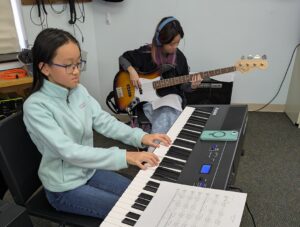
How to Choose a Bass Guitar

Along with drums, bass guitar rounds out and anchors the overall sound of a band. A good bass player adds flavor and depth to the rhythm. An experienced player can also contribute rich harmonies and low-end solos. Because the instrument is used in virtually all modern musical styles, talented bass players can usually find work with bands quite easily.

The bass is comparatively simple, straightforward and fun to learn. But before you select your first instrument, it’s important to know the basics of bass.

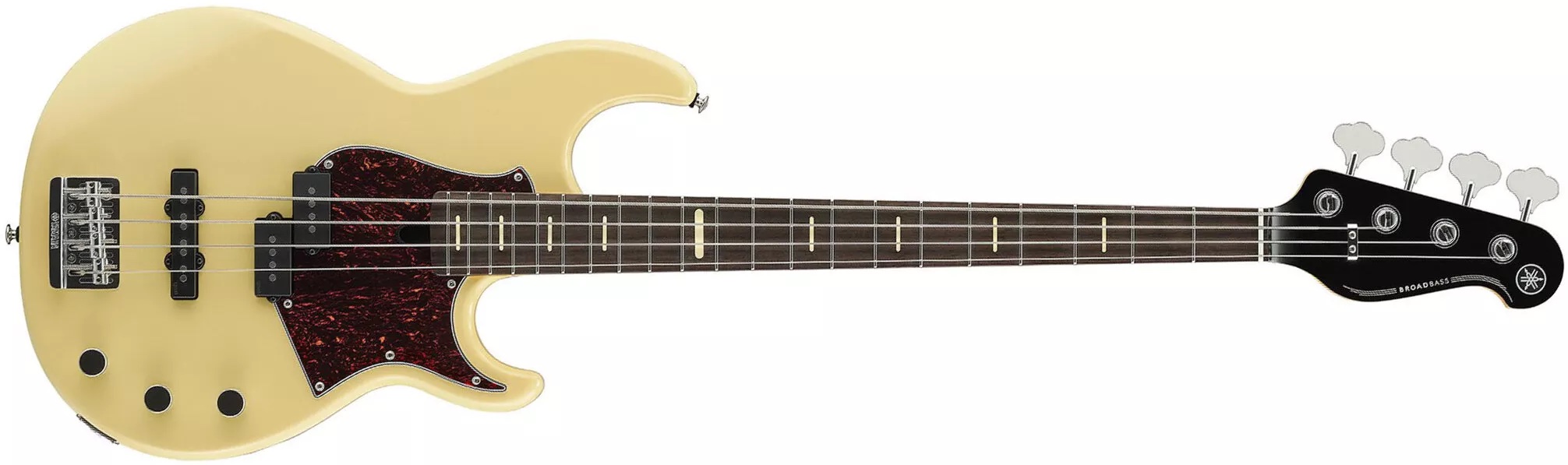
Bass guitars vary widely in quality and price, so before you start looking, figure out your budget and how you intend to use the instrument. Beginners can find a variety of good, affordable starter basses, such as the Yamaha TRBX174 and BB234. They both come from established series — the TRBX and BB Bass, respectively. Yamaha has more than 50 years of experience handcrafting electric basses for players of all levels, and the company’s philosophy is to make a beginner’s experience as positive as possible. So, although these two models feature slightly lower-grade hardware and electronics than top-of-the-line options, their playability helps new bassists excel during the early stages of learning and performing.

Experienced players may want to invest in an instrument with richer tone woods, better electronics and upgraded hardware. A higher-quality bass will sound better, feel better and serve a musician longer. At the top of the TRBX and BB lines, they’ll likely find exactly what they’re looking for. 2 It’s important to have a good understanding of the parts of a bass guitar before you start shopping. Understanding how the instrument is designed and built, as well as knowing its different parts, will help you to ask the right questions and make an informed decision.

How to Choose a Bass Guitar Guide

Click here to download the complete “How to Choose a Bass Guitar Guide”

Top Baseball Video Games

In 1961, inventor John Burgeson created the first-ever computerized baseball simulator game. In the decades since, there have been literally hundreds of video games released that, at least in part, are based on his concept. And although every baseball fan can’t play in the majors, anyone can practice their sliders and home-run swings on their gaming consoles.

As spring training approaches, it’s time to continue along the path that Burgeson set out by enjoying these nine classic baseball video games. Batter up!

1. R.B.I. BASEBALL (1987)

This title was the first of its kind to include licensing by the Major League Baseball® Players Association (MLBPA). As a result, it was the first video game to use the names of real players, including superstars of the era like Nolan Ryan and Andre Dawson. Although it did not include actual team names, there were eight squads from cities like Boston, Detroit, New York and others. Making it even more realistic, the virtual players boasted various skillsets (some were speedy on the basepaths, others had a great fastball). For gamers of a certain age, this is the Holy Grail of baseball titles. Preview it here.

2. KEN GRIFFEY JR. PRESENTS MAJOR LEAGUE BASEBALL (1994)

This game from Software Creations® did feature the names and stadiums of real MLB® teams, including the Chicago Cubs and Seattle Mariners, though unlike R.B.I. Baseball, it didn’t offer the names of actual players, with the exception of the title’s namesake. In the 1990s, Ken Griffey Jr. was the star of stars on the diamond and his inclusion in this game made it a must-have. Available for consoles like Super Nintendo®, there was a later release on Game Boy™ that did include real players, but even the original provided the groundbreaking feature of allowing users to save their stats during their season. Preview it here.

3. TRIPLE PLAY 97 (1996)

In the mid-to-late-1990s, video games began to look more realistic. Gone were the cartoonish, rudimentary baseball images of players and in came graphics that looked almost like a real-life matchup. This title from EA Sports® was at the forefront of that movement. Not only was it one of the best baseball video games of its time, it was one of the best video games of any kind, period. Triple Play 97 featured real players, real teams, announcers, crowd noise and more, providing a life-like immersive experience. Preview it here.

4. BACKYARD BASEBALL (1997)

Most sports video titles are known for taking themselves and their subject pretty seriously. More and more, they aim to be as accurate as possible in terms of the look, feel and pace of the actual pro game. But not this one! There is accuracy, to be sure, but it’s of a different kind — that of a child’s imagination. The premise here is: What if you and your school-aged friends got together for a game at the park? From homespun uniforms to cute trash-talking, this one is as fun as a Saturday afternoon with friends. Preview it here.

5. MLB SLUGFEST 2004 (2003)

This offering from Midway Home Entertainment® leaned into the fantastical. Users could play as real-life teams, including the Kansas City Royals or St. Louis Cardinals, or they could play as a band of ninjas, with swinging samurai swords in place of baseball bats. Similar to basketball games like NBA Jam or football games like NFL Blitz, it allowed players to enjoy an extreme version of the sport that was at times part-wrestling match. Preview it here.

6. MVP BASEBALL 2005 (2005)

Though MVP Baseball is nearly two decades old, it might just be the best baseball video game ever. It not only features real players and teams, but it also was granted licensing from Minor League Baseball®, meaning users could play with a franchise’s farm team. Now that’s detail! But it also presents the game within the game, as users could make trades, manage rosters and navigate player injuries as if they were a real-life team’s coach or front-office executive. Compared to everything that came before, this is mind-blowing stuff! Preview it here.

7. MARIO SUPERSTAR BASEBALL (2005)

Love baseball and also love the Super Mario Bros.™ world of characters? Then this game is for you. Here, you don’t have to know contemporary pitchers or hitters; you just have to step up to the plate with folks like Luigi, Wario or Princess Peach. Originally created for the Nintendo GameCube®, it’s actually one of several Mario Bros.-themed sports games, including Mario Power Tennis and this title’s sequel, Mario Superstar Baseball. As colorful and light-hearted as you might expect, this is a game for all age groups. Preview it here.

8. SUPER MEGA BASEBALL 3 (2020)

Somehow realistic and over-the-top at the same time, this title combines the oversized cartoonish nature of some baseball video games with the lifelike gameplay of others. While the first rendition was released in 2014, Super Mega Baseball 3, the third in the series, came out in 2020 and is one of the more popular games to date. Available for consoles like Nintendo Switch™ and PlayStation 4®, it includes a franchise mode where users can control not just a batting lineup but a whole fictional team, like the Sharks or the Heaters. The game can also be played online against opponents all over the world. Preview it here.

9. MLB THE SHOW 20 (2020)

Some may see this game for the first time and confuse it with an actual Major League Baseball contest — it’s that realistic. Created by San Diego Studio® for PlayStation 4, this title features minor league baseball players as well as those in the majors. Users can play online against other opponents or just bask in the realism it offers. It’s hard to imagine video games getting more lifelike than this one. Even the onlooking fans in the stands seem real with their own individual movements and appearances. Add in varying weather conditions, day and night games and real-life ballparks, and you have just about everything you need to completely replicate the actual in-stadium experience. Preview it here.

March Is Multi-Screen Madness

Enjoying major sporting events at home is the reason you have a 70″ 4K TV and a legit sound system. The Super Bowl™, Kentucky Derby, Daytona 500, the Masters — all are must-see for sports fans.

For these events, all you need to know to watch the action from beginning to end is: what time does it start and what channel is it on?  It’s that simple because they happen just once a year, at one specific time, and the broadcasting networks do their best to make sure they don’t conflict with one another. Even NFL, NBA and MLB playoffs and championships (including the World Series) are coordinated so the start times don’t overlap. That way, dedicated fans can see all the action … and the networks can maximize their ratings.

There is, however, one huge exception to this meticulous planning. Around the middle of March, the NCAA® Tournament begins. This culmination of the college basketball season presents a challenge for the fan who wants to enjoy a real home court viewing advantage.

Once the final 64 teams are seeded into four single-elimination brackets, the fun begins. A full schedule of 48 games are played in the first four days, making it impossible for a network to broadcast them all on one channel. With so many games being played at the same time, game conflicts simply can’t be avoided.

The networks have, however, come up with a solution: Spread all the games across four different channels: CBS, TBS, TNT and truTV. Sound good? Not really. Surfing between the four channels with your remote only guarantees you’ll miss a lot of great plays. The best way to watch is to pick up all four broadcasts on four separate TVs.

Sound complicated? Not really. Not if you’re a serious sports fan. In this article, we’ll show you how easy it is to convert your living room into a multi-screen, tournament-ready sports lounge. With a creative combination of cable, satellite, terrestrial broadcast and internet streaming devices, you’ll be able to watch four games simultaneously without interruption. But be sure to start planning early, so you’re not running to the store on game day.

What You Need

1. Four TVs in one room.

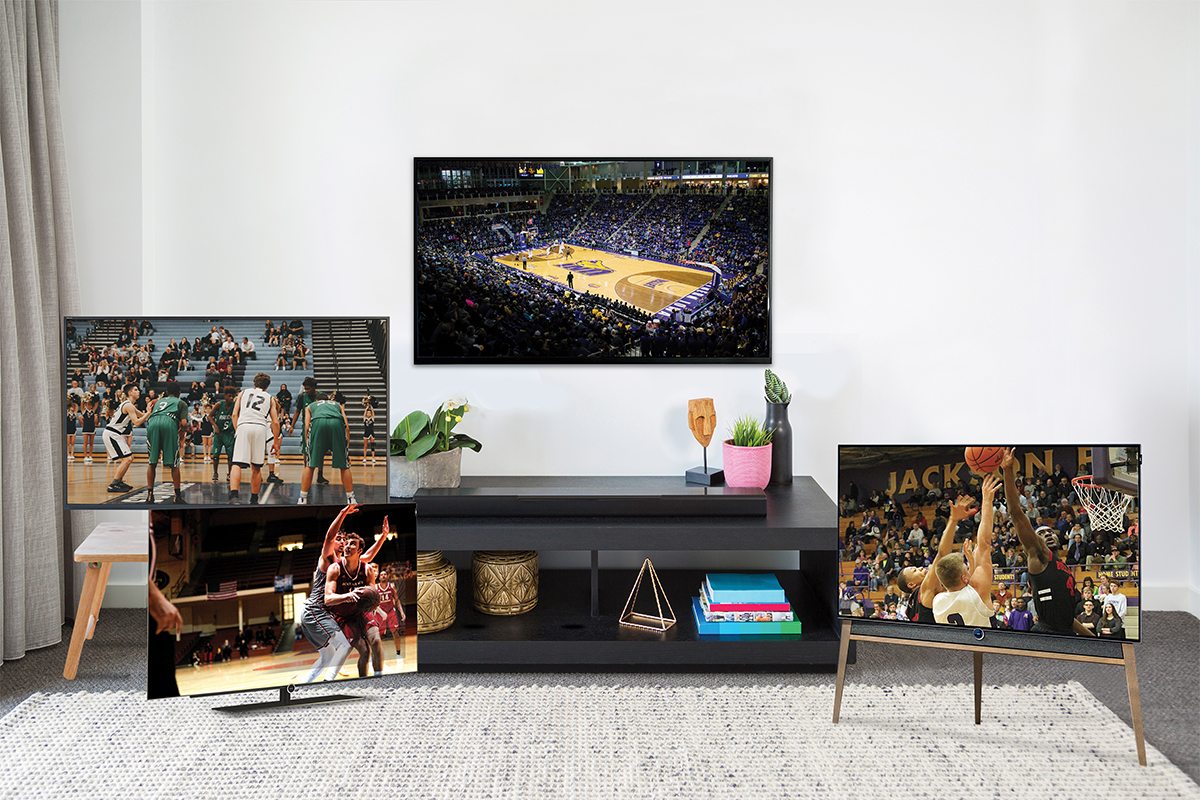
You’ll need one for each broadcast channel, so gather the television sets from around the house (bedroom, kitchen, borrow from a friend, etc.) and set them up in your living room alongside your main monitor.

An image of 4 different tv's in a room.

2. Access to streaming apps for each TV.

If all the sets are smart TVs, they should be able to access the most popular streaming apps: YouTube™ TV, Hulu™, Sling™ and others. If they’re a little older and don’t support the latest versions of these apps, don’t worry — there are hardware add-ons available to get the job done, such as Apple® TV, Fire® TV, Roku®, Chromecast® or Xbox One. Any of these can upgrade any monitor to a state-of-the-art smart TV.

The logos of popular streaming services and devices.
On the left: streaming services. On the right: streaming devices.

3. Indoor HD antenna for terrestrial broadcast.

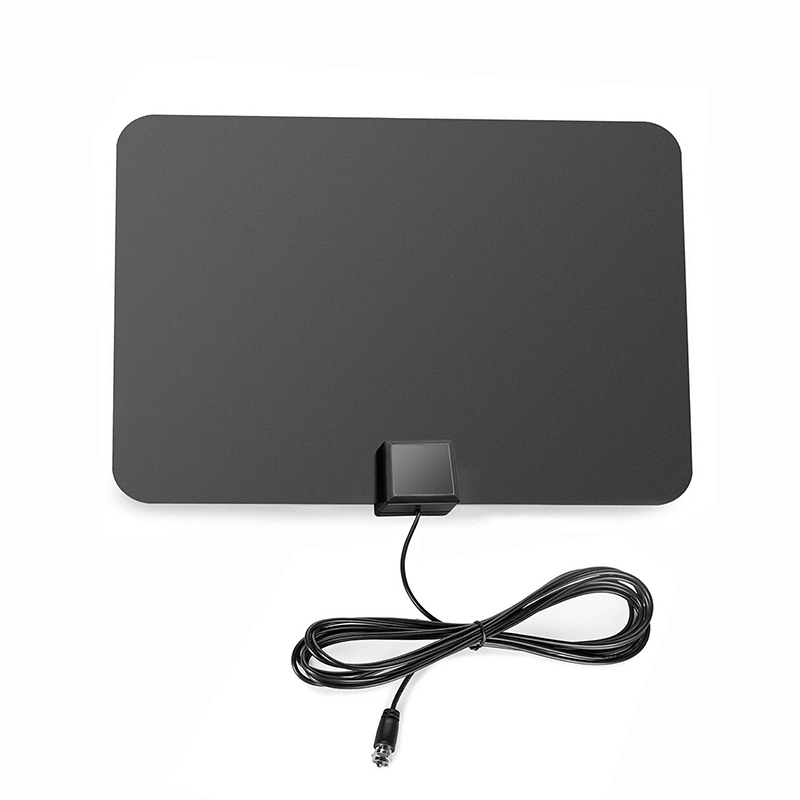
You’ll need an antenna to pick up your local CBS channel. HD antennas are available online or from any big-box store. Models vary, but to ensure clear picture quality, get the one that can pick up the farthest digital station.

An indoor HD antenna.
Indoor HD antenna.

You’ll also need to subscribe and register your smart TVs and/or streaming devices to a streaming services app like YouTube TV, Hulu, Sling or any other that carry the four channels you’ll need to watch the tournament (i.e., CBS, TBS, TNT and truTV).

Note: If you don’t already subscribe to one of these services, do a little research. The services vary in terms of broadcast content and the hardware they support. The number of simultaneous streams each subscription supports is important. Some services limit the number of channels that can be simultaneously streamed into the home. You’re going to need two to three streams to see all the games. The good news is that these are normally month to month services with no penalty for subscribing for a single month.

Set Up Your TVs

There are many ways to make this happen, but the good news is that all are equally effective. Here’s an example that uses a combination of connections from cable TV, terrestrial broadcast and two internet streaming devices. (If you’re tech savvy, get creative with the hardware and streaming services you already have available.)

1. Monitor One (TBS broadcast):

This is the main TV that normally sits in your living room. Use the cable or satellite service already connected to this TV to receive the TBS broadcast.

2. Monitor Two (CBS broadcast):

This monitor will get its signal from local terrestrial broadcast using an indoor HD antenna.

3. Monitors 3 and 4 (TNT and TruTV signals via internet streaming):

These last two monitors are going to get their signals from the internet using the built-in apps or external streaming devices mentioned above.

Switch the Sound

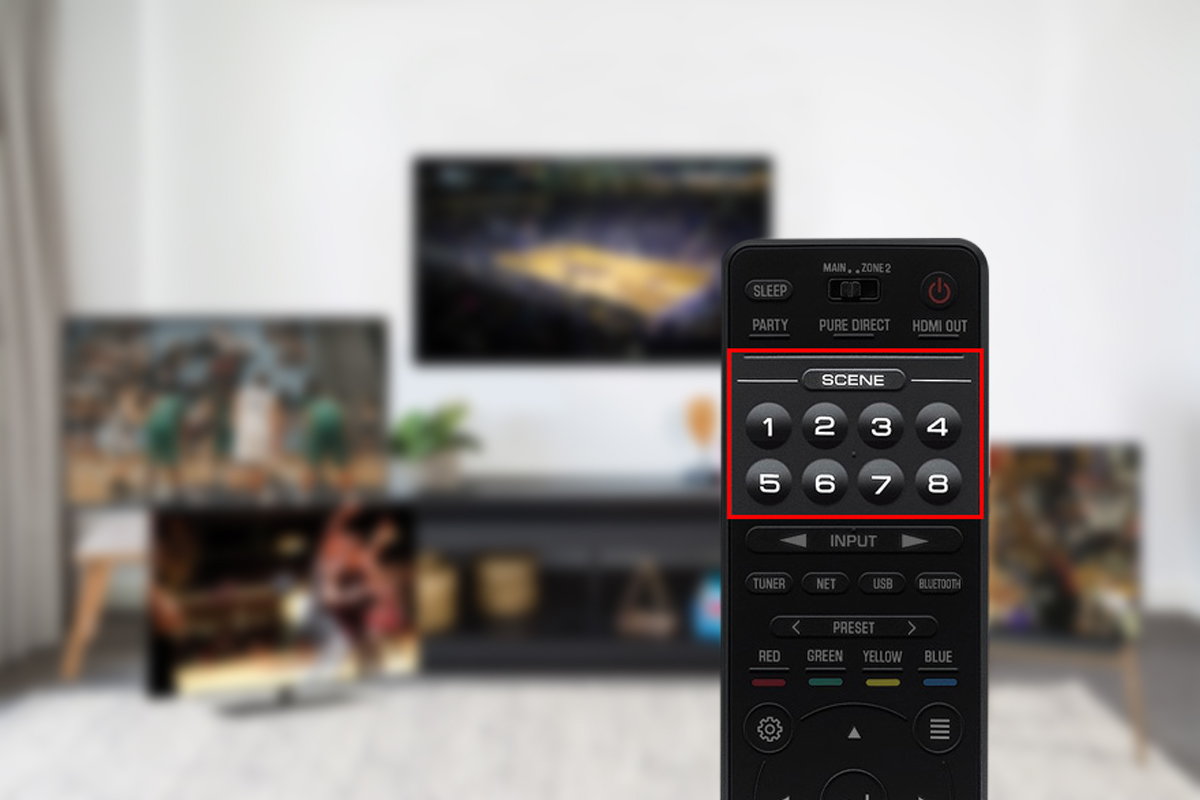
Now that you have different games on all four monitors, it’s just a matter of switching the sound to the one you want to watch. This is simple if you’re using a Yamaha AV receiver that has a SCENE function. (All models made in the past 15 years have it.)

Here’s how:

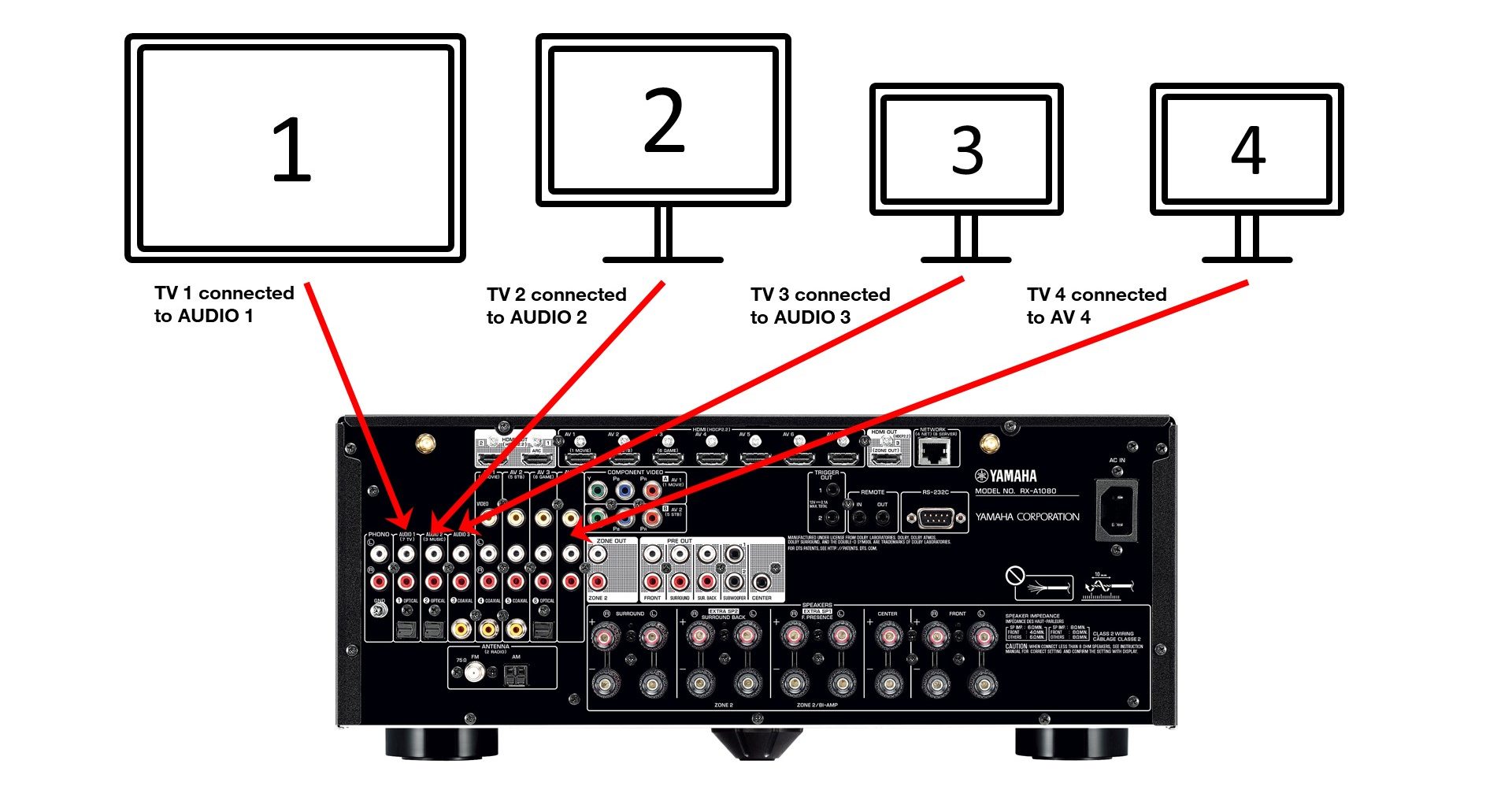
1. Connect each TV’s audio output to an analog or digital input on the receiver:

An image displaying audio / analog output diagrams.

2. Set the receiver’s input to the monitor you want, then press and hold a SCENE button for five seconds to set the scene. For example, connect Monitor 1 to the Audio 1 input and set SCENE 1, then connect Monitor 2 to the receiver’s Audio 2 input and set that to SCENE 2, and so on.

3. During the games, simply press one of the four programmed SCENE buttons on your remote to select the sound from the desired monitor. See the action, hear the action!

An image of the SCENE button a remote control linked to a home theater system.

Now you’re all set to watch the drama of the tournament unfold in the comfort of your home theater. Grab your bracket, your favorite snacks, and enjoy! Will it be March Madness™ or March Sadness for your team?

It Costs Nothing to Say Nothing

You’re at a festival, and watch as a band finishes their set, and it’s … not great. Missed entrances. Thin tone. A trumpet solo that clearly felt longer to the kid playing it than to anyone else in the room.

You’re walking back to the buses when you hear the two directors behind you start dissecting everything.

  • “Tone was rough.”
  • “Why would they program that?”
  • “They’re not ready for that level of literature.”

You glance over at your students loading equipment. They heard it too.

I’ve been at that festival. I’ve been that insecure young teacher, trying to prove I knew what was wrong with someone else’s group. It feels good for about 30 seconds.

Criticizing another band doesn’t fix your program. It just tells everyone where your head is. And, most importantly, your students are paying attention.

happy group of band students sitting on floor

Your Students Are Watching More Than You Think

When you criticize another program in front of your kids, you’re teaching them how to talk about people who aren’t in the room.

Students watch how you react when things go badly. They’re learning from you what professionalism should look like.

If you roll your eyes at another band, your kids learn that that’s part of being a musician. Make sarcastic comments about repertoire, and they learn that mockery is part of being an adult.

I’ve had students repeat comments back to me that I barely remembered saying. They’re always listening. Always (except when I say to put button one down for Bb).

If we want students to show empathy when a peer misses a note, we have to show it when an entire ensemble struggles. Not the fake, patronizing kind. Just simple respect.

“They worked hard. That took courage.”

That’s enough.

man sitting at desk with papers and an open laptop

You Rarely Know the Full Story

It’s easy to critique a 12-minute performance. It’s harder to understand the years behind it. You don’t know if that director lost staff. You don’t know if half the band shares instruments. You don’t know if their feeder program disappeared three years ago.

I’m the only band director at my school. Some years I’m just trying to keep everything afloat. There have been semesters where students moved in and out constantly. Years where I’m teaching beginners and seniors in the same rehearsal and hoping both groups grow.

If someone judged my program based on one performance, they’d miss the entire story. They wouldn’t see the kid who learned to buzz a mouthpiece six months ago. Or the one who finally came back to school after weeks of being absent.

They just hear a cracked entrance.

The same is true for the group you’re tempted to critique.

looking in mirror with melancholy look

Most Criticism Is About Us, Not Them

When I’ve been tempted to tear down another program, it usually had nothing to do with them.

I was tired and felt behind. I was worried about my own scores, my own programming, my own issues. Pointing out someone else’s problems gave me a temporary boost.

I’d think, “Well, at least we sound better than that.” But that thought doesn’t last.

If things are going well in your program, don’t take shots at someone else’s group. Just watch and think, “They’re working. Good for them.” Or, “I’ve been there.” Because most of us have.

person holding hand out in front of her

Sometimes Professional Just Means Quiet

When I thought I had something to prove, I gave an opinion about everything. Now I think professionalism looks more like restraint.

If a colleague asks for feedback, that’s different. Be honest. Be specific. Be helpful. And do it privately. But unsolicited analysis isn’t mentorship. It’s ego.

There’s a difference between professional dialogue and commentary within earshot of kids still loading tubas. Sometimes the most professional response after a performance is simple: “That took courage.”

Or, say nothing at all. You don’t lose credibility by holding your tongue. If anything, you gain it.

frustrated man with hands on both sides of his head

Your Program Won’t Grow Because Someone Else Struggled

If a group has an off day, you might move up a spot in some competitive festival rankings. But ensembles don’t grow because another band had a rough night.

Better tone comes from teaching tone. Better programming comes from studying scores. Higher standards come from raising them in your own rehearsal room.

Most of us don’t have extra energy to waste. The job is already demanding enough. At some point, your group will be the one that struggles on stage. A rushed tempo. A cracked entrance. A piece that didn’t land.

You’ll walk off knowing exactly what went wrong. And as you’re heading back to the buses, you might hear some voices behind you. You won’t need to turn around.

Your students know that it wasn’t their best performance but praise them for working hard and having the courage to perform in front of others. Have a group discussion about the things to focus on during rehearsals and in preparation for the next festival — all while showing your kids professionalism, resilience and kindness.

10 Best Baseball Songs

You know it’s spring when baseball season begins. Time to begin enjoying those peanuts, caramel popcorn and the crack of the ball on the bat with these 10 beloved songs about America’s Pastime.

1. GLORY DAYS

This song from Bruce Springsteen’s iconic Born In The USA album focuses on a man who ruefully looks back on his “glory days” playing high school baseball while recalling some of the friends he knew. The first verse is based upon a chance encounter Springsteen had with one of his past Little League® teammates when he himself played baseball in a Babe Ruth league. Listen to it here.

2. THE GREATEST

The lyrics of this 1999 Kenny Rogers song portrays a little boy repeatedly tossing a baseball up in the air, then swinging and missing, though he constantly refers to himself as the greatest player. When his mom calls him in for dinner, we discover that he imagined himself as the pitcher, not the hitter, earning strikeout after strikeout. Listen to it here.

3. NIGHT GAME

This beautiful ode to baseball was written by Paul Simon, based on his memories of attending baseball games in the New York area where he grew up as a kid. The track features the legendary Toots Thielman weaving an evocative harmonica part over Simon’s guitar as the song slowly develops … just the way a great game would. Listen to it here.

4. DID YOU SEE JACKIE ROBINSON HIT THAT BALL?

This feel-good jump blues track was originally recorded by the Count Basie Orchestra in 1949, two years after Jackie Robinson made his major league debut. The song was later covered by Natalie Cole and included in a Ken Burns baseball documentary. Listen to it here.

5. CENTERFIELD

You’re virtually guaranteed to hear this track playing over the PA at most baseball games, both major league and minor. Interestingly, singer/songwriter John Fogerty (the famed front man for the ’60s group Creedence Clearwater Revival) has said that he chose the name of the album before he wrote the song, which was inspired by the ultra-deep centerfield at the original Yankee Stadium. Listen to it here.

6. THE CHEAP SEATS

The Cheap Seats is not only the fifteenth studio album by country music band Alabama, but the name of this feel-good baseball-tinged track, which was used as the theme song by ESPN for their Minor League Baseball games during the 1994 broadcast year, when the single was riding high in the charts. Listen to it here.

7. JOE DIMAGGIO DONE IT AGAIN

This fun track by Billy Bragg and Wilco from the 2000 album Mermaid Avenue Vol II features banjo and guitar, along with lyrics by Woody Guthrie written in 1949, about an old-timer struggling to keep up with the younger kids … proving that some topics are timeless. Listen to it here.

8. ALL THE WAY

Eddie Vedder, lead singer of the rock band Pearl Jam, wrote this one about his favorite baseball team, the Chicago Cubs. Vedder was from Evanston, Illinois and was a lifelong fan. The song is also known as “(Someday We’ll Go) All the Way,” in reflection of the fact that, when it was first released in 2008, the Cubbies hadn’t won a World Series in 100 years — something the team rectified in 2016 … which prompted a video re-release of the track. Listen to it here.

9. SWING

Country artist Trace Adkins recorded this track in 2006. The video uses baseball as a metaphor for a women’s night out at a tavern, depicting the men that play the “game” — including Adkins himself, who ultimately has to step up to the plate. Listen to it here.

10. TAKE ME OUT TO THE BALLGAME

It doesn’t get more baseball than this 1908 Tin Pan Alley song, which has become the unofficial theme to the game, traditionally sung during the seventh inning stretch. Interestingly, neither of the composers had attended a ball game before writing the song! It’s been recorded literally hundreds of times, but the classic version is the one performed by Frank Sinatra and Gene Kelly from the film of the same name. Listen to it here.


Check out 10 of the best baseball movies of all time.

I’m a Band Director — Why Am I Teaching Choir?

I’m a band director. I eat, sleep and live band. Ask me any questions about any band composer, literature or conductor, and I’ll answer correctly 80% of the time, every time. #Band4life.

My first job? Four sections of choir. Two sections of band — one of which I co-taught as the assistant. And to make it more interesting, the previous choir director had already applied for a state conference performance, and the group was accepted.

So, a few months into my teaching career — still figuring out attendance, copy machines and why someone kept parking in my assigned spot — I was supposed to help take a choir to perform at the state conference.

I walked into my first class and was met by 60 vocalists waiting to see if I know what I’m doing.

woman with hands on both sides of her face

The Moment You Realize You’re in Trouble

One class, I asked the tenors to sing alone for the first time. Silence.

Them: “We don’t know the part.”

Me: “It’s on the page — just read the notes.”

Them: “We can’t.”

OK. New plan. This is not the typical “choir kids can’t read music” complaint. The only advantage band members have is that they have buttons and keys, and they’ll occasionally hit the right notes the first time due to having less notes at their disposal.

I replanned the next several rehearsals to include note-reading, solfège, rhythm exercises and diction. In other words, I couldn’t just wing it like I thought. This would require some real rehearsal architecture and goal setting.

I had the same thoughts every day driving home: “Did they hire the wrong person?*

Sometimes you aren’t hired because you’re the perfect specialist. You were hired because the schedule needed to work. You had just enough skill to be functional in two different disciplines, and someone has to teach those sections. A real gut punch to your ego.

two people ready to start a race

You’re Not Starting From Zero

I used to think: “If I don’t know everything about this discipline, I shouldn’t be teaching it.” This sounds responsible and reasonable, but it’s also not true.

Most of a music teacher’s job isn’t choir-specific or band-specific or orchestra-specific. All include rehearsal structure, pacing, expectations and musicianship.

So, was the goal to get kids to understand and demonstrate proper diction, diphthongs and tone quality? Absolutely. But the goal was also to continue to move our rehearsals forward.

If you’re teaching a discipline that you’re not used to, you’re not starting from zero. You’re starting from about 70%.

Here’s what you can do:

  • Plan a concert cycle
  • Diagnose rhythm issues
  • Know when kids mentally need a reset.

The other 30%? This comes with time, observation and a little humility. Humility just means saying, “I don’t know this yet.”

close up of choir

Some Universal Things

Rehearsal structure transfers everywhere: When I stopped trying to become a choir guy overnight and just ran rehearsals the way I knew how to run rehearsals, things improved.

Warm up with purpose: Not random vocalizing. Targeted. “We’re going to fix vertical alignment today.” Then the warm-up addresses that.

Isolate small sections: I pulled just the tenors and basses for eight minutes while the sopranos marked and listened. That felt normal to me — it’s what I would do with low brass. Then I just worked on fixing two measures instead of running sections or the entire piece.

Reinforce fundamentals every day: Posture check. Breath plan. Unified release. Choir, band, orchestra — a unified system works everywhere. Your job is to work to refine your teaching on those concepts that are specific to the discipline and the grade level that you are teaching.

Leadership is leadership: Clear expectations transfer across all classrooms. Start on time. Stop rehearsal and reset when needed. Have clear behavior expectations. The first few weeks, I overfocused on vocal technique and under-focused on leadership basics. We’d spend five minutes adjusting vowel shape, but entrances were sloppy and kids were talking between reps. Once I tightened rehearsal transitions — “Folders up. Eyes here. We start in three.” — behavior improved.

And when behavior improved, listening improved. And when listening improved, tone improved.

I’ll reiterate: students do not always need a specialist first. They need a steady adult who understands that tone problems can sometimes stem from classroom expectation problems.

looking through lens of a narrowing passageway through a cave

Narrow the Focus So You Can Keep Going

The stress of that upcoming state performance almost sent me into over-correcting mode. I wanted to master everything. Every vowel nuance. Every stylistic rule. Every technical detail.

I printed articles. I watched conference videos late at night. I convinced myself that if I just consumed enough information, I’d feel qualified. I was a band guy, but now I have to prove that I belong here. Student-first? Not exactly. But that’s what was going on in my head at the time.

Instead, I just felt tired. I felt like I couldn’t sustain this. So, I narrowed the focus.

The goal was no longer to perform at the state convention and gain the respect of my new peers. Now it was to make sure the students felt comfortable performing with proper posture, diction and tone quality. It was to make sure they felt connected to each other in their classroom and performance.

I stopped chasing every flaw. We worked on the list above — posture, classroom expectations, musical elements.

They improved. Not because I became an expert, but because I simplified.

band rehearsal of French horn section

No Excuses

I apologized a lot and made a lot of excuses at the beginning. “I’m more of a band person …” or “I’m still learning choir …”

I thought I was being transparent. Students hear something else. They hear: This class is secondary; it’s not as important to our director.

You are the choir director this year. Own it. You can be learning and still be in charge. When I stopped qualifying everything and simply led, rehearsal felt different. Confidence isn’t knowing everything. It’s knowing that you can rise to the level the students need.

Borrow Shamelessly

I’ve heard from countless educators that “teachers steal constantly.” See a teaching technique that works? Take it and try it out with your class.

Many new teachers feel like they have to create materials or methods, otherwise it doesn’t count. This is a quick way to burn-out.

Sit in on other directors’ rehearsals and take notes. Find a book like “Building Beautiful Voices” by Weston Noble and use those warm-up methods.

Most great teachers often cobble together what works from other directors. Borrow. Refine. Keep moving.

writing in notebook "Plan: Survive"

A Manageable Survival Plan

Here are some additional tips if you find yourself staring at a schedule that doesn’t match your speciality:

  • Pick conservative literature. Choose music that builds confidence.
  • Establish a consistent rehearsal routine.
  • Keep a running list titled “Things I Need to Understand Better.”
  • Study 10 minutes a day — not two hours in panic mode.
  • Build one mentor relationship.

This list is doable. Especially when you’re also prepping for a state performance that you didn’t apply for. And still trying to remember to submit attendance correctly.

music teacher working one-on-one with flute student

This Isn’t an Identity Crisis

You’re not a band director stuck teaching choir. You’re a music educator teaching the students in front of you.

Teaching multiple disciplines was a gift. My ear improved. I started listening more carefully. My language became more direct, and I was fortunate enough to interact with even more students who wanted to perform and wanted a place to belong.

I learned how to become a better teacher for whoever was in front of me.

A Bassist’s Guide to Playing Guitar, Part 2

In Part 1 of this two-part series, I wrote about my experience picking up guitar for the first time. I firmly believe that learning even a little bit about other instruments can help you become a better bass player and a better all-around musician. For bassists, learning guitar feels like new territory, both mentally and physically. When I started playing guitar in earnest last year, I was curious to see where it’d take me and the journey held more than a few surprises. If you’re a bass player who’s thinking of learning guitar, here are a few tips that may help you get comfortable as you begin the process.

GETTING STARTED

As I mentioned in Part 1, picking up guitar after playing bass is an adjustment for the hands; the spacing is tighter and the strings are thinner. Putting in the work does have its rewards, though: Even basic chords and double-stops on my Yamaha FG800J acoustic guitar (the instrument I chose for learning) sound great. Trying other acoustics has shown me that the wider string spacing of classical guitars can feel a bit more comfortable, however, especially for those of us accustomed to 5- and 6-string basses.

An acoustic guitar.
Yamaha FG800J.

The mental shift is important, too. Generally speaking, bass players are expected to showboat the least; we mostly play single notes, and we choose those notes with intention. On our best days, we are the epitome of usefulness. But when we pick up guitar, we can be supportive without being foundational. We can imply chords without being definitive, and we don’t have to play nearly as much. Guitar players often “sit out” at will, but if the bass goes quiet, the band stops. For a bass player, this freedom takes some getting used to.

FIRST STEPS

I enjoy playing three-note chords (triads) on my 6-string Yamaha TRB bass (still available in Europe but since replaced in the U.S. by the newer TRBX line) and 5-string BBP35, so when I pick up a guitar, my first instincts are to play the same chord shapes I use on bass, as well as single-note lines and melodies on the low strings. Hearing chords that ring out cleanly and clearly on guitar is still a thrill.

Bass is tuned in fourths, which makes it easy to move shapes around the neck and get results without overthinking. A guitar’s four lowest-pitched strings (EADG) are also tuned in fourths — but the fifth string, B, breaks the pattern. (The high E on guitar, which is two octaves higher than the low E, is a fifth from B.) So playing my favorite three-note bass chords on the bottom strings of guitar is easy, but I’ve also learned that playing something as simple as basic intervals (thirds, fourths, fifths, sixths, sevenths and octaves) up and down a scale sounds good, too. And I’m learning to “mind the gap” by adjusting for that B string.

PLAYING RHYTHM

I started out as a drummer, and being inspired by Steve Gadd and Dave Weckl, my kit of choice was a Yamaha Recording Custom. When I switched over to bass as my main instrument, connecting with the drummer was a no-brainer, and rhythm guitar still grabs my attention. When I’m playing guitar, however, my responsibilities are different: My strumming hand still feels the need to keep the pulse, and even though it doesn’t feel as crucial as it is on bass, I like to think of downstrokes as the backbeat and upstrokes as a lift.

FLYING BLIND

After spending so much time analyzing and learning bass parts, I want to know exactly what I’m doing on guitar, but I’m learning to ease into a beginner’s mindset and enjoy simple pleasures without overanalyzing. It’s fun to play a random fret with one finger on the top three strings, for example, while experimenting with basic fingerpicking and strumming. Technically, that’s a first-inversion minor chord (think of it as a minor triad with the root on the top string), but I’m letting myself not overthink it. This “shape” is easy to do, and it sounds good. It’s those little victories that motivate me to keep learning.

NEW GIFTS

As bass players, we mostly think in root position: If the music asks for a G7 chord, we usually play a G and outline the chord with the third (B), the fifth (D), and the seventh (F). In my new role as a guitarist, where the root is not my responsibility, I’ve become more interested in inversions, which can help create smoother, more melodic bass lines and connect chords chromatically, especially when playing walking basslines. Playing inversions on guitar is great for my ears, and it reinforces the importance of the root on bass. It can be helpful to see our job from the outside and understand its importance.

I’ve noticed that when I return to bass after playing guitar, I’m more comfortable leaving space and I’m more selective about the notes I play. This journey is also making me realize how much of the acoustic guitar music I’ve absorbed is from West Africa and the African diaspora, and it’s interesting to hear those flavors come through my neophyte guitar hands.

LETTING GO

In my experience, learning guitar can feel like starting over, but really, it’s more about letting go. Playing guitar is a chance to enjoy new territory. Thinking like a guitarist doesn’t have to mean taking a “me-first” attitude; you just have to be OK not being the anchor. Embrace the change and know that this new adventure can stimulate your fingers, your ears, and your curiosity — and if you do it right, it’ll make you a better bass player too.


Check out E.E.’s other postings.

Don’t Be a Pushover

The assistant principal asks, “We need your room during fifth hour for testing. Can you relocate band for a few weeks?”

If you’ve taught long enough, you already know what happens next. Little to no percussion access. Half the class time lost to logistics. And a group of kids who feel like they were pushed aside.

I didn’t want to be known as difficult, so I said “yes.”
Three weeks later, rehearsal quality dropped. Kids were frustrated. I was frustrated — but I didn’t let anyone know. I replayed the conversation on the drive home. I told myself pushing back wouldn’t have changed anything. But I knew the truth.

Nobody forced me. I agreed to this.

close up someone biting their lip

Being Easy to Work With Isn’t a Plan

Many early-service teachers think being low maintenance makes them professional. Quick agreement can build trust, and cooperation simply means “we’ll figure out the stressful stuff later.”

Your speedy acquiescence makes your program the easiest one to squeeze out. In my case, when something had to move, we moved. When something had to give, we gave. It soon stopped being a discussion. It became an expectation.

Feeling like we were the only group that had to make concessions was frustrating. Moving forward, it wasn’t about becoming difficult or saying “no” just to say “no.” It was about advocating for my program.

man's arm with a watch on

Fast Answers Usually Come From Fear

One of the biggest early mistakes I made was answering immediately. Requests came in, and I responded on the spot. Room changes. Schedule shifts. Extra performances. Pull-outs during rehearsal.

I thought my administration would care if I responded promptly. I even thought they’d be upset if I didn’t get back to their email within the same hour (even though some of my emails took a day or two for them to respond to).

Speed did not really matter. All it did was show the anxiety I had about being seen as a team-player.

Silence can feel uncomfortable, but that doesn’t mean you have to fill the space right away. Instead of trying to answer quickly, answer thoughtfully because thoughtful answers protect students and programs.

frustrated teacher with clenched hands held in front of her

Frustration Doesn’t Translate

I’m a musician. An artist. Translation: I sometimes get a little emotional and want to say:

  • “This is frustrating.”
  • “This keeps happening.”
  • “This makes rehearsal difficult.”

All true, but sharing these thoughts is not effective.

When advocating for your program, state facts. Impact works better than emotion.

  • “It’s difficult for us to make that change because we lose percussion access, and 10 kids per class won’t be able to participate for five weeks.”
  • Or, “We lose instructional time every day we relocate.”
  • Or, “This affects over 100 students preparing for graded, summative performance.”

That’s a different conversation. You’re no longer venting. You’re informing.

band rehearsal with one student raising her hand

Most People Don’t Understand Rehearsal Reality

We’re not criticizing your admin or building leadership. We’re just pointing to reality. Chances are you don’t completely understand your principal’s job, and they don’t understand yours. That’s OK — as long as we work together.

Running a music rehearsal includes many considerations. Most people don’t understand how routine affects beginners, how setup time compounds across weeks, or how physical space shapes ensemble outcomes. If you don’t explain it, people will assume. And we all know what they say about assuming…

Be clear and direct when you speak. It’s not rude or off-putting — it’s simply translating the problem into language that everyone understands.

Patterns Matter More Than Incidents

One disruption is manageable. Again — it’s fine to be a team player and help out your school community. But repeated disruptions? These have a compounding and long-term effect.

Early on, I kept everything in my head. I thought I would remember all the instances we were pushed out or that we had to sacrifice rehearsal time for another activity. But, I didn’t remember everything. Now I log. Not for leverage — for accuracy.

Go back to facts and the impact the disruption will have:

  • Don’t say, “It feels like we’ve lost a lot of time” — this is vague.
  • Instead, say, “Since September, we’ve lost nine instructional days” — this is concrete.

Documentation doesn’t make you confrontational. It makes you credible.

hand held up to plastic sheet

Decide Your Boundaries Before the Meeting

If you wait until a conversation starts to decide what matters, you’ll make decisions under pressure. And the less experience you have, the easier it is to agree without considering the long-term impact.

Define what you need to protect, and it will be easy to say:

  • Rehearsal space is non-negotiable.
  • Beginner instructional time is non-negotiable.
  • Concert scheduling can be flexible — with ample notice.

When you know your lines, decisions are easier. You also sound more confident.

Not Every Pushback Is Professional

Did I mention I’m a musician, and that sometimes I get a little emotional? There were times that I pushed back because of my ego. I felt overlooked. I wanted to prove a point that we needed respect.

That wasn’t leadership. That was insecurity. And that was on me to pause and go back to my boundaries. Is this affecting instruction, access or long-term expectations? Is the school really in a jam without me adjusting something? These questions helped me set my ego aside and decide rationally.

trumpet section during band rehearsal

Preparation Changes Conversations

Musicians are great at practicing. This goes beyond our instrument or voice. Having a few prepared responses can help you and your program.

  • “I need to think through the impact before I commit.”
  • “I want to support this, but here’s what it affects.”
  • “What would need to be in place for this to work?”

Practice these with a friend, in the mirror, on the drive home or even on a Google doc. Planning ahead for some hypothetical situations (that have a high percentage of occurring) cuts down on nerves and helps you make a decision in the best interest of your program.

flexible woman bending over backward over a chair

If You’ve Been Too Flexible

Here’s what you don’t want to do. If you’ve been a pushover, you’ve probably stewed about this in your head and haven’t spoken about it to many people. Then one day, you’ve just had enough and erupt.

“Hey Don, we’re going to have to use the band room again tonight. No problem, right?”

“I’M SICK AND TIRED OF THE BAND ALWAYS GETTING PUSHED OUT!” Followed by a whole lot of other things you will regret saying.

The person asking for this “favor” has no clue what is going on in your head and says, “Whoa — where did that come from?”

Avoid this awkwardness by resetting expectations without frustration and drama. Try this instead: “I’ve been flexible, but I need to clarify something moving forward.”

Most reasonable people adjust quickly once expectations are defined.

Music programs (and teachers) don’t need to absorb every cost. Speaking clearly and advocating for your program prevents lost progress and a build-up of resentment.

March Madness® On TV

With the month of March upon us, it’s hoop time! But there’s no need to go to the arena — here’s a list of ten basketball-centric shows you can watch on your big-screen TV in the comfort of your home.

1. SURVIVOR’S REMORSE

This series ran from 2014 to 2017 and was produced by LeBron James, who also appeared in a few episodes. It explores the life of Cam Colloway (played by Jessie T. Usher) immediately after he signs a pro basketball contract. After moving his family from Boston to Atlanta, he has to deal with a crazy entourage who takes advantage of his kindhearted nature and generosity. Find out where to stream it here.

2. HANGIN’ WITH MR. COOPER

This ’90s sitcom starred Mark Curry and Holly Robinson Peete. Set in Oakland, California, it follows the evolution of a fictional NBA player who gets cut from the team after getting taken down by Charles Barkley, then rises from being a lowly substitute high school teacher to head coach for the boys basketball team. Find out where to stream it here.

3. BIG SHOT

This is one comedy that skips the cliches, portraying some of the obstacles women face in sports. Premiering in April of 2021, it featured John Stamos as a temperamental basketball coach who is fired from an NCAA® Division 1 job after throwing a chair at a referee. He then moves to California to coach at an elite girls school, where he meets a quirky cast of characters, including the no-nonsense dean of the school (Yvette Nicole Brown) and the good-natured assistant coach (Jessalyn Gilsig). Find out where to stream it here.

4. THE WHITE SHADOW

This compelling drama aired in the late 1970s / early ’80s and starred Ken Howard as a white professional basketball player who retires from the Chicago Bulls after a severe knee injury and takes a job as head basketball coach at a mostly Black and Hispanic high school in Los Angeles. While retaining some elements of humor, it addresses many serious topics ranging from physical and mental disabilities to sexual orientation and child abuse. Find out where to stream it here.

5. ONE TREE HILL

Premiering on the WB Network in 2003 and running for nine seasons, this show is set in the fictional North Carolina town of Tree Hill. It followed the lives of two half-brothers who compete for positions on their high school basketball team, starting out as enemies but eventually bonding over the years. Find out where to stream it here.

6. HOOPS

How about some basketball animation? This 2020 Netflix® comedy depicts the frustrations of Coach Ben Hopkins, a bad-tempered high school basketball coach, and his assistant Ron … who just happens to be dating Hopkins’ ex-wife. There are numerous twists and turns as the coach tries to turn around the team’s poor reputation and reconnect with his estranged wife. Guest voices include Guy Fieri as Himself and Damon Wayans Jr as Damian Chapman. Find out where to watch it here.

7. SWAGGER

Inspired by NBA star Kevin Durant’s youth basketball experience on the AAU circuit, “Swagger” premiered in October 2021 on Apple TV®. The 10-episode series garnered critical acclaim for its social commentary, writing and acting. Starring O’Shea Jackson Jr as Ike Edwards and Isaiah Hill as Jace Carson, it explores the multifaceted dramas swirling around ambition, opportunities, corruption and basketball dreams. Find out where to stream it here.

8. LONG SLOW EXHALE

Created by Pam Veasey for BET, this drama premiered in April of 2022, starring Rose Rollins as J.C. Abernathy, head coach of a women’s championship college basketball team in Atlanta. The plot revolves around a sexual abuse scandal wrapped in secrets that threatens all the coach has built. Find out where to stream it here.

9. WINNING TIME: THE RISE OF THE LAKERS DYNASTY

Based on the book Showtime: Magic, Kareem, Riley and the Los Angeles Lakers Dynasty of the 1980s by Jeff Pearlman, this show premiered in March 2022. It presents a dramatization of the personal and professional lives of the ’80s Lakers and features an all-star ensemble cast that includes John C. Reilly as Jerry Buss, Quincy Isaiah as Magic Johnson, Jason Clark as Jerry West, Adrien Brody as Pat Riley, and Solomon Hughes as Kareem Abdul-Jabbar. Find out where to stream it here.

10. BASKETBALL AND OTHER THINGS

This fascinating documentary series features NBA players such as Julius Irving and Allen Iverson discussing the lessons of life they’ve learned throughout their careers, exploring both the dark and bright sides of their personal and professional lives and talking about what playing basketball has taught them. The interviews are interspersed with animated clips, making for some great hoop-watching with the family. Find out where to stream it here.


Ready to watch some great basketball-centric movies? Check out this blog posting.

The Five Numbers Every Music Teacher Should Know

You know that meeting that you dread? The one where someone across the table asks, “What percentage of the building is in your program?” or “What’s your retention rate from last year?” or worse, “How does your attendance compare to the school average?” You get defensive and start talking about how hard your kids work, how good the last concert was, how committed these seniors are.

If you’re like me, you probably thought that passion would push your program forward. I used to believe that if administrators saw the rehearsals, heard the performances or just felt how much I cared, then it would be enough.

Sadly, it’s not enough.

They want numbers because effort isn’t the same thing as evidence. They weren’t attacking me. They were doing their jobs. I just wasn’t speaking the same language … yet.

meeting with people looking at data and graphs on laptops and printouts

Why You Should Care (Especially Early in Your Career)

Here’s how schools work:

  • Staffing decisions are based on enrollment trends.
  • Budgets can be based on participation numbers.
  • Class sections are built off percentages of the building.
  • Evaluations favor measurable growth.
  • Equity conversations rely on demographic data.

That’s the game. You don’t have to like it, but you need to understand it.

If you don’t bring your own numbers, you are letting someone else define your impact, determine what your ensembles should look like, and decide whether or not another director is warranted.

Knowing your numbers doesn’t mean you love spreadsheets. It just means you’re not walking into a budget meeting blind. It also changes how you feel walking into those rooms. You stop hoping everything will “go well.” You know whether it will because you’ll have these five numbers.

orchestra rehearsal with student holding violin

1. Enrollment & Percentage of the Building

Start simple.

  • How many students are in your program?
  • What percentage of the total school population is that?
  • What’s the trend over the last three to five years?

If your school has 1,000 students and 120 are in band, that’s 12%. If it was 9% three years ago, that trend matters. Growth and stability are hard to cut. Declining enrollment isn’t.

I keep a simple running document with year-to-year totals. Enrollment by grade and overall percentage of the building. When someone says, “We need to look at reducing sections,” I don’t panic. I can say, “We’ve grown from 9% to 12% of the building in three years.”

That changes the conversation from opinion to pattern.

music teacher talking to student in front of keyboard


2. Retention Rate

Recruiting gets attention. Retention builds strength. What percentage of your students return year to year? Where are the drop-off points? Is it between middle school and ninth grade? Between sophomore and junior year?

If 80% of your freshmen come back as sophomores, that’s powerful. If only 55% do, that’s information you can act on. (Pro tip: Don’t volunteer this information if no one asks!)

One year, I realized we were losing a noticeable amount of students after sophomore year. Not because kids hated band. They were getting jobs. Taking more AP classes. Trying to “make room” for everything else. That forced me to look at scheduling flexibility and how we communicated long-term value. Without that number, I would’ve just said, “Juniors are busy.” The data made me deal with it.

Retention tells you if kids actually want to stay. Anyone can sign up kids in the spring. Keeping them means they feel successful, connected and supported.

When you can say, “Our retention has increased 15% over two years,” that’s evidence of culture — not just recruitment.

music teacher overseeing rehearsal of flute players


3. Representation & Access Data

Does your ensemble look like your school? We’re talking free and reduced lunch. Race and ethnicity. English learners. IEPs.

You don’t need a perfect match, but you should know where the gaps are. If your school is 60% Hispanic and your band is 25% Hispanic, it’s worth asking why. If your building is 40% low-income and your top ensemble is 10%, that’s a conversation.

I’ve had years where my numbers didn’t line up well. It’s uncomfortable to see it in print, but pretending it’s fine doesn’t help anyone.

Tracking these numbers over time is even more important than the snapshot. It keeps you from looking like you’re running your own island. When equity conversations happen — and they will — you’re not caught off guard. You’re already aware and already working on it.

happy band students talking and smiling in band room

4. Attendance Data

What’s your class attendance rate? How does it compare to the school average? What about chronic absenteeism?

If the school average attendance rate is 91% and your program runs at 95%, that’s measurable engagement. Data. And data gets attention. High attendance says that students want to be in band. It says your room feels safe, meaningful and worth showing up for.

If your attendance isn’t higher? That’s not shame. That’s information.

One year, mine dipped slightly below the building average. I assumed everything was fine. The numbers told me otherwise. When I dug in, I realized we had a cluster of students missing first hour consistently. It wasn’t motivation — it was transportation issues.

Without looking at the data, I would’ve focused on the wrong thing.

comparison charts on laptop screen

5. Growth Data

This is where music teachers often get uncomfortable.

We say, “They sound better.” “Look — they’re engaged. Sitting up in class. Performing with ‘expression.'”

But how can you show it? With pre- and post-assessments using a simple rubric. Festival rating trends over time. The percentage of students who move up at least one performance level during a semester.

You don’t need a complicated system. Even tracking how many students improved tone, rhythm accuracy or sight-reading scores from quarter one to quarter four is enough.

Start with something simple: A four-level rubric. Two checkpoints. Done.

Growth data lets you say, “Eighty-two percent of my students improved at least one level on our performance rubric.”

That lands differently than, “Trust me, they’ve grown.” Chances are you’re already doing this. You just need to write it down.

What This Is Not

This isn’t about turning music into a spreadsheet. It’s about not being surprised in meetings.

I’m also not suggesting you remove artistry from your classroom, or start competing with other programs in your building. It’s understanding the system you work in.

Schools run on numbers. You can still run your classroom on music. Those two things can coexist.

When you know your enrollment, retention, representation, attendance and growth, you don’t feel cornered in conversations.

Jeff Coffin

Saxophonist Jeff Coffin on Music’s Relational Power

The accomplished musician and instructor champions the idea that connection through music is a metaphor for life itself

Written by Lisa Battles

Saxophonist Jeff Coffin is a three-time Grammy Award winner, a member of Dave Matthews Band for almost two decades, a university adjunct professor and record label owner. Even so, and after playing for almost 50 years and teaching over 400 clinics, he “wishes he were better” at combining chords to build harmonies.

Although it usually takes him only one hour to teach high school students chord fundamentals and open up a whole world, the journey into it can go as far as they want. The same goes when covering more advanced material with students in Vanderbilt University’s Blair School of Music, where he shares the same message that fundamentals are the building blocks for everything else: the better we understand them, the better everything else will be, just like with anything in life.

He holds himself to the same standard, always learning, evolving and improving.

True to his heart for teaching, Coffin is all about relatability and a master of metaphors about music, art, life and how they all relate. He aims to stay malleable “like wet clay” when tackling new creative projects. His calendar is overwhelming at times, so he reminds himself that with meaningful commitments, he’s “pouring water into a cup,” not onto a flat table.

Coffin shared with us some of his latest pursuits and philosophies, including where his own fundamentals began.

Building a foundation

Coffin grew up in Dexter, Maine, “a small town in the dead center of the state, along the 45th parallel,” he says. He began playing saxophone in middle school, and the summer before entering eighth grade, his local band director chose him to play in a professional combo that gigged on weekends. By the time his family moved to New Hampshire the next year, he had bought his first horn with the money he made from gigs.

He began his college career part-time at the University of New Hampshire before transferring to the University of North Texas, where he earned a degree in music education in 1990. While he learned to practice at the former, he learned commitment at the latter.

“I was in the practice rooms, you know, every day for over three years, between eight and 12 hours a day, absolutely every day. I felt like I had a lot to catch up on, and it was my time to be very self-disciplined. It was work that I found I really enjoyed doing, which also served me well,” Coffin says.

After graduation, he briefly considered New York and San Francisco before landing in Nashville in 1991. He’d spent about a week there on his way driving back to New Hampshire after school in Texas, liked the vibe and happened to have a friend who needed a roommate.

Finding a fit

Not a fan of country music or even interested in doing studio work long-term, he picked up some work gigging and as a private music instructor and substitute teacher, ultimately finding a home, many friends and collaborators in Music City.

“This is where I met the Flecktones. Béla [Fleck] was living here, all the Wooten brothers were already here, and I thought, ‘Wow, okay, you know, there’s this going on, also.’ And then slowly, people started moving in, I call ‘the misfits,’ and we would all find each other. I had a jam session that cats would come to, and we would meet, play and start groups together. That continued to expand.”

Coffin met Béla Fleck in 1996 and joined the band a year later, staying on for 14 years. It was during that time he met members of Dave Matthews Band, with whom he began playing in 2008. He initially subbed for the band’s original saxophonist, LeRoi Moore, after an accident and complications from it that ended Moore’s life several weeks later. Coffin kept commitments with both groups for a while, also continuing to write and record his own music.

Entering a new energy

When Coffin joined the Dave Matthews Band, he stepped into one of the biggest live acts in American music, one that still draws well over 13,000 fans on average per show, each of which lasts two and a half to three hours.

“It is amazing, and it also has a particular anonymity to it, which is interesting. I get more nervous if I am playing where people are right up on us, and there’s like 75 or 80 people there. With the [Dave Matthews Band] shows, the energy that we get back from the audience is palpable, and what we give is palpable. It’s a very high-energy band, and every show is different; that is why people keep coming back,” Coffin says. “That’s what we dream about as musicians. When you play Little League, you dream that you’re in the World Series, and you win the game . . . [It’s magic] being in a group that feels like every time we play, we win the World Series.”

Coffin describes the band’s 2024 induction into the Rock and Roll Hall of Fame as an overwhelming honor, adding that he’s thankful for recognitions and accolades, like this and his Grammy awards, while keeping it all in perspective.

“I try to have a healthy relationship with those things, and, as I tell my students, ‘Give yourself a little pat on the shoulder and a little kick in the ass, but don’t do either of them too much. If you start to get a big head, well, we’re gonna talk about it,’” Coffin says.

Teaching life through music

When he’s not on the road, Coffin teaches clinics to high school and university students while also working with his students at Vanderbilt, a role he took on in 2015. Acknowledging the range of experience across these groups, he always seeks to present the material through practical applications.

“At the end of the day, we are teaching life, just using music as the metaphor to get to these different things,” Coffin says.

He points to fundamentals and how mastering them serves students, whether or not they pursue music as a career. If they do not, the discipline will set them apart in any field. If they do, it takes more than talent to stand out in an extraordinarily competitive field.

On that note, sometimes plumbing is his metaphor of choice, too.

“I was telling someone the other day, ‘If you want to be a plumber, you damn well better know how to fix a toilet, right?’ So it’s the same thing with a musician. If you wanna be a musician, you’d better be able to play. It’s all the other stuff that gets you called back. That’s the stuff we talk about a lot, the relationships that they have with people,” Coffin says.

Some of the concepts he covers with students at all levels include being an asset and how listening to be considerate of others is as important as listening to music. He underscores that by sharing how the word “listen” can be rearranged to spell “silent.” He asks them to raise their hands if they’ve ever had goosebumps from hearing music. When everyone’s hands are up, he asks them to look around and consider the shared experience of music and its collective power.

“Being at Vanderbilt, these kids are off-the-charts smart and self-disciplined. They learn really fast, and they get it,” Coffin says. “Every lesson is patterned to help facilitate the best possible outcome, not only how they learn but with what’s going on in their lives. There have been times when my student will come in, and we don’t even play. We just talk the entire hour because that’s what they need. Communication is a lesson in itself.”

Serving through music

Coffin says he also teaches music as a service industry, first serving the music, second the musicians he plays with, and third, the audience.

“So I’m at least fourth on the list, but by serving those others, I, in turn, get served. And so I think that this, this philosophy has helped me align my priorities in a way that worked for me,” Coffin says.  

To that end, Coffin has built a creative life with many moving parts. He launched Ear Up Records about 14 years ago and has 24 solo records to date. He writes, engineers and occasionally mixes. He’s published books and has a children’s series in the works, co-created with trumpet player and illustrator Augie Haas. The series introduces kids to instruments with a sense of humor and a rhyme scheme he describes as what you’d get “if Dr. Seuss and Thelonious Monk had a child.”

He co-founded AfricaNashville, which brings master drummers from West Africa to the city, and serves as artistic director of the Nashville Jazz Festival, with the second iteration set for October 24-15, 2026. Last year’s inaugural edition employed 71 local musicians. This year, he’s working earlier, building in student workshops and exploring a live radio broadcast partnership.

Exploring art with intentionality

Coffin also makes art, including a longtime passion for photography and a growing collection he wants to exhibit someday, ranging from macro shots of frozen raindrops on fallen leaves to archival images from his years with the Flecktones and Dave Matthews Band. Most recently, he’s been creating other forms of visual art, using an iPad app.

He continues to tour while keeping a list of other musicians he’d love to collaborate with on recordings. Music education and advocacy on a national platform also holds a lot of appeal, Coffin says. It all runs on the same principle of intentionality.

“For me to go after a bone, it has to have some meat on it. I’ve played a lot of gigs and toured a lot, and I love it. But I don’t want to go out and do gigs just to do gigs; I want it to be meaningful,” Coffin says. “When people who are Dave Matthews Band fans talk to us about how they feel the music has literally saved their lives, it doesn’t get any heavier than that, you know? That to me is as deep as it gets. When there is music that affects people like that, it’s a whole different perspective. It makes you realize that there is truly a power in music, there is truly a healing in music, and those are things that I consider every time I play.”

The Three440 Artist Story Series takes you beyond the spotlight and into the real lives of Yamaha Performing Artists. Each story is a window into the creative process, pivotal moments, setbacks and victories that define an artist’s path.

The Basics of Teaching Classical Guitar

As I was preparing to teach my first guitar class, I spoke to many experienced guitar teachers who all had the same advice: You only need to be one step ahead of your students.

Thankfully, I took this advice to heart because my first couple of years were a train wreck in slow motion, as I learned to play guitar alongside my students. Then, I started to improve. Eventually, instead of reacting to issues, I was anticipating them, but most of it was trial and error.

With any music class, the first month of instruction is critical. During this time, you must set up habits that will be foundational for your students’ success.

I teach classical guitar, and here are some things that worked for me.

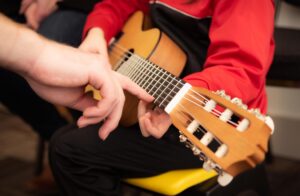
teacher pointing to fretboard of a student's guitar

Setting the Tone of the Class

The time you spend working on basic techniques will pay off. Reminders and remediation will be required as the year goes on — that’s normal and to be expected. Students physically change throughout the course of a school year, which will require adjustments to technique as well.

I am upfront with students from the beginning. I tell them I am not a formally trained guitarist and that I’m learning just like them — only later in life. I share with them my failures and what that failure has taught me. This demonstrates that learning to play guitar is a lifelong journey, and it takes away the pressure on students to feel that they need to do everything perfectly.

YouTube plays an important role in my guitar classroom. There are unlimited videos of guitar professionals using correct technique. Conversations in class no longer focus on me (“Mr. Baker keeps bothering me about my thumb”), but on the professionals on YouTube (“The guitarist in the video plays with their thumb that way, and Mr. Baker is helping me to play that way”).

I support the usage of various styles of guitars and guitar playing because I want students to discover their own unique preferences. This is a great opportunity for them to determine what works for them and what doesn’t.

For students who have never played guitar, all information in class is new. But for students with some guitar experience, we work together to build upon what they already know, not tear it down. My goal is to acknowledge their experience and make them more receptive to learning how to play classical technique. By showing different styles, students can differentiate — “I play a steel string guitar this way, and I play a classical guitar this other way.”

Learning classical technique makes students more versatile guitar players. We watch videos of various classical guitarists to observe solid technique, which we then compare to other styles. I highlight the physical differences between the guitars and how adjustments can be made. I lead the students to the answer rather than just telling them. This creates student buy-in and fosters a positive classroom experience.

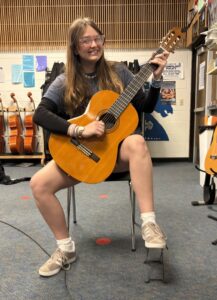
student holding guitar
Proper posture with feet shoulder-width apart.

Posture

I rely on videos of professional classical guitarists with impeccable posture to emphasize its importance. I specifically look for videos of guitarists playing on piano benches to illustrate how the back of a chair is not used or needed when playing guitar.

Students’ feet should be about shoulder-width apart and flat on the floor, so they can easily stand without using their hands for support. I have students take note of where their left foot is because this is where the footrest will be placed. I find that boys have a more difficult time sitting tall in chairs. I believe because boys grow so quickly, once they reach high school, they are not used to sitting tall because they are unable to keep up with the pace at which they are growing.

Footrests

The headstock of a classical guitar should be roughly at eye level. To accomplish this, a footrest is essential. Most footrests have adjustable heights, and I encourage students to experiment to find the right height for them. As a student grows, I remind them to adjust their footrest accordingly.

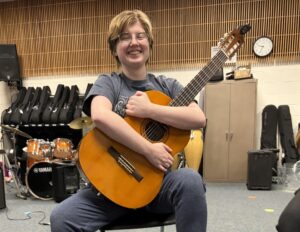
student hugging guitar
Teach proper guitar placement by hugging the instrument.

Guitar Placement

How a student holds the guitar will be a constant work in progress because the hold changes as they advance, grow and develop preferences. One challenge is that students who have played electric or steel-string guitar tend to rest the waist of the guitar on their right leg. The proper instrument placement is for the waist of the guitar to rest on the left leg and the lower bout of the guitar rests between the student’s legs. The back of the guitar should be held firmly against the player’s body.

To show how close to hold the guitar, I do something silly — I hug my guitar and rock back and forth, side to side, telling the class how much I love my guitar. I instruct them to do the same, and they really get into it. This demonstrates not only how to hold the guitar close, but that there is full range of motion while holding the guitar when seated properly.

student holding guitar
This student showcases correct right forearm placement.

Right Hand and Arm

The contact point of the guitar with the right arm is the forearm, not the bicep. An easy check for understanding this is to have students point to their forearm and then their bicep.

Because many students tend to slouch while playing the guitar, both their hands and arms are thrown off. So, I tell students to sit with good posture and hold their guitar. Then, I have students draw an imaginary line from the bridge of the guitar upward toward the lower bout of the instrument. When their finger moves to the area where the face of the guitar meets the lower bout, I tell them to stop. This is where their forearm should be placed.

To demonstrate proper forearm placement, I wave my right hand up and down and have them do the same. This shows that the right arm and hand are free to move at this pivot point created on the guitar. I also demonstrate what not to do by having students place their bicep on the guitar — which causes them to slouch, and their arm is locked in place.

Once students set their forearm in the correct spot with good posture, it’s time to place the right hand on the guitar. At the beginning stages of playing guitar, the easiest place to play with the best sound is the middle of the sound hole.

I have students sit tall, place their forearm correctly on the instrument, make a fist instead of waving to me, and then place their fist in the center of the sound hole by moving the contact point on their forearm as needed. Some students get it immediately, while others will need reminders about forearm placement and good posture (i.e., no slouching).

right hand ready to strum guitar
Proper PIMA.

Rest Stroke

I begin with rest stroke or “alternating I and M.” This gives students a more confident sound to begin with, and it’s much easier to learn than free stroke, which is introduced later in the year. I will tackle free stroke in a future article.

Before teaching rest stroke, make sure students understand PIMA by being able to identify the Spanish words for the fingers: Pulgar (thumb), Indice (index), Medio (middle) and Anular (ring). I have students hold their right hand in the air and wiggle the correct finger as I call out their names. I mirror which finger to begin with and then call out another finger. To keep things fun, I will often show them how using the wrong finger can trip them up. Once students have a working knowledge of the vocabulary for their right-hand fingers, it’s time to place the fingers on the guitar.

At this time, discuss the names of the strings and the corresponding numbers. This is generally an easy step for students to understand, but they will need regular review during the beginning stages.

right hand ready to strum guitar
Incorrect PIMA.

To reinforce PIMA, proper posture and forearm placement, I have students go through the motions of getting into a good seated position, checking the pivot on the contact point with their forearm and placing their fist over the sound hole. Next, I instruct them to keep their fist steady, stick out their pulgar (P) like they’re hitchhiking, and place that finger on the sixth string. Then I have students place their indice (I) and medio (M) on the first string. I demonstrate how to play using both I and M, then encourage them to experiment on their own. We then discuss how they alternate between their I and M, and they discover — with some help from me — that they’re playing “alternating I and M,” which is a core classical guitar skill.

I use the word “pull” rather than “pluck.” This is paired with further instruction on alternating I and M, which is a vertical motion, not a horizontal one. I demonstrate the different sounds made by pulling and plucking the strings. Most students prefer the pulled sound.

using tongue depressor on guitar strings

This leads to another discussion of what makes the plucked sound unappealing. Students see that when they pluck, they create a hook with their fingers and the string is pulled away from the fretboard, making a slapping sound rather than having the sound resonate freely. I help students understand this concept further by using a set of tongue depressors. I have students hold the depressor in their right hand and make a sound on the guitar. If a student moves the depressor along the top of the string, it creates a resonant sound — which is what pulling on the string sounds like. If a student places the depressor under the string, they have to pluck the string away from the guitar, which creates a slapping sound.

Another way I reinforce pulling is to have students think of pulling through the string adjacent to the string they are playing. For instance, if a student is playing on the second string, they must think of playing the second string by following through to the third string. Students cannot do this if they pluck the string by making a hook with their finger. This is also an easy technique to use by connecting with the athletes in the room. To properly throw a softball or football or shoot a basketball, the athlete has to follow through on the motion.

hand gripping neck of guitar
Incorrect left-hand placement with “hitchhiker” thumb.

Left Hand and Arm

In classical technique, the left thumb is positioned behind the neck, which reduces hand strain. Students who have played steel-string or electric guitars will often have a “hitchhiker” thumb. I regularly tell students that I shouldn’t see their left thumb while they are playing.

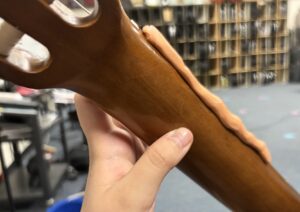
silly putty on the side of a guitar's neck
Put silly putty on the neck of the guitar to keep students’ thumb from creeping up the neck.

One trick I use is to place silly putty on the top of the guitar neck where a student’s “hitchhiking” thumb usually wanders. The putty sticks to the neck without damaging the instrument. When a student’s thumb creeps up the back of the neck, it will hit the silly putty, resulting in an “icky” feeling.

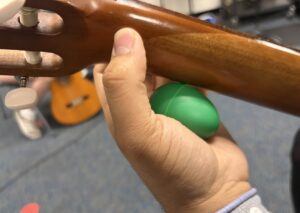
The left forearm and back of the left hand should be relatively straight. I emphasize that the left hand should touch the guitar in only two places: the pad of thumb and the tip of whichever finger is on the fretboard. Some students collapse their wrist and rest their palm on the guitar neck, which creates tension. To correct this, I place an egg shaker in their palm and hold it in place with a rubber band around their hand to create a rounded hand shape.

guitar student holding guitar and egg shaker in left hand
To help students achieve the rounded left-hand shape, use an egg shaker.
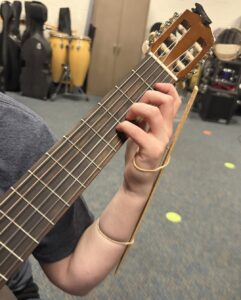
a ruler attached to guitar students left hand with rubberbands
Keep students’ wrists straight with a ruler.

To help students keep their wrist as straight as possible, I place a ruler on the back of a student’s hand and forearm with a rubber band around their palm and another rubber band on their forearm.

Shoulders must be relaxed. I tell students to stand and shrug their shoulders a few times. Then, I have them shrug as high as their shoulders will go and release the shrug as quickly as possible. Afterwards, they describe how their shoulders feel. If it feels like their arms are heavy, they have done it correctly.

Students do the same shrugging exercise while seated, first without and then with their guitar. The elbow should be low, feeling the weight of the entire arm in the shoulders.

The fingers on the fretboard should always be curved, and the tip of the finger is used to press down on the strings. This is challenging for students who have long fingernails. I show videos of professional female guitarists highlighting that if they had long fingernails, they wouldn’t be able to play the way they do.

The final step in the left hand and arm lesson is teaching students the finger numbers: 1 for the index finger, 2 for the middle finger, 3 for the ring finger and 4 for the pinky. Similar to the right-hand PIMA game, I do the same with the left hand finger numbers. Students who play piano may be thrown off by how fingers are numbered for guitar, however, this generally isn’t an issue with the students.

holding a guitar pick

Picks

I teach students how to use a pick, even though they are learning to play classical guitar. To get a fuller sound with a pick on a classical guitar, students must use the leading edge or the long side of the pick. I point out that on steel-string and electric guitars, you use the pointed part of the pick. To ensure that they use the proper side of the pick, I have students hold the pick between their right thumb and index finger with the point of the pick toward their palm.

When playing chords with a pick, I show how the hand will pivot on the forearm, just like when the right forearm was initially placed on the guitar. This allows the arm and hand to move freely. For melodies, I have students place their right pinky on the face of the guitar, which gives a physical reference point for the pick and increases accuracy.

________________________________

The techniques and tips covered in this article aren’t magic. Students need constant reminders and plent of practice — so be patient. As always, rely on the advice of successful guitar teachers. Find a mentor who can help you. Teaching guitar can be isolating at times, and you can feel like you are the only one having certain technique issues with your students. I promise you, you are not. Keep creating guitarists and have fun doing it!

Parent Orchestra Gets the Whole Family Involved

As the Performing Arts Department Chair and Orchestra Director at Annandale High School in suburban Washington, D.C., Annie Ray has a passion for teaching students. But she doesn’t stop there: She teaches music to the kids’ parents, too!

Back in 2018, Ray drew inspiration from her mentor, Brian Coatney, a fellow music educator from her home state of Texas, who had developed a simple but powerful idea: create a community orchestra specifically for the parents of music students in Fairfax County Public Schools. There would be no kids allowed, and no experience required. This would be an adults-only orchestra, where music student parents — many of whom have never played an instrument before or haven’t picked one up since childhood — can have their own creative outlet.

Teacher Annie Ray leading a rehearsal of the Parent Orchestra
Annie Ray leading a Parent Orchestra rehearsal.

Over the past half decade, the Parent Orchestra that Ray directs has grown to more than 225 mothers and fathers and 15 teachers who volunteer to teach it twice a month. The Parent Orchestra, which meets to practice two Thursday nights a month, is so popular that Ray has a waiting list of more than 100 adults eager to participate.

“It sprung up into this beautiful thing,” Ray says. “A lot of these caregivers are people who have never touched a musical instrument in their lives.”

Getting the Parent Orchestra off the ground took equal parts creativity, persistence, and community trust. Ray began with a simple Google Form and the support of her co-founder, Dr. Michelle Keenan, sent out to the families in her school pyramid and quickly grew year after year. Because the project aligned with Fairfax County Public Schools’ goals around family engagement and access to the arts, administrators quickly offered their support.

There was no start-up budget and a small participation fee. Every aspect of Parent Orchestra was built through shared resources and volunteer spirit. Instruments were easy – play your students instrument, even if it was tiny! Teachers across the district volunteered their time to coach sections and design lessons. Ray and her co-director, Austin Johnson-Stawarz handled logistics with scheduling rehearsals, organizing music, and ensuring each caregiver had a place to start, whether that meant holding a bow for the first time or relearning fingerings from decades ago.

What began as a grassroots experiment soon grew into a districtwide collaboration. The simplicity of the model inclusive and community-driven has made it sustainable. “We wanted to remove every barrier possible,” Ray says. “If you can show up, we’ll put an instrument in your hands and make sure you feel welcome.”

teacher conducting parent orchestra rehearsal

The Suzuki Triangle

The Parent Orchestra, Ray says, is an expansion of a music education concept known as the Suzuki Triangle, which promotes a collaborative environment involving three parties –— students, teachers and parents — in the learning process for success. Parents often can help their children with math or reading homework, but unless they play an instrument themselves, they can’t help much with music lessons. In the Parent Orchestra, parents get to experience what their kids do as student musicians, and it helps parents understand the hard work involved. It also leads to fun parent-child bonding over a shared activity: playing the violin, viola or cello, Ray says.

“They have said over and over again that they are doing something just for them and connecting with people,” she says about members of the Parent Orchestra. “A lot of them have said the big thing they get out of it is understanding what their child is actually learning. It’s a way for them to connect with their kid.”

Parents learn empathy about the huge learning curve involved with playing musical instruments, Ray says.

“They get to model resilience to their own child,” she says. “You’re not going to be great at this right away. It is a process — a long process. You’re going to sound really, really bad before you sound good.”

The Parent Orchestra runs during the school year, with an end-of-year performance. The most advanced members of the Parent Orchestra performed in a session at the Midwest Band and Orchestra Clinic in 2024.

Connecting Parents

In a YouTube video from Fairfax County Public Schools about the Parent Orchestra, with the title “It’s Never Too Late,” parents describe how participation has enriched their lives and helped them bond with their sons and daughters.

“When I heard about this opportunity, my husband and I were like, ‘We’re signing up,’” Karen Reiley, a mom, said in the video. “For my son, I think, as he watches us struggle, he finds out that struggling through a process is just part of the process. It’s what’s normal and it is what you have to go through to get to the other side, where you can be accomplished.”

Ray says that the Parent Orchestra draws participants from a geographic area with a wide range of income levels, and people who normally wouldn’t meet and befriend each other are connecting as they learn to make music together.

“You have some incredibly affluent parents who are becoming friends with parents who are having a much more difficult situation in terms of finances,” Ray says. “These cultures that would not have crossed are … not just bringing the students together, but their parents across Fairfax County.

“We’re an open door,” Ray says. “We’re a community.”

two parents making notes on sheet music

District-Wide Camaraderie

As for the 15 teacher volunteers who teach Parent Orchestra, they, too, get a chance to get to know each other and learn from their teaching styles, Ray says. Student teachers learn from watching more experienced teachers instruct the Parent Orchestra.

“Normally … we don’t get to see each other,” she says. “Now, we’re watching each other teach.

“It doesn’t just benefit the parents; it benefits us as well,” Ray says. “You’re watching your colleague teach and you’re learning how they approach things.”

Key leaders in the school district — like school board members, principals and even the superintendent — sometimes attend rehearsals. This gives them an appreciation for the performing arts, Ray says.

“It’s an activism piece for community when the parents are right there in front of the superintendent,” she says. This sends the message to decision makers: “This means so much to us, and the arts are important,” Ray says.

Ray has earned recognition for leadership in several areas, including winning the 2024 Grammy Music Educator Award and being named a 2025 Yamaha “40 Under 40” educator. Her accomplishments are varied and far-reaching. In addition to the Parent Orchestra, Ray also founded an orchestra for students with disabilities, implemented an arts-based, anti-absenteeism program and co-founded Motherhood and Music Education, which provides resources and support for caretakers/music teachers on leave.

Photos by Alene Boghosian

Key Centers vs. Tonal Centers

What is the first question most musicians ask each other before playing a song, or starting a jam? It’s usually “what key are you playing in?”

Establishing the key of a song is paramount to working together as a band, and there are 15 keys to choose from: One natural key, C (which has no sharps or flats), seven sharp keys, and seven flat keys.

The seven sharp keys are as follows: G, D, A, E, B, F#, C#.

The seven flats keys are: F, B♭, E♭, A♭, D♭, G♭, C♭.

The key center is the overall key that a musical piece is written in, and will contain some, or all of the seven single notes and chords found within that major or minor key. Key centers are sometimes called the parent scale.

In addition to understanding the key of a musical piece, we also need to identify the tonal center of the harmonic progression within the song. This is the resolution point of a chord progression or melody within the overall key of the musical piece. It’s where we hear (and feel) the musical movement naturally coming to rest … and where it finds a resolute conclusion. The tonal center is usually the first chord in the progression, and, as we will see shortly, there are seven possible tonal centers within each key center.

Now that we’ve defined them, let’s dig into each of these terms in greater detail.

Key Centers

The seven-note major scale is represented in formal notation by a key signature that appears after the treble clef and before the time signature in the first measure of music. These key signatures tell us what key the musical piece has been written in. This allows the composer to designate the key without writing sharps or flats as “incidentals” throughout the entire manuscript. We simply apply those sharps or flats to the notes they apply to throughout the musical piece.

Here are the seven sharp and flat key signatures:

Musical notation showing the seven sharp keys and the seven flat keys.

Another important aspect of key signatures is that they allow us to retain the major scale formula of intervals when we transpose harmonic structures and melodies into alternative keys. (For more information, check out this blog.)

That interval formula is a set sequence of whole steps (two frets on the guitar) and half-steps (one fret) between the seven notes. The interval formula used to create every major scale in music is:

Whole – Whole – Half – Whole – Whole – Whole – Half

The whole step is often represented as a W, and the half step as an H.

As an example, here’s how the major scale of A defines the intervals between the notes and chords.

W                 W               H             W              W               W              H                  (Interval Formula)

I (Tonic)    2                3              4               5                6                7                    (Scale Position)

I                    II               III            IV              V               VI              VII                (Roman Numerals)

A                  B               C#           D               E               F#              G#                     (Note Name)

Ama        Bmi        C#mi      Dma         Ema       F#mi       G#dim                      (Triads)

Ama7     Bmi7      C#mi7    Dma7       E7           F#mi7    G#mi7(5)              (Sevenths)

This shows us a complete set of melodic tones, as well as the chords that are built from the root of each of those tones. Once we have this information, we can determine the key of a chord progression or melody by simply looking at the score or chord chart.

As you can see, there are only two places where a semi-tone interval occurs: between the third and fourth degree, and between the seventh and eighth degrees (the octave). In addition, major triads occur on the first, fourth, and fifth degrees of the scale, while minor triad chords occur on the second, third, and sixth degrees of the scale. A diminished chord occupies the seventh degree.

Armed with this information we can easily determine the overall key of a musical piece, and the overall key center. It also helps us visually identify the interval relationships between the melodic tones and the harmonic structures within every key.

Tonal Centers

As previously mentioned, the tonal center of a chord progression is usually the first chord of the sequence. As an example, let’s take a simple chord sequence in the key of A, and assign a modal name to that resolution point. (The modal name is simply another way of telling us what scale position the tonal center occurs on within the scale.)

The first modality of the major scale (Ionian mode)

I             2mi         3mi           4             I

Ama7    Bmi7     C#mi7      Dma7      Ama7   =  The A Ionian mode

Ima7      IImi7      IIImi7      IVma7      Ima7

Here we have a chord progression in the key of A major that starts on the first chord of the scale, sequences through the next three diatonic (i.e., from the same scale) chords, and then resolves nicely back to Ama7.

This first mode of the major scale is called Ionian mode. This is a Greek name that we use to identify the first mode, and the tonal center of the major scale.

Next, let’s invert this progression to change the tonal center.


The second modality of the major scale (Dorian mode)

2mi         3mi            4             I              2mi

Bmi7     C#mi7       Dma7      Ama7      Bmi7  =  The B Dorian mode

IImi7      IIImi7       IVma7      Ima7        IIm7

This progression has been created using the same four chords in the A major scale, but the first chord in the progression is now the second chord in the scale, Bmi7.

Not only can you identify this tonal center shift visually, when you listen to it, you can also hear that this new sequence resolves nicely to the Bmi7 instead of Ama7.

Now let’s invert the progression again to shift its tonal center.


The third mode of the major scale (Phrygian mode)

3mi          4              I             2mi           3mi

C#mi7    Dma7      Ama7     Bmi7         C#mi7  =  The C# Phrygian mode

IImi7       IVma7      Ima7      IImi7         IIImi7

Here, the progression starts on the third chord of the major scale, and likely ends there too. On listening we can confirm this tonal center shift to what’s known as the Phrygian modality within the key of A.

Let’s invert the chord sequence again to further illustrate the point.


The fourth mode of the major scale (Lydian mode)

4              I             2mi        3mi            4

Dma7     Ama7      Bmi7      C#mi7       Dma7  =  The D Lydian mode

IVma7    Ima7        IImi7      IIImi7         IVma7

The first chord of the progression is now the fourth chord within the parent scale. On listening we can further confirm the tonal center of the progression to Dma7 … the fourth chord in the key of A. (This is known as the Lydian mode.)

Let’s complete our study of tonal center modalities using the remaining three chords built from the A major scale: E7, F#mi7, and G#mi7(♭5).


The fifth mode of the major scale (Mixolydian mode)

5           6mi          4              5

E7       F#mi7      Dma7       E7    =  The E Mixolydian mode

V7         VImi       IVma7      V7

The first chord is E7, the fifth chord in the key of A major. This is the tonal center of this progression, known as the Mixolydian mode.


The sixth mode of the major scale (Aeolian mode)

6mi          4               3mi         Iimi         6mi

F#mi7     Dma7        C#mi7    Bmi7       F#mi7   =  The F# Aeolian mode

VImi        IVma7        IIImi        IImi        VImi

Here, the first chord is F#mi7, the sixth chord in the key of A major. This is the tonal center of this progression, known as the Aeolian mode.


The seventh mode of the major scale (Locrian mode)

7mi7(♭5)        5         6mi         4            7mi7(♭5)

G#mi7(♭5)     E7     F#mi7    Dma7     G#mi7(♭5)  =  The G# Locrian mode

VII                  V7      VImi        IV             VII

Finally, the first chord of what is called the Locrian mode is G#mi7(♭5), the seventh chord in the key of A major. This is the tonal center of this progression. However, diminished and half-diminished chords are dissonant in nature, and therefore unlikely to sound resolute or rested … so this tonal center won’t sound and feel like a strong resolution point.

Tonal Center Recap

  • A Ionian Mode: A chord progression built from the A major scale that resolves to the first chord, A or Ama7.
  • B Dorian Mode: A chord progression built from the A major scale that resolves to the second chord, Bmi or Bmi7.
  • C# Phrygian Mode: A chord progression built from the A major scale that resolves to the third chord, C#mi or C#mi7.
  • D Lydian Mode: A chord progression built from the A major scale that resolves to the fourth chord, Dma or Dma7.
  • E Mixolydian Mode: A chord progression built from the A major scale that resolves to the fifth chord, Ema or E7.
  • F# Aeolian Mode: A chord progression built from the A major scale that resolves to the sixth chord, F#mi or F#mi7.
  • G# Locrian Mode: A chord progression built from the A major scale that resolves to the seventh chord, G#dim or G#mi7(♭5).

Melodic Confirmation

Why is determining the tonal center of a progression so important? Well, when we can determine the key, and the tonal center within that key, we can apply the correct major scale modality to improvise and resolve correctly over the tonal center chord.

To further illustrate this point and prove its value melodically, let’s try an exercise. Start by playing an Ama7 chord, then play the A major scale from A up to A. This is A Ionian Mode and works perfectly because the chord was built from that sequence of notes.

Now play a Bmi7 chord, then play the A major scale from B up to B. This sequence of notes (B Dorian mode) works directly over the chord that’s built from those tones.

Continue with this sequence through the remaining five chords and scale sequences, and you will hear why improvising towards the tonal center is so effective and powerful.

Check out the video below to see and hear the full sequence of chords and scale modalities in the key of A.

The Video

The video above features a cool E Mixolydian chord progression and solo. I’m making sure my scale, arpeggio and double-stop lines all resolve nicely to the tonal center chord and chord tones of E7.

The Guitar

Three views of a black electric guitar.

The guitar I’m playing in both of these videos is the exciting new Yamaha 60th Anniversary Revstar RSP20B, crafted to celebrate six decades of excellence. This superb instrument offers a perfect blend of visual appeal and musical performance, featuring a Göldo tremolo unit and Gotoh locking tuners that deliver excellent tuning stability, dynamic range, and expressive playability. The bone nut further enhances the guitar’s natural and balanced resonance.

Like other Revstars, the RSP20B features a chambered body designed to sculpt tone and reduce weight, with carbon reinforcement in the body and neck to improve vibration transfer. The push/pull tone control of this model also functions as a Focus switch, activating a passive boost that emulates overwound pickups for darker highs and enhanced mids and lows for more aggressive tone. In addition, the five-way pickup selector introduces a subtle phase shift in positions 2 and 4 by slightly delaying the opposite pickup, offering a fresh take on classic “in-between” sounds.

The RSP20B has a flame maple top and comes in a gradient Noble Black Burst finish, blending luxurious aesthetics with unique character. The headstock and tremolo unit feature a commemorative logo, while the back of the headstock is stamped with a special 60th Anniversary hanko (a traditional Japanese personal seal stamp).

The Wrap-Up

When we understand that there are seven possible tonal center resolution points within each key center, we can write chord progressions with unique moods and modalities, and then apply the major scale in its correct sequence to resolve perfectly over those resolution points within the key. Understanding key centers and tonal centers really is the key (pardon the pun) to musical mastery over your guitar.

For more information, be sure to check out my blog postings Major Scale Modes, Part 1: Ionian Mode and Major Scale Modes, Part 2: Dorian Mode.

PHOTOGRAPHS COURTESY OF THE AUTHOR.


Check out Robbie’s other postings.

How to Set Up a Guitar Classroom

We all have different guitar teaching situations, but we have the same goals — to create an environment where students can learn and to develop processes that set students up for success. These processes are crucial during the first few weeks of class, and once established, teachers can manage them with minimal effort.

The following suggestions are based on what I have learned from other guitar teachers and what has worked — and hasn’t worked — for me.

I teach classical guitar technique. The instruments are easier to manage, versatile and lead to the best sound quality. Students can learn a technique on a classical guitar then easily apply it to a steel-string or electric guitar. The guitar program at McQueen High School has acquired several steel-string guitars over the years, in addition to 12-string guitars, electric guitars and Yamaha SILENT Guitars. Students are encouraged to experiment with different types of guitars, as it builds interest in the full world of guitars and encourages them to be lifelong musicians.

small hourglass with letter tiles that spell out "time"

Patience is Key

The following processes require an investment of time and, in some cases, money. Many of the students in beginning guitar have no idea what an instrumental music class is like, so they will experience a paradigm shift that is completely different from their other courses.

Guitar teachers must invest time, patience and understanding especially at the beginning of the school year, so their class will be set up to move faster and more smoothly than if these items and considerations were not addressed.

rack holding guitars

The Physical Space

Most guitar students are not in band, choir or orchestra. Wherever guitar is taught, make sure this is reflected in what you call the space. It took me a long time to stop saying guitar was taught in the “orchestra room,” which gave the impression that my guitar students were imposters in a space meant for other students. How condescending and demeaning! This unintentional slight may prevent buy-in with students, so I regularly practice being mindful, and I call my room the “strings” room.

Music rooms are complete chaos even before school starts. On any given day, I’ll have a kid on the drum set, another playing piano, others watching TikTok on their phones and everything in-between. With this level of mayhem, we must ensure there are minimal physical distractions in our teaching space. As with all instructional spaces in music, the room should be as tidy as possible. Make sure every piece of equipment, music, folders, instruments and countless other items in the room have specific places to live.

For the instruments themselves, there are multiple ways to store them. I recommend rolling guitar storage racks that have two rows to allow multiple styles of guitars to be stored. Our guitar program has five of these racks — all have held up quite well. Each week, at least one rack is rolled from the strings room to the cafeteria for a performance. These racks also allow for flexibility in the arrangement of all the equipment in the room, so students can use the space as efficiently as possible. I also allow students to store their binders, footrests and books inside their cases, which reduces the need for additional racks and shelves for these items.

colored dots on floor of rehearsal room
Colored dots identify where the different guitar sections should sit.

Student Setup in the Space

As a high school orchestra teacher, I took a lot for granted. Incoming freshmen knew how to put instruments into cubbies, stack chairs and put music stands onto the racks (always a struggle!). Do orchestra students magically know these simple things? No! There are countless elementary and middle school music teachers who, over the course of several years, teach kids how to put their instruments away, stack chairs and get stands properly onto a rack (sort of). Because of this, students in my orchestra classes can get into their places quickly and are ready to play by the time class starts.

On the other hand, guitar students need help on how to properly get themselves ready for class. I have tried a setup of columns and rows. I also had students sit in arcs like a traditional orchestra setup. Both have advantages and disadvantages, which I encourage you to explore.

I took way too much time explaining the setup to students — how many rows and columns there are or the configuration of the arc, etc. I was constantly reteaching and reinforcing setup. One day, I walked into a middle school choir classroom and saw hook-and-loop fastener dots on the floor that showed students where to place their chairs — this changed my whole world.

I immediately ordered a set with different colored dots, and it quickly transformed the layout of my guitar class. The dots help me to quickly see where any setup issues may be and easily remedy them.

Helpful tip: Use different colored dots to identify sections, so students know blue is guitar 1, orange is guitar 2, etc.

Our department is fortunate to have a music stand for every guitar student. This ensures that every student is writing the same information on their own music on their own stand, as needed.

guitar student sitting
Student with proper equipment: guitar, tuner and footrest.

Individual Student Equipment

I have learned from other teachers and stumbled upon several ways to keep individual student equipment orderly. Having taught for over 20 years, I understand issues may arise when making purchases for my classes. Building instrument inventory and equipment stock takes time. With limited budgets, we must always consider cost, quality, durability, playability and longevity.

Work with your preferred vendor to create bids when making purchases. This builds a relationship with the vendor, allowing them to potentially seek more competitive pricing and buy-in for your guitar program. There’s also a high likelihood the vendor has experience helping other guitar teachers, so they can help recommend products at specific price points, which will be advantageous.

student label on guitar headstock
  • Labels: Everything must have the student’s name on it. Do not be afraid of mail merge — it is your friend. I can crank out name labels, nametags for music stands, and all sorts of handy stuff by using mail merge. If you’re not familiar with mail merge, check YouTube.
  • Guitars: Every guitar the school owns is assigned a school inventory code that helps with fast identification. The guitars are labeled as “McQGxxx.” This tells me it’s a McQueen Guitar (followed by a three-digit number I create). I engrave this ID using an inexpensive engraver on the guitar tail. If I’m super on top of things, I’ll create individual labels for the guitars with my label maker and put the label on the back of the headstock.
name tag and pick holder on guitar case
Fasten name tag and pick holder onto guitar cases.
  • Name Tags: Several years ago, I purchased luggage tags with our school’s logo from an online vendor and attached one on every student’s instrument case handle. I print labels with the student’s name and ID number on a barcode. If the student uses a school instrument, I also have a label with all the instrument’s information including make, model, school inventory code and serial number. The orchestra boosters subscribe to an online music program management system that keeps track of the guitar inventory. I can easily merge the student and guitar information into my school district’s instrument rental contract and then distribute them to students, reducing time and paperwork.
  • Footrests: Because I teach classical style, each student has an assigned foldable footrest. Some guitar teachers shy away from using collapsible footrests and use blocks of wood instead. While wood blocks may be less expensive and more durable, my students take decent care of the footrests. The main reason I opted for collapsible footrests is that they take up less space in my classroom and are easy for students to take home to practice. A handful of them will wear out during the school year, but I keep replacements on-hand, and the folding footrests are easily stored in guitar bags.
  • Digital Tuners: It drives me crazy when a student says, “I don’t need a tuner, I can tune by ear.” Tuners are a non-negotiable in my class. If a guitar is out of tune, it sounds bad. I put students’ names on tuners with a silver or gold Sharpie. You can find affordable tuners online, sometimes in multi-packs. If you’re looking at a tuner from an unknown brand, order one to test for accuracy before ordering a class set.
  • Pick Holders: There are three locations for a pick: in a kid’s hand, inside the kid’s guitar or somewhere in the “Land of Missing Picks.” To help reduce lost picks, I use pick holder key rings that I attach to the luggage tag on the guitar case handle. These are inexpensive and can be purchased through most retailers.
  • Guitar Picks: You can buy picks in bulk for a reasonable price. I order three thicknesses of picks for students to try, then they can figure out which one they like best. This has created a pick economy in guitar classes, where kids start trading and bartering picks. I also invested in a pick punch that can be used on old gift cards or any other plastic card. Students love using their previous year’s ID to make a pick with their picture on it.
  • Method Books: There are many high-quality, comprehensive guitar method books on the market. As with all method books, they have strengths and weaknesses. In my guitar program, we primarily use two different method books — one for note reading and chord reading and the other for classical style.
  • Strap Buttons and Straps: Even though I teach classical technique, I equip all our guitars with strap buttons and guitar straps. Why? Because this teaches students to play both seated and standing. Standing makes large performances, and some rehearsals with a lot of students, more manageable. The buttons can be purchased in multi-packs and can be installed with a power drill and screwdriver. There are many how-to videos online that detail how to install the buttons.
putting a puzzle together

Find Your Solutions

These are just a few organizational strategies that have served me well over the years. If you’re starting a new guitar program, seek advice from as many guitar teachers as you can.

Don’t be afraid to try something. If it fails, try something else.

Good luck with your journey!

Top Five Irish Artists

Let’s celebrate Saint Patrick’s Day by paying homage to five of the most famous Irish musicians … including one that will probably come as a surprise:

1. U2

They’re inarguably the most well known band to ever come out of the Emerald Isle. Originally a six-piece, the group formed in Dublin in 1976. Within a few short years, singer Bono, guitarist David “The Edge” Evans and their compatriots Adam Clayton and Larry Mullen Jr. were selling records by the millions and setting attendance records in stadiums the world over. They’ve had so many hits over the decades, it’s hard to pick just one or two, but to get a flavor of the group’s powerhouse sound, check out “Pride (In The Name Of Love)” and “I Still Haven’t Found What I’m Looking For.”

2. Van Morrison

Born in Belfast in 1945, Van began playing guitar at the age of 11 and added piano and saxophone to his repertoire while still in his teens. In 1963, he formed the R&B group Them (who had a major hit in 1964 with his song “Gloria”) before launching a successful solo career and giving us two of the most quintessential sing-along tracks ever: “Brown Eyed Girl” and “Moondance.”

3. Enya

Born Eithne Pádraigín Ní Bhraonáin, she’s Ireland’s top-selling solo artist ever, with a distinctively esoteric musical style that includes folk melodies, extensive voice layering and dense reverbs, as exemplified in her hits “Orinoco Flow” and “Only Time.” Her songs have also been featured in the Lord of the Rings trilogy.

4. The Chieftains

Formed in 1963 under the leadership of Paddy Moloney, this group has become synonymous with traditional Irish folk music, with a sound that is almost entirely instrumental and largely built around uilleann pipes. Over the years they have collaborated with numerous artists, including the aforementioned Van Morrison, as well as Luciano Pavarotti, The Rolling Stones and Roger Daltrey.

5. Paul McCartney

Yes, that Paul McCartney. Like many Liverpudlians, Macca is of Irish descent, and, with his post-Beatles band Wings, he released a single entitled “Give Ireland Back to the Irish” in February 1972 as a protest to the events of Bloody Sunday, when British troops in Northern Ireland shot dead thirteen Irish Republican protestors. The record was immediately banned in the UK, and was largely overlooked in the United States too, reaching only number 21 on the Billboard Hot 100 … but it did top the national charts in Ireland.

What’s the Difference Between Fiddle and Violin?

In the world of stringed instruments, it’s a common question. After all, at first glance, a fiddle and a violin look alike. They seem to sound the same, too, when it comes to tone and range. But there must be a clear distinction, right?

Actually, no. In fact, there is no significant physical difference between the instruments. Rather, what demarcates the two is mostly the music being played and the musical approach being taken. When playing folk, country or bluegrass, for example, the instrument is understood to be a fiddle, but when playing classical music, it’s a violin. Want to know more? Keep reading …

THE VIOLIN

The violin is perhaps the most well-known instrument in the string family. The word “violin” comes from the Italian word violino, and the first instruments of the same name appeared around the 16th century. When a bow is pulled against the violin’s four strings (a technique called “bowing”), vibrations are created that are amplified by the instrument’s hourglass-shaped wooden body. The violin’s sound emanates from two f-shaped holes carved in the body, called “f-holes.”

View of violin from above.
A Yamaha violin.

A violin’s strings are tuned to the notes G, D, A and E. The instrument operates in the soprano range and its neck is fretless. Each string is tuned by one of four tuning pegs at the top end of the neck (the “scroll”).

Diagram.
The parts of a violin.

Players hold the violin with one hand, using that hand’s fingers to press down on different areas of the strings along the neck, bowing the instrument with their other hand. (The strings can also be plucked with the fingers, creating a brighter, more staccato sound.) The chinrest at the bottom end of the violin is placed between a player’s chin and shoulder to steady it.

When performing, a violinist will typically take advantage of the instrument’s entire range of pitches, playing all over the fingerboard, from the notes nearest to the tuning pegs to those all the way up the neck. This, as we will see shortly, differs from common fiddle playing.

THE FIDDLE

The term “fiddle” is a generic, colloquial or even just an affectionate name for a violin. The word is likely derived from the Latin fidula — an ancestor of the bowed stringed instrument known as a lira. Like the violin, the fiddle has four strings tuned to G, D, A and E, and, again, a bow is used to create friction with the instrument’s strings to create the sound, which emanates from a pair of f-holes carved into the body. (As with the violin, the player can also pluck the strings with their fingers, though fiddle is mostly bowed.)

A fiddle often sounds as if it’s being bowed faster than a violin. One reason for this is that a fiddler will generally only play the notes nearest the tuning pegs, keeping his or her hand in what is known as “first position” (see illustration below). In contrast, violinists tend to utilize the entire fingerboard and full range of notes.

Diagram.
First position fingering.

PHYSICAL DIFFERENCES

By and large, fiddle and violin are pretty much the same physically, but there can be some minor structural differences that are worth noting. For example, some fiddles may have a flatter (i.e., less arched) bridge as compared to violins. In effect, this brings the strings closer to the instrument’s neck and fingerboard for an easier “action,” allowing fiddlers to do things like play two or more notes at a time and facilitating faster playing.

Another difference is the type of strings preferred by violinists — gut or synthetic-core — versus the steel-core strings typically chosen by fiddlers, who prize the crisp sound those strings lend to the music.

Finally, some modern fiddles may include a fifth, lower C-string, although this distinction can be more of a grey area when considering contemporary electric violins, which are also often called “electric fiddles,” given that some electric versions of the instrument also offer a lower C-string.

FIDDLE VS. VIOLIN MUSIC

The fiddle is used in country and bluegrass, Cajun and Appalachian string bands, Irish and Celtic folk tunes, and even traditional West African music — genres that often call for solos or other musical embellishments. Fiddle music is usually performed at a fast tempo designed to get listeners up and dancing,

Violin is used mainly to play classical music, as performed by orchestras, symphonies and chamber groups, all musical environments prized for precision over creative interpretation. As such, violin music rarely, if ever, calls for improvisation.

Classical violinists are trained to be very precise in how they play a piece; there must be no deviation from the music as it was written by the composer. Fiddlers, on the other hand, are given the freedom to interpret the music they play in their own unique way, and are also encouraged to create their own signature playing style.

For an example of some great fiddle playing, look no further than country icon Alison Krauss, who both plucks and bows her fiddle in the country tune “Choctaw Hayride,” or check out Michael Cleveland & Flamekeeper’s “Lee Highway Blues.” An example of technical violin music can be found in this performance of a Beethoven Concerto, which involves more musical precision.

PLAYING DIFFERENCES

The biggest differences between fiddlers and violinists lie in the music they tend to play and the approach they take to playing their instruments. Fiddle music is more common during celebratory get-togethers like square dances, while violin music is mostly meant for more cerebral, contemplative musical performances. Fiddlers also often play “by ear,” without sheet music, whereas classical violinists adhere strictly to the written notation.

Playing style can vary subtly amongst violinists and fiddlers, but one common difference is the way a fiddle player holds their instrument. Fiddlers tend to rest their palm against the neck, instead of allowing space between it and their hand, as more technically-minded violinists might do. In addition, when using the bow, fiddle players sometimes place their hand higher up the bow than violinists would, making it easier to play at fast tempos. Finally, fiddlers often employ non-traditional playing techniques, such as string bending or extended double- and triple-stops (where two or three strings are bowed simultaneously).


Yamaha offer a wide range of student violins and electric violins.

Ask Me Anything

The Ask Me Anything Wall was designed to give educators and students attending The Midwest Clinic and the Texas Music Educators Association (TMEA) convention a space to ask questions that they might be too afraid to ask. Attendees could write their questions and hang them on the wall.

Yamaha staff would take each question and reach out to key subject-matter experts — Yamaha Performing Artists, Master Educators, “40 Under 40” educators, staff and industry partners who were also at these shows — to answer the questions.

Corey Graves
What’s your best advice for a new educator?
  1. Find a great mentor!
  2. Attend conferences!
  3. Hear other directors’ ensembles.
  4. Record your ensemble often.
  5. Give yourself grace!

Corey Graves, a 2023 “40 Under 40” educator and Director of Bands at Tony A. Jackson Middle School in Forney, Texas

How do you start a guitar program?

“Attend a teaching guitar workshop!” Dr. Rob Pethel, musician, educator and researcher based in Atlanta, who started a classroom guitar program in 2008

How do I approach taking the lead without stepping on senior teacher’s toes?

“It’s important to keep the senior teacher ‘valued’, so do your part to continue to move the relationship in a positive direction. From there, use your voice to add your unique approach.” James Stephens, Director of Advocacy and Educational Resources at Music for All

Joe LaMond, Marcia Neel and Bob Morrison advocating for music education
From left, Joe Lamond, former NAMM president, Marcia Neel and Bob Morrison
How do I reassure parents and students with an unstable high school program to keep going?
  1. Remain NEUTRAL with parents.
  2. NEVER speak ill of others.
  3. ALWAYS make the conversation about the student.
  4. ALWAYS promote continued music-making in high school. Seek additional music pathways like private lessons.
  5. ALWAYS visit with your administration.

Marcia Neel, Yamaha Master Educator, Senior Director of Education for Yamaha and President of Music Education Consultants

  1. Always have a music parent or representative at the school board meeting.
  2. Be visible even when you are not asking for something. This builds respect, which will lead to trust with the board for future needs.

Bob Morrison, Founder and CEO of Quadrant Research, the nation’s leading arts education research organization

Gillian Desmarais in class
Gillian Desmarais
How do you use technology in the classroom?
  1. Find your students’ genre interests.
  2. Tailor lessons within that style.
  3. Use MIDI controllers and mics.
  4. Let students help and have fun!

Gillian Desmarais, a 2024 “40 Under 40” music educator and Member of the Board of Education for Technology in Music Education (TI:ME)

What are easy ways to incorporate music tech in my classroom?

“It depends on the class, grade and what you want to accomplish with tech. Tech for tech sake is never a good idea. That being said, start with whatever tech you have. Take ONE lesson and see how tech can be used by the students to show they understand the concept.” Dr. Barbara Freedman, Teacher of Electronic Music Composition and Music Production at Greenwich High School in Connecticut and Board Member of Technology in Music Education (TI:ME)

When should you increase your fees?

“Your community will let you know, but you have to ask. Get their input, present your plans and a summary of cost with the ‘why’ and they will follow.” Christopher Ferrell, Yamaha Performing Artist and the Supervisor of Instrumental Music for the Cobb County School District in Atlanta

Yamaha Vibraphone
Vibraphone
What’s the difference between a vibraphone and a marimba?

“Vibes have metal bars with damper pedal. Marimbas have wood or synthetic bars.” Joel Tetzlaff, Product Marketing Manager for Percussion and Drums at Yamaha

What resources exist to diversify repertoire easily — composer diversity and musical diversity?

“I’d suggest the Institute for Composer Diversity. It’s great for composers and styles!” Rob Deemer, Professor and Head of Composition at the State University of New York at Fredonia and Founder of the Institute for Composer Diversity

Should I use my Julliard full ride or live my dream and go to school with an education degrees?

“First of all, many congrats on your Julliard acceptance and full ride! Impressive! I would advise you take advantage of that performance degree and then get a master’s with education with your teaching certification!” Lamar Burkhalter, Yamaha Performing Artist and the Music Director for the NFL Houston Texans

happy elementary students hugging teachers
For elementary teachers, how do you remember ALL their names?

“Meet them at the door and sing ‘roll call’ — ‘What’s your name’ and then ‘What’s his/her name?’ This works well and is quick.” Dr. Kathleen D. Sanz, Executive Director of the Florida Music Education Association

Matthew Martindale
What are the best ways to secure funding?
  1. Look into state department grants.
  2. Local organizations will sponsor the program.
  3. Business sponsors 50/50 split with student and program.

Matthew Martindale, a 2021 “40 Under 40” music educator and Band Director at Shelby County High School in Alabama

My program is small. Our budget is tiny. How can I build a bigger program?

“Find sources of funding BEYOND traditional arts. Look at city grants, CTE, workforce development. Find local partners to sponsor your program.” Danielle Collins, 2022 “40 Under 40” and Director of Arts, Media and Entertainment for Inspire EDU

How do you balance family, health and life while still having a successful and competitive program?
  1. Don’t worry about being competitive, be your best and it was take care of itself.
  2. Take time to invest in yourself, friends and family.
  3. Be an artist every day.
  4. GO FOR IT!

Richard Floyd, Yamaha Master Educator and Texas State Director of Music Emeritus
at The University of Texas at Austin

close up of student playing violin
Photo by CKYBE/Adobe Stock
What are unique ways to recruit string students for my orchestra program?

“Have older students perform, then have them teach a member of the younger rising class an open string song.” Dr. Rebecca MacLeod, the Daniel J. Perrino Endowed Chair in Music at the University of Illinois Urbana-Champaign and Board Member of the American String Teachers Association

“Let those recruits see you in action with your students! Show them what’s possible. High energy and fun!” Jeffrey Grogan, Yamaha Master Educator and Professor of Conducting at Baylor University in Waco, Texas

Have you ever totaled an instrument?

“Unfortunately, yes!! I accidentally destroyed a $10,000 violin at a trade show.” Doug Steinmetz, Director of Sales at Yamaha

Given the challenges students face today how are you fostering hope and positivity in your classroom?

“Model hope and positivity in all words and actions. Listen to student needs and make all students the center of your program. This will create a community that all will flock too.” Anne Fennell, Western Division President of the National Association for Music Education, Advocacy in Action Committee Chair for Music for All and a retired educator

How have you broken through walls/cross through invisible red tape?
  1. Don’t let anyone tell you there is something you can’t do — including yourself!
  2. Just be yourself, get recognized for doing things well, do the thing despite any “barriers” (from a female high school band director who was repeatedly told she can’t).

Charlene Cannon, a 2024 “40 Under 40” and Band Director at Horizon High School in Winter Garden, Florida

Love Music painted on wall
What is music to you?

“Music is a universal language. It’s entirely up to your interpretation and will help you build life-long communities. It’s a constant in life, and always there for you!” Natalie Morrison, Senior Segment Marketing Specialist, Education and Co-Host and Co-Founder of ReVoicing the Future

How do you know when your expectations for your students are too high?

“They’re never too high!” — anonymous music educator

Marcia Neel
How do I advocate for my music program?
  1. Engage your principal directly. If in middle school, have them help you give out instruments to your “newbies.”
  2. Invite your principal to attend parent night to speak about what students learn in music … even beyond the notes. Provide bullet points.
  3. Consider how you market your program as opposed to advocate for it!
  4. Stay positive! Share the good news!

Marcia Neel, Yamaha Master Educator, Senior Director of Education for Yamaha and
President of Music Education Consultants

Is going into music as a career a stable choice?

“Absolutely! After a 40+ year career as a band director, clinician and private teacher, I still love what I do! Plus, teacher retirement is a great program!” Cheryl Floyd, Yamaha Master Educator and retired music educator

Why pursue music?

“You’ll know that music is right for you when you become ‘soul sick’ when you stay away too long.” Omar Thomas, Yamaha Master Educator and Assistant Professor of Composition at The University of Texas at Austin

“Music makes the world a better place every day. Musicians of any age/love/get to share something wonderful!” Jeff Conner, a Yamaha Performing Artist and an original member of the Boston Brass

Jeff Conner of Boston Brass playing the trumpet
Jeff Conner of Boston Brass
How much does it cost to make a trumpet?
  1. Time
  2. The right development artist
  3. Research and development
  4. 3-6 years
  5. Tooling to make the instrument
  6. Test and evaluation with many players
  7. Prototyping and refinement
  8. Final vetting with other artists

Wayne Tanabe, Senior Technical Manager at Yamaha Artist Services

Gary Lewis
How do you continue to love music having a director that doesn’t make it fun?

“You clearly love music or you wouldn’t have asked this questions! Good for you. Challenge yourself to ‘bring the joy’ to rehearsals and your music-making. Try to ‘infect’ those around you and don’t let others get you down. I admire your determination! Be a leader and example and most of all, have FUN! Gary Lewis, Yamaha Master Educator, Director of Orchestra Studies at the University of Colorado Boulder

How do we address the voucher situation with our parents?

“Be the reason they stay! Market and brand the positive!” Joe Clark, Band Director at La Porte High School in Indiana

Do you have a question that you would like to pose to an expert? Please send an email to educators@yamaha.com, and we will send your question to a Yamaha Master Educator, Performing Artist, “40 Under 40” music educator or one of our partners and friends in the music industry.

The Magic of “Me Time”

In modern professional culture, particularly in education and service-oriented fields, “me time” is often viewed as optional or unnecessary. Many feel an unspoken expectation to be constantly available, responsive and productive. Emails arrive after hours, planning extends into evenings and personal commitments are postponed in the name of responsibility. While dedication and passion are admirable, the long-term cost of neglecting personal time is significant.

Research consistently demonstrates that chronic overwork and lack of recovery contribute to burnout, emotional exhaustion and declining job satisfaction (Maslach & Leiter, 2016). However, many professionals continue to push forward, believing they will eventually rest when things slow down. For most, that moment never arrives. Sustainable success is not built on constant output. It is built on intentional balance.

“Me time” is not a rejection of professionalism. It is an essential component of it. When individuals protect time to refuel, they bring greater clarity, patience and creativity to their work. Achieving this balance does not require large lifestyle changes or rigid boundaries. Instead, it happens through small, consistent habits supported by organization, intentional scheduling, and systems that honor both work and personal needs.

man working on laptop outside

Reframing “Me Time” as a Professional Skill

One of the greatest barriers to work-life balance is mindset. Many professionals equate rest with laziness or fear that setting boundaries signals a lack of commitment. Occupational health research suggests the opposite. Individuals who regularly recover from work demands are more engaged, effective and resilient over time (Sonnentag & Fritz, 2007).

Reframing “me time” as a professional skill rather than a personal indulgence changes how it is prioritized. Just as planning, communication and organization are considered essential competencies, the ability to manage energy and recovery is as well. Professionals who master this latter skill are better equipped to sustain long careers without sacrificing health or fulfillment.

Organization plays a foundational role in this reframing. Disorganization often creates a cycle of inefficiency that pushes work into personal time. When tasks are unclear or systems are inconsistent, the workday becomes reactive rather than intentional. Over time, personal hours are consumed by unfinished tasks, not because of workload alone but because of a lack of structure. Thoughtful organization allows work to stay within its intended boundaries, making personal time possible.

photographer

The Role of Personal Hobbies in Long-Term Sustainability

Personal hobbies are often the first things to go in a busy schedule. Activities that once brought joy are gradually abandoned under the pressure of professional responsibilities. However, research consistently shows that hobbies play a vital role in stress reduction, emotional regulation and overall life satisfaction (Iwasaki, 2017).

Hobbies serve as more than simple distractions. They provide psychological distance from work-related demands. This distance allows the brain to shift out of problem-solving mode and into recovery. Whether the activity is physical, creative, social or contemplative, the key benefit lies in its ability to engage different cognitive and emotional pathways than those used at work.

Choosing the right hobbies is crucial. Restorative hobbies are those that replenish energy rather than drain it. They do not need to be impressive, monetized or productive. Reading for pleasure, walking, cooking, making music, gardening or creative writing are examples of hobbies that allow individuals to engage fully without pressure. When hobbies become competitive or outcome-driven, they risk replicating the stressors of work.

Scheduling hobbies as intentional activities reinforce their value. When personal interests are left to chance, they are easily displaced by urgent tasks. Treating hobbies as non-negotiable appointments sends a clear message that personal well-being is a priority. Over time, these moments become essential anchors that provide rhythm and balance in an otherwise demanding schedule.

notebook with "take a break" written in it

Small Moments with Big Impact

While extended personal time is important, balance is often built through small, intentional moments embedded within the workday. Brief mental breaks significantly reduce fatigue and improve sustained focus, according to research on attention and cognitive performance. (Ariga & Lleras, 2011). These small breaks do not require leaving the workplace or disengaging for long periods. Even a small break that lasts a few minutes can make a meaningful difference.

Small breaks might include stepping outside for fresh air, taking a short walk, listening to music between tasks or sitting quietly before transitioning to the next responsibility. These moments help regulate stress and prevent the accumulation of emotional exhaustion. More importantly, they also model healthy behavior for colleagues and students, reinforcing a culture that values well-being.

Many professionals hesitate to take breaks due to guilt or fear of appearing unproductive. However, research consistently shows that strategic pauses enhance performance rather than diminish it. A professional who is mentally refreshed is far more effective than one who is continuously exhausted. Over time, small breaks become a sustainable habit that supports both efficiency and emotional balance.

woman stretching at desk

Designing a Schedule That Works With Your Energy

Time management alone is not enough to achieve balance. Energy management is equally important to balance. Chronobiology highlights that cognitive performance fluctuates throughout the day based on natural rhythms (Foster & Kreitzman, 2014). Ignoring these rhythms often leads to frustration and unnecessary fatigue.

Designing a personal schedule that aligns with energy levels allows professionals to work more effectively within the same amount of time. High-energy periods are best reserved for tasks that require focus, creativity or problem-solving, while lower-energy times can be used for routine or administrative work. This alignment reduces the overall effort required to complete tasks and preserves energy for personal time.

Protecting the start and end of the workday is another critical component. Clear temporal boundaries reduce work–family conflict and improve overall well-being (Derks et al., 2015). While complete separation is not always possible, even small boundaries, such as consistent end times or protected evenings, can significantly improve balance.

Building margin into the schedule is equally important. Overloaded schedules leave no room for unexpected responsibilities, resulting in personal time being sacrificed to compensate. Margin provides flexibility, reduces stress and allows individuals to respond to challenges without depleting their personal reserves.

someone working on laptop at night

Managing Mental Carryover After Hours

One of the most pervasive threats to “me time” is mental carryover. Even when physically away from work, many professionals continue to replay conversations, anticipate problems or plan tasks. This constant mental engagement prevents true rest and undermines recovery.

Mentally disengaging from work during non-work time is essential (Sonnentag & Fritz, 2007). Individuals who achieve this detachment experience lower stress, better sleep and improved emotional well-being. However, detachment does not mean ignoring responsibilities; it requires managing responsibilities effectively.

A simple system for capturing work-related thoughts can dramatically improve mental disengagement. Keeping a notebook or using a phone app to jot down quick reminders allows the brain to release those thoughts without engaging in full problem-solving. This practice of externalizing information reduces mental load and anxiety (Risko & Gilbert, 2016).

The key is restraint. Writing down a reminder should take seconds, not minutes. The goal is not to solve the problem, but to ensure that it is not forgotten. By establishing trust in this system, professionals can enjoy personal time without the constant fear of overlooking something important.

Organization as the Foundation of Balance

Organization is often misunderstood as rigidity or perfectionism. In reality, effective organization is about clarity and control. Clear systems for planning, communication, and task management reduce uncertainty and decision fatigue, allowing individuals to focus on what truly matters.

Perceived control is strongly linked to reduced stress and improved job satisfaction, according to organizational psychology research (Karasek & Theorell, 1990). When professionals know what needs to be done and have a plan to do it, work becomes more contained. This containment prevents work from encroaching on personal time.

Sustainable organizational systems are simple, adaptable and individualized. There is no universal solution that works for everyone. I like David Allen’s Getting Things Done model. The most effective systems are those that fit naturally into existing routines and can be maintained even during busy periods. Organization should serve the individual not become another source of pressure.

man writing in journal

Building a Sustainable Approach to “Me Time”

Protecting “me time” is not about achieving perfect balance or eliminating stress. It is about creating systems that support long-term sustainability. Small, intentional choices such as scheduling hobbies, taking small breaks, aligning work with energy, managing mental reminders and maintaining organized systems will collectively create meaningful balance.

Professionals who prioritize recovery are not less committed — they are more resilient. Well-being and effectiveness are deeply interconnected, and individuals who protect personal time remain more creative, patient and engaged over the course of their careers.

“Me time” is not a reward reserved for the end of the day or the end of the week. It is a necessary component of a life and career that can thrive for years. By treating personal renewal as an essential practice, you can build a sustainable approach to work that honors both excellence in the workplace and well-being for your health.

References

Career Growth and Longevity for Higher Education Music Faculty

As a third-generation music educator, I grew up witnessing the wide range of emotional swings that this career could yield. At one end of the spectrum, I experienced joy, recognition and a sense of purpose every time my students achieved at the highest levels. At the other end, I felt frustration, anger and overwhelm from constant curricular, administrative and other external pressures.

When I decided to pursue music education as a career, I perceived having a huge advantage because I knew exactly what I was getting myself into. However, even with knowing all that came with the job and having family and colleagues to lean on for commiseration and support, I found myself completely burned out after teaching high school band for five years. I loved what I did, but health issues, recurring hospital visits and missed time on the job had me and my loved ones concerned for my long-term physical and mental well-being.

man looking through binoculars

A Prophetic Meeting and a New Outlook

During this time, I was also completing my Ph.D., and I was so fortunate to have had an impactful meeting with my dissertation advisor that changed my view of my career path. I was researching music teacher burnout and attrition. As I frustratingly explained my health challenges, I admitted that I felt like a fraud for studying a phenomenon that I was falling victim to. My advisor recommended, “Instead of studying why teachers leave the profession, maybe consider what makes them stay.”

My outlook instantly and completely changed! I decided to focus more on restorative-based career outcomes, which led to my dissertation, “Predictors of Instrumental Music Teacher Job Satisfaction” (Bryant, 2012).

Since then, I have been passionate about music teacher career growth and longevity. Higher education music faculty, in particular, occupy one of the most complex professional roles in the academy. Unlike other disciplines in higher education that prioritize research and large-dollar grant funding, music faculty must also excel in classroom instruction, music theory, musicology, applied instruction, ensemble leadership, scholarship, technology innovation, academic advising, recruitment, and service to both the institution and community. All this is considered “just part of our workload!”

Similar to our K-12 colleagues, this intensity creates profound intrinsic fulfillment and significant burnout risk. What I have found in my experience is that career growth and longevity cannot be left to happenstance. Now more than ever, we must curate our own career journey by knowing our why, aligning our purpose to a matching institutional mission and work-life integration.

music educator in front of class

Understanding Our Passion

Job satisfaction in any career begins with understanding our passion, which drives us on a deep level. But, our career fulfillment over time cannot survive on passion alone. Most music faculty enter higher education because of their love and dedication to their art, but many often leave when they find that there is a lack of balance between the time commitment of the many other facets of the job and what they actually want to be doing: Making music. Add in lack of compensation, mounting administrative tasks and an underappreciation for the value they bring to the institution, and it is easy to see why so many become dismayed so quickly.

One of the main factors behind my “why” stems from a desire to improve systems within institutions so that students can improve their chances at success. We are all familiar with the common cliché “look to your left, look to your right – one of them will not make it to the end of this year.” I was shocked and frustrated to see many of my peers in undergrad not persist in pursuing higher education after the first few semesters. However, unlike the cliché suggests, it was not their lack of academic readiness or inability to better manage their time that led them to drop out. Oftentimes, it was communication breakdowns between financial aid, housing, advising, the registrar’s office, the bursar’s office or some other administrative unit on campus that caused missed deadlines and loss of educational funding.

My desire to improve these systems is what led me to not only teach in higher ed, but also to advise students and serve as a liaison between these different units to advocate for student success. Every career decision I have made since entering higher education, including each job opportunity I have declined, was based on understanding how my passion and purpose are aligned with the mission of the institution.

letter cubes spelling out "change"

A Second Aha Moment

Many of my fondest memories — and my most intense frustrations — came out of my undergraduate experience at a Historically Black College and University (HBCU). I am driven by wanting those same powerful learning experiences for my students, while mitigating the frustrations as best I can. This is what led me to want to pursue working at an HBCU.

While this personal alignment to a specific type of institution seems like an obvious decision now, I was initially hesitant to work at an HBCU. I thought that I would not be able to have as significant an impact as I wanted because most systems are slow to change. And, personally, I carried some resentment toward my alma mater earlier in my career over some administrative things that I had endured, which could have been easily avoided.

However, one day, I was having a debate with a colleague, who was also an HBCU alum, about why things had not improved after all these years, and they challenged me to “be the change” that I wanted to see. Another aha moment!

This second change in perspective led me to the possibility of teaching at an institution where I felt my impact could be most significant. At this point, the alignment between the “what,” which for me is music teacher preparation, and the “why” of improving minority student outcomes, came into focus in a profound and meaningful way.

7 members of a family hugging

Work-Life Integration

Central to all of this, however, was how my work was integrated into the rest of my life. As musicians, we work non-traditional schedules that stray from the typical 9-to-5 and often include many evening and weekend activities. Evening rehearsals, weekend performances and travel obligations can complicate family dynamics and place a great deal of stress on the family unit (Croysdale, 2025). There is some emerging research that supports what I call work-life integration, though it may also be referred to as work-life balance or work-life sustainability.

Research by Gooding (2018) found that faculty who perceived greater autonomy and clearer expectations reported stronger intentions to remain in the profession. Examples of this include negotiating release time, expectations for service on committees, and flexible class scheduling among other issues. Similarly, Cha and Amrein-Beardsley (2024) found that early career and non-tenure-track music education faculty experienced significantly higher stress. We all know that institutional climate in general and departmental culture specifically can have a major impact on faculty stress. Still, we should consider how we can maximize our benefits (mental health, sabbatical, professional development grants and other forms of faculty development) to improve our well-being and move our career forward.

These findings also align with broader higher education research that indicates how autonomy, collegiality and mission alignment are central to faculty satisfaction (Gee & Konner, 2025). I know that tenure-track positions like mine are few and far between in higher education today, but there are still benefits that come with all faculty jobs that we can leverage to reach our career and life integration goals.

small college class with professor at front of class

Make Your Higher Education Career Sustainable

We in the music faculty ranks often begin our careers with a wealth of prior experience in other sectors, and we are drawn to this work because of our artistic commitment and pedagogical passion. We truly believe in the power that teaching and performing at the highest level can transform lives and communities. However, longevity in the profession is shaped by how well our professional identity aligns with workload expectations, opportunities for advancement, personal obligations, compensation, administrative support and more. From personal experience, I can attest that the evidence is clear: A sustainable career in higher education is not simply the product of grit, luck or some combination of a number of intangibles. It is the result of being open, intentional, understanding your why and pursuing opportunities that are best aligned to the work-life integration you desire to have.

References

My Guitar Program: The Prework

Whenever I’m asked about the progression of my guitar program at McQueen High School in Reno, Nevada, a line from John Lennon’s “Beautiful Boy” comes to mind: “Life is what happens to you while you’re busy making other plans.”

If I told my undergraduate viola-playing self that in 2025, almost half my students would be guitar players, I wouldn’t have believed it! The motivation for me to teach guitar was initially based on selfishness — I began my career at McQueen and split my time between teaching high school orchestra and elementary general music. I wanted to teach at the high school full time, but my orchestra enrollment alone was not enough to allow this to happen. So, I began making plans to add a guitar program well before it came to fruition. I cannot stress enough how important patience is during this process.

two teens with guitar and tablet

Keep the Conversation Student-Centered

Students are the reason we are educators. Therefore, we must prioritize their educational needs, aspirations and objectives.

If I focused on wanting to start a guitar program at McQueen with the goal of being able to teach at one school, the conversation would have ended before it even started. Instead, I centered the discussion around what the entire student body was missing out on.

It is well-documented and researched that students who are involved in music have better attendance. It is also widely acknowledged that student attendance directly impacts performance. So then, a guitar program would essentially increase student achievement.

I also use additional data from sources like Music for All, NAMM Foundation and Save the Music Foundation to make my case for adding a guitar program to your school’s course offerings.

someone holding up letters that spell "no"

Identify the Problem

When I began teaching at McQueen over two decades ago, the music department consisted of our band, choir and orchestra programs. The music program was for students who had participated in music in their middle school years.

At times, the instrumental programs would have beginners, but this was not the norm. It was difficult for a student to start the cello in their sophomore year without any previous experience. This meant we were not serving the needs of a vast majority of our student body.

I had to ask very difficult, self-reflection questions, which I shared with the administration:

  • Does our school’s music department allow entry points at any grade?
  • Is every student able to access instrumental performance ensembles?
  • Am I interacting with the entire student body or just a specific subset?
  • Is guitar a class or is it simply a fun class period for students?
  • Do I have the proper training to teach guitar?
  • Are there current scheduling issues preventing a guitar class?
  • Do we have the funding to support a guitar class?
  • Is our school offering similar opportunities compared to other schools in the district/region/state?

The answer to all these questions was a resounding “no.” I wanted to address each question before talking with the administration and presenting a viable solution.

female looking through magnifying glass

Solve Small Day-To-Day Problems on Your Own

The dialogue between you and the administration about adding a guitar course is not a one-and-done situation. It will take multiple conversations over a long period of time, and adding a guitar class will not happen immediately. Conversations with my administration started over five years before a guitar program was implemented at McQueen.

Since I started my career, I have made it a point to only show up at my administrator’s door — unannounced or for a scheduled dedicated meeting — for something important. I do not waste admin’s time making my pitch and then walking away for them to solve the problem. The relationship with my principal is based on trust, so when I would show up, they knew it was something that required their immediate and full attention. If I identified a problem, they trusted that there was a legitimate issue that I had already attempted to resolve on my own.

Solve Scheduling Issues

I came up with a timeline of when I would be able to teach guitar during the school day. For my specific situation, I had to build the orchestra program, so one specific orchestra class could be split into two sections. Then, I could teach guitar in another period. This would ensure the overall enrollment necessary to justify additional funding.

guitar student sitting on bench outdoors

Gain Support of Students and Parents

The administrator who eventually oversaw the creation of the guitar program at McQueen used to say, “Treat every student like they’re special … because they are. The parents don’t keep the good ones at home.”

Parents love when their kids want to participate in something positive like athletics, music and other extracurricular activities. To garner the support of students and parents, I included them in the process, and they were also on our problem-solving team. It’s easier for the administration to say “no” to a single teacher than to a group of students and their parents.

Of course, I didn’t want this to turn adversarial, but I had to find students who were passionate about including guitar instruction as part of our curriculum. Some were already in other instrumental music programs, but the majority were not. I held lunchtime meetings where interested students put their names on a list, which I then showed to the administration to prove there was sufficient interest.

I asked students and parents to write notes to the principal explaining why they wanted to take a guitar course. It spoke volumes when, in response, so many students echoed the same sentiment: “We WANT a course where we do a difficult thing.” It is rare for students to advocate for a course or instruction that challenges them, so the need to follow through with the implementation of a guitar program was undeniable.

letter blocks spelling out the word "funding"
Photo by CHRUPKA/Shutterstock

Determine How the Guitar Program Will Be Funded

When we began our guitar program, I enlisted the help of my orchestra boosters who were some of the initial supporters of adding guitar. The boosters agreed to pay for my flight to participate in the GAMA Teaching Guitar Workshop if the administration paid for my hotel. I was able to pay the affordable registration from my orchestra budget. This was an easy sell to my administrator — a training workshop in exchange for a $400 hotel bill.

While having a set of classical guitars was not financially feasible for the first year, I received a private donation to purchase 10 guitars for the school. I then worked with a music vendor who offered a discount to students who wished to purchase their own guitars. Other students brought in guitars they already had at home. The first year was a mixture of classical and steel-string guitars, but it was a start.

The other materials — tuners, footrests and picks — were paid out of a small budget the school provided to start the program. This funding restriction did not come as a surprise to my administration because I was transparent throughout the process. I had already informed them that we would need financial assistance to purchase other items to provide a better experience for the students.

Lastly, we purchased method books that the administration paid for using textbook funds. At $10 each, it was easy to secure $250 for the inaugural class to have textbooks (the cost of two math textbooks, at the time). I made sure to write a justification for the books linked to state standards to ensure the administration knew the course was curricular and serious.

A year into teaching the course, I was given the opportunity to apply for a $5,000 grant. Due to my extensive discussions with administration over the years, I already had the justifications and the foundation necessary to complete the application. I was fortunate to earn the grant, which funded more than a full class set of guitars and other essential equipment for the program.

male playing Yamaha SILENT guitar and wearing headphones
Yamaha SILENT Guitar

This guaranteed that any student who wanted to play guitar would have the opportunity, regardless of their family’s financial situation. Since this grant was awarded, every student could use a school-owned guitar. In fact, students are encouraged to use a school guitar, and during the school year, students are exposed to different types of guitars. Over the years, McQueen has accumulated steel guitars, Yamaha SILENT Guitars, electric guitars and a 12-string guitar. This allows students to be informed consumers, so they can feel confident purchasing a guitar on their own that is suitable for their budget and aspirations.

guitar student

Looking Toward the Future

In the middle of the second year of the guitar course, several students from the first year of the program expressed interest in taking another guitar course. These students had already completed something challenging, and they wanted to continue to advance. I spoke to the current class … they also wanted a second year of guitar instruction.

This created another “problem” to be solved, but the addition of a second year of instruction was a much easier process. There was already a blueprint for establishing such a program, and administration had already seen the benefit and success of the first program. They were excited to add a second guitar course

The guitar program at McQueen has been around for over a decade now. I have grown as an educator and have thoroughly enjoyed watching students come into the program with no guitar background, and by the end of the first semester, perform in concert, in front of their families and friends.

Being a part of that transformation is special, and I do not take it for granted. I know everyone’s teaching situation is different, so I hope this gives you a framework for starting a guitar course of your won.

NAMM 2026 Yamaha Guitars Recap

The Yamaha guitar displays at the annual National Association of Music Merchants (NAMM) show are always major hubs of activity, filled with new product announcements and appearances from some of the most popular guitarists and bassists in the world … and this year was no different. Here’s a look back at what was happening with Yamaha guitars at NAMM 2026.

THE SHOW BEFORE THE SHOW

Two days before NAMM, Yamaha kicked off its 60th anniversary of building guitars with a special event at the House of Blues in Anaheim, emceed by Nathan East and Billy Sheehan.

Nathan East and Billy Sheehan holding microphones at a concert.
Nathan East and Billy Sheehan at the Yamaha Guitars 60th Anniversary Show.

Ethan Ridings opened the night, playing the newly unveiled 60th Anniversary FG9 acoustic guitar, followed by sets from Welsh band Cardinal Black (featuring Chris Buck playing his Signature Revstar) and Matteo Mancuso with bassist Vincen Garcia.

A seated man in a flannel plaid shirt playing an acoustic guitar.
Ethan Ridings.
A four-piece rock band onstage.
Cardinal Black.

NEW GUITAR PRODUCTS

A display of Yamaha Revstar electric guitars at a trade show.

On the show floor, Yamaha showcased many of its classic instruments, as well as a heap of new products. In addition to several new colors of Revstar electrics, Cardinal Black guitarist Chris Buck’s Signature Revstar debuted. This distinctive guitar offers custom-voiced P90-style pickups, a wraparound bridge, a chambered body and a carbon-reinforced neck.

A man playing an electric guitar while singing into a microphone.
Chris Buck playing his Signature Revstar.

Complemented by exclusive 60th-anniversary specs available only on this commemorative model, the limited-edition 60th Anniversary Revstar is one of the most distinctive Revstars ever released. It boasts a refined Noble Black Burst finish, chambered body, Göldo tremolo, Gotoh locking tuners and custom-designed dual humbuckers.

Three views of a black electric guitar.
60th Anniversary Revstar.

The newly debuted line of Pacifica SC Professional and Standard Plus electrics definitely made waves. They combine easy playability with extreme versatility by virtue of their Reflectone pickups, Focus switch and Acoustic Design Technology.

A display of Yamaha Pacifica electric guitars at a trade show.

The new TAS3 C second-generation TransAcoustic guitar also got a lot of attention. It offers modern technology in a concert-size body, incorporating a built-in looper along with reverb, chorus and delay effects, as well as a rechargeable battery and Bluetooth connectivity.

A display of Yamaha TransAcoustic guitars at a trade show.

The gorgeous 60th Anniversary FG9 acoustic guitar — crafted in Japan with an Adirondack spruce top and Guatemalan rosewood back and sides — drew big crowds, and for good reason. This limited‑quantity commemorative model celebrates six decades of craftsmanship with premium tonewoods, refined voicing and exceptional projection. It stands as a rare collector‑grade instrument that blends tradition, power and unmistakable Yamaha character.

A display of Yamaha acoustic guitars at a trade show.

YAMAHA GUITAR GROUP

A group of people in a small room with guitar products on the wall.

The classic BBTRBX and Signature Billy Sheehan, Nathan East and John Patitucci basses in the main display area were all plugged into Ampeg amps, but the adjacent Yamaha Guitar Group (YGG) room was home to several additional Ampeg bass rigs, including last year’s breakout star, the Venture VB-88 cabinet.

A display of Yamaha basses and Ampeg bass amplifiers at a trade show.

The room, also featuring Line 6, Guild, and Córdoba brands, was packed with players checking out gems like the Córdoba Stage Artist solid-body nylon-string electric, which has a neck that’s slightly thinner and narrower than a conventional nylon-string; the 24-fret, 7-string Córdoba Abasi Stage 7, a nylon-string electric guitar engineered for modern electric players; and the eye-catching Córdoba 15C ukuleles.

A display of Cordoba acoustic guitars and ukeleles at a trade show.

Guild were showing two jumbo new acoustics: the F-412 12-string and the very limited-series Ventura Reserve VR1 F-40 Au Naturel.

A Guild acoustic guitar on display behind glass at a trade show.
Guild VR1 F-40 Au Naturel.

Line 6 drew enthusiastic crowds to their Helix bar, where they demonstated the new Helix Stadium Floor and Stadium Floor XL amp / effects processors (launched in June 2025, but making their first appearance at this year’s NAMM show).

A group of people trying out effects processors at a trade show.
The Line 6 Helix bar.

Visitors to the YGG room also had the opportunity to check out the new Yamaha Extrack Music Practice App (available for iOS and Android), which lets you split the instruments and analyze the chords of your favorite songs so you can practice and play along in “minus one” style (with one selected part muted), as if you’re performing with a real artist.

A man playing guitar in front of a table at a trade show.
Checking out the Extrack app.

Besides a bevy of new products, the YGG room was also host to several live performances. Bass aces Vincen Garcia and Pops Magellan, who brought down the house at the Bass Magazine Awards a few minutes away from the convention center, showed off the Ampeg SVT and Venture bass rigs, as did Tye TrujilloAdam Simons brought out the best of Guild’s F-412 and D-55 USA Series guitars; Tosin Abasi did a Q&A about his signature Abasi Stage 7; and several demonstrations and performances— with Paul HindmarshEric Klein, Yamaha Signature Artist Chris Buck, Jemmuel Magtibay, and Scott Uhl — took visitors through the tones and intricacies of the Helix Stadium.

Two men on a stage in front of a screen at a trade show, one playing guitar, one talking into a microphone.
Paul Hindmarsh and Eric Klein demonstrating Helix Stadium.

NAMM continues to flourish as a singularly powerful opportunity for in-person connection between players, manufacturers and retailers. It’s safe to say that the instruments made by Yamaha, a presence at NAMM since 1957 — yep, even before the official 1960 formation of the Yamaha Corporation of America — will always be an important part of the magic.


Check out E.E.’s other postings.

Jazz Guitar for Beginners

Guitar can be a tricky instrument for band directors to incorporate into their existing jazz programs. You may have some very talented players in your school who are not part of your bands because they don’t know that they can audition or join. With the success of youth music programs like School of Rock, online and YouTube guitar lessons, and free apps and tab sites, these students might be some of the best budding young jazz musicians on your campus. Here’s how to get them involved.

woman playing Yamaha Pacific on stage

Auditions

If your school requires auditions for jazz ensemble, encourage your guitar and bass players to audition on anything they can play well, including rock, blues or pop songs. This will give directors a good idea of each guitarist’s overall musicianship and skill level. These students may be new to jazz, but they can usually pick it up quickly based on their experience with rock and blues soloing and improvisation, and they can adapt the chords they know to fit your rhythm section.

Learning Styles: Playing by Ear vs. Note Reading

Many guitar players (including the teachers!) are ear players or are mostly self-taught. This means they learn by hearing the music. They most likely have strong memorization skills and are great improvisers. However, they may not be great note readers.

Allow for some flexibility with note reading. Most guitar and bass players learn by ear or from tab (using fret numbers), so give them time to learn traditional notation. Offer to work with them individually or help them memorize note-reading.

Because of their strong playing-by-ear skills, they will greatly benefit from listening to any recordings you can provide of the specific arrangement you are working on, as well as classic examples of famous musicians playing that tune or composition. Above all, encourage your guitar and bass players to use all available tools — reading, listening and playing with peers — to master the material.

Guitarists who are strong soloists and improvisers will push your other soloists to perform at a higher level and play bigger and bolder. Most can jam over a standard 12-bar blues progression using the minor pentatonic scale. They will already know a handful of Stevie Ray Vaughan– and John Mayer-inspired licks. Ask these players to tear it up on the A minor pentatonic scale and move it up one fret, and they’ll be ready to rip over a Bb jazz blues. Small adaptations like getting familiar with jazz band keys (Bb, Eb and F) and incorporating “jazzy” sounding notes like adding the 2nd and 6th of the scale to their pentatonic runs will make them shine.

close up of someone playing the electric guitar

The Guitar’s Role in Jazz Band

It’s important that your students understand the role of the guitar in the jazz rhythm section. The guitar doesn’t step on the piano, and it doesn’t play the bass notes especially when the bass is walking. The guitar sits right in the middle — not too high, too low or too much. I call the guitar the “meat in the sandwich.” It’s not the bread or the mayo, but it holds everything together in the middle. A good ear and the ability to listen to the other chord instruments (piano, vibes, organ, synth, etc.) is essential. It’s also perfectly fine for a guitar player to stop playing on solo sections or when the improvised sections become too dense. Horn players spend a lot of time during a tune counting bars of rests and not playing. Often the most musical choice is to play nothing and listen!

Jazz guitarists should stay on the neck pickup for a fatter, warmer jazz tone and use a clean amp sound with a little bit of reverb. They should use a jazz pick (Dunlop makes them) or their thumb for a darker sound. A semi-hollow or hollow body guitar with a humbucker will yield much better results than a solid-body or a heavy metal-style guitar. Save the whammy bar tricks, distortion and pyrotechnics for later — right now, we are looking for a clean, natural guitar sound that’s not too bright or punchy but still cuts through the band.

You will see many big band jazz guitar charts reference Count Basie’s rhythm guitarist, which is often called “Freddie Green style.” Green was known for “chunking” quarter notes through most of the jazz tunes and provide the pulse and swing for the whole band. In big band settings, the guitar and bass players are often driving force of the band and in keeping time. Drums keep time as well, of course, but guitar and bass players are the metronome and need to work hard to develop their sense of time. A quick YouTube search will turn up plenty of videos of this style. Here are a couple of my favorites: 1) Jazz at Lincoln Center’s guitarist, James Chirillo, explaining Freddie Green’s comping style and 2) Nick Rossi’s description of Green rhythm playing.

guitarist playing while sitting on bed

From Rock to Jazz

One of the major differences between pop/rock/blues and jazz guitar songs lies in the keys in which these styles are played. Guitarists mostly play in sharp keys due to the tuning of their instrument — E, A, D, G, Em, Am, F#m and Bm are great keys for rock and pop songs. They use the easiest chords on the guitar and incorporate the open strings (E, A, D, G, B, E). These are difficult keys for young students improvising on brass instruments. Likewise, horn keys (Bb, Eb, F) are the most challenging for young guitarists. They require stronger knowledge of the guitar neck and use a lot of bar chords, which are difficult and require more strength and stamina. A level 1 jazz chart for your horn players in Bb concert will be a level 3+ for your guitar players based on the key alone! For comparison, try asking a horn player to jam a blues tune in E, A or B. Simply getting your guitarists and bassists used to playing and reading chord changes in flat keys can do wonders for their playing.

Bass notes on strings 5 and 6: For new jazz guitarists, I start them on learning their notes on the neck and blues changes. All guitar chords in the included lesson are built off string 6 (open low E) or string 5 (open A). Having your guitar and bass players memorize the top two strings is crucial for chord reading and comping because that’s where we find the roots of our chord voicings. Learn the two top strings chromatically from the open string (E – F – F# – G, etc.) and memorize which notes correspond to the fret marker dots. For the low E string it’s open E, then G (3rd), A (5th), B (7th), C# (9th) and E again (12th fret, double dots). Do the same for the A string, and your students will be able to find any note quickly by using the dots and adding or subtracting a half-step.

There are apps that can help. I use Tenuto, which has a fretboard quiz. Finding the root of the chord is crucial, but we will see below that it commonly gets left out to provide more room for the bass. In other words, guitarists will build a Bb7 chord on the 6th string Bb and then leave out the Bb root on string 6 when strumming the chord.

Start with the blues: Blues is the common denominator between rock and jazz, and most guitar players are already familiar with the 12-bar form and improvising over it. I start students playing the blues in A, then raising it a half-step to the more common “jazz” key of Bb. Chuck Berry’s masterpiece, “Johnny B. Goode,” is in Bb, and a lot of rock guitar players know how to play this song. YouTube has plenty of great play-along and backing tracks. Search for the key and style you want, such as “Bb jazz blues play-along” or “chameleon backing track” to find some decent options for generic progressions and standards, usually with changes included in the video. Beginners can slow down the playback speed (click the settings gear) to be able to play along. Remind students to watch the original masters perform these tunes as well! Two of my favorites are Miles Davis’ “Freddie Freeloader” and Kenny Burrell’s “Chitlins Con Carne,” which was also covered by Stevie Ray Vaughan.

male playing the Yamaha Revstar while sitting on a couch

Jazz blues progressions and 7th chords: Teach students some basic bar chord voicings for Bb7, Eb7 and F7. Later, add Fm7 and C7 to create a couple of ii-V progressions and you’ll have a very simple jazz blues progression (see the sample lesson below). Tell students to memorize these chord grips so they can play other chords using the same shapes. For example, Ab7 is the same as Bb7 — just move down two frets. It’s vital to tell your guitarists to leave out the bass notes — that’s what bass players do, and we want to stay out of their lane, especially when improvising.

Have guitarists ignore strings 5 and 6, the top two strings of the guitar, when comping with the picking hand. Their guitar chord grips can still use the same shape, just avoid picking the bass strings. I also tell students to avoid string 1 on the top of the chord. This note is usually not necessary and gets in the way of the horn parts, vocalists and soloists, and it can conflict with the melody. My rule is to stay on strings 2, 3 and 4. You can still play the same chords in the left (fretting) hand but leave those low notes out when you pick. Eventually it will be possible to simplify these chords down to just the three strings needed in the fretting hand.

Three-note chord voicings: Once a player gets used to “seeing” the root of the chord shape, they can begin to leave it out entirely. Sometimes these are called “rootless voicings” — think Bb7 without the Bb or Cmin9 without the C root. Essentially, the bass player provides the chord root and the ear hears the chord in that context, so if the bass player is playing Bb, the guitar player can leave it and play the other notes in the chord (3rd, 5th, 7th, etc.). Since we only have six strings on the guitar, three-note chord voicings that are missing the root and the fifth will give us the best results and still outline the rest of the chord (3rd, 7th, 9th, etc.) and allow for some very hip extensions and alterations down the line.

Blues for Freddie sample lesson -- page 1

Download the “Blues for Freddie” sample lesson 


Sample Lesson

Some easy and usable three-note chord voicings and a few hip and common substitutions are included in my Bb jazz blues study, “Blues for Freddie,” a tribute to Freddie Green. I included chord examples in chord grids, standard notation and tablature. The tab is very useful because it shows exactly where to put each finger for each chord voicing. Standard notation can give guitar players too many options. Tab says play this exact string on this exact fret to get this exact Bb, while standard notation just says play a Bb and the guitar has at least three ways to play that same note!

Thirds and Sevenths: A standard 12-bar blues in Bb would usually use Bb7, Eb7 and F7, or the I, IV and V chord in Bb. All of these are dominant chords and use the major 3rd and flat 7th of the chord. The simplest and clearest notes for chord players to outline when comping are the 3rd and 7th of the chord. In my guitar voicings in “Blues for Freddie,” these are the voicings I’ve notated, with the bass note of the chord in parenthesis for reference. This note should not be played by the guitar because the bass and other low instruments should outline the root of the chord. Often on guitar we end up with voicings using the 7th, 3rd and 5th of the chord. For Eb9, I added the 9th of the chord to the 3rd and 7th to give the chord more color and because it’s an easier grip for guitar players to get to than the regular 7th chord. It is very common for chord players to swap out 7th chords for 9th chords and your ear (or your band director) should tell you if it’s usable in context.

close up of someone playing the electric guitar

Chunk the Quarter Notes: The guitar part is written comping quarter notes on every beat in the traditional Basie big-band style. High school jazz players should have this down because it is the most basic pattern and approach to chord playing. It leaves room for the piano and other rhythm section instruments while the guitar still provides a strong sense of tempo. To make it even more consistent, cut each chord short by lifting the fretting fingers just enough to stop the strings — this will give us the “chunk-chunk” sound that we are looking for.

Accent the Backbeat: Finally, add emphasis by playing harder on beats 2 and 4 while beats 1 and 3 are softer and quieter. This makes the guitar part feel bouncy because the left hand is lifting between each quarter note and soft/loud sounds alternating in the right hand. Every jazz rhythm player should know that emphasizing the backbeat is essential for groove and to make the music swing. Think 1 – 2 – 3 – 4 (say 1 and 3 quietly and 2 and 4 loudly), and you’ll see what the guitar chord accents should be. It’s essential to get your guitar players familiar with these techniques, and once they know how to do it, they will also start to hear it in big band recordings and performances.

Yamaha at NAMM 2026

This year’s NAMM Show, which coincided with the 125th anniversary of the National Association of Music Merchants, shined a bright spotlight on 1,650 exhibitors and 5,400 brands. While attendance came in around 60,000 this year (63,000 last year), nearly twice as many artists demonstrated and endorsed products, and the Anaheim Convention Center was packed.

As always, Yamaha had a strong presence at the show, unveiling a wide array of new products and participating in numerous learning sessions and panels. Here’s a look at what we had going on at NAMM 2026.

The Yamaha Display

The Yamaha booth at a busy trade show.

Even before entering the main Yamaha display area, visitors had the opportunity to get an up-close look at the custom C7 Concert Grand piano we created for famed touring artist Benson Boone for his sellout 2025 American Heart Tour. This remarkable instrument, with its distinctive silver-flake finish and special high-traction grip coating, served as the visual and musical centerpiece of the main stage during live performance, as well as the launch surface for many of Boone’s trademark backflips.

A silver sparkle grand piano on display at a trade show.

Drums

An area at a trade show showing acoustic and electronic drums.

The drum area was, as always, a hub of excitement as experienced and burgeoning drummers alike had the opportunity to sit down behind a Yamaha drum kit (including the DTX6K5-M with mesh pads and the DTX8K-PROX with TCS [Textured Cellular Silicone] pads) and try them out.

A group of people gathered around a man in a glass booth wearing headphones and playing a set of drums.
The EAD50 demonstration area drew large crowds at NAMM.

Large crowds were drawn to the ongoing demonstrations of the new EAD50 Professional-Grade Electronic Acoustic Drum Microphone System and its companion DSU50 stereo condenser microphone/trigger pickup, which were both recipients of prestigious “Gotta Stock It” awards from a panel of gear experts and buyers who shopped the show floor. Together, the system combines the capabilities of a DTX-PROX Drum Module, a built-in digital mixer, and processor to deliver expanded drumming flexibility and enhanced audio capture capabilities suitable for home practice, live performance and studio recording environments. The EAD50 offers five XLR mic inputs plus an eight input/10 output audio interface, as well as 2,317 Voices and 252 Digital Effects, plus Looper, Sampler and Playback functions.

An electro-acoustic drum module.
EAD50 Electronic Acoustic Drum Module.

Included with the EAD50 and also available as an add-on or stand-alone microphone, the DSU50 is built specifically to capture the natural sound of an acoustic drum kit. In addition to traditional bass drum hoop mounting like its revolutionary Yamaha EAD10 counterpart, it also has a 3/8″ threaded base compatible with microphone stands, allowing it to be used for overhead miking of drums. The DSU50 is also ideal for capturing fresh tones from instruments like acoustic guitar or mallet keyboards, delivering balanced mids and crisp highs.

A stereo condenser microphone designed to be used with drums.
DSU50 stereo condenser microphone.

Percussion

An area at a trade show showing marching drums.

The Percussion area showcased a wide variety of timpani, mallet percussion, and marching drums and accessories. The new line of Power-Lite Series Marching Drums and Carriers drew special attention and were recognized as one of the top overall products at 2026 NAMM, winning a “Best In Show” award. Designed specifically for young percussionists, these products feature a lightweight construction that helps reduce fatigue while maintaining the superior tone, durability and adjustability that Yamaha is known for, combining comfort, performance and reliability.

A marching drum carrier.
Power‑Lite Series marching carrier.

Paired with the carriers are Power-Lite Series snare, tenor and bass drums. Newcomers to the lineup include the QD-6312 Micro Quad (6″, 8″, 10″, 12″ configuration) and QD-6313 Small Quad (8″, 10″, 12″, 13″ configuration) multi-toms. Featuring a pre-assembled mounting rail and REMO drumheads, these are ready to play straight out of the box.

Four marching multi-toms.
QD-6312 Micro Quad multi-toms.

Winds

An area at a trade show showing wind instruments.

On display in the Winds area were a number of new instruments, including the limited edition YTR-8335IIRSKG NAMM26 XENO trumpet (only 100 units produced), the bold style of the YAS-480SGLK alto and YTS-480SGLK tenor intermediate saxophones, and the next evolution of the acclaimed Yamaha Geyer-style Custom horn, the YHR-871II.

The new YAC Flute-Assist attachment, an innovative teaching and performance support tool, also received its debut at NAMM 2026, and was awarded a “Gotta Stock It” designation. Engineered to make learning the flute easier, this small plastic device supports students at various stages of their development by promoting proper technique and enabling more confident play. Its recognition underscores the Yamaha dedication to developing solutions that empower players and educators alike.

A small plastic device attached to the blow hole of a flute.
YAC Flute-Assist.

Strings

An area at a trade show showing string instruments.

The Strings area featured many acoustic stringed instruments as well as electric and SILENT™ violins, cellos and violas. The revolutionary line of Yamaha SILENT Cellos was enhanced with the debut of the SV300C and SV300F models. The SVC300C offers show-stopping looks and expansive sound capabilities, while the SVC300F brings a more traditional, acoustic-like experience to its sound and feel. Both allow for a combination of different sound types through a blend control, onboard EQ and easy control of multiple reverb settings, and their geared tuning pegs provide quick and easy tuning. In addition, both are lightweight and easy to transport in their included soft cases, with the SVC300C model collapsing into a narrow, travel-friendly footprint.

SVC300C
SVC300C SILENT Cello.

SVC300F
SVC300F SILENT Cello.

Someone using their phone to capture an imate of two violinists performing at a trade show.
Capturing an impromptu performance in the Strings area.

Guitars

An area at a trade show showing guitars.

In the guitar area, two new Revstar electrics were being debuted: Cardinal Black guitarist Chris Buck’s Signature Revstar, which offers P90-style pickups, a wraparound bridge, a chambered body and a carbon-reinforced neck; and the 60th Anniversary Revstar, which has a distinctive refined Noble Black Burst finish, chambered body, Göldo tremolo, Gotoh locking tuners and custom-designed dual humbuckers.

A gold electric guitar.
Chris Buck Signature Revstar.
Three views of a black electric guitar.
60th Anniversary Revstar.

A new line of Pacificas was also unveiled at NAMM 2026: Pacifica SC Professional and Standard Plus single-cutaway electrics, which combine easy playability with extreme tonal versatility thanks to their Reflectone™ pickups and Focus switch.

Seven electric guitars in different colors.
The full line of Pacifica SC electrics.

The new TAS3 C second-generation TransAcoustic guitar got a lot of attention at the show. It offers modern technology in a concert-size body, incorporating a built-in looper along with reverb, chorus and delay effects.

An acoustic guitar with a cutaway body.
TAS3 C.

The new 60th Anniversary FG9 acoustic drew big crowds too. With its Adirondack spruce top and Guatemalan rosewood back and sides, this stunning guitar looks every bit as good as it sounds.

An acoustic guitar.
60th Anniversary FG9.

Keyboards

Two men at an electronic keyboard in a trade show, both smiling.

In the keyboard area, three new synthesizers — the M6, M7 and M8 MODX M, with their expressive control and streamlined workflow, and the lightweight portable 61-key PSR-E483 and PSR-E583 — had lots of pros, aspiring musicians and music enthusiasts lining up for hands-on tryouts.

An 88-note keyboard synthesizer.
MODX M8.
A 61-note portable keyboard.
PSR-E483.

Pro Audio

There were many new professional audio products making their NAMM debut too, including the line of MGX digital mixers, which offer built-in microSD card multitrack recording, dual USB-C audio interfaces and HDMI-USB video capture/pass-through (on “V” models).

A digital mixer.
MGX16V.

These mixers share DNA with the new URX Series audio interfaces, which represent a higher-performance evolution in our audio interface lineup by offering prosumer-level 32-bit/192 kHz audio with advanced onboard DSP.

An audio interface.
URX44.

Last but not least was the Elgato Stream Deck-friendly CC1 USB controller, which aims to make life easier for producers of streaming audio, podcast and video content.

A small USB controller.
CC1.

Performances

Even before NAMM kicked off, Yamaha threw a party to celebrate its 60 years of guitar-building with a concert at the House of Blues in Anaheim. Atlanta-based guitarist Ethan Ridings and vocalist Caelyn Carsten opened the night, followed by Welsh band Cardinal Black (featuring guitarist Chris Buck playing his newly unveiled Signature Revstar) and a set from guitar phenom Matteo Mancuso with bassist Vincen Garcia.

A man playing an acoustic guitar onstage.
Ethan Ridings.

At the Experience Yamaha concerts on the Grand Plaza, Cardinal Black and Mancuso played on successive afternoons; keyboardist Ethan Bortnick also did an exciting set.

A man playing an electric guitar onstage.
Chris Buck of Cardinal Black playing his Signature Revstar.
A man playing an electric guitar onstage.
Matteo Mancuso.
A man playing an acoustic piano onstage.
Ethan Bortnick.

The 15th annual Yamaha Night of Worship at NAMM 2026 featured Bernie Herms with special guests Natalie Grant and The Belonging Co.

A man playing an acoustic piano onstage.
Bernie Herms.
A blonde woman wearing a baseball cap singing into a microphone onstage.
Natalie Grant.
A band playing on a large stage.
The Belonging Co.

The Yamaha All-Star Concert on the Grand is always a popular event attended by large and enthusiastic crowds. This year, the All-Star House Band was led by Will Wells and Greg Phillinganes and the show featured show-stopping performances from The War and Treaty, Sheléa, Alana Springsteen, and Ethan Bortnick.

A man in a white suit onstage talking into a microphone with his arm around another man playing synthesizer keyboard.
Will Wells and Greg Phillinganes.
Four singers onstage, three women and one man.
Sheléa, Alana Springsteen, and The War and Treaty.

Learning Sessions and Panels

Four women in a panel discussion at the 2026 NAMM show.

Beyond the thrill of viewing exciting new products and dazzling performances, NAMM offers a wide variety of educational opportunities, and, as always, Yamaha had a strong presence in the various learning sessions and panels. Lisa MacDonald, Director of Vertical Marketing, represented Yamaha at the Music Education Leaders Summit as a panelist, emphasizing what it takes to build education and industry partnerships that are effective, meaningful, and long-term. Along with fellow Yamaha team members Brian Petterson (Director of Marketing, Winds & Strings) and Doug Steinmetz (Director of Sales), Lisa also contributed to a data-driven conversation about education landscape trends at an event sponsored by AIMM (Alliance of Independent Music Merchants).

Senior Segment Marketing Specialist Natalie Morrison led a double session featuring the ReVoicing the Future podcast, elevating women’s voices, and spotlighting how storytelling strengthens trust and connection across the industry’s ecosystem, and Segment Marketing Manager for Education Heather Mansell participated in Building a State Advocacy Coalition, focused on practical steps for creating sustainable state and local advocacy networks. In a second learning event featuring GAMA (Guitar & Accessories Marketing Association), Heather led a conversation about guitar and non-traditional education partnerships, highlighting how programs like Teaching Guitar Workshops (TGW) and Lead Guitar are expanding access and creating new pathways for student participation.


Well, that’s a wrap! Hope to see you at next year’s NAMM, which will be held from Jan 26 – 30, 2027 at the Anaheim Convention Center.


Winter Weather Care for Woodwind and String Instruments

The late fall and winter months are the most dangerous time of year for wooden instruments, particularly if you live in the northern half of the U.S., where temperature and humidity changes are the most extreme. During this period, woodwind instruments are at a higher risk for cracking, and tenon and socket fit issues may arise. Similarly, parts of string instruments may shrink, crack or shift position at this time. Musicians must pay special attention to the effects of weather and take appropriate measures to ensure their instruments make it through the winter months.

Wood, a material that was once alive and full of water, never loses its ability to react to the moisture in its surroundings. When it absorbs water, it expands and when it dries again, it contracts. While temperature has some effect on wood, moisture has a more pronounced effect. Extreme heat causes absorbed water to evaporate and the wood shrinks rapidly. Extreme cold causes absorbed water to expand, which, in turn, causes the wood to expand as well. Wood can crack when it expands or contracts too quickly or unevenly.

How to Care for Woodwinds in Winter

Although no one can guarantee that a woodwind joint will not crack, following these recommendations will reduce the possibility significantly:

 – Play the instrument gradually. Many musicians underestimate the need to break in a woodwind instrument and swab it consistently to help control moisture in the bore. When first playing a new instrument (or one that has been that has been fitted with a new replacement joint or allowed to dry out while stored for more than a few weeks), play it gradually. For example, play the instrument for 5 – 10 minutes during the first session, then swab it out, including the tenons and sockets where the end grain can absorb moisture more easily. Then after the instrument sits for at least 4 – 6 hours, play it again, adding 5 or so minutes to each session. After playing it gradually for a week to 10 days, playing for longer periods should not cause a radical change in the wood’s moisture level, and therefore is less likely to cause problems. If this strict schedule is not possible, at least be sure not to play for more than just a few minutes the first day, with a quick swab at the end of the session.

 – When playing for long periods of time, swab the instrument out more frequently. A “handkerchief”-style swab will often do a better job than many other types. Having more than one swab on hand is a good way to ensure that you can pull a dry swab through instead of a damp one.

 – Never attempt to force a tight swab through a joint. Before the bottom end of the swab disappears into the joint, stop pulling it through so it can still be removed from the instrument if necessary.

 – Avoid playing the instrument when it is cold to the touch. It needs to warm up to the temperature of the room or outdoor environment — gradually if possible — before warm air is blown through it. Hold the instrument under a jacket or let it sit in the room for at least 20 – 30 minutes before playing.

 – In dry conditions, place a small humidifier in the accessory area of the case. These are available at most music stores.

 – Ensure the interior bore is properly oiled. Generally, the treated wood of a new Yamaha woodwind instrument or joint doesn’t need further treating, but if the interior bore gets a very dull, dry look, careful application of bore oil can keep the wood sealed. A properly oiled bore allows only a small amount of condensation from playing to enter the instrument. Bore oiling is best left to a skilled technician, however, as applying too much can create problems. Note: Yamaha Duet+ oboes with lined joints should never have their bores oiled due to the possibility of adverse chemical reactions.

How to Care for String Instruments in Winter

Like woodwinds, members of the acoustic violin family are also subject to the effects of changes in temperature and humidity that accompany winter weather. In northern geographical areas, the wood parts of the instrument can shrink and shift position as environments become drier due to the heating of homes and buildings — something that can even change the weight and the sound of your instrument. The further north in the U.S. you are, the more extreme the changes in temperature and humidity. In some regions, the temperature can fluctuate from 100 degrees plus with high humidity in summer to well below zero and extremely dry in the depths of winter. These huge changes pose danger to the health of your string instrument. In more temperate climates with less drastic temperature and humidity changes, there is less worry.

Here are some tips:

 – Avoid quick changes in temperature. Don’t leave your string instrument out in the cold, and let the instrument slowly warm to room temperature in its case before opening the case and handling.

 – Invest in a good quality hygrometer to monitor the humidity in your instrument’s environment. The storage area for a violin should ideally be kept at the same humidity year-round. The humidity of the environment in which the instrument is stored should be maintained at around 45% — or at least in the 40% to 60% range, depending on your local conditions.

 – Use a furnace-mounted humidifier at your home, or a free-standing humidifier in an orchestra room. These can help keep the environment from getting too dry, which can result in cracks in the wood … unless you get lucky and the water-soluble glue in the instrument gives way to alleviate the stress, in which case the seam can usually be re-glued quite easily. There are also commercially available internal humidifiers made of rubber tubes and other materials, but these must be used with care. Too much water in these products can drip into the instrument and damage the instrument by opening seams held by water-soluble glue.

Keeping a close eye on the temperature and humidity during the winter months and taking a few simple precautions will go a long way towards maintaining the health of your woodwind and string instruments year-round. Let it snow, let it snow, let it snow!


Click here for more information about Yamaha wind instruments.

Click here for more information about Yamaha woodwind swabs and maintenance supplies.

Click here for more information about Yamaha string instruments.

Music To Keep You Warm When It’s Cold Outside

Let’s face it: Wintry weather gives us an excuse to procrastinate — to postpone chores that would entail bundling up and going out into freezing temperatures. Instead, why not stay put, light a fire and crank up some tunes on your home audio system? There’s no better way I know to feel warm and toasty.

Here’s a playlist that complements the frigid season instead of fighting it.

1. Light My Fire

This uber-romantic acoustic version of The Doors’ 1967 classic by Jose Feliciano sets the perfect mood. Hopefully there are enough logs in the hearth to last a few hours. The time to hesitate is through! Listen to it here.

2. California Dreaming

If you’re not quite ready to leave the comfort of your living room to take a walk on a winter’s day, put this Mamas & Papas track on instead and imagine how safe and warm you would feel if you were in a sunnier climate. Bonus: With so many harmonies to embrace, it’s the perfect song to sing along to. Listen to it here.

3. Snow on the Beach

This is my personal favorite from Taylor Swift’s album Midnights. No matter what the temperature is outdoors, close your eyes and listen to this song while imagining yourself on the beach watching a snowflake fall gently on the sand. The dreamy and sonically pleasing production, along with Taylor’s velvety delivery, will warm you up instantly. Listen to it here.

4. Wintertime

Norah Jones’ voice is synonymous with warmth and comfort. Just about all of her material will serve to elevate the thermostat. But this track in particular, about leaning on a special someone to help us make it through the coldest season of the year, is especially cozy and heartening. Listen to it here.

5. Song for a Winter’s Night

With sleigh bells in the background, perhaps left over from yet another Christmas gone by, Gordon Lightfoot brings his trademark yearning — a cry to be near the one he loves when he’s all too aware that the fire has gone out. But your fire is just fine. So throw another log on and enjoy the crooning. Listen to it here.

6. Valley Winter Song

This boppy record from Fountains of Wayne might actually make you want to take a short break from those hypnotic flames and get up and dance! It’s an uplifting song to a friend during a dark winter day, but take heart because the sun won’t be hidden away for long. Listen to it here.

7. Baby, It’s Cold Outside

I love, love, love this Zooey Deschanel and Leon Redbone cover of the classic flirty duet. It’s a playful, more contemporary contrast from the vintage versions of the ’40s and ’50s. If it’s nostalgia you crave on a cold winter’s night, light a candle and make sure this is in your queue. Listen to it here.

8. Sweater Weather

As this song by the American alternative band The Neighbourhood points out, we all instinctively grab for a sweater when there’s a chill in our bones. Whether it’s brand new or laden with holes up the sleeve, whether it’s made of cashmere or cotton, a favorite sweater is like a best friend … a warm security blanket on a frigid day. Listen to it here.

9. Cold

Sure, you can almost feel the frost emanating from the skin of the arctic woman that’s being sung about, but Chris Stapleton’s soulful vocals put a fever in the room. With a fire crackling in front of you and a glass of wine in hand, you’ll almost forget that the couple’s love is on ice. Sit back and get ready to feel cozy. Listen to it here.

10. Here Comes the Sun

This iconic Beatles tune, penned by George Harrison as he took a stroll around his garden one early spring morning (after a long, cold, lonely winter), will have you looking out the window, watching the ice slowly melting before going off to bed with hope of a warmer tomorrow. And I say … it’s alright. Listen to it here.

How to Ace a Bass Audition

You’ve been steadily improving as a bassist and spending quality time practicing. Your bass, your amp and your pedals are enabling you to sound like yourself. Now you’ve decided to put yourself out there — and you’re ready to audition.

Auditions can be both exciting and terrifying. Even if you feel pretty good about your playing abilities, it’s still normal to be somewhat nervous about playing prepared music for ears that are listening very closely. In that spirit, here are some tips to help you arrive at your audition confident and ready to showcase your best self.

PICK THE RIGHT SONGS

Most of the time, you’ll get to choose what you want to play at the audition, so begin by creating a setlist that shows off your strengths. (Some schools have their own requirements.) It can be tempting to open with something flashy, but consider starting with the song you feel most confident about. Usually, playing something simple with great tone and dynamics (and playing it correctly) will make a better impression than trying to tackle something tough and not nailing it. Keeping the setlist short will give you more time to get inside every piece so that you can play it well even if you’re nervous, tired, or otherwise distracted.

CHOOSE YOUR APPROACH

If you’re auditioning for an established band, ask how closely they want you to emulate another bass player or whether they’re willing for you to provide your own interpretation. If the goal is to nail someone else’s approach, isolate the bass part and put it under a magnifying glass. Get as close as you can to their tone, note choices, note length, and general vibe. Sheet music will help you make sure you’re playing every note correctly. Think carefully about how you will mesh with the rest of the band. Either way, pay close attention to the groove being laid down by the drummer, your closest rhythm-section partner.

FOCUS ON THE DETAILS

Whether you’re copying what’s been done or coming up with your own approach, you should know the songs inside and out. Even if you’ll be reading music at the audition, aim to have everything thoroughly memorized — including the most common keys and tempos for every song, the technique (i.e., fingerstyle, pick, thumb, etc.) that works best, and where you intend to play the notes on your bass) — a couple of weeks before the audition.

During your pre-audition practice sessions, don’t hesitate to slow the bass part down, loop tough sections, and mute bass lines so you’ll be able to nail the part when you’re playing along with the band. During those rehearsals, record yourself and evaluate your playing ruthlessly. Instead of simply making a mental list of weak spots — “there’s a tricky section around bar 49,” for example — work out every wrinkle so that you’re 100 percent confident when you step into the audition. As celebrated Olympic skater Scott Hamilton says, eliminating every “could’ve, would’ve, and should’ve” will allow you to step into the audition room feeling as prepared as you can be.

PREPARE WITH MOCK AUDITIONS AND VIDEOS

Once you’ve tightened up the songs on your own, play them in front of other people. Many classical musicians do “mock auditions,” which give them a chance to play their audition pieces for friends or teachers. Mock auditions are a great opportunity to play through trouble spots and get honest feedback from musicians you respect.

If you don’t have the opportunity to play the audition pieces live in front of others, video can help you see what others see: Where do you hesitate? Do you look tense or relaxed? Are you able to smile and look up from your instrument? Ask yourself also if you plan to sit or stand. How’s your strap height? Is your bass set up and ready to go? Do you have the best strings for the audition, and do you want them to be brand new or broken in? Will you be wearing earplugs or in-ear monitors? How do you manage transitions between songs? As you go down the setlist, stop and fix details, but remember that in performance, you’ll have to keep going even if you make a mistake. Be prepared for the bandleader to call any song on your list in any order.

Pre-audition rehearsals are also a good time to think about the clothes you’ll be wearing. Tight clothes or shoes can affect how you play, but wear what’s right for the band. Wearing your “audition outfit” in the mock audition videos might seem a little excessive but it gives you a chance to see what’s both comfortable and appropriate. Just as putting on a uniform gets you into the mindset of a particular job, practicing while wearing your audition clothes can help you get in the spirit. It also means you won’t have to worry about picking out clothes the day of the audition.

PRACTICE IN YOUR MIND

Some bass players listen to the music on repeat for weeks before the audition, but even if that’s not possible, set aside time each day to practice the songs in your mind. Hear each note, each phrase, each section, and each song all the way through. If your brain practices deeply, it’ll send the messages to your fingers. Visit the audition space beforehand if you can (or at least look at pictures of it online) and visualize yourself playing well in that room. The goal is to be able to play the music in your sleep; knowing each note at a cellular level and seeing yourself succeed is the best way to boost your confidence.

This kind of stringent preparation also gives you a chance to practice putting the stresses and worries of your personal life on hold while you focus on the audition. Think about the effect that your adrenaline will have: Do you clam up or sweat when you’re nervous? Will your hands shake, making it tough to play or hold a pick? The good news is that you can deal with nerves by deeply understanding the music and building trust in yourself. Consider using breathing techniques favored by public speakers and actors to deal with adrenaline.

ACING THE AUDITION

On the day of the audition, make sure you’re rested. Drink plenty of water, stretch, and listen to your body. If you’ve prepared well, the music itself should be the last thing you’re worried about.

Warm up before you leave home. Build in extra time in case you get lost or encounter traffic so that you arrive early enough to feel grounded and get in tune (this is another reason to visit the audition room before the day of your audition if possible).

If your nerves threaten to overwhelm you, try to be grateful for the talent you have and acknowledge the hard work that got you this far. Trust your training. Be fully present. Think twice before making last-minute changes to the music you’ve practiced so hard to perfect. Do your best, and don’t criticize your performance until you leave the room because the moment you let your confidence and clarity waver is the moment you risk slipping.

Good luck!


Check out E.E.’s other postings.

Bonus Lessons

When I started teaching nearly 30 years ago, I started a 7th-grade jazz band. Many students were interested in the jazz ensemble for the first couple years, but then I had a hard time finding bass players. I also discovered that students who wanted to play piano, guitar and drum set had a hard time learning jazz because the chords, rhythms and technique were so different from what they already knew.

A few years later, I started other bands — rock, country, bluegrass, hip hop and mariachi — and had si0 milar issues. I also had to introduce instruments like a DJ controller, banjo and guitarron and ended up spending a lot of rehearsal time helping these students. However, what they really needed was some focused time without the rest of the band around.

THE ADVENT OF BONUS LESSONS

Our school district offered pull-out lessons for students to have small-group lessons on their band instrument once a week for short amounts of time. These lesson times were highly beneficial for teaching students technique, embouchure and skills specific to their instrument.

I decided to add another element to these pull-out lessons — on occasion (every other week or once a month), students could receive a lesson on drum set, bass, piano, guitar, guitarron, DJ controller or banjo in what I called “bonus lessons.” Students received lesson time on their band instrument two or three times a month, but they would also receive a lesson on a secondary instrument once or twice a month.

letter tiles spelling "bonus"

OTHER BENEFITS

I found many other benefits from bonus lessons. Students who were losing interest in band were now engaged in music again, and they were developing new skills and passion.

  1. Students who could not participate in after-school classes like jazz band, rock band and mariachi for whatever reason could now participate in learning these genres and the instruments associated with them.
  2. Bonus lessons expanded beyond instruments. Other topics that we began to offer included improvisation, songwriting, production, theory and history.
  3. These lessons provided opportunities to work with students who were very advanced on their band instrument, struggling on their band instrument, new to their band instrument or had special needs.
close up of mouthpiece

LOGISTICS

Our pull-out lesson program has changed over the years, and districts across the country have many different systems from very extravagant to nothing at all. Here are some ideas on how to fit bonus lessons into your schedule.

If you already offer pull-out lessons, make two or three of them meet the needs or interests of your students. For example, have a bass guitar or drum-set lesson once every other week. The week that students have a bonus lesson, they do not go to their regular pull-out class. In this way, the students’ schedules do not change.

  • Some schools have flex or resource time where students have periods of time each week where they can choose what they need. Our school calls it “WIN (What I Need) Time.” This time can be used for getting extra help in a class, study hall or learning a new skill like a new instrument. Depending on how often students have these flex/resource times, you can offer a guitar session every week. Or, maybe alternate it with a ukulele session. There are schools that form clubs during this time where students have a weekly session for two months. A perk of a schedule like WIN Time is that any student in the school can take bonus lessons, not just students in an ensemble.
  • Find parents, private lesson teachers or high school/college students to teach these instruments as a pull-out lesson during the students’ band hour. This takes a little more effort because you will need to get administrative approval and possible background checks as well as financial backing of some sort to have visitors coming in to teach, but it’s possible. Along these same lines, you could have peers mentoring same-age peers.

Next, let’s dive into the areas of study that bonus lessons can explore and some ideas on their viability considering that regular attendance may not be possible due to the pull-out and flex/resource time setup.

student playing bass guitar

BASS GUITAR

Let’s begin with the instrument that I started with — bass guitar. At every bonus lesson, I teach or review holding position, hand position, string names and basic technique. Then we learn a song — well, usually it’s just a portion of a song, but it’s the best part. We’ll learn the song with notation and tablature. A couple great rock songs to start with are “Seven Nation Army” by White Stripes or “Don’t Stop Believin’” by Journey. You can find tablature on Songsterr. A great site for both tablature and traditional notation is GuitarInstructor.

When learning jazz songs, I’ll usually skip the tablature portion because jazz charts usually don’t have tabs. I love using “Jazz Ensemble Method” books by Dean Sorenson because it explains technique and has great beginning-level jazz charts.

After a few lessons, we will get into reading chord charts. You can find chord charts for songs on Ultimate-Guitar.com. This gets students to think in terms of harmonic structure and it forces them to use their ears. Because chord charts don’t spell out every single note that is played and don’t show how many beats or bars a chord lasts, it helps the student pick out those notes by ear. This is typically more advanced, but some students take to ear-training more quickly. From a jazz standpoint, this also is a good time to teach walking bass lines. A great book to assist with this is Hal Leonard’s “Jazz Bass Method Book.”

Another way to engage students is through YouTube videos. Students already search for song tutorials on YouTube where a bass player goes measure by measure through a song. These videos are hit or miss, of course, based on the musician’s ability to teach. However, if you preview some suitable YouTube tutorials before the lesson, give the links to your students so they can watch the videos at home to reinforce the lesson.

two students playing ukuleles

GUITAR AND UKULELE

Bonus lessons for guitar and ukulele can follow a similar format as the one described above for bass guitar. Start each lesson with a review of the basic holding position, hand position, string names and basic technique. Then teach students a song. My go-to rock songs to start with for guitar are “All the Small Things” by Blink-182 and “Smoke On the Water” by Deep Purple. For ukulele, I like “Riptide” by Vance Joy and “Hey Soul Sister” by Train. Introduce chords, tablature and traditional notation using those same sites listed for bass guitar as well as the Dean Sorenson book for jazz guitar. Introducing a song every one or two lessons will keep students’ interest and show them that they are going to have to practice to be successful.

Two other resources I recommend are Music Will and Bob Habersat’s ShedtheMusic. These sites have so many great ideas and interactive playing and learning opportunities.

PIANO

There are a variety of approaches to take with bonus lessons for piano. It really depends on the students who are interested in learning it and what your intentions are for teaching piano. I usually look to help students who could play piano in our jazz and modern bands. For both of these bands, I put a lot of focus on chord recognition. So, I start with teaching note names and proper hand placement. Then, I move to scales, major and minor chords, and inversions. I’ll then introduce embellished chords like dominant, major and minor sevens, and their inversions. I like using Frank Mantooth’s “Voicings for Jazz Keyboard.”

Next, we jump into teaching songs. For jazz, I use the Dean Sorenson book, and for pop, I use the Ultimate-Guitar and GuitarInstructor sites as well as MuseScore and MusicNotes. This is where I get into reading notation like traditional piano lessons. If a song doesn’t have many or any piano riffs, it’s nice to use a chord sheet. However, if it’s a more elaborate part, I might encourage the student to read a completely notated part.

drum set

DRUM SET

My most popular bonus lesson is for drum set. I usually start every lesson by having students play body percussion because I only have one drum set in the room and typically have five to 10 students. Students start by tapping their right foot at a steady tempo representing the kick drum. Then, they will tap their left hand on their right leg on beats 2 and 4, modeling the snare drum. Next, students will tap their right hand on their left leg in a straight 8th-note pattern to model the hi-hat. I rotate students on the drum set during this process and have them start combining two and then finally all three patterns, which result in a basic rock beat.

For a swing beat, students will alternate their feet as quarter notes on bass and hi-hat. Then I’ll have students add their right hand on their right leg playing the swing pattern. Through this entire process, I try to give every student a turn on the drum set where I can teach them proper stick and hand placement and where the stick should strike the drums and cymbals.

Next, I teach them another groove. I use Tommy Igoe’s “Groove Essentials,” which is also great for teaching how to read notation. Lastly, like the other instruments, I put on a song so students can try to figure it out by ear. Start easy with Queen’s “We Will Rock You” and White Stripes’ “Seven Nation Army.”

student writing songs while holding guitar

SONGWRITING

There are many ways to approach songwriting. I start by asking students for a song that has great lyrics. We pull up the lyrics and analyze — we look at the story it tells, the rhyming structure, words/syllables per line, literary devices and overall song form. Then, we compare it to other songs and see what similarities and differences we find. Next, students try writing their own lyrics.

After a few lessons using this approach, we create some melodies and chord progressions and use some of the student lyrics. We discuss common chords used in popular music (I, IV, V, vi) and play around with them in different orders. I like to play Axis of Awesome’s “4 Chords” video, which demonstrates how many songs use the I-V-vi-IV progression.

I also recommend SongWritingForMe by Sarah Gulish and Kat Reinhert, and the book “How To Write One Song” by Jeff Tweedy. You will encounter so many great ideas on how to teach songwriting through these two resources.

I have offered composition from a classical or orchestral angle as a separate bonus lesson, but sometimes I will include it in songwriting lessons.

trumpet player

IMPROVISATION

I start improvisation bonus lessons by playing some examples of great soloists on different instruments in different genres. Some great examples include:

We listen and talk about what we like, and we might even transcribe a riff or two. Then, we discuss coming up with a toolbox of ideas that we can use in our solos. Because many ideas come from listening to a variety of solos, I give students a list of songs and artists they should add to their playlists.

Then I break down some of the basics of improvisation, starting with call and response. Students will use the first three notes from a concert B-flat blues scale and play along with a B-flat blues backtrack on YouTube to make it sound better. We follow up with a Q&A where students can make up their own response, using the same three notes. Then they try a solo all the way through the 12-bar form. The class discusses concepts like creating melodies, using common rhythms like quarter notes and eighth notes, using space, repeating riffs that are cool and building a solo (“tell a story”) — by starting simple and progressively playing faster and higher.

I then incorporate music theory and introduce chord progressions. Students learn that each chord comes from a scale and these notes sound best in each measure. Have students play with a recording and play only the bass note for each chord. Then introduce guide tones (the third and seventh of each chord) and have students play them with the recording. Students can also play patterns like the first three notes of each scale for each chord with the recording.

The next and most important connection is telling students to incorporate the theory (what’s in their head) with what they are feeling (their heart). This is where the magic happens!

music production

PRODUCTION

I wrote about music production in my article about Band AND, a new concept I started in my band class. In bonus lessons, I demonstrate how to use a digital audio workstation (DAW) like Cubase or BandLab. If you need a demonstration yourself, both sites have tutorials or check on YouTube.

A good first lesson is to show students how to use the beatmakers and on-screen piano keyboard to create music as well as recording their voice or live instrument. Then show them how to use the pre-programmed loops — how to loop and split tracks, as well as control volume. Finally, teach them to save and export a file.

During class discussion, point out that songs of virtually any genre have a beat, bass part, harmonic content or hook, and vocals — so they should have at least these four tracks.

If you want to go further with music production, check out ShedtheMusic.

DJing

DJ

DJing is a very cool bonus lesson that might be out of your comfort zone, but it’s definitely doable. Purchase a DJ controller with two jog wheels with Serato software. You don’t have to obtain the most expensive model; you can purchase some for under $300. Download songs onto your computer and drag them into Serato. Then, drag one song each into a jog wheel, press “play” on your controller, and use the fader between the jog wheels to transition from song to song. That’s all you need to do to start!

Now it’s time to experiment with tempo controls, effects and, of course, scratching. Your students will love it. It won’t be long before you have students DJing at lunch, school pep fests and assemblies, and dances.

ADAPTIVE MUSIC

One of the highlights of bonus lessons is adaptive music for neurodivergent learners and special needs students. There are many ways you can set this up. I use a system developed by Ruth LeMay where I remove the highest three strings on acoustic guitars, drop D tune the low E string. Then I place colored tape on the frets creating open fifth chords that are taught by color instead of pitch. You can put corresponding colored tape on a piano keyboard or a bass guitar (or better yet, a bass ukulele) with just the E string. Add in a singer and a drummer, and you’re ready to jam! Have your band students help so they can learn leadership skills.

I make slide decks for the songs. Each slide is divided into quadrants with each square representing a measure. I use colored triangles as quarter notes with the words below the triangles. Some songs we have had a lot of success with are “Party in The USA” by Miley Cyrus, “Dancing In the Streets” by Martha and the Vandellas and “Baby Shark” by Pinkfong.

If you are interested in learning more, check out LeMay’s 3Strings.

line of music stands with sheet music

HISTORY AND THEORY

Two final topics that I offer occasionally through bonus lessons are music history and theory. Usually, I have more success at the middle school level to include history and theory into teaching an instrument, songwriting or improvisation.

 __________________________

Bonus lessons are a highlight of our music program. They give students a new area of music to become passionate about, and they increase creativity in your program. Students who can’t get enough music love all the new opportunities. Students who are losing interest, bonus lessons just might be the spark they need. And a possible bonus of bonus lessons? You might just find that bass player for your jazz band.

When You’re Absent

I dread having to miss a day of school, maybe even more than teaching when I’m sick, because writing sub plans is the worst. However, you will miss a day of school due to an illness, a festival, or just because you can’t handle it one day and you need a day off!

Don’t worry, there are ways to make sure things keep running smoothly and keep students playing their instruments even when you’re not there. I never hear the question “are we playing today?” because we always play, regardless of my attendance. No rest for the wicked! If you have the proper procedures, student leaders, and clear musical plans in place, your students can accomplish a lot.

band member pulling out major scales sheet music from folder

Procedures

Having clear procedures is important to an effective and efficient rehearsal. These procedures must be efficient and work for you in order for them to work just as well when you’re away.

How do students come into the room? What are they expected to do to get ready for the downbeat? How do you begin your rehearsal?

For example, this is how I handle attendance, something that should be easy and not take away from rehearsal time. Well before high schools implemented cell phone bans, I found that cell phones were a huge issue with rehearsal productivity, so I linked their phones to attendance. Students are required to put their phones in phone caddies, and each slot has a unique QR code that is scanned by a student leader to take attendance. If a student’s phone wasn’t in the caddy, they were absent — either physically or mentally. For my top ensemble, they are responsible for “clocking in” to rehearsal by scanning their own QR code. The responsibility here is now on the students, not on you.

Having responsible student leaders is important to the success of your procedures while you’re away. Check out my articles on choosing student leaders and collaborating with student leaders for more about their roles in the success of your program.

small string ensemble

Chamber Groups

One of my favorite units is on chamber ensembles. Playing in a brass quintet was a formative time for me musically. Being able to collaborate respectfully with my peers, make decisions together, and communicate with each other while performing improved my playing and connected me with the members of my ensemble. The greatest part is that chamber ensembles rehearse themselves! Once they have the process and procedures down about who is in their group, what they are playing and where they are rehearsing, this is almost a “set it and forget it” sub plan. You can use this if you expect to be out for several classes, but the ensembles can also rehearse this way when you’re there.

I won’t lie, this does take a fair amount of preparation. Between assigning groups, picking music, and making schedules for their rehearsals, the preparation work is significant, but the reward is invaluable because of the way these skills from small ensembles transfer into your large ensemble. I explain this briefly in my article about preparing for spring concerts.

flute section

Sectionals

A tried-and-true student-led musical activity is the coveted sectional. If you are in the middle of a concert cycle, this is an effective way to ensure that students have learned and feel comfortable on their parts. I often send students to sectionals throughout the year while I am absent. With a 75-minute class block, surely they would get a lot done, right? No! The time was too long. Because they knew they had a lot of time, they were actually less focused and intentional in their approach.

So, I decided to give them a little more guidance and hold them more accountable for their time navigating the music on their own. Now their expectation in sectionals is to choose specific parts in their music that are giving them issues and focus their time on those sections (yes, I know that’s how sectionals work). The added component is that they must then record and submit their performance of those sections. Now that they need to submit that performance, they will (hopefully) get those difficult sections to sound really good with a lot of repetition and practice. They might work for the full 75 minutes, but they might not.

The first time I took this approach, I was frustrated. How could students end their sectionals early? Surely, they know they should have worked the whole time! However, I understood after students gave me some feedback. They found that they were far more productive than they usually were because they had a clear goal and directive as opposed to being told to “go and work.”

student playing violin

Student-Led Rehearsals

A student conductor or a drum major who can run rehearsals offers many benefits. Your exceptional student gets podium time, which is valuable if they are planning to go into music education. The rest of your students receive feedback from another set of ears that you trained through your own teaching. Overall, students enjoy and have a lot of fun with a peer on the podium. Students will respect the right leader, but it’s also like letting the inmates take over the prison. It might be chaotic, it might be goofy, but if your expectations are clear, your students will get something done.

Students can also collaborate on the music together like a large chamber ensemble. While I have only done this process with my group under my supervision, there is no reason that they can’t be successful if they have the right tools. Learn more about this in my article about letting students take control during rehearsals.

male student playing tuba

Individual Practice

Another option is to have your students practice individually. Students will do their work in groups, and then are encouraged to practice individually on their music. If you want to get creative, have students create and try out a practice plan. I believe that many students do not practice because they do not know how to. I don’t know how to do origami, so I usually don’t unless I’m crumpling up some important document.

Make students write down a practice plan for various time lengths (10 minutes, 30 minutes, 60 minutes) that includes a warm-up and specific plans for their repertoire with timespans. Then they should try it!

Students will be surprised that they can’t warm up with all 12 major and minor scales around the circle of fifths and also in 3rds in two minutes. They also find out very quickly that they need more than two minutes to warm up for a one-hour practice session! With this activity, they learn how to practice efficiently and effectively, and you tricked them into practicing during class time!

________________________________________

These are just a few ways that your students can be productive and still play their instruments without you present at rehearsal. Don’t give your students a day off because there is already so little time, and my philosophy is that my students always play in class. Although they may not admit it, that’s what they want to do!

I linked to a number of other articles that I’ve written, not in an effort of self-promotion, but because many of these topics have led to my students being autonomous and my program being a machine that continues to run uninterrupted when I’m away from it. One of the biggest compliments I receive from substitute teachers is that subbing for me is easy because my students know what to do and take care of themselves.

The Music of Mardi Gras

It’s been called America’s greatest block party … and it runs for two solid weeks every year, starting on Fat Tuesday — the English translation of the French words “Mardi Gras.” New Orlean’s unique celebration is marked by costumes, parades, beads, food and sustenance of the liquid variety, all in abundance.

But music plays a big role, too. Let’s take a closer look at the genres that predominate the festivities, along with a list of the top Mardi Gras songs you’ll want to add to your streaming playlist.

Zydeco and Cajun

Louisiana is host to a confluence of cultures, including that of Native Americans, Africans, Canadians, Haitians and the French, among others. This has led to continuous creative strides in jazz and blues, as well as the development of regional music such as zydeco and Cajun, both of which are today considered part of the foundation of American music.

The two genres grew up in the bayou and are closely related, with similar instrumentation: guitar, accordion and/or fiddle, upright bass and some kind of percussion, which can range from a simple triangle or washboard to a full drum kit. Early on, many practitioners became more reliant on the accordion than the fiddle, possibly because the accordion did a better job of overcoming noisy revelers on crowded dance floors.

Examples of Cajun music include “Pauvre Hobo“ and “Le Chanky Chank Francais,” as performed by the group Beau Soleil. For zydeco music, listen to “Beast of Burden” and “Hey Hey Hey,” by Dwayne Dopsie & the Zydeco Hellraisers.

Native American Influences

There are times when inspiration for new music springs from the communities that consume it. Such is the case with the Mardi Gras Indians, who are Black Americans that mask and dress in traditional Native American attire while parading in order to honor American Indians who helped protect enslaved people who fled from bondage — a practice that has existed for more than a century. Their street chants, once used in battle, are found in songs like the Meters’ “Hey Pocky A-Way” (see below). “Street music was the root of all the songs that got to be known as New Orleans rhythm and blues,” says George Porter Jr., bassist for the Meters and leader of the Runnin’ Pardners.

Much of the music associated with Mardi Gras arises from historical events. A good example is “Corey Died on The Battlefield” — a song inspired by a fight in a neighborhood where a Native American was killed. “Being folk music, it changes over time,” says Louisiana State University ethnomusicologist Joyce Marie Jackson. “Sometimes Corey’s a man, sometimes a woman.”

Top Mardi Gras Songs

These are some of the songs you’re likely to hear performed by marching bands (along with brass arrangements of modern R&B favorites) if you’re lucky enough to attend a Mardi Gras parade in person. Who dat!

When the Saints Go Marching In

There’s no song more closely associated with Mardi Gras than this jazz standard popularized by trumpeter and vocalist Louis Armstrong with his 1938 recording. Also known as “The Saints,” the song started as a Christian hymn, with the earliest renditions adopting a slow tempo. While the song’s writer remains unclear, a number of composers have sought copyright, including Luther G. PresleyVirgil Oliver Stamps and R. E. Winsett

Carnival Time

New Orleans native Al Johnson, sometimes called Al “Carnival Time” Johnson, is best known for his performances of this song. First recorded in 1960, the tune has become a staple of the Mardi Gras celebration.

Hey Pocky A-Way

Adopted from the street chants of Mardi Gras Indians, “Hey Pocky A-Way” is a carnival favorite. The song was first released in 1974 by the New Orleans funk band The Meters, led by the late singer/songwriter Art Neville. Its title comes from early Native American vernacular, and is sometimes written as “Two Way Pak E Way,” which means “get out of my way.”

Iko Iko

This tune drew little traction during its first release in 1953 under the title “Jock-A-Mo” by James “Sugar Boy” Crawford and his Cane Cutters. More than a decade later, the Dixie Cups gave the song new life as “Iko Iko.” Singer Barbara Hawkins has said that the rhythm came together by happenstance. “We were just playing around with it during a session using drumsticks on ashtrays,” she recalls. “We didn’t realize Jerry and Mike had the tapes running.” Legendary songwriters Jerry Leiber and Mike Stoller, who served as producers for the recording, then enhanced the track with bass and percussion.

Go to the Mardi Gras

This R&B favorite, which encourages listeners to visit New Orleans and participate in Mardi Gras, was co-written by Professor Longhair (Henry Roland Byrd) and released by him in 1949. (His 1959 rerecording featured a young Mac Rebennack on guitar, long before he became known as Dr. John.) Byrd is credited with originating a “rhumba boogie” style that fused elements of blues, barrelhouse and Caribbean influences.

Big Chief

This homage to Mardi Gras Indian groups became a local hit in New Orleans when Professor Longhair released his version in 1964 and is today a staple of most brass bands marching in Mardi Gras parades. Longhair’s recording features a whistled first chorus in a rollicking blues piano style, with lyrics written in mock-American-Indian pidgin. (Check out Dr. John’s instrumental version here.)

Mardi Gras Mambo

This catchy tune was first recorded in 1954 by the Hawketts, whose members included Art Neville, later of the Meters, who would release their own version two decades later. According to Hawketts drummer John Boudreaux, the group first tried to play the song in a calypso style before settling on the now-familiar mambo instead.

Give Student Leaders a Voice

A positive culture is crucial to the success of your music program. It directly impacts students’ feelings of belonging as well as their participation and engagement. The culture of your program is influenced by your approach to teaching and rehearsing, but students are essential to promoting the positive culture you want to build.

Student leaders have firsthand knowledge about the temperature of your ensemble and how they feel about the environment in which they are working and learning. Collaborating with your student leaders will give you valuable information and help create a positive, open culture with your ensemble. If you are looking for ideas on where to start, check out this article on choosing student leaders.

teacher and students looking at computer laptops

Have regular meetings

A few years ago, I felt that our culture and community were not as strong as they had been previously. Afraid of what that meant for the health of my program, I met with student leaders — the four elected positions of president, vice president, publicity manager and social chair — to discuss their thoughts and feelings on the current climate in our rehearsals (as someone who constantly worries about what people think of him, I felt proud to have had the courage to ask this question!). As I should have expected, they provided a lot of really good, constructive feedback.

This started a tradition of regular meetings with student leaders to constantly evaluate the band’s culture and come up with ideas on how to improve it. There’s always room for improvement, and these frequent meetings have been a great way for me to meet with my student leaders, give them directives, and for them to bring their own ideas to the table. Each leader serves a unique and important role in improving culture, which they were elected to do. As the year gets busier, we might go longer between meetings, but that hiatus is often met with an inquisitive “when are we meeting next?” by one of the officers.

notebook full of notes and tabs

Give them autonomy

It’s important to give your student leaders autonomy in their ideas to engage students more. It is extremely rare for me to veto an idea from the leadership team. I’m willing to try something at least once. During our regular meetings mentioned above, the leaders wanted more section-building activities that may or may not be musical in nature. We decided that the last rehearsal before a break, we would run through our rep, then play Jeopardy! or Kahoot! The leadership team wanted a full block to play their game, but they knew I would never agree to something like that, so we agreed to the compromise of rep first, then the game.

The student leaders come up with great ideas that I am willing to listen to and try. Some of the ideas might be half-baked, but I just direct the team to figure out how they actually see it working, and once they can articulate that — sure, let’s give it a shot! You can trust that they have the ensemble’s best interest in mind because they were selected to be leaders (by their peers or by you) and they take that responsibility seriously.

adult holding megaphone and pointing

Give them directives

Your student leaders want to help make your ensemble a fun and engaging place for everyone. It’s part of the reason why they chose to take on a leadership position. I admit that I’m often of the mindset of “if you want it done right, do it yourself.” But take my advice: Let the students take on some of the responsibility. Give your leadership team directives on what you would like to see and let them problem-solve on how to achieve that.

As mentioned earlier, student leaders have great ideas. If they have direction, they can solve all of life’s problems — OK, maybe not, but they will have ideas on how to achieve goals for your program. This is another reason why frequent meetings are important. Being able to discuss goals and ideas with the students is incredibly valuable for everyone.

student leader speaking in front of class


Give them face time during rehearsal

Your students see and hear you repeatedly giving them announcements during rehearsals, and you know they aren’t actually listening by how surprised they are when a concert is coming up. Giving students face time during rehearsals can be beneficial to engagement for upcoming events, initiatives, fundraisers, and the list goes on.

The band president speaks frequently to the students at the beginning of rehearsal. As leadership changes, so do their agendas. You will find that different leaders take different initiatives.

For example, a band president from a few years ago asked for bulletin board space. Of course, I was willing to give it a chance. He put up a piece of the week, student of the week, motivational quotes and pictures. He had time at the beginning of class each week to share these with everyone — most band members thought it was a positive addition to our beginning-of-the-week rehearsal.

The initiative he took led to student leaders after him asking for time to engage with their peers on a variety of things, from socials to fundraisers and beyond. I’m happy to give up that time to further engage the students and help my leaders grow and feel that they are making a difference because they are.

student moving chairs

Everyone is a leader

Every member of your ensemble can be — and should be — a leader in their own way. There are many ways students can be leaders, and I’m sure you could identify leadership qualities in every single one of your musicians. I am open to input from all my students, regardless of whether they have an official leadership role or not. Sometimes, I get ideas from students just from casual conversations in the hallway before or after rehearsal. Sometimes, students approach me with ideas. They all have skin in the game, so why not give them a chance to be a leader by bringing ideas to you?

Being open and receptive to all students’ ideas has created a positive culture in my program where students feel welcome and heard. This openness is a quality of being a leader yourself.

Regardless of whether you have a leadership structure in place, everything above can still apply with some modification. You could have meetings with students who asked to plan a social or outreach event. You can share your vision for your program with your students and give them autonomy over their ideas to help you achieve that vision. You can allow students to share important events or ideas during rehearsal.

________________________________________

You need students to create a positive culture. Students want to be part of something great; something bigger than themselves. It’s important to utilize student input from your leaders in order to create a culture that they find worth being a part of. By giving students a voice, autonomy, and direction, you are demonstrating to them how to be great leaders.

Fighting Absenteeism with the Arts

At Annandale High School, where Annie Ray is the Performing Arts Department Chair and Orchestra Director, more than 96% of students are classified as economically disadvantaged by the state of Virginia. A few years ago, the school had some of the lowest scores in the giant Fairfax County Public Schools district, the ninth largest school district in the country that serves more than 180,000 students.

Now, thanks in part to the “involvement intervention” and individualized student support program that Annandale High School implemented, Principal Shawn DeRose says that Annandale High is the top overperforming school in the district relative to its poverty rate. The key to the program is to incorporate the relationship-based approach that is common in the performing arts, where students in music and drama often have the same teacher for all four years of high school. This relationship keeps students connected to performing arts even when they are struggling academically, Ray says.

“Arts educators are often the first ones to notice that students are missing. We have these deep relationship ties with students, which create this huge sense of belonging in the school,” she explains.

As Ray gets to know her students and who they are over four years, the kids look more forward to coming to school. “Of course, those students are much more likely to open up to me about the struggles in their lives,” she says. “They’re comfortable enough with me to admit that they don’t understand something.”

Hip-hop artist Christylez Bacon teaches Annandale High School orchestra students in Annandale, VA
Hip-hop artist Christylez Bacon teaches Annandale High School orchestra students. (Photo by Joyce N. Boghosian)

Looking at the Stats

Both the strong student-teacher relationship and what is taught between the notes and rhythms on the page of performing arts motivate students to attend these classes, Ray says. In fact, a 2024 study called “Chronic Absenteeism and the Arts in Virginia Public Schools: A Statistical Review” conducted by Robert B. Morrison, Annamarie Bollino, Kelly Bisogno and Patrick McCormick, found that students involved in performing arts showed significantly less chronic absenteeism (defined as missing 10% or more days, excused or unexcused, in a standard 180-day school year), along with higher test scores, better grades and a greater sense of belonging.

The researchers reviewed data from the Virginia Department of Education from 2018 to 2023, and identified students as “no arts” (students who did not take any arts courses) and “any arts” (students who took one or more arts courses). They further organized the data to look at just seniors based on “career arts” (students who have taken four years of arts instruction) and “non-career arts” (students with less than four years or no instruction).

The findings consistently showed that students in the performing arts had lower rates of chronic absenteeism. This report demonstrates a significant correlation between career-arts students and improved chronic absenteeism rates. Career-arts seniors from each year since 2020 show between 32.3% and 50.8% lower chronic absenteeism rates than those who are not.

graduate speaking

Additionally, every senior class for each year shows a significant statistical advantage for the career-arts students. These findings held when comparing the data across multiple key variables such as race/ethnicity, gender, free and reduced-price meals, and English language learners. This indicates a strong correlation between career-arts students and lower chronic absenteeism rates.

“Seeing a student as an individual is foundational to Annandale High’s approach to engagement and inclusion,” Ray says. “The goal is to build the infrastructure that allows it to grow and become a sustainable model for other schools as well.”

In addition to DeRose, Ray credits the following for their work: Attendance Dean Cass Haynes, Dean Jacquie Blair, Dean Christina Licciardi, Pyramid Intervention Specialist Dannielle Causley and Assistant Principal Hanna Langstein.

first page of Anndandale Processes

Download Annandale’s Intentional Support Approach

Keeping Students Plugged Into School

At Annandale High School, the students who are in performing arts are less likely to skip school on the days that they have their performing arts classes. With this fact in mind, the school stopped pulling struggling students from electives to focus on remediation with extra science or math. Instead, students continue attending performing arts classes and music lessons, which motivate them to keep coming to school.

“Any student who is behind in learning and skipping school — all of that improves because they are staying in lessons. We are keeping students plugged into school via what makes them want to be at school,” Ray says.

Annandale High School also includes hosting monthly activity days for all students, who sign up for sessions to do something fun of their choice, ranging from knitting, Black Student Alliance and Future Business Leaders to basketball shooting practice and even playing Dungeons and Dragons.

“In one year with six sessions of the monthly activity days, the school saw a significant increase in students’ reported sense of belonging,” Ray says. “It works!”

hand holding card saying "Awesome Atom" for student recognition

The Key: Relationship-Building

The program is all about relationship-building with students as individuals as well as meeting students where they are and encouraging them to find ways to grow. Sometimes, Ray will have struggling students come to her music classroom during math or science class so she can check on them periodically and ask other students to help them.

“Once you have a kid in the habit of coming, and they are seen as an individual and see people invested in them, they want to show up,” Ray says. “Relationship is the essential and fundamental super key to what we do in performing arts.”

One of the benefits of teaching music is that in an age where kids are often glued to a screen, playing music is very hands-on and requires a student’s full focus. “When I’m working with a student, I get to know them without any technology in the way,” Ray says. “If a student is engaging in the arts, they’re not reaching for their phones.”

chart showing reading and math test pass rates

The Data

The Virginia Department of Education recently released Standards of Learning (SOL) scores from this past year, and the results speak for themselves. In reading, Annandale posted an impressive 83% pass rate, well above Virginia’s average of 74% and the Fairfax County Public Schools (FCPS) average of 79%. In math, the margin is even greater, with Annandale students achieving an 85% pass rate, compared to 72% statewide and 78% across the district.

chart showing biology and science test pass rates

In addition to strong performances in reading and math, Annandale has made significant gains in science over the past three years. Our pass rate has grown from 56% in 2023, to 67% in 2024 and now 71% in 2025. Biology in particular has been a standout success story. Over the past three years, our pass rate has climbed from 67% in 2023, to 76% in 2024 and now an incredible 86% in 2025, besting both the state and FCPS averages.

Moreover, we continue to expand our advanced course offerings. This year, we are partnering with Northern Virginia Community College to offer dual enrollment in World History and Auto Technology. In addition, for the first time in school history, we are offering Advanced Placement Seminar, an interdisciplinary course for sophomores that develops critical thinking, collaboration and academic research skills. This is in addition to our full array of International Baccalaureate courses.

These results are no accident. They reflect the “hard work of our students, dedication of our staff and support from families and the community,” Ray says. “You can continue that support by staying curious — ask your student about their learning, connect with teachers, attend games and performances, and help us share Annandale’s story.”

handwritten notes from teacher

From Practice to Policy: Why This Matters Statewide

As this evidence has grown, policymakers have started to ask how Virginia can better recognize and encourage the kinds of student experiences that keep young people connected to school. One response currently under consideration is House Bill 478, known as HB478. The bill would establish a Diploma Seal for Excellence in Fine Arts. Like existing diploma seals in areas such as STEM, civics, career and technical education and biliteracy, the fine arts seal would formally recognize students who demonstrate sustained achievement in music, theater, dance or visual arts.

HB478 acknowledges what schools like Annandale are already showing. When students feel seen, valued and engaged through the arts, they are more likely to attend school consistently, persist through challenges and graduate prepared for college, career and life beyond high school.

By elevating fine arts achievement to the same level of recognition as other diploma distinctions, HB478 aligns state policy with both research findings and real-world outcomes highlighted in this article.

first page of Annandale's Multi-Tiered System of Support

download Annandale’s Multi-Tiered System of Support

How You Can Support Arts-Based Student Engagement

Parents, educators and community members all have a role in supporting policies that strengthen student connection to school. Readers who are interested in advancing the work described here can choose to contact their local delegate or senator to share why arts education matters for attendance, belonging and graduation outcomes. National Association for Music Education members can take 5 minutes to complete this form to show their support. Sharing this article with school leaders or community groups can further elevate data-informed conversations about chronic absenteeism and student engagement.

As Virginia continues to address challenges related to attendance and disengagement, policies that recognize proven, relationship-driven approaches like sustained participation in the arts can help ensure that more students show up, stay connected and succeed.

Ray has accumulated many awards for her dedication, including the 2024 GRAMMY® Music Educator and as a 2025 Yamaha “40 Under 40” music educator. Her accomplishments are varied and far-reaching. In addition to being an advocate for the fine arts at the state and national level, she founded an orchestra for students with disabilities, a parent orchestra (so parents can learn to play instruments like their children), and co-launched Motherhood and Music Education, which provides resources and support for caretaker/music teachers on leave.

The History of Marching Drums at Mardi Gras

Drumming is a vital part of any marching ensemble and is especially important for the bands in New Orleans — a city that has been a cultural melting pot throughout its history. Nowhere is that more evident than in its music, which evolved from African, European, Caribbean and Native American influences.

One of the most visible examples of the city’s musical diversity is its marching band tradition. Such bands and “Second Lines” — a type of musical procession unique to New Orleans — are ubiquitous year-round in the Crescent City, but are most visible during the Mardi Gras season.

In case you’re wondering, “Mardi Gras” is French for “Fat Tuesday,” which falls each year on the day before Ash Wednesday, the start of Lent. The term is said to have derived from “Boeuf Gras,” which means “Fat Ox,” and referred to the 17th-century French tradition of eating fattened farm animals on the day before Lent. Fat Tuesday marks the end of two weeks of intense partying, with parades and marching bands abounding. It’s a celebration of the end of Carnival, which begins each year in early January and is celebrated in many countries throughout the world.

Multicultural Roots

Nearly fifty years after its French founding in 1718, New Orleans became a Spanish territory. It remained that way until 1800, when Spain ceded it back to France. Just three years later, the region became the property of the United States as a result of the Louisiana Purchase.

New Orleans was a busy port that was integral to the slave trade until the end of the Civil War. During the Spanish colonial period, slave laws were not as onerous as they would later become. Enslaved people were often given Sundays off and allowed some freedom of movement. Many would gather in Congo Square — a plaza located in the neighborhood that’s now called Tremé — to play and dance to the music from their home countries.

Congo Square played a significant role in developing the musical traditions of New Orleans, particularly drumming. The syncopated rhythms played in those gatherings, such as the “Bamboula,” are considered a foundation of what we think of today as New Orleans-style beats.

On the March

Closeup of a saxophone player in a marching band on a New Orleans street.
A New Orleans jazz funeral band.

Marching bands have long been a staple of New Orleans music. Their origins go all the way back to the 1830s, when they were primarily military-style ensembles. After the Civil War, emancipated African Americans began forming marching bands, which typically featured brass instruments and usually a pair of drummers: one on bass drum and one on snare.

Such bands became a staple of African American funeral processions, later known as “jazz funerals,” a tradition that continues today. The musicians would play slow dirges as the mourners marched to the cemetery along with the rolling casket. Then they’d play upbeat music on the way back, and the people would dance to celebrate the deceased person’s life. The rhythms they played had a heavy West African influence, as did the dancing of the marchers, which came from West African circle and ring shout dances.

The Second Line

Marching bands performed at many different social events in New Orleans, but the type of procession they formed at funerals became adopted at parades and eventually became known as the Second Line. (The “First Line” is the main section, featuring a full brass band.) The Second Line consists of additional musicians and assorted other marchers who dance and engage with bystanders — a style called “second-lining.” Some have termed this “the quintessential New Orleans art form — a jazz funeral without a body.”

Second Line drumming, particularly for the snare drum, is improvisational, which sets it apart from the highly regimented snare parts in traditional marching bands. At small Second Line parades, the person on bass drum will typically set a steady rhythm, emphasizing the first and third beats of a measure, while the snare player adds syncopated counter-rhythms. At larger parades like those held at Mardi Gras, a second line snare drummer typically follows the brass band, playing off of the marching beat with improvised polyrhythmic figures that can inspire the second line dancers or even the band itself.

Brightly colored individual Yamaha snare drums in staggered rows.
Yamaha MS-9414 marching snare drums.

Mardi Gras Celebrations

Up until the late 1800s, the inner-city population of New Orleans was largely shut out of Mardi Gras festivities, which had traditionally been a province of the upper class and consisted of fancy dress balls featuring classical musicians and ballroom dancing.

But at the turn of the 20th century, especially in poorer neighborhoods, people started their own Mardi Gras celebrations. They formed their own Social Aid and Pleasure Club organizations (better known as SAPCs or “krewes”), which began sponsoring parades and other events. Thus began a tradition that’s still a big part of the African American Mardi Gras experience: dressing up in costumes and trying to outdo rival krewes in both music and regalia.

Mardi Gras Music

At around the same time, Dixieland jazz and ragtime were developing as popular musical forms, and both had a major impact on the music played at Mardi Gras. Over the years, additional musical styles have become integrated into the festivities, including jazz, R&B, gospel and funk.

Today, if you’re lucky enough to visit New Orleans during Mardi Gras, you’re sure to see and hear lots of bands of all varieties — everything from small Second Line ensembles to full traditional marching bands with complete brass and marching percussion sections that include multiple snares, bass drums, toms and other marching instruments. High school and HBCU (Historically Black Colleges and Universities) marching bands from as far away as Kentucky, North Carolina and Virginia regularly perform at Mardi Gras parades in The Big Easy, with many incorporating Second Line rhythms into their material.

But Mardi Gras isn’t the only time of year you can enjoy New Orleans’ rich musical offerings. On any given Sunday afternoon, you can visit Congo Square and listen to (or even participate in) drum circles playing traditional West African polyrhythms and Second Line beats on hand drums. Or you can go to famous Bourbon Street in the French Quarter, where many bars offer live music nightly, featuring bands with drummers who interpret infectious New Orleans rhythms on standard kits instead of drumlines.

Whether you play drums or just like to listen to great music, the vibrant New Orleans music scene offers something for everyone!

Photographs by Deborah Gremito and Getty Images / Philip Gould


Yamaha offers a wide range of marching drums. Click here for more information.

Building a Global Nonprofit that Advances Gender Equity

When I started what is now We Make Noise, I didn’t plan to build a global organization — I was trying to survive in the music industry. The short version:

  • I was unhappy as an artist and actively planning a transition.
  • I was one of the only women working for an array of music-tech companies.
  • My private students — almost all women — kept telling me the same thing: I explained things in a way they understood and made them feel powerful.

That chorus — and those people — pointed me toward the mission.

Back then, the “fix” was an IndieGoGo campaign to fund an online music-production curriculum — before the internet was overflowing with tutorials. I launched it with one of my artist releases to drive awareness. Within a few months, we were fully funded, and the Lower Eastside Girls Club invited us to incubate the program in their space and community.

It all happened very quickly. Before I fully understood what I was building, I found myself in a major sink-or-swim moment — in front of a classroom of 13-year-old girls, teaching them how to sequence MIDI in Ableton using a Push 1. If you’ve never taught a room full of pre-teen girls, let me tell you: It is exhilarating, hilarious and, still to this day, the most nervous I’ve ever felt while teaching. The questions come fast, the energy is real, and every minute demands clarity, patience and purpose. It was baptism by fire — and it was the moment I knew that I loved teaching and that this work mattered.

six women talking and taking notes around a synthesizer

Growing Momentum and Opening Doors

After a few years, momentum kicked in — slowly at first, then all at once. So much of my artist career felt like an uphill climb, but when I focused on advocacy, the friction eased and doors started opening. We launched our first chapters in Minneapolis and Los Angeles, and the circle widened. I accepted a full-time role at Berklee College of Music and moved from New York City to Boston. More chapters followed, and with each one, new opportunities kept arriving.

It’s 12 years later, and that circle has a name and a global footprint: We Make Noise (WMN). We’ve grown up alongside our community — maturing our programming for early and emerging creatives, deepening our partnerships and network, and building pathways that go beyond first contact to focus on real professional opportunity. We remain grounded in our core principles — education, community, opportunity — and we’ve evolved to meet our creators’ needs as they grow with us.

two women at mixing studio

My Story and Approach

My entry into music tech wasn’t smooth. I didn’t have anyone to show me the ropes, so in 2006 I taught myself — mostly by Googling terms, equipment and processes. That led to a lot of tutorial videos and plenty of trial and error. I took whatever I learned and applied it to what I was doing, stumbling forward until concepts clicked. It was the opposite of easy, but it unlocked something in me: I could finally name the ideas that had been floating in my head and shape them in sound. I became obsessed. With each new skill, I had another tool to express my musicianship — the process was difficult but empowering.

That DIY learning curve ended up shaping my entire career. I discovered how many people — especially women — quietly shared my experience: feeling powerless over their careers and even over how their own music sounded. With me, they felt safe and powerful. Because I had taught myself with a songwriter’s brain, I could translate concepts and tools into language that made sense. What I didn’t fully recognize at first was that I also had both high-level musicianship and technical chops — skills the industry historically split into separate roles. Being able to flex both sides at once made me distinctive and, ultimately, employable.

two women sitting and talking

Once I figured it out for myself, it felt like a responsibility to teach the next person — and the next — and watch them carry it back to their own communities. A teach-forward chain. Looking back, that version of me was audacious and a little naïve — but relentless effort, an entrepreneurial mindset and good timing turned it into reality.

My teaching has always been intentionally hands-on — leading with the musical tool and not the technical function. I taught signal flow by co-writing songs and recording vocals, automation by shaping emotion, arrangement by moving blocks on a screen until the song felt like it was breathing. I mimicked my own experience and built confidence through completion: one beat, one loop, one verse, one song, one set — repeat. Believe it or not, I’ve taken plenty of flak from the old guard for leading with music first in music-tech education — songs before software manuals. But that approach is exactly what set me apart.

group of women clapping while standing around keyboard

What We’ve Built (So Far): A Snapshot of Impact

As our community has advanced and spread across the world, we’ve evolved alongside it. Early on, our focus was foundational production and engineering literacy; now, our mandate is to get people into the rooms where the work — and the magic — happens. Here are a few of those highlights and programs.

The Hub (Digital Membership Platform): The We Make Noise Hub centralizes workshops, short courses, certifications, office hours and opportunities for our global community. We’ve welcomed 500+ members, delivered six branded online courses and certifications with leading music-tech partners, and we have seen direct industry hires as a result. Members get practical perks — discounts, job postings, feedback sessions with publishers and supervisors — and they join a living network of peers and mentors who they can actually reach.

on woman standing in front of mic while another woman is sitting at computer

WMN Sessions (Songwriting & Production Camps): We Make Noise Sessions are multi-day songwriting and production retreats for women and gender-expansive creators to craft material for today’s rising and established artists. They bypass gate-kept opportunities, putting our people directly in rooms they’re rarely invited into. In the past four years, 236 participants have attended; 71 earned writing/production/engineering credits across 22 releases. These camps are powered by long-standing partners including Sweetwater, The Music District, Amazon Music, She Sounds, She Is The Music and more.

Label and Releases: The We Make Noise Label exists to carry the baton across the finish line. A signature moment was “Let Me Be Water” with artist/activist Madame Gandhi — a 10-song album born in our 2023 camp that helped 40+ participants earn professional credits. The project is now under GRAMMY® consideration (New Age), and whether we win or not, it demonstrates how an equitable process can produce competitive outcomes.

two women sitting on a stair talking to a group of women

Revenue-Sharing and Hiring: We always try to tie opportunity to income. Between being the only non-profit in-house label within Splice, as well as a partnership with BandLab, we have hired 38 creators and raised/made $85,000+ in revenue and shared it with contributors. That matters. It models how learning pipelines can become earning pipelines and shows students, parents and partners what equitable economics looks like at the ground level.

Global Presence and Spanish-Speaking Communities: So much of our progress comes from partnering with local leaders worldwide. Our multi-country chapter network runs programs tailored to each scene — then plugs into a global pipeline of education, community and opportunity. In Spanish-speaking regions, growth has accelerated through our BIME (Bilbao/Bogotá) partnership and includes co-programmed panels, WMN-led sessions and direct connections to decision-makers across Spain and Latin America. In 2025, we hosted our first fully Spanish WMN Sessions in Madrid, uniting artists, writers and producers from Europe and LATAM — and proving that the model travels and thrives.

group shot at The Music District

Where We’re Going Next

It still feels like we’re building the plane while flying it. On paper it looks big. In practice it’s been 12 years of trial, error and writing our own playbook, which is hard, messy and worth it.

Next year, we’re doubling down on opportunity and professional development.

Our focus:

  • Pipelines: more direct routes from learning to paid work.
  • Creator program: connect our community’s content makers with industry partners.
  • Credits: increase writing/production/engineering credits from WMN Sessions and label projects.
  • Placements: more jobs, internships and commissioned work.
  • Credentials: additional certifications and skill badges that translate to hireability.
  • Show floor demos and visibility: more stage time, more hands-on, more proof of talent.

More credits. More checks. More careers in motion.

I didn’t set out to build a global non-profit. I wanted to open a door and then keep it open long enough for a bunch of people to walk through. My hope was for some to hold the door open for the next person. The one thing that I want fellow educators to take from our journey: Design the room you wish you had when you were learning, then fill it with people who will push, support and do the work together. The rest — partners, programs, press, even awards — follows the evidence of what your learners can do.

Top 10 Love Songs

Ah, Valentine’s Day! Love is in the air, and chocolates and flowers abound. But music can also play a big role when it comes to romance. Here are the stories behind ten love songs sure to set the right mood.

1. Love Me Tender

This 1956 Elvis Presley hit put new words to an adaptation of the Civil War hymn “Aura Lee,” published in 1861. The principal writer was Ken Darby, though the lyric was credited to his wife Vera Matson … and to Presley, whose manager “Colonel” Tom Parker demanded that songwriters concede 50 percent of their credit — and income — if they wanted Elvis to record their work. When later asked why he named his wife as co-writer instead of himself, Darby replied sardonically, “Because she didn’t write it either.” Listen to it here.

2. I Can’t Stop Loving You

Country singer Don Gibson wrote this one hot afternoon in Knoxville, Tennessee in 1958. Four years later, Ray Charles only needed to hear the first two lines before deciding to record it for his album “Modern Sounds in Country and Western Music” … and the rest is history. Listen to it here.

3. And I Love Her

This classic Beatles song, featured in the 1964 movie A Hard Day’s Night, was sung and mostly written by Paul McCartney, though he had some help from John Lennon on the bridge. George Harrison contributed the signature acoustic guitar lick, underpinned by Ringo Starr’s gentle bongo drums. It’s a great example of how the individual strengths of the four members of the group meshed together so well. Listen to it here.

4. Your Song

Composed and performed by Elton John with lyrics by his longtime collaborator Bernie Taupin, this originally appeared on John’s self-titled second album, released in 1970. Interestingly, it was originally just the B-side to “Take Me to the Pilot,” but was preferred by the disc jockeys of the era, and so the two sides were flipped. Listen to it here.

5. Love Will Keep Us Together

First recorded by Neil Sedaka in 1973, this became a worldwide hit two years later when it was covered by The Captain & Tennille (keyboardist Daryl Dragon and his wife, singer Toni Tennille). The duo acknowledged Sedaka’s authorship—as well as his mid-1970s comeback — by working the phrase “Sedaka is back” into the song’s fadeout, accompanied by applause from the studio musicians. Listen to it here.

6. How Deep Is Your Love

This 1977 Bee Gees hit was a big part of the soundtrack to the film Saturday Night Fever … yet the brothers Gibb hadn’t seen the script for the movie when they wrote the song — in fact, they weren’t even certain that there would be a love scene in the film! Listen to it here.

7. I Want To Know What Love Is

The members of Foreigner weren’t sure that this power ballad should even be a single when they recorded it in 1984, with singer Lou Gramm concerned that it might do irreparable damage to their rock image. Songwriter / guitarist Mick Jones later told Billboard the track was released “because it was coming out at Christmas and it had the right kind of mood.” Listen to it here.

8. I Just Called To Say I Love You

Written, produced and performed by Stevie Wonder, this remains his best-selling single to date. Used in the soundtrack to the 1984 Gene Wilder movie The Woman in Red, the song won both a Golden Globe® and an Academy Award® for Best Original Song, as well as three Grammy® nominations. Listen to it here.

9. I Will Always Love You

Whitney Houston’s signature song, released to accompany the 1992 film The Bodyguard, was originally a Number 1 hit for the woman who composed the tune, Dolly Parton … not just once, but twice, in 1974 and again in 1982. Listen to the Dolly Parton version here, and the Whitney Houston version here.

10. Love Story

Taylor Swift wrote this 2008 hit about a real guy she was dating. Her family disapproved, inspiring her to base the song on the most famous love story of all — “Romeo and Juliet” — but this time with a happy ending. Listen to it here.

Method Books for Beginner Guitar and Ukulele

Many of the students in our Beginning Guitar and Ukulele elective course at Springfield High School in Pennsylvania want to learn to “comp” along with popular music. So, we teach playing by ear, using chord charts and reading tab. However, we also feel it is critical for general music students in a performance-based class to learn to read music and develop a fundamental understanding of music theory.

Balancing all this was central to planning the curriculum for our beginner course. Learning to read and share music through notation provides a more complete music education. Additionally, traditional music reading in guitar and ukulele has fostered an interest in music theory and other elective courses. How do we teach traditional notation reading and melodic playing in our entry-level course?

guitar student using method book

One-Week Crash Course in Music-Reading

Before starting the method book, the class spends a week on basic music-reading. While many students have some knowledge reading music from previous music courses, this preemptive unit assures that everyone is on the same page. This one-week crash course focuses on pulse, rhythms and note-reading in treble clef. I use a variety of free resources like musictheory.net to provide direct instruction and rely on worksheets and online note-naming and rhythm identification activities to give students ample practice before applying their skills to the guitar or ukulele.

ukulele student using method book

Method Books

For the beginning course, we use the Alfred Method books for guitar and ukulele. The books mirror each other in form and structure and allow for an easy transition when we swap instruments at the quarter. When choosing a method book talk with others who specialize on the instrument.  Guitar pedagogue, performer and recording artist David Cullen recently recommended the Hal Leonard series to me. There are dozens of great method books out there and I encourage you to find one that best suits your needs.

The Alfred books are well-structured, beginning with instrument care, playing technique, tuning and general knowledge before introducing a brief tutorial on reading music. Students identify note names on the staff and their rhythmic values in small chunks (usually one measure at a time). The book introduces new notes on one string at a time and gives four to six exercises on those notes before moving to the next string. There are pink highlighted reference boxes at the top of each section that show the note on the staff, a fret diagram and a photo of someone playing the note. Just like for chord teaching, photos are extremely impactful to student learning.

Throughout the book there are pages that introduce new musical concepts, such as different meters, music symbols, repeat signs and more. The book also integrates chords as students’ playing ability progresses. For our course, the chord integration sections are usually the final points we teach in the course.

two ukulele students using method books

Teaching from The Book

When introducing a new section, I begin by showing students the note on the fret board. Then, students fret the note, pick it and say the note name aloud. I encourage them to look at the note on the staff in the reference box at the top of the page as they play the note. (Note: it is critical to get students fretting close to the top of the fret with a rounded left hand as they learn to play.)

After playing through and identifying the new notes, I walk students through exercises, or “book songs,” using the following steps:

  1. Note naming: Have students identify the note names on the staff and their rhythmic values in chunks (one measure at a time usually works well).
  2. Chunking: Have students play small sections of the selection together while saying the note names. After students have mastered a small section, they can play another small section and then link those together.
  3. Call and Response: Play small sections of the selection for the students and have them play it back while tracking the notes on the staff.
  4. Finger Names: One thing that really helps some students is saying the finger number/fret number instead of the note name. Just make sure that students track the notes on the staff as they say the finger/fret number so they learn to read the notation.

As I deploy these steps, repetition is the key to success. Students must be given the opportunity to succeed by allowing opportunities to make errors.

guitar student using method book

Individual Work

Group instruction from the method book is brief compared to the amount of independent melodic practice that students do. Students working independently can work at their own pace and self-reflect on their performance. I walk around the class and provide direct feedback and instruction to students — I think of these as mini one-on-one lessons.

Students are assigned two to three songs a week. The songs in the method book are original educational etudes as well as standard folk songs that you find in many beginning instrumental books. Each day during class, students are allotted time to practice, ask questions, collaborate with a peer and perform their selections. I help students with everything from technique to dynamic contrast depending on the ability of the player. I really enjoy this individual work because it better serves students then a one-size-fits-all group approach for every song.

guitar and ukulele students

Learning Management Systems in Guitar and Ukulele Teaching

One of the most unexpectedly valuable tools is the assignment record feature in Canvas, our school’s learning management system (LMS). While I am more than happy to listen to every student play their selections, having students record and submit selections in Canvas has many benefits.

First, it creates a learning artifact. Recorded videos allow me to give specific feedback that students can observe and note in their videos; something not possible in a real time performance. The artifacts can be shared with parents, administrators or used for peer reviews. I have also found that having students record themselves creates a natural cycle of self-reflection because they must review videos for submission. Often students will even leave comments in their recordings, noting things they think they did well or incorrectly.

As a teacher, using the LMS to capture, grade and provide feedback on weekly song performances creates a lot of flexibility in my classroom. I am able to target students who need assistance during class time, and monitor and encourage all students. It also facilitates the different work and learning styles of students.

Learning to read and play from a method book may not seem exciting at first, but student feedback has been overwhelmingly positive. Most students appreciated the opportunity to learn to read traditional notation and some expressed interest in continuing to learn through a music theory class. One student said she was able to use her skills to play out basic melodies for her church worship group.

Do you have a great method book or instructional idea for teaching students to read traditional notation on guitar and ukulele? Feel free to share it with me.

Top 10 Romantic Movies to Stream … That Aren’t Too Sappy

If you’re staying in this year for Valentine’s Day, you might be at a loss for what to watch. We’ve gathered our list of the 10 movies you should check out for date night — some that are funny, some that are thought-provoking, but none that are overly sentimental. (Warning: spoiler alert.)

1. 50 First Dates (2004)

Here’s a movie that offers a different take on romance. Adam Sandler plays the role of a veterinarian who’s living on Oahu, studying marine animals. He’s your typical bachelor, whose standard has become a slew of one-night stands. However, when he falls for a local art teacher named Lucy (Drew Barrymore), she presents a unique challenge: a car accident from the year before has left her with short-term amnesia. Because she forgets him, he has to figure out how to win her over every day. Find out where to stream it here.

2. The Notebook (2004)

No Valentine’s Day is complete without this cult classic. Based on Nicholas Sparks’ 1996 novel of the same name, this romantic drama stars Ryan Gosling and Rachel McAdams, who play a young couple from the 1940s. While McAdams’ character Allie Hamilton comes from a wealthy family, Gosling’s Noah Calhoun decidedly comes from the wrong side of the tracks, which causes the couple to part ways. However, they find their way back to each other years later, as a testament to the undying nature of love. Find out where to stream it here.

3. Pretty Woman (1990)

This film is equal amounts romance and comedy. Julia Roberts’ character Vivian Ward is a sex worker who meets wealthy businessman Edward Lewis (Richard Gere). While Ward is initially hired to accompany Lewis to just a few functions, the two grow close over a week’s time, revealing exactly where their similarities and differences lie. Named after Roy Orbison’s 1964 hit song “Oh, Pretty Woman,” the movie is also the source of the famous line, “Big mistake. Huge.” It’s what Ward says to a high-end retail store worker on wealthy Rodeo Drive after the employee turns Ward away for how she’s dressed. Find out where to stream it here.

4. The Proposal (2009)

This is a tale of a green card marriage gone right. The movie follows an overbearing book editor named Margaret (Sandra Bullock) and her assistant Andrew (Ryan Reynolds), who embark on a sham engagement so that Margaret won’t have to face deportation back to Canada. They initially start out as an unhappy couple, forced to be together for Margaret’s benefit, but things fall in their favor and Margaret’s tough exterior surrenders. Find out where to stream it here.

5. The Big Sick (2017)

The Big Sick is one big, romantic culture shock. The story centers on an unexpected relationship that unfolds between Kumail Nanjiani and Zoe Kazan’s character Emily. After the pressure from Kumail’s family to have an arranged marriage leads to the couple breaking up, Emily becomes hospitalized for an illness. Her parents arrive and they tell Kumail his presence isn’t necessary, but he sticks it out and slowly wins them over while continuing to stand firm against his own family’s wishes. Will the battle he wages to make his own choices prove worthwhile in the end? Find out where to stream it here.

6. The Apartment (1960)

Here’s the perfect throwback film to watch on Valentine’s Day. It’s the story of an insurance clerk named C.C. “Bud” Baxter (Jack Lemmon) who climbs the corporate ladder by allowing his managers to use his New York City apartment for their illicit affairs. Bud ends up falling for Fran Kubelik (Shirley MacLaine), an elevator operator in his office building. There’s just one thing: She’s taken, by his boss no less. Now Bud has to figure out whether she’s worth fighting for. Find out where to stream it here.

7. Eternal Sunshine of the Spotless Mind (2004)

Love isn’t always perfect and this movie is proof of that. Here, we follow the erstwhile couple Clementine Kruczynski (Kate Winslet) and Joel Barish (Jim Carrey), who, in a science-fiction twist, have their memories of each other erased. Yet they somehow find each other again and have an iconic date where they ponder their fates as they lay on their backs on the frozen Charles River in Boston. Is it too late for love to return? Find out where to stream it here.

8. Crazy, Stupid, Love (2011)

This film tells the timeless story of a married couple who find themselves in a rut and eventually divorce. After Cal Weaver (Steve Carell) gets his wife Emily (Julianne Moore) to admit that she is cheating on him, he moves out, only to meet Jacob Palmer (Ryan Gosling), who teaches Cal how to flirt with women at bars and gives Cal the boost of confidence he needs. The movie closes with a glimmer of hope: Will Cal and Emily find their way back to one another? Find out where to stream it here.

9. Just Friends (2005)

Reformed playboys are often at the heart of romantic comedies like this one. It starts with an overweight New Jersey high school student named Chris Brander (Ryan Reynolds) who is in love with his best friend, Jamie Palamino (Amy Smart) even though she ultimately friend-zones him. Years after leaving his hometown with his tail between his legs, Chris returns, having shed the excess pounds and with a cushy job in hand. He reconnects with Jamie and, while he wants to treat her like all the other women before her, he ultimately stops himself when he realizes her friendship is important to him. Find out where to stream it here.

10. The 40-Year-Old Virgin (2005)

While this film isn’t your typical romantic fare, it will have you laughing. It stars Steve Carell as Andy Stitzer, a 40-year-old virgin who works at an electronics store. Once his coworkers — played by Paul Rudd, Seth Rogen and Romany Malco — find out, they’re determined to help him lose his virginity. While he picks up some game from them, he seems like a hopeless case … until he meets Trish (Catherine Keener). Find out where to stream it here.

Teaching Chord-Based Songs for Beginner Guitar and Ukulele

After I wrote an article about starting a guitar and ukulele elective at Springfield High School in Pennsylvania, I found a social media comment about it that said: “It’s always why, not how.”

I hear you!

In this article, I will share how I teach beginner-level high school guitar and ukulele classes using chord-based songs. In a separate article, I focus on learning melodies from traditional notation using method books.

Teaching Chord-Based Songs

Learning to play chords in an accompanying style along with popular music is what draws most students to the guitar and ukulele elective. While there are many method books that help you teach students the chords to their favorite pop or rock hits, I have built my own instructional content when teaching these selections because it allows me to:

  1. Tailor selections to meet our curriculum.
  2. Use songs that directly appeal to each class’s musical interests.
  3. Present the material in a structured manner that emphasizes practice and reinforcement.
  4. Simplify/modify selections to meet the needs of my students.

The songs you chose to study will vary based on your curriculum and your students’ interests, age level, experience and general skill level entering the class. I look for songs that are geared toward teaching students chords in common key signatures like C major, G major, D major, E major, etc. One great thing about teaching chords in common keys is that you can substitute a large number of songs that share the I, IV and V chords in those keys based on student interest.

I start the semester with one-finger chords, which use only the top three strings to ease students into chordal playing. This is great for scaffolding because you can teach a song with the reduced chord fingerings and then introduce the full chord once students have mastered the technique.

As I continue through this article, I will refer to my slide deck for “Eleanor Rigby” by The Beatles, one of the first songs I teach. My slide deck includes materials for guitar and ukulele. Feel free to use it for your classes!

I start with “Eleanor Rigby” for several reasons.

  • It uses only two chords.
  • The chords are common and not technically challenging.
  • It introduces major vs. minor.
  • It has a simple, steady strum pattern.
  • Students often know and enjoy the song.
Eleanor Rigby lesson plan, slide 1

The Beginning of the Teaching Process

Slide 1: Every instructional unit for a song starts with me identifying the song and artist and listening to a recording of the song. I usually pull these from YouTube and sometimes provide multiple examples, especially for selections like “Twist and Shout,” which have several well-known recordings.

Eleanor Rigby lesson plan, slide 2

Slide 2: The next step is to identify the key signature and the chords within that key signature. Students will learn the I, IV and V chords in common keys and recognize their relationship within the key signature. Because “Eleanor Rigby” only uses two chords and is the first selection I teach, I use this opportunity to teach major vs. minor chords. Most students in my guitar and ukulele classes have limited knowledge of music theory, so I focus on identifying the audible characteristic differences of major vs. minor. This is a great opportunity to plant the seed of interest in music theory!

Eleanor Rigby lesson plan, slide 3

Introducing Chords

Slide 3 and 4: Next, I introduce students to the chords using chord charts and photos. For this to be effective, students must already have an understanding of how to read and apply chord charts.

I recommend including photos of someone playing the chord along with the chart. I didn’t originally use photos in my lessons, but when I did, I received a lot of positive student feedback. You can take photos yourself or find examples with a simple Google search. There are almost endless resources for chord charts, but I make a lot of my own on chordpic.com, which allows me to customize finger placement and make all my charts consistent.

When teaching students chord charts, I describe where every finger goes but description alone can be confusing — for example, when we move “down” the fretboard, we are moving up in pitch. Demonstration and physical assistance are really the keys to success. If you have a camera, project your hand placement on a smart board. As students are figuring out the finger placement of the chords, you should circulate around the room and provide feedback. Pointing to locations on the fret board as well as guiding their fingers to the right destination, with their permission, is a quick and effective way to help students figure out finger placement.

Eleanor Rigby lesson plan, slide 4

To reinforce chord finger placement, have students squeeze the shape for 10 seconds, release for 10, then repeat. This will help them develop muscle memory and develop strength with their fingers and fingertips.

Once everyone’s fingers are correctly placed, allow students to free strum a bit so they can hear the chord and get used to avoiding strings if the chord calls to only play certain strings.

Note: There are many “correct” fingerings for a chord, but I choose ones that keep fingers in the same location when transitioning to the next chord, which minimizes motion.

Eleanor Rigby lesson plan, slide 5

Chord Transitions

Slide 5: Next is one of the most challenging parts of teaching guitar: chord transitions. On this slide I outline a structured progression of exercises that you can use to help students build confidence transitioning between chords, which can be applied to any song. The goal is to create “transition time” between chords early on and then reduce that time as they gain confidence and accuracy.

There are a few big ideas that students must think about as they learn chord transitions:

  1. Think about common finger placement between the transitioning chords.
  2. Think about minimizing the amount of motion necessary.
  3. Think about the overall shape of the hand in that chord and not just individual fingers.

I often spend several days on transitions before putting the song together.

Eleanor Rigby lesson plan, slide 6

Putting it All Together

Slide 6: Next, I teach the strum patterns through counting, speaking, demonstration and repetition. Students play the strum pattern on every chord as a way to reinforce both the strum and chord shapes. I include simplified strum patterns where I can so students can achieve success quickly.

Eleanor Rigby lesson plan, slide 7

Slide 7: Next, we put it together and start making music! Early on in the course, I break down the song into sections of the form and focus on teaching how many strums or counts to play on each chord. As we progress, I will move into playing the chords along with the lyrics so students associate the chords with the form and not just a number of counts.

Just like anything else in music, the key to success is SLOW practice and ACCURATE repetition. For ”Eleanor Rigby,” I teach one section at a time and highlight the repetitive nature of most chord progressions. Once students have mastered the sections, I move to adding the lyrics on top of the progression.

Eleanor Rigby lesson plan, slide 8

Slide 8: The final step is to add lyrics to the progression. Just like the previous slide, students will play the progression and pattern in each section and then add lyrics on top. Initially, I prefer to sing along with the selections. This gives me a lot of flexibility with tempo as we are learning as well as stopping, starting and repeating with ease. When students are ready, I have them play along with a recording.

When playing with a recording, note that you may have taught the song in a different key than the original … no problem! I highly recommend using the free Transpose tool, which is an extension on Google Chrome. This allows you to shift keys and tempos on YouTube selections. I love this tool for my courses and my own individual practice.

________________________________

There are many other great pedagogical strategies that can be used and deployed within this framework. If you would like to share one, please email me and check out my article on teaching students to play melody with traditional notation.

The Best Romantic Comedies of All Time

Romantic comedy movies (better known as RomComs) can bring warmth to the spirit even in the depths of winter — and of course are required viewing for Valentine’s Day! Here are the top RomComs of all time.

1. WHEN HARRY MET SALLY (1989)

This classic was directed by Rob Reiner and stars Billy Crystal and Meg Ryan as Harry Burns and Sally Albright. The two first meet in Chicago after college graduation and then share a ride to New York City. Through a series of chance encounters over the years, they eventually start to fall in love. The lunch scene, filmed at the Big Apple’s famed Katz’s Delicatessen, is one for the ages! Find out where to stream it here.

2. MOONSTRUCK (1987)

What would Valentine’s Day be without this flick? It stars Cher as Loretta Castorini, a 37-year-old widow living at home with her parents and grandfather in Brooklyn, who accepts a proposal from her boyfriend but finds herself falling for his younger brother. Plot twists, pasts, futures and romance all perfectly enmesh, thanks to Cher’s stunning performance, along with that of a great supporting cast that includes Nicholas Cage, Danny Aiello and Olympia Dukakis. The film received six nominations at the 60th Academy Awards®, with Cher bringing home the Best Actress Award. Find out where to stream it here.

3. YOU’VE GOT MAIL (1998)

Tom Hanks and Meg Ryan star in this tale of an online romance where the two parties share no information about their personal lives. The twist is that the burgeoning couple are actually business rivals. They eventually meet but don’t discover their real connection until it finally reveals itself through an email exchange. You have to watch it to find out the rest! Find out where to stream it here.

4. SLEEPLESS IN SEATTLE (1993)

Yes, it’s another RomCom with Tom Hanks and Meg Ryan but the resemblance ends there. In this uplifting story, Annie Reed (Ryan) is a journalist who, although engaged, becomes interested in recently widowed architect Sam Baldwin, played by Hanks. Having just moved to Seattle with his son, Baldwin gets on a talk radio show to discuss his feelings, which leads Reed to fall for him. Find out where to stream it here.

5. PRETTY WOMAN (1990)

This big budget film centers on escort Vivian Ward, played by Julia Roberts, as she crosses paths with Edward Lewis, a powerful corporate raider from New York, played by Richard Gere. One night during a business trip, Lewis mistakenly drives into Hollywood’s red-light district, where he meets Ward, who shows him how to operate the manual transmission shift of his sports car. Despite the differences in their lifestyles, the two end up together. Find out where to stream it here.

6. COMING TO AMERICA (1988)

Directed by John Landis, Coming to America showcases the many talents of Eddie Murphy, who created the story and also stars as crown prince Akeem Joffer of the fictional African nation of Zamunda. Seeking an escape from his upper-class life and upcoming arranged marriage, he and his best friend/personal aide Semmi, played by Arsenio Hall, travel to Queens, New York where they take jobs in a fast food restaurant and rent a tenement apartment. In search of an independent woman, Joffer eventually finds love with Lisa McDowell (Shari Headly), with whom sparks begin to ignite. Find out where to stream it here.

7. ROMAN HOLIDAY (1953)

This black and white classic stars Audrey Hepburn and Gregory Peck, and would net Hepburn an Academy Award for Best Actress. She plays Crown Princess Ann, who while touring Rome away from her duties, takes a sedative from her doctor and falls asleep on a bench. American reporter Joe Bradley, played by Peck, finds her and takes her back to his apartment for safety. Needless to say, romance ensues! Find out where to stream it here.

8. IT HAPPENED ONE NIGHT (1934)

Yes, it may have been filmed 90 years ago (!), but this endearing film, directed by Frank Capra (who also gave us the holiday chestnut It’s A Wonderful Life), still delivers romance and laughs aplenty. Here, Clark Gable plays Peter Warne, a rough reporter who runs across spoiled heiress Ellen “Ellie” Andrews on a Greyhound bus to New York City, who is running away from her tycoon father in Florida. Warne recognizes who she is and offers to help reunite her with her new husband in exchange for a story. Snappy patter, adventure and, of course, love follows. Find out where to stream it here.

9. ANNIE HALL (1977)

Woody Allen stars as comedian Alvy Singer as we follow the ups and downs of his romantic relationship with quirky nightclub singer Annie Hall (Diane Keaton). The film brilliantly challenges stereotypes, contrasting the cities of New York and Los Angeles while exploring Jewish identity and other elements of psychology. It won four Academy Awards, including two for Allen as Best Director and Best Original Screenplay, and one for Keaton as Best Actress. Find out where to stream it here.

10. BULL DURHAM (1988)

Mixing sports with romance? It may seem improbable, but Bull Durham manages to pull it off. Based on the real-life minor league baseball experiences of writer/director Ron Shelton, Kevin Costner stars as “Crash” Davis, a seasoned AAA catcher who is tasked with teaching and guiding pitcher Ebby Calvin Laloosh (Tim Robbins). Baseball groupie Annie Savoy, played by Susan Sarandon, eventually finds herself being romantically drawn away from Laloosh to Davis — and the story of that journey is both hilarious and heartwarming. Find out where to stream it here.

Why Community Modern Band Ensembles Matters

When I was in elementary school, I participated in the community youth wind ensemble that served students from all districts in the surrounding area. Each weekend, we met at the local university to rehearse with students from across the county. I made friends in the ensemble that I wouldn’t have otherwise met if I restricted my music-making to my school only. The youth ensemble worked with guest conductors on repertoire that I never would have played in my home district. The experience was incredibly meaningful and is part of what inspired me to become a music educator. Years later, I was able to volunteer for the same ensemble as a student teacher and had my first experience on the podium leading real students through warm-ups and learning a piece of music. I credit this community ensemble with my development as a musician and teacher.

three happy students

Now as an educator in New York City, I co-direct the Salute to Music All-City Modern Band for students in grades 4 to 8. We serve students from all five boroughs of New York City and help students of all levels (from beginners to shredders) learn how to be in a rock band together. The Salute to Music Program in NYC has provided free musical instruction in chorus, concert band and orchestra to all NYC Public School students for over 60 years. Jazz ensemble joined in over the years, but it wasn’t until 2023 that modern band was added. This ensemble was born out of a need to reach all student musicians in the city, not just the ones who play or sing classically. The need for popular music-making was there, and our students have shown us year after year that this was the outlet they needed to bring out their best inner musician.

Community music-making helped mold me into the educator I am today, which is why I believe it is so important to cultivate community ensembles wherever and whenever possible. Below, I offer some reasons why it is important to specifically include modern band in your community music-making endeavors, as well as some considerations to get started.

student playing keyboards

3 Reasons Why You Should Start a Community Modern Band

1. Create new pathways for community music-making in your area: In many areas, there are longstanding community-based organizations that provide music education experiences for youth in the form of choirs, orchestras, concert bands, jazz ensembles and wind symphonies. These programs are important, but they sometimes leave out students who do not play classical instruments and those who may not be enrolled in their school music program at all. Opening up the opportunity for students in your area to join a rock band may inspire more students to get involved in music in the first place, and it will create pathways for more students to become lifelong music-makers.

2. Reach a much wider group of students when you include modern band: In a similar thread to reason number one above, there are students who like to rock everywhere! You may never know this fact if your school system doesn’t offer modern band in their courses. Of the students in the Salute to Music Modern Band, 75% do not play their “main” instrument like guitar, bass or keyboard in school. Some take private lessons outside of school, but most simply jam on their own whenever they can. For most of our students, our programming is the only time they get to play in a real band with a real sound system. What an honor to provide that space for them! Creating a way to reach students who fall outside the traditional music canon can only serve to strengthen youth supports and music programming throughout your area and local district schools.

three music educators

3. Community music-making has the power to bring students and teachers together in ways traditional district-based programs cannot: As a teacher, I personally love collaborating with other educators from different districts and parts of the city as much as possible. When I work with my colleagues from around the city, I learn and gain as much valuable knowledge as our students. Creating a community-based ensemble in your area allows for more connection between music educators across your city, district or county, which can only lead to more shared ideas, more learned techniques and better outcomes for students across your entire area.

Pooling and sharing resources, time and intellectual energy between multiple teachers and schools across a given area can also open the doors for more exciting opportunities for students. You may be able to consider a performance venue for concerts instead of a school auditorium, bring in working musicians for a masterclass with one or more sections of the band, or take students to see live performances. These opportunities become easier to plan and coordinate when you work outside the confines of a traditional school day and in tandem with some of your best colleagues in your area.

student playing electric guitar while sitting on amp

4 Steps to Get Started

1. Find the space: This may sound like a no-brainer, but there are specific considerations when selecting a rehearsal site for your new modern band. While a concert hall or auditorium is important for the day of the show, you will likely not want to rehearse with one large group in one large room for the entire season. Modern band lends itself well to sectional rehearsals, where students of similar instruments work on the same song together and can lean on each other for support. This is a great time to leverage age differences within your group. Your older and more experienced students can be support systems and mentors for your newer and younger students. Modern band can also be taught in small groups of students who form their own “mini-bands”.

The Salute to Music program has 30 students enrolled, but we almost never have all 30 playing together at one time. We break them into multiple smaller bands that consist of one drummer, one bassist, a few guitars, a few vocalists and one or two keyboard players. This rehearsal style gives students more choice and autonomy over the music they choose to perform, and it gives them more opportunities to shine on their own. Being the only drummer in a group really encourages that student to work hard at learning their part and encourages newer players to step up to the challenge of being a real rock star.

With these rehearsal models, I personally recommend finding a space that allows you to separate students into these smaller rehearsal groups easily. That could mean using common spaces or different classrooms around the school or finding a rehearsal location that has practice rooms adjacent to your main rehearsal hall. You may also want to consider choosing a school or rehearsal site that is already outfitted with a sound system and the appropriate gear you will need. More on gear below!

students playing electric guitar and keyboards

2. Gather your gear: Having the appropriate gear for a modern band rehearsal is essential. You want the kids to be able to hear each other while rehearsing and become familiar with the sound engineering components of being in a rock band. Your gear list will change based on the number of students in your group and which rehearsal models you intend to use. For our program of 30 students, we tend to have students form four mini-bands. This means we need a minimum capacity of four rock band setups to be used at once. Yes, that means four drum sets, four bass amps, many guitar amps and multiple keyboards.

Here are my personal recommendations for one band setup:

  • powered PA system and unpowered mixer (This is my favorite way to mix a band. If you have a set of unpowered speakers and a powered mixer, that’s OK, too!)
  • 2 guitar amps and electric guitars
  • 1 bass amp and electric bass
  • 1 drum set (don’t forget the drumsticks!)
  • keyboard with 88 weighted keys (don’t forget the pedal)
  • a good keyboard amp or a DI box that will allow you to connect your keyboard directly to the PA system
  • 2-4 unpowered monitors (for performances)
  • 2 vocal microphones
  • multiple XLR (microphone) cables
  • multiple ¼” (instrument) cables

If you have a larger group, you will need to expand the number of keyboards, bass amps, guitar amps and drum sets you need, ideally so that everyone can be rehearsing in their separate spaces at the same time. It should be a priority to source gear for at least one full band setup that can be used for concerts, and then you can get creative with other rehearsal gear needs. Consider using electric drum sets, having students practice on acoustic guitars or using mini keyboards.

two students sitting at lunch table

3. Recruitment: You never know who has a student in a neighboring district who loves to rock. Consider reaching out to all the music teachers in your district first, then expanding to neighboring ones. If your local area or state has a music educator’s association, reach out to your local representative who may be able to spread the word via social media and email, and can also put you in touch with more local music educators. This is also the time to reach out to administrators at neighboring schools. Remember, not every music program has a modern band program, and some music teachers may not even know that there are guitar-shredding kids in math class. By reaching out to all educators in the district and neighboring ones, you will broaden your reach and tap into ALL students who want to rock!

4. Rock out! Leverage the powers of modern band by allowing students to choose the repertoire they play, pick out a band name, and brainstorm where and when they would like to perform and share their work with family and friends. Student buy-in to the program should be the top priority during the first few weeks of a new venture, and planning ample time for student bonding combined with student choice in their learning will help everyone have the smoothest and most rockin’ time!

First Look: Yamaha Pacifica SC

One of my favorite Yamaha electric guitars is the PAC1611MS Pacifica Mike Stern Signature model. If you’ve followed my postings here for a while, or subscribed to my Youtube channel, you’ve seen me extol the virtues of this amazing instrument … and heard just how good it sounds.

In January 2026, Yamaha launched two new electrics that take this classic shape to a whole new level of aesthetic and musical expression. The Pacifica SC Professional and Pacifica SC Standard Plus come in a wide variety of California sun-drenched colors, along with modern features unique to the Yamaha brand of guitars.

Let’s take a closer look at these excellent guitars in more detail.

TONEWOODS

A blue single cutaway electric guitar on its side in front of a mixing desk, a computer monitor, and four speakers.

Pacifica SC Professional guitars are hand-crafted in Japan, while Pacifica SC Standard Plus guitars are made in Indonesia. The SC Professional features a two-piece alder body, while SC Standard Plus models have a three- or five-piece alder body. The body has a beautiful arm dress to the upper bout, and a substantial “tummy-cut” on the back for additional playing comfort.

The back of a blue single cutaway electric guitar on its side in front of a mixing desk, a computer monitor, and four speakers.

The SC Professional body has also been I.R.A. (Initial Response acceleration) treated, which essentially relieves the tension and stress within a new guitar body to allow the tonewoods to resonate and sound more “played-in.”

The neck is maple: custom-tinted satin on the SC Professional, and a natural smooth satin on the SC Standard Plus. It has a rounded C-shape that is slightly larger than those found on Pacifica Professional and Standard Plus double cutaway guitars.

FINGERBOARDS AND FRETWORK

Both guitars are available with a maple or rosewood fingerboard, and the frets for both are stainless steel medium jumbo. The SC Professional model features a compound radius fretboard from 9.5″ at the bottom range of the guitar to a 12″ radius at the upper range, while SC Standard Plus models have a 9.5″ radius throughout.)

The fretwork on the SC Professional model I have here in my studio is flawless; the fretboard edges are smooth and the intonation is perfect along the entire fingerboard length, including the upper register. You’ll hear just how good the intonation is in the video below, where I play all the way up at the 22nd fret.

Both the SC Professional and SC Standard Plus have a unique truss-rod spoke wheel at the neck heel/ body joint. This allows you to make precision truss rod adjustments quickly, without having to remove a truss rod cover on the headstock or unscrew the neck. Having the truss rod at the treble end of the neck also allows for more headstock mass, which equates to increased sustain, tuning stability, and a richer sound.

PICKUPS

A closeup of the two pickups on a blue single cutaway electric guitar.

Both models have two pickups: a single-coil in the bridge position and a humbucker in the neck position. This, as you may well know, is a classic pickup configuration for this style of guitar.

The pickups are both Reflectone, developed in collaboration between famed audio manufacturer Rupert Neve Designs and Yamaha.

The single-coil bridge pickup can be further enhanced by using the “focus switch” feature. Simply pull up on the tone control, and you’ll enjoy a mid-forward passive boost to the tone — more on this shortly.

HARDWARE

There is a three-way pickup selector switch, along with a volume and tone control to blend the pickup tones. In addition, the aforementioned focus switch pull-pot can be used to add extra versatility to the bridge pickup. If you select the neck and bridge pickups (middle position on the selector), you’ll also enjoy the focus switch blended with the humbucker, so in effect you have five onboard pickup variations.

Both guitars offer Gotoh locking tuners, and the nut is black Graphtech Tusq XL. There are two string trees on the headstock, one for the top E and B strings, and one for the G and D strings.

Pacifica SC headstock

Pacifica SC back of headstock showing tuners

The bridge features a classic stainless steel plate that houses three brass compensated saddles. The SC Professional comes with a hardshell case, and has a lovely chrome inlet logo on the headstock. SC Standard Plus guitars come with a gig bag and a blackscreen printed logo.

COLOR OPTIONS

Seven single cutaway electric guitars in a variety of colors.

I love the new Pacifica SC colors. The SC Professional is available in Ash Pink, black Metallic (maple fretboard versions only). Breeze Metallic Blue, Sunny Orange, and Shell White are available on the rosewood fretboard models.

SC Standard Plus guitars are available in Ash Pink and Peppermint Green for both maple and rosewood fretboard models. Desert Burst (sunburst) and Shell White finishes are available for instruments with rosewood fingerboards, and a Metallic Black is available on instruments with a maple fretboard.

All Pacifica SC guitars are extremely appealing aesthetically, which I think goes a long way to wanting to play them. Speaking of which …

PLAYABILITY

I’ve had an SC Professional in my studio now for a few weeks, and I really enjoy playing it.

The body contours allow you to quickly bond with the instrument, as more of your body gets to connect physically with the guitar, and you therefore feel the resonant frequencies it produces.

The neck, although a bit chunkier than other Yamaha electric models (in a good way) feels extremely stable, positive, and resonant with the body. Because it’s super thin and satin-finished, it’s smooth, fast, and easy to navigate. I love the medium jumbo stainless steel frets too. These fret wires won’t need dressing for a long time, which means your intonation will remain crisp and clear for years to come. The fret edges are dressed perfectly, and the compound radius of the Professional model allows for precise chordal passages in the lower register and expressive bends, without choking in the “dusty end” of the fretboard.

The tuning remains stable even after hours of playing, which I appreciate greatly. We want to play our guitars, not spend time tuning after every song.

TONALITY

I usually like to play a new electric guitar acoustically first, to see how it resonates unplugged. You can tell if a guitar will sound good amplified if the body, neck, and headstock feel like they are connected, and vibrating as one element — and the SC Pacifica easily passes that test. It sounds clean, warm and clear, allowing chordal detail and single-note clarity, even without amplification.

I paired my SC Professional with a Helix Stadium XL amp/effects processors to audition the electric tones, and I honestly think this is the best-sounding setup I’ve heard in ages. I’m a big fan of Reflectone pickups anyway as I feel they have the perfect balance of clarity, character, and warmth guitar players crave from their instrument.

All five pickup selections delivered classic pop, blues, and R&B tones, allowing each of the amps, cabinets, and effects in the Stadium XL to “speak” clearly in tandem with the guitar. Overdriven tones retained clarity, even when playing complex chordal passages, and delivered super sweet melodic lines, that sat perfectly in a busy mix, without the need for further equalization (EQ).

THE VIDEO

For this video, I wanted to create a piece of music that would showcase complex chords, arpeggiated overdubs, and a nice melodic solo using the various pickup selections on the SC Professional.

For the main rhythm guitar part, I used the middle position humbucker and single coil pickups, with the focus switch engaged. This gave me a distinct a mid-forward tone that perfectly complemented the chords being played. The amp had a touch of tube breakup to create more Blues than Jazz in the tone.

The overdubbed arpeggiated lines follow the harmonic structure faithfully, except I’m using upper voicings for clarity, and to define the voice leading within the progression. You’ll notice that I added a subtle harmonic tremolo effect to the clean arpeggiated tones. I used the bridge single-coil, combined with the focus switch, to allow for a well-defined second guitar part.

For the solo, I wanted to create a warm, sweet tone that would sit nicely on top of the chords, so I engaged the neck humbucker throughout. I also added a touch of overdrive using the Minotaur overdrive model to a Matchless amp model within Helix Stadium XL. The dual delay adds a really nice stereo spread to the tones, and the hall reverb helped blend everything into one ambient space.

THE WRAP-UP

I believe Yamaha have hit a home run with the Pacifica SC line. The classic body design, paired with contemporary tones, give the discerning player everything they’d desire, within one incredibly versatile workhorse instrument. These guitars are visually stunning, feel like an old friend to play, and sound impeccable through multiple amp setups.

Having a classic sound from a well-designed state-of-the-art instrument blends the best of both worlds: vintage plus modern technology to enhance the stylistic vision of today’s discriminating guitarist. You owe it to yourself to check the new Pacifica SCs out.

PHOTOGRAPHS COURTESY OF THE AUTHOR.


Check out Robbie’s other postings.

Top 10 Winter Movies

Winter is the perfect time to grab a soft blanket, heat up some hot chocolate and fire up the home theater. Here are ten winter-themed movies that will warm you and your loved ones.

1. FARGO

Taking place in and around the wintry tundra of Fargo, North Dakota, this black comedy follows the ever-spiraling misadventures of a financially strapped Minneapolis car salesman (William H. Macy), who hires a pair of thugs (Steve Buscemi and Peter Stormare) to kidnap his own wife (Frances McDormand) in order to extort a huge ransom from her wealthy father. Thanks to its twisted plot and superb acting, Fargo won seven Academy Awards® in 1997 (including Best Picture) and was selected for preservation by the United States National Film Registry in 2006 for being “culturally, historically, or aesthetically significant.” Find out where to stream it here.

2. FROZEN

Inspired by Hans Christian Anderson’s 1844 fairy tale The Snow Queen, this charming film tells the tale of Princess Anna of Arendelle, who teams up with a snowman, an iceman and his reindeer. Together, they search for Anna’s estranged sister Elsa, whose magical powers have mistakenly trapped the kingdom in an eternal frozen winter. The film is visually captivating thanks to its deft use of a combination of CGI (Computer Generated Imagery) and traditional hand-drawn animation — so realistic that at times you’ll almost feel the cold of the deep and heavy snows that swirl all around. Find out where to stream it here.

3. THE ICE ROAD

Set in the far north of Canada, this thriller tells the tale of a convoy of ice road truck drivers (Liam Neeson, Laurence Fishburne and Amber Midthunder) who brave untold wintry conditions to deliver critical supplies to save miners trapped in a collapsed mine. Crank up the speakers to enjoy the edgy multi-genre soundtrack executive-produced by Nikki Sixx of Mötley Crüe fame. Find out where to stream it here.

4. THE REVENANT

This gripping tale of survival is set in the Dakotas in early 1823. It stars Leonardo DiCaprio as Hugh Glass, a fur trader, trapper, hunter and explorer. After being mauled by a grizzly bear and left for dead by his companions, he endures a series of frozen dramatic encounters with nature, American Indians and his own former friends. The cinematography is stunning, as is the score by Japanese musician Ryuichi Sakamoto and German electronic musician Alva Noto, and the film won three Golden Globe® Awards and five BAFTA awards, as well as earning a Best Actor Academy Award for DiCaprio. Find out where to stream it here.

5. COOL RUNNINGS

Bobsledding in Jamaica? Well, sort of. This sports movie is loosely based on the true story of how Jamaican sprinter Derice Bannock (played by Leon Robinson) managed to assemble a national bobsled team for the 1988 Winter Olympics. John Candy provides additional comic relief, and there’s a soundtrack that includes much reggae, mon. This fun flick will get you feeling good about winter! Find out where to stream it here.

6. THE SHINING

“Heeeeeere’s Johnny!” Truly one of the great psychological horror films of all time, this 1980 classic by Stanley Kubrick is based on the Stephen King novel of the same name. Jack Nicholson stars as Jack Torrance, the newly hired winter caretaker of a remote hotel in the Rocky Mountains, who has been told that the previous caretaker killed himself and his family. As Torrance’s mental health deteriorates and his son’s frightening visions worsen, the story takes a series of disturbing twists and turns that will have you on the edge of your seat. Find out where to stream it here.

7. INTO THE WHITE

This exciting adventure film, set during the Second World War, is inspired and based loosely on real-life events that happened in Norway. It presents the trials and tribulations of the crew of a German bomber that has been shot down. In their snowbound trek to get to the coast, where they hope to be rescued, they encounter two British airmen who have also been shot down. The drama and intergroup antagonism builds as weather conditions deteriorate. Find out where to stream it here.

8. TRACK OF THE CAT

This oldie but goodie, released in 1954, stars Robert Mitchum as Curt Bridges, the head of a squabbling family who spend a terrible winter on their ranch in Northern California in the early years of the 20th century. The adventure starts when a hired American Indian hand tells Bridges there is a panther prowling up in the hills. Curt and his brother Harold then embark on a perilous journey into the frozen wilderness to track the panther while the rest of the family, ensnarled in their own drama, await their safe return. Find out where to stream it here.

9. THE DAY AFTER TOMORROW

This 2004 science fiction disaster film, based on the 1999 book The Coming Global Superstorm, depicts how catastrophic climate effects and a series of extreme weather events can bring on a new ice age. You’ll need to stay warm while watching this one, especially when a huge tropical depression splits into three hurricanes above Siberia, Scotland and Canada, flash-freezing everything in its path. Another superstorm then strikes Manhattan, causing NOAA paleoclimatologist Jack Hall (Dennis Quaid) and his son to embark on a series of wild adventures in order to escape the frozen disaster that ensues. Find out where to stream it here.
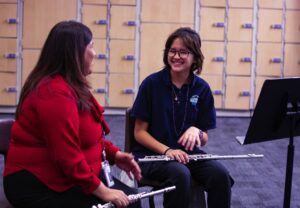
10. SNOW DOG

Starring Cuba Gooding Jr. as a celebrity dentist based in Miami, Florida, this comedy revolves around his cold weather misadventures when traveling to Alaska to claim an inheritance — which includes blizzards, grizzly bears, thin ice and an old mountain man played brilliantly by James Coburn. The good doctor eventually falls in love in the frozen town and even learns how to drive a dog sled led by a defiant lead dog. Find out where to stream it here.

Teaching Music at Historically Black Colleges and Universities

For much of America’s history, Historically Black Colleges and Universities (HBCUs) have existed in parallel to mainstream institutions of higher education (Wade, 2021). Music has always been at the core of the mission at HBCUs. Since the creation of the first HBCU in 1837 with Cheney University, musical studies have inspired generation after generation of graduates toward social mobility, economic empowerment and community galvanization (Clark, 2019).

While there are many pressing issues within higher education writ large and college music programs specifically, I want to highlight both the remarkable work and the particular challenges currently facing HBCU music departments. I also want to offer opportunities toward the betterment of all music programs within higher education. Whether it is our impressively high-stepping marching bands, exquisite dance teams, phenomenal choirs, swinging jazz bands or cutting-edge and culturally relevant music industry curricula, the music-making and academic experiences that students receive at HBCUs are imbued with historical context, filled with joy, forged through persistence and celebrated in every way possible.

Tennessee State University
The author teaches at Tennessee State University, an HBCU in Nashville.

Positionality & Perspective

As a proud alumnus of an HBCU — Florida A&M University — who now prepares the next generation of great music teachers at another HBCU — Tennessee State University — I believe my unique lived experience can serve as one of many examples of the power that HBCU music programs have to develop student-musicians who are both exceedingly capable of and astonishingly persistent at transforming the world through the gift of music. The significance of HBCUs is neither abstract nor symbolic to those of us who were trained at one and/or now teach at one. It is thoroughly woven throughout our daily lives.

Because HBCU music programs do not attempt to simply replicate the conservatory model found at most schools of music, we have been at the forefront of student-centered learning and curriculum innovation for generations (Earvin, 204). From the African-American spiritual and gospel to jazz and high-stepping marching bands, HBCUs have greatly contributed to musical offerings at institutions of higher learning.

Some may try to diminish our contributions with claims that our programs do not hold the same high standards for musical quality as our mainstream peers (Hamiel, 2021). However, with more than half of all HBCU music programs actively accredited by the National Association of Schools of Music (NASM), and evidence of HBCU music programs achieving national and international recognition at or above the same level as our mainstream counterparts, the exceptional musicians and ensembles found within our institutions simply cannot be denied.

Black man playing trumpet

A Closer Look: What HBCUs Do Well

Music has been central to HBCU institutional identity since the 19th century as core academic and cultural infrastructure (Wade, 2021). Early HBCUs understood music as a means of spiritual grounding, communal unity and social legitimacy within a nation that denied African Americans equal opportunities. From this need emerged several achievements and innovations that highlight all that HBCUs bring to the table.

HBCU music programs have been at the forefront of approaches to musicking (Small, 1998) and community engagement that have only recently become jargon in the modern higher education zeitgeist. Terminology that speaks to cultural responsiveness, diverse perspectives, equitable outcomes and inclusive pedagogy has been integrated into the HBCU experience since its inception.

Black sacred music traditions coupled with the pressing need to raise funds for sustainability anchored many early programs, such as the Fisk Jubilee Singers and Hampton University Choir. HBCU choral programs throughout the United States continue to preserve the African-American spiritual while also integrating Western choral traditions in their repertoire. The international success of these choirs highlights not just Black sacred music, but American music, to the rest of the world. The capabilities of these performing ensembles to achieve musical excellence under the larger context of segregation and discrimination in America, while simultaneously generating institutional credibility, financial support and cultural affirmation, cannot be understated.

Tuskegee University
The first HBCU marching band was founded in 1890 at Tuskegee University in Alabama.

No discussion of HBCU music programs is complete without acknowledging the significant cultural influence of HBCU marching bands. Since the founding of the first HBCU marching band at Tuskegee University in 1890, these ensembles have transformed the marching band from a strict military-derived unit into a high-energy cultural celebration steeped in contemporary performance traditions (Clark, 2019). With the establishment of the Marching 100 at Florida A&M University in 1946, director William P. Foster developed more than 30 innovative techniques from high knee lift and idiosyncratic musical arrangements of popular music to fast marching, dance routines and more, that all other HBCU bands would later adopt into what is now known as the “HBCU band style” (Thomas, 2016). See a recent performance by the Marching 100 in the video below.

Many non-HBCU bands have now begun began to adopt these popularized innovations. The pinnacle of this movement was witnessed by the release of the movie “Drumline” in 2002, which introduced many to HBCU bands and our unique approach to marching music for the first time.

Current Challenges

Despite their contributions, HBCU music programs continue to face persistent challenges, such as:

  • historical and chronic underfunding,
  • aging facilities,
  • inequitable state support
  • and heightened accreditation pressures.

As faculty, we are often asked to do more with less — teaching heavier loads, recruiting and sustaining ensembles, mentoring students and maintaining compliance with national standards that were not designed with HBCU contexts in mind. All of this without any additional course release time or pay, of course.

And yet, even within these constraints, HBCU music programs continue to thrive. Many of our institutions have expanded offerings in music technology, sacred music study, music industry studies and even music therapy, responding to shifts in musical interests and needs while remaining rooted in tradition. These adaptations are often framed externally as “catching up,” but in reality, they represent strategic evolution grounded in long-standing institutional resilience.

Black student playing violin

HBCU Music Programs Matter

In an era of declining funding, demographic shifts and the increasing pressure to justify the arts, HBCU music programs offer a compelling case for the intrinsic and essential value of music (Kelly, 2018). Our institutions consistently demonstrate how music can function as workforce preparation, cultural preservation, community engagement and personal transformation simultaneously. More importantly, HBCUs remind the academy that excellence is contextual. The success of HBCU music programs has never been defined solely by endowments or facilities, but by our successful outcomes: trained musicians, prepared teachers, served communities and sustained traditions.

As higher education continues to interrogate issues of access, equity and relevance, HBCU music programs should not be viewed as historical artifacts or niche institutions. We are living laboratories and active examples of musical excellence from which the broader higher education music community can learn.

As I close, I am reminded of a quote that I share with my students that speaks to our common purpose. In the words of the reverend Dr. Martin Luther King Jr., “We are caught in an inescapable network of mutuality, tied in a single garment of destiny. Whatever affects one directly, affects all indirectly.”

It is my hope that this serves as a reminder of our common purpose as we strive to make memorable musical experiences for us all.

young Black male wearing suit
References


Helpful Hints for First-Year Music Teachers

First-year music teachers may often feel overwhelmed. Instead of panicking, take the advice of people who were in your shoes just a few years ago — the 2026 Yamaha “40 Under 40” educators. From finding mentors to being authentic, you’ll find a wealth of helpful advice. Read on!


2026 Yamaha "40 Under 40" educator Ryan Adair

Ryan Adair, Director of Bands, Salem Hills High School, Salem, Utah

  • TIP 1: Show up for your students, your program and your community.
  • TIP 2: Know and magnify your role to the best of your ability without comparing yourself to others in your field.
  • TIP 3: Have ideas.


2026 Yamaha "40 Under 40" educator Zachary Arenz

Zachary Arenz, Instrumental and General Music Teacher, Flower City School No. 54, Rochester City School District, Rochester, New York

  • TIP 1: Build relationships — Students learn best when they feel seen, safe and valued. Your colleagues are far more likely to collaborate when you invest in them, too.
  • TIP 2: Stay flexible — No day, rehearsal or lesson will go exactly as planned, and that’s normal! Adaptability is not a backup plan, it’s one of your greatest teaching strengths.
  • TIP 3: Protect your curiosity — Keep learning, finding mentors and trying new things. Curiosity fuels creativity, sustains passion and reminds you why you chose this work in the first place.


2026 Yamaha "40 Under 40" educator Heather Barclay Drusedum

Heather Barclay Drusedum, Director of Choirs, Tarkanian Middle School, Las Vegas, Nevada

  • TIP 1: Create a positive, respectful environment by showing students that you care, while also maintaining clear expectations and consistent boundaries.
  • TIP 2: Growth happens over time. Set realistic goals, celebrate small wins and remember that every rehearsal is a step forward. Give yourself and your students grace as you learn together.
  • TIP 3: Stay involved in professional organizations, your school community and feeder schools. These relationships provide support, perspective and encouragement. They also remind you that you’re not alone in this work. Being connected strengthens both you and your program.


2026 Yamaha "40 Under 40" educator Ben Byrom

Ben Byrom, Music Teacher, Raleigh Oak Charter School, Raleigh, North Carolina

  • TIP 1: Don’t cry. I’m not being funny or kidding — breathe! Help your students breathe by modeling breath control. You’re doing better than you think. Development is slow, uneven and often invisible before it becomes obvious. Love music, let students know you care and hold expectations consistently.
  • TIP 2: When it comes to unruly playing in the classroom, know when to persist and when to pivot. Sometimes throwing the lesson out the window (metaphorically) leads to deeper engagement, and play is actually crucial to learning. The founder of Waldorf education, Rudolf Steiner, said, “We are fully human only while playing, and we play only when we are human in the truest sense of the word.” The teacher’s role then shifts from legislator to guide, fostering students’ curiosity toward real understanding.
  • TIP 3: Don’t be afraid of music theory. It isn’t too advanced if you tier it for age-appropriate accessibility. It should be treated like a second language. I’ve had 3rd graders observe shape notes and instinctively put together tetrachords from shared geometric properties; 4th graders fly through fully named chords by treating piano rolls like board games; and students identifying diminish and augmented chords by their emotional qualities. We jokingly call augmented chords the “no … don’t go in that dark room; the monster is right behind the door!” A major 7th chord is the bittersweet movie ending chord. I’m currently finishing a Yahtzee/Rummy-style dice game for chord building that I could see being used in classrooms across the country. When theory is playful, visual and experiential, students are often capable of far more understanding than we assume.


2026 Yamaha "40 Under 40" educator Dr. Francis Cathlina

Dr. Francis Cathlina, Director of Choral Activities, University of Memphis, Memphis, Tennessee

  • TIP 1: Build a circle of mentors. Seek people who will not only answer your questions but help you ask better ones. That guidance will save you years.
  • TIP 2: Commit to continued study. Advanced training sharpens your musicianship, deepens your pedagogy and expands how you think. Growth does not stop at the degree — it accelerates through it.
  • TIP 3: Master the unglamorous work. Clear emails, reliable deadlines and follow-through shape your reputation faster than podium presence. Strong administration makes you a trusted colleague.


2026 Yamaha "40 Under 40" educator Mary Claxton

Mary Claxton, Director of Teaching & Learning at Music Will and Adjunct Professor at the University of Northern Colorado, Greeley, Colorado

  • TIP 1: Keep it simple! It’s so easy to want to try every idea you’ve ever had during your first year, but it’s better to do a simple thing well and leave room for flexibility and student choice.
  • TIP 2: Get to know your community. Go to local concerts and meet the performers and engineers. Go to athletic events and library classes – get to know the people who can become your classroom’s “village.”
  • TIP 3: Invest in your own creativity. Try new things alongside your students, let them spur your curiosity and remember what it was like to be a beginner discovering the love of music!


2026 Yamaha "40 Under 40" educator Ashley Cobb

Ashley Cobb, Elementary General Music Teacher, Catawba Trail Elementary School, Richland School District 2, Elgin, South Carolina

  • TIP 1: Do what makes you happy. Balancing everything during your first year can be overwhelming, so make sure to find joy in everything you do. Shift your perspective from “I have to …” to “I get to …” and you will find the positives in even the most overwhelming parts of your first year of teaching. Some things like observations and induction meetings are required and outside of your control. But when it comes to your classroom, your performances, your repertoire and the things you can control, do what makes you and your students feel the happiest and most successful.
  • TIP 2: Find your ideal balance between quality and quantity. You don’t have to do the most all the time. You do not have to program the hardest pieces or take the most ensembles to performance assessment or have a concert for every event at your school. Find the balance where you can prioritize both work-life and home-life for yourself. Find the balance where your students have challenges but still feel successful.
  • TIP 3: Become a life-long learner. Do not be afraid to try new approaches and ideas in your classroom to figure out what works best for you and your students.


2026 Yamaha "40 Under 40" educator Brittany Dacy

Brittany Dacy, Director of Bands, Westwood High School, Austin, Texas

  • TIP 1: Go home — work will still be there the next day. You need to take care of yourself first so you are able to take care of your students.
  • TIP 2: Ask questions, ask for help. Don’t be shy — even ask the people who you’re nervous to approach. They may become your mentors!
  • TIP 3: Relationships matter. Be kind to those you meet, be eager to help if you can and invest in your students. If they invite you to a different activity that they participate in, go!


2026 Yamaha "40 Under 40" educator Dr. David Dockan

Dr. David Dockan, Assistant Professor of Music Education, Louisiana State University, Baton Rouge, Louisiana

  • TIP 1: Know that your lived experiences are different from other people’s lived experiences.
  • TIP 2: Your job is not to create perfect performances, it’s to foster creativity and curiosity in your students.
  • TIP 3: Remember that it is a blessing to be able to make, teach and explore music as a career.


2026 Yamaha "40 Under 40" educator Joshua Emanuel

Joshua Emanuel, Music Teacher, A. MacArthur Barr Middle School, Nanuet Union Free School District, Nanuet, New York

  • TIP 1: Be open to novel ideas, wherever they may come from. I have learned to say “yes” to my students. If I give a project assignment and a student has an idea for a different way to demonstrate their understanding of the concept, I say go for it. Along those same lines, don’t let yourself be too static. If things are feeling too comfortable, it’s time to change things up.
  • TIP 2: Find your people. Depending on the size of your school, being a music teacher can be isolating. Find colleagues, either locally or globally, who have similar interests and can spur you to try new things.
  • TIP 3: Listen to your students and give them some autonomy in their learning. This can take place by developing the class culture, choosing repertoire or suggesting music for you to listen to. If you buy into your students, they will buy into your class. Last year, my 5th grade band students asked if they could perform something for the class that they learned outside of school. This led to a bi-weekly set of student performances in which students performed anything they wanted, which fostered a sense of community and support while building confidence.


2026 Yamaha "40 Under 40" educator Elaina Gallas

Elaina Gallas, Music Teacher and Choral Director, Mill Creek Elementary, Nolensville, Tennessee

  • TIP 1: Build relationships — with your students, with the other teachers in your building and with a mentor music teacher. You can’t do it alone — and trust me, you don’t want to. Build relationships with your students and let them see you as a real person so they will let you see them and open up to you. The best learning happens when you connect with your students so that they feel safe and seen by you. Build relationships with the classroom teachers and let them know everything that you do. Music teachers are often misunderstood by regular “academic” teachers, but making friendships with them, learning from them and teaching them about the things you do will help in so many ways. Lastly, find a mentor music teacher. The advice and listening ear of someone who understands and can provide insight is priceless!
  • TIP 2: It’s OK to make mistakes as long as you try. What’s not OK is not even trying. It’s also OK to show your students when you make a mistake. Showing them that you are a real person and that you mess up just like they do will form a bond of trust. They will learn that it’s OK to make mistakes in your classroom and that it is a safe place. Some of the best lessons come through making a mistake, and it just makes the success that much sweeter.
  • TIP 3: It will be hard, but you can do hard things. There will be so many times when you question yourself or stumble, but just keep going! Your hard work will pay off, and those faces you teach are so worth it.


2026 Yamaha "40 Under 40" educator Matthew Gramata

Matthew Gramata, Band Director, West Milford Township High School, West Milford, New Jersey

  • TIP 1: Don’t be afraid to challenge the status quo and implement your own vision. Respect program traditions and take inventory of elements that can be enhanced while maintaining the foundation rather than eliminating it.
  • TIP 2: It’s OK to make mistakes and laugh at yourself. For the amount of critique we provide our students, showing them that you’re not the definition of perfection creates a more harmonious learning environment. They will respect you more for being vulnerable.
  • TIP 3: Learn what a piano mover is and hire one! Don’t try to lift a baby grand piano from the pit on to the stage with your first-year jazz ensemble for the jazz festival the next day. Piano movers are a real thing … who knew?


2026 Yamaha "40 Under 40" educator Heather Hurley

Heather Hurley, Director of Bands, Princeton Community Middle School, Princeton City Schools, Cincinnati, Ohio

  • TIP 1: Focus on classroom management from day 1. Establish clear routines and expectations, use positive reinforcement and consistent consequences, and only allow what you are willing to accept.
  • TIP 2: Celebrate growth and progress. Focus on effort, improvement and teamwork, not just perfect performances. Small successes build confidence and keep students motivated.
  • TIP 3: Be direct and consistent to keep parents and administrators informed. This builds trust, prevents misunderstandings and helps the program run smoothly.


2026 Yamaha "40 Under 40" educator Dr. Kyle Hutchins

Dr. Kyle Hutchins, Assistant Professor of Practice in Saxophone, Virginia Tech, Blacksburg, Virginia

  • TIP 1: Meet the students where they are at.
  • TIP 2: Stay curious and embrace creativity.
  • TIP 3: Encourage risk and embrace failure — they build resilience!


2026 Yamaha "40 Under 40" educator Kasey Julian

Kasey Julian, Vocal and General Music Teacher, Orchard Hills Elementary School, Novi, Michigan

  • TIP 1: Follow what inspires you and your students. Don’t do things just because you feel like you have to! Get creative in finding a way that works for your program. Personal and program branding is important so invest time in getting to know yourself, your students and their specific needs. Listen to them.
  • TIP 2: Protocols, data and organization will save you. You don’t have to reinvent the wheel each time. Prioritize a system of templates for simple things like programs or volunteer sign-ups and copy it each time. It doesn’t have to be the same form as other music educators — there isn’t a “correct” version. Find what works for you.
  • TIP 3: Your relationship to yourself is so important and sacred. Trust and listen to yourself. Make your own path. Keep learning and don’t stop growing as a person or educator. Never forget to fill your own cup, too.


2026 Yamaha "40 Under 40" educator Aron Kontorovich

Aron Kontorovich, Marching Band Director, Director of Piano and Coordinator of Student Activities, James Madison High School, Brooklyn, New York

  • TIP 1: Building community and relationships within the classroom will yield musical results you never thought possible — don’t skip it.
  • TIP 2: If you want students to open up and be vulnerable, you must be willing to model that for them first.
  • TIP 3: Don’t disregard the musical interests and experiences of your students. You could be missing the chance to learn something new and connect with something they care about.


2026 Yamaha "40 Under 40" educator Jake Matheson

Jake Matheson, Band Teacher at Forest Lake Area Middle School and Band Director for Forest Lake Marching Band, Forest Lake, Minnesota

  • TIP 1: Build relationships and a family culture. Take the time to know your students as people first. At Forest Lake, our strongest moments come from the trust and camaraderie we’ve built. When students feel supported and valued, they engage more deeply and are willing to challenge themselves musically.
  • TIP 2: Empower student leadership. Give students ownership of the program early. In our marching band, student leaders mentor younger peers, propose new ideas and shape our culture. Create meaningful leadership roles that strengthen both the ensemble and classroom community.
  • TIP 3: Be yourself and focus on your students. Your personality and authenticity matter more than trying to be “perfect.” Own your mistakes. Remember that it’s not about you — it’s about the students, their growth and the community you’re building. When you prioritize their experience, your impact will be far greater.


2026 Yamaha "40 Under 40" educator Tiphanie L. McClenton

Tiphanie L. McClenton, Elementary Music Specialist and Board-Certified Music Therapist, Bryant Elementary School, Mableton, Georgia

  • TIP 1: Know your students. Every child learns differently, so take the time to discover what excites, inspires and challenges them. Building strong relationships is the foundation for everything you teach.
  • TIP 2: Be flexible and creative. Lessons rarely go exactly as planned. Embrace improvisation, adapt to the moment and turn surprises into opportunities for learning and fun.
  • TIP 3: Celebrate every victory and have fun! Big or small, every improvement, performance or “aha” moment matters. Recognize your students’ growth, and don’t forget to celebrate your own wins — they remind you why you became a music educator and make the journey joyful for everyone!


2026 Yamaha "40 Under 40" educator Chris R. Millett

Chris R. Millett, Assistant Professor of Music Therapy, Practicum Coordinator and Board-Certified Music Therapist, University of Louisville, Louisville, Kentucky

  • TIP 1: Protect your sleep and protect your health! Nothing good is going to flow out of a tired teacher.
  • TIP 2: Become comfortable with ambiguity. Being a new teacher often means feeling isolated at times with nowhere to get answers. Learn to trust the process and to find mentors who can offer supervision when you really need it.
  • TIP 3: Absorb and diffuse the awkwardness. So many situations have the tendency to go one terrible way or the other depending on how we respond. If we take steps to make things comfortable, normal and safe for everyone, it goes a long way to creating a positive environment.


2026 Yamaha "40 Under 40" educator Meghan Mulligan

Meghan Mulligan, Music Teacher, The Deron School Inc., Montclair, New Jersey

  • TIP 1: Conducting is overrated. Play/sing/move with your students, even during the concert. Perform the way you practiced instead of having to practice the way you perform when it comes time for your dress rehearsals.
  • TIP 2: When it comes to special education, do what works. Get over yourself. Truthfully ask yourself when you program your performances if you’re programming for your students’ benefit or for your own vanity. Do not program pieces that are clearly too difficult just to say that you had your students perform them. Get over your idea of traditional ensembles, performances and audiences.
  • TIP 3: Along the same lines as my second tip — get over the “traditional route” of learning and performing music. Students who are not reading in their primary language should not be trying to read music. If anything, you should reinforce pre-reading concepts (for music and their primary language). Many students will stay in the “learning-to-read” category and may never move onto “reading-to-learn.” Approach music learning via multiple modalities and don’t be afraid to teach by rote.


2026 Yamaha "40 Under 40" educator Amrutha V. Murthy

Amrutha Murthy, Band Director, Park Vista Community High School, Lake Worth, Florida

  • TIP 1: Build trust before chasing results because culture drives everything. Consistency breeds confidence
  • TIP 2: Empower students early; ownership creates motivation, accountability and long-term success.
  • TIP 3: Mastery requires patience. When you fall in love with the process rather than the product, you don’t have to wait to give yourself permission to be happy.


2026 Yamaha "40 Under 40" educator Kyle Norris

Kyle Norris, Assistant Director of Bands, Vandegrift High School, Leander, Texas

  • TIP 1: Find a mentor. Someone who will answer your questions, who you can trust, who you can call at the end of a hard day, who you can celebrate with … this is the best advice I ever received and the best I can pass along.
  • TIP 2: If you’re anything like me, this is not fun, but record yourself, not just your ensemble (video is better). I wish I was better at doing this when I was younger. You will learn a lot about what you are communicating to your students, either consciously or unconsciously.
  • TIP 3: Keep it in perspective. Often, what seems like a big deal at the time ends up not being that, especially when you zoom out and think of things in the context of a life-long career.


2026 Yamaha "40 Under 40" educator DeVon Pickett

DeVon Pickett, Director of Arts, Scotland County Schools, Laurinburg, North Carolina

  • TIP 1: Keep your circle small! Everyone is not worthy of knowing your vision and dreams. Those who know your dreams should earn the right to do so. Not because you are cocky but because negativity can crush dreams faster than anything.
  • TIP 2: Develop an internal love for education. That internal love will be what carries you through the tough times and allows you to grow.
  • TIP 3: Keep students first! As long as students are the center of what you are doing, success will find you! Do not base what you do off of social media; base your vision off the needs of your students.


2026 Yamaha "40 Under 40" educator Cahterine Plichta

Catherine Plichta, Director of Instrumental Music, The Theater Arts Production Company School, Bronx, New York

  • TIP 1: Be yourself. You are enough for your students. You don’t have to pretend to be someone else. Doing this allows you to lead with authenticity, integrity and transparency.
  • TIP 2: Less is more. Do less but do it well. Don’t say “yes” to every single opportunity. It’s easy to spread yourself too thin as a music teacher, especially a first-year music teacher. Saying “no” allows you to say “yes” to the things that really matter.
  • TIP 3: Ask for help early and often. Teaching is an incredibly challenging profession, and we all need help from time to time. Asking for help early and often helps you avoid pitfalls and can keep you from burning out during your first year.


2026 Yamaha "40 Under 40" educator Rolando Rivera

Rolando Rivera, Mariachi Director, Diamond Hill-Jarvis High School, Fort Worth, Texas

  • TIP 1: Always be ready to adapt to any teaching environment.
  • TIP 2: Meet your students at the level they are at and improve alongside them.
  • TIP 3: Stay consistent with daily routines and expectations.


2026 Yamaha "40 Under 40" educator Al Rodriguez

Al Rodriguez, Orchestra Director & Music Technology Teacher at Mount Vernon High School; Department Chair, Performing Arts Music Director at Washington Metropolitan Youth Orchestra, Alexandria, Virginia

  • TIP 1: Be flexible. The teachers who are most successful are the ones who don’t try to be perfect but instead lean into making mistakes and trying new things.
  • TIP 2: Be human. Your students do not want or need a perfect teacher. Show them that you are working hard to improve your craft each and every day, and that’s what you want and expect from them.
  • TIP 3: Take all the time you need to build caring relationships. When students know that their teacher cares about them and that their classmates care about them and see them, they are willing to take more risks and truly engage with the deeply personal process of making incredible music. The trust you build directly influences the music you will make.


2026 Yamaha "40 Under 40" educator Sean Rosenberry

Sean Rosenberry, General Music Teacher and Director of Bands, Horace Mann School Lower Division, Bronx, New York

  • TIP 1: You’re going to fail — a lot. Lessons are going to bomb, things you thought would work are going to blow up in your face. You’re going to be exhausted and spent and feel like you’re drowning. None of that means you are a bad teacher. Every veteran teacher you work with was once in the same position, and the only reason they have their act together now is because they spent many years making mistakes and learning from them. Good teaching is incredibly intuitive, and that kind of intuition takes time to build. Your first year is always rough, don’t let it discourage you. It only gets better.
  • TIP 2: Don’t be afraid to find and develop your own style of teaching. I spent many years thinking I was a lousy teacher because I wasn’t good at writing meticulous, detailed lesson plans like I was taught in college. And even when I did, I wasn’t good at following them. Eventually, I realized that I have a very improvisational teaching style, and my brain works better when my lesson plan is more broad strokes, which allows me to figure out the details in the moment. That system doesn’t work for everyone, but it works for me. Play to your strengths and find what works for you.
  • TIP 3: Find a community of other music teachers to connect with. All of us are in very specialized positions in our schools, and oftentimes we’re by ourselves, or one of maybe two or three teachers in the school or district. It can be very isolating, so it’s important to find other teachers to connect with. Join discussion groups online and go to conferences if you can. There is nothing more valuable or energizing than connecting with other people who share your experiences.



 

2026 Yamaha "40 Under 40" educator Trevor Rundell

Trevor Rundell, Band Director, Bartlett High School, Bartlett, Tennessee

  • TIP 1: Don’t try to be anyone but you. It’s OK to emulate your mentors, but remember that you are a collection of your own experiences, instincts and personality. Everyone’s situation is different. Some of what works down the road (or for the best programs in the country) might not work for you, and that’s OK. There is some combination of who you are as a teacher, who your kids are as students, and the materials and methods you choose to use that will yield the results you want — trust yourself and find what that combination is, don’t just search for the “secret elixir”!
  • TIP 2: Success breeds success, and cumulative success will snowball into greater successes. Be careful of the goals you set for your program — make sure they are appropriate for where you are in that moment. Don’t try to go from 0 to 80 if you haven’t gone from 0 to 60 yet, even if “those guys down the road” are doing that. Do small things exceptionally well, which will build into doing bigger things just as well over time.
  • TIP 3: Learn to transpose on the fly and use that skill to model for your students on an instrument you sound great on.


2026 Yamaha "40 Under 40" educator Dr. Sonya Schumann

Dr. Sonya Schumann, Lecturer of Piano and Community Music School Piano Coordinator, San Diego State University, San Diego, California

  • TIP 1: Make friends with your colleagues, both in your field and in unrelated fields. Friends in unfamiliar fields help us to learn and grow. Who knows — you might just create or cross-collaborate on something new together!
  • TIP 2: Continue to expand your own musical palate and remember to refill your “musical cup.” That could be taking private lessons on a secondary instrument or keeping a subscription to the symphony or having a listening party with friends every month.
  • TIP 3: Not a glamorous piece of advice (and certainly not specific to music education), but one that saves me to this day: Set aside your prep time and keep it sacred! Today’s you will thank the past you.


2026 Yamaha "40 Under 40" educator Matt Siffert

Matt Siffert, Director of External Affairs, Musical Mentors Collaborative, Boulder, Colorado

  • TIP 1: Get to know your students. Music education is a wide umbrella and can be administered in infinite ways. The better you know the student you’re teaching, the better you can find a bridge between what you think is valuable as a music educator and what will be salient and suitable to them.
  • TIP 2: Come up with a plan but be flexible. It’s essential to have a roadmap for how to help your student achieve their goals — exercises, compositions, etc. However, students grow and change. If you can see these changes as they’re happening and adapt, you can find ways to continue providing structure and direction while helping your students grow in ways that neither of you anticipated.
  • TIP 3: Lead with love. Over two decades in music, I have encountered educators and administrators of many demeanors, and the ones who accomplish the most and have the most positive, enduring impact on their students bring a loving, dedicated energy to their pedagogical practice. When students feel seen, understood and supported, they thrive.


2026 Yamaha "40 Under 40" educator Dr. Andrew J. Smouse

Dr. Andrew J. Smouse, Co-Director of Bands and Orchestras, Valley High School, Clark County School District, Las Vegas, Nevada

  • TIP 1: Always ask “how does this help the student” with anything you do. If you cannot find a great reason, keep working on the idea. It all comes back to how does it help the student, not you.
  • TIP 2: Never underestimate the power of a student, regardless of their talent, situation, age, etc. Your words and actions shape each student daily and can change lives, including many whose lives you never knew you changed. Take that power seriously.
  • TIP 3: Never stop learning. Find a mentor and a group of trusted colleagues as soon as possible. Share your successes but also share and talk through failures or plans that do not go right — this is where the learning takes place, making you a better teacher who can better serve each student. Failure is not failure unless you refuse to learn from it and keep trying.


2026 Yamaha "40 Under 40" educator Eric Stashek

Eric Stashek, Director of Bands, Lincoln Jr./Sr. High School, Lake City, Minnesota

  • TIP 1: Prioritize building strong relationships with your students before chasing perfection. Connection and culture always come first. When students feel seen, valued and supported, their growth and learning naturally follow.
  • TIP 2: Establish a healthy support system of colleagues who you can trust and lean on for guidance. Teaching is a team effort, and it’s important to remember that you are never alone on this journey.
  • TIP 3: Never lose sight of the spark that inspired you to become a music educator, that first moment when you said, “Yes, this is why I am here!” Some days will feel overwhelming, but your positive impact is lasting. Teach with heart, believe in yourself and let your passion and spirit shine through every lesson.


2026 Yamaha "40 Under 40" educator Shannon Stem

Shannon Stem, K-8 Music Teacher and 6-8 Musical Theater Director, University Academy and Founder, Beacon Artist Collective, Panama City, Florida

  • TIP 1: Build relationships first. Invest time to get to know your students, colleagues and community. Trust and connection are the foundation for both learning and artistic risk-taking.
  • TIP 2: Create a culture of ownership. Give students meaningful leadership and creative opportunities from the start. Empowering them fosters engagement, accountability and growth.
  • TIP 3: Start simple, plan strategically. Focus on clear, achievable goals and scaffold skills over time. A cohesive plan allows students to experience steady progress while keeping you organized and confident in your teaching.


2026 Yamaha "40 Under 40" educator Erik Stone

Erik Stone, Band Director and Vocal Music/Media Arts Teacher, Gordon Parks Academy, STEM Leaders in Applied and Media Arts, Wichita, Kansas

  • TIP 1: Do not internalize student or family reactions. Behavior is rarely personal and often rooted in care for the student. Lead conversations with empathy and keep student growth and success at the center of every decision.
  • TIP 2: Change and growth take time, especially when leading a music program. Move slowly and intentionally at first to truly know your students and community. This foundation allows you to build a program that reflects your values and the people who shape it.
  • TIP 3: Find a work-life balance that fits you. Early enthusiasm can lead to taking on too much. Protect the time it takes for you to rest and recharge in meaningful ways so you can show up fully for your students and sustain your program long term.


2026 Yamaha "40 Under 40" educator Luis "Tito" Talamantes

Luis “Tito” Talamantes, Interim Assistant Principal at Cesar Chavez High School and Mariachi Director at University of the Pacific, Stockton, California

  • TIP 1: Build relationships before chasing perfection. Your students won’t remember every wrong note, but they’ll remember how you made them feel. Invest time in trust, belonging and care; strong relationships create conditions for real musical growth
  • TIP 2: Design for success, then raise the bar. Start will achievable goals that allow students to experience early wins. Confidence fuels commitment. Once students believe they can succeed, they will rise to higher expectations.
  • TIP 3: Find your people and keep learning. Teaching music can feel isolating early on. Seek mentors, collaborate with colleagues and stay connected to a professional learning community. Growth happens faster and more sustainably when you don’t do it alone.


2026 Yamaha "40 Under 40" educator Enrique Tellez

Enrique Tellez, Director of Bands and Orchestras, Butler Middle School, Cottonwood Heights, Utah

  • TIP 1: Try and fail, try and succeed — and from it all, learn and adjust. The day you think you’ve figured it all out, is the day you’ve stopped being a life-long learner.
  • TIP 2: Be careful not to over-program. You can take an easier piece and focus on the fundaments. Holding notes the correct length, teaching how to breathe properly before entering a passage, how to shape, etc. Additionally, you can add to easier pieces. Often, easier pieces don’t have many articulations, crescendos, etc. This is a great opportunity to have students write notation and dive further into musicality.
  • TIP 3: Take care of yourself. Your mental, physical and emotional health are crucial to the enjoyment of your job. If you haven’t already, consider getting a therapist, going to the gym and spending time on yourself.


2026 Yamaha "40 Under 40" educator Daniel Upton Jr.

Daniel Upton, Jr., Director of Bands, Harrisonburg High School and Adjunct Music Faculty, Bridgewater College, Harrisonburg, Virginia

  • TIP 1: Teach people through music. Early on, I taught music to people. Once I realized it was all about the people, the entirety of the profession changed for me in the most positive of ways. The connections and relationships were so much stronger.
  • TIP 2: Have mentors. Steal ideas from everyone you respect and look up to. Put the best of all those people into practice and now you are making it your own. Reach out to those mentors often — don’t go at it alone!
  • TIP 3: Learn how to develop work-life balance early on. I took way too long to do so, and it’s hard to figure out now.


2026 Yamaha "40 Under 40" educator Alex Whitehead

Alex Whitehead, Director of Bands, Jefferson Middle School, Fort Wayne, Indiana

  • TIP 1: Everything you do is PR for your program. Take every opportunity to brag and boast about your kids’ successes — perform for your school and wider community as much as possible. You know the value of what music does for students, but everyone else might not. It’s your job to teach the community that what your students do is valuable.
  • TIP 2: Never be afraid to ask for help because you won’t and don’t know everything. Have a trusted mentor who is there to steer you right, even when you don’t like the answer they give you. You can’t do it alone.
  • TIP 3: Be yourself. Don’t try to mold yourself to be someone else in front of the kids or teach in a way that is inauthentic to you. You’ll find yourself at your most effective when you can be unapologetically genuine in your teaching.


2026 Yamaha "40 Under 40" educator Sarah Williams

Sarah Williams, Band Director, West Junior High School, Pocono Mountain School District, Pocono Summit, Pennsylvania

  • TIP 1: Do not take yourself so seriously. If you make a mistake, own up to it without trying to cover it up. You are human. Tell your students about the mistake and how you plan to learn and grow from it. This gives them the security to learn and grow from their own mistakes.
  • TIP 2: You may need to remind the class about something many times but that is OK. Sometimes students need many repetitions to process instructions. Sometimes students need the reminder not because they weren’t listening but because they need the reassurance. All our students are different and process information differently. Provide the information in as many different forms as you can. Many will not get the information the first time you explain it.
  • TIP 3: Go the extra mile and join professional organizations, attend conferences and workshops, and take those classes. The connections you make learning with other music educators are invaluable. The ideas and support from others are necessary to have a long, successful career in music. Plus, you probably do not (or never will) know everything there is to know about music. Learn as much as you can so you can pass it on to your students.


2026 Yamaha "40 Under 40" educator Keith Ziolkowski

Keith Ziolkowski, Orchestra Teacher, Creekside Middle School, Carmel Clay Schools, Carmel, Indiana

  • TIP 1: Do not isolate.
  • TIP 2: Ask questions, no matter how simple it may seem.
  • TIP 3: Put up firm boundaries for yourself so that you can establish work-life balance.

Check out tips for first-year music teachers from the 2025 “40 Under 40,” 2024 “40 Under 40,” 2023 “40 Under 40, 2022 “40 Under 40,” and 2021 “40 Under 40” educators for more invaluable advice!

Chris R. Millett

Back to 40 Under 40

2026 Yamaha

Chris R. Millett

Assistant Professor of Music Therapy, Practicum Coordinator
and Board-Certified Music Therapist
University of Louisville
Louisville, Kentucky

Imagine a high-quality, affordable, community music therapy program that serves people across their lifespans — from mommy-and-me groups for NICU grads to senior adult community choirs. That’s what the Music Therapy Clinic (MTC) at the University of Louisville offers the people in the Louisville-Southern Indiana (Kentuckiana) region.

Assistant Professor of Music Therapy Chris R. Millett is a clinic mentor and former MTC coordinator and explains, “Our mission is to make lives in Louisville richer and healthier through music, and we serve thousands of individuals, families and facilities every year with music-based experiences like songwriting, group musicking, improvising and more to improve health-related outcomes.”

The university just celebrated the 25th anniversary of its music therapy program. “We pride ourselves on our care for students as developing humans, forward-thinking pedagogical practices and an environment that encourages compassion and critical thinking to tackle the concerns of 21st century music therapists,” Millett says.

His teaching approach centers on radical inclusivity of students and musical practices that enable them to better serve an increasingly multicultural world. “This includes preparing students to be their best self musically, stretch themselves clinically and to understand the nature of trauma-informed and anti-oppressive practices to help them adapt to any setting or people group,” he explains.

Millett admits to being relentlessly committed to incremental improvement and is constantly tinkering and improving his lesson plans and workflows. He has integrated modern technologies like digital audio workstations (DAWs) and artificial intelligence in his teaching, as well as redesigned courses to include contemporary popular music and electric guitar.

“I view modern technologies in music practices as both a boon and, at times, a stumbling block,” Millett says matter-of-factly. “I balance the use of digital music tools, artificial intelligence and other technology with an approach that critically evaluates where it is helping and where it impedes or supersedes the creative process. We don’t want to trade our minds for convenience, most especially in creative domains like music!”

The Music Therapy Clinic is the only nonprofit music therapy in the commonwealth of Kentucky and served more than 7,000 individuals in the Louisville area in 2025. Nearly 75% of those who received music therapy services paid low or no costs because of grant and philanthropy funding. Millett himself has helped raise nearly $200,000 since he started in his position at the University of Louisville in 2019 to help offset the costs associated for families and facilities. One organization that Millett and his students serves is Boys & Girls Haven, a private residential group foster home. MTC also hosts the All-Abilities Rock Band, The Grooves, which helps members learn to play instruments, play in a band and foster social connection. The Grooves regularly performs at concerts and local events through a neuro-inclusive, adapted rock band model.

Since the pandemic, the American music therapy community has lacked conference opportunities to build professional communities. In 2022, Millett hosted the first UN-conference, where individuals from around the world participated in the online conference. In 2024, the UN-conference expanded on the theme “Community Music Therapy” and brought hundreds of global music therapists together for a free continuing-education experience.

Millett serves on the board of directors for Certification Board for Music Therapists (CBMT), the music therapy accrediting body that upholds the board-certification credential for music therapists. “It is a humbling experience to be amongst such great leaders in our field, and to hold the responsibility of protecting the public and shaping the next generation of music therapists,” he says with pride.

Continue reading

Tiphanie L. McClenton

Back to 40 Under 40

2026 Yamaha

Tiphanie L. McClenton

Elementary Music Specialist
Board-Certified Music Therapist
Bryant Elementary School
Mableton, Georgia

At Bryant Elementary in Mableton, Georgia, every student has the right and ability to learn, and “it’s my job to help them discover it,” says Elementary Music Specialist Tiphanie L. McClenton. “My program is all about curiosity, creativity and bold experimentation.”

In her classes, students explore music, movement and improvisation in ways that let them shine and take risks. Through hands-on experiences, laughter and collaboration, they build confidence, social skills and a lifelong love of the arts. “Even if they never pursue music professionally, I aim for every student to leave my classroom with joy, self-expression and artistic curiosity that lasts a lifetime,” she says.

McClenton provides music instruction and performance opportunities for all 860 students at Bryant, which makes music an inclusive and shared experience across grade levels. “In my classroom, music, movement and improvisation happen every day, and students know it’s time for fun the moment they walk in,” she says with a smile.

Class begins with a movement activity to wake up bodies and brains followed by a quick brain teaser, a hello song and beat and rhythm practice. “Improvisation bursts forth through movement, instruments and acting, letting students explore creativity in the moment. As a certified Orff Schulwerk educator, I pack every lesson with playful, hands-on experiences that spark imagination and keep students eager to return,” she explains.

McClenton also created and directs two performing ensembles: the Sounds of Bryant Orff Ensemble (35 students) and the Bengal Beat Squad (10 students). Both groups perform at school and throughout the greater Atlanta area.

The Sounds of Bryant Orff Ensemble began during the 2021–2022 school year to challenge 4th and 5th graders with more complex repertoire and advanced performance opportunities. In just a few years, the group has earned superior ratings at the Southern Star Music Festival three years in a row, performed at the Georgia Music Educators Association‘s in-service conference, and inspired the creation of an instrumental division in the annual Elementary Music Festival. Looking ahead, the ensemble plans to perform at out-of-state festivals and the Midwest Band and Orchestra Conference. Seeing her students shine on stage “still gives me chills and showcases the exceptional talent and dedication of my young musicians,” McClenton says with pride.

She took the lead in last year’s Fine Arts Night by writing the script, composing and arranging the music, choreographing dances and designing all the props. The performance, “The Mystery Museum,” featured 3rd to 5th graders, including students from Bryant’s special education program. Student actors portrayed news anchors searching Atlanta for a museum of student art. After visiting local museums like the Savannah College of Art and Design, the High Museum of Art, the National Center for Civil and Human Rights, the Children’s Museum of Atlanta and the College Football Hall of Fame, the anchors discovered that the museum was located at Bryant Elementary, where families toured the student-created exhibits afterward. Mystery solved!

As a certified music therapist, McClenton uses her training to approach challenges with empathy, support students with special needs and help every child grow socially, emotionally, physically and academically through music. “Sometimes it’s as simple as switching an overstimulating instrument or keeping a consistent routine for a student who thrives on structure,” she explains. “Other times, it’s using a song, movement or improvisation to spark engagement and connection. Music becomes more than a subject; it’s a tool to help students succeed, express themselves and feel seen.”

McClenton was named Teacher of the Year in two different counties and District Elementary Performing Arts Teacher of the Year. She’s proud to follow in the footsteps of her father, who was a music educator for more than 40 years.

Continue reading

Jake Matheson

Back to 40 Under 40

2026 Yamaha

Jake Matheson

band teacher at Forest Lake Area Middle School
Band Director for Forest Lake Marching Band
Forest Lake, Minnesota

Band Teacher Jake Matheson leads with heart and creates a culture where every student knows that they belong, feels valued and can contribute regardless of their skill level. “You don’t have to be the best musician — or even a ‘good’ musician — to be an important member of the band,” he says. “I focus on empowering students, building mentorship, nurturing ownership and teaching kids to be good people, so they can grow as musicians, leaders and human beings.”

In addition to teaching at Forest Lake Area Middle School, Matheson is also the Band Director of the Forest Lake Marching Band, which is made up of students in 7th to 12th grades and is run through the Forest Lake Area Schools Community Education. In 2016, he revitalized the marching band, which has grown from 30 members who performed at one parade to 144 students playing at 20 annual events. “In 2025, we reached a major milestone with our first field show in 34 years,” Matheson says proudly. “Along the way, I have been able to hire additional staff and add a flag corps program, which gave another group of students a place to belong.”

The marching band restores a proud community tradition dating back to 1928, while offering students a strong sense of belonging within a supportive “family,” Matheson explains. “In an increasingly self-centered world, our program emphasizes connection, joy, leadership and service.”

The band’s mission — empowering students through ownership and mentorship, so they come to understand that they are part of something bigger than themselves — is deeply personal to Matheson. “I was once a student in this program before returning to lead it,” he says.

As a junior high student in the Forest Lake Marching Band, Matheson was called “Tuba Jake” — a nickname that has stuck with him all these years. His students start off calling him Mr. Matheson, but soon transition to Tuba Jake or simply Matheson. “The nickname serves as a direct link to my own history with the program and because the tuba remains central to my identity as a music educator,” he says with a smile.

Matheson built community support for his program in several ways, including:

  • Eliminate financial barriers — “Money should never be a barrier to participation. By matching student needs with community generosity, we provide scholarships that ensure every student can join band,” he says.
  • Strategic partnerships — the Forest Lake Area Schools Community Education provides the logistical foundation and administration stability required to operate. Additionally, we are supported by the generosity of local businesses, organizations and individuals every year.
  • The value of showing up — “We teach our students the immense value of showing up for their community and proving that the band is a reliable pillar of local pride,” Matheson explains.

In 2019, Matheson created a formal marching band leadership team that participates in targeted training and community-building activities, then serve as positive role models for the group. “We emphasize kindness, compassion and followership to foster a safe and supportive culture,” he says. “This mentoring system builds continuity, excitement and confidence as younger students enter the program, while giving older students meaningful ownership and responsibility.”

Soon after the formation of the leadership team, the Forest Lake Marching Band was the featured “Fund-a-Grant” at a fundraising event sponsored by The Education Foundation of the Forest Lake Area. Matheson led the band from a farm field into a greenhouse where a live auction was underway. “Within five minutes, the auctioneer had raised nearly $30,000 — which was enough to equip the band and fuel its future,” he says excitedly. “Seeing students take ownership of the program and watching it thrive, knowing that our work continues to shape both students and the community is the ultimate realization of a teacher’s dream!”

Continue reading

Aron Kontorovich

Back to 40 Under 40

2026 Yamaha

Aron Kontorovich

Marching Band Director, Director of Piano and Coordinator of Student Activities
James Madison High School
Brooklyn, New York

After the pandemic, the marching band at James Madison High School in Brooklyn, New York, was shut down. Aron Kontorovich wanted to resurrect the band and was “building the ensemble with no existing band members,” he explains. “To get students to join, I made frequent visits to band classes during the day to make my pitch.”

Sharing his excitement with students worked! In the Fall of 2023, the marching band returned and currently consists of the color guard, winds, drum line and majorette squad with a total enrollment of 60 students.

Madison High has always had a strong and large music program. When Kontorovich was hired in 2018, he became the eighth music staff member. “I was bouncing from room to room teaching Concert Band, Modern Band, West African Drumming and wherever I was needed within the existing programs,” he said.

In his second year, he started a piano program and grew it to four sections before COVID. When students returned to in-person learning, Kontorovich had to start over because all his previous piano students had graduated. He drew from his experience running and teaching a private lesson studio to design a curriculum that prioritized student experience and retention to grow the program. “Since returning from the pandemic, the program has grown to a full sequence of beginning, intermediate and advanced classes,” he says proudly. “We hired another educator to teach additional beginner classes and currently serve approximately 160 students.”

Kontorovich has taken on additional roles at Madison. He created a club focused on technical theater in partnership with Roundabout Theater Company. Once-a-month sessions with teaching artists provide hands-on training in lighting, set design and other areas of technical theater. This led to the creation of a stage crew that supports everything from Spring concerts and culture festivals to senior movie nights on the field.

Last year, Kontorovich became the Coordinator of Student Activities, which includes overseeing 70 clubs and serving as the club advisor for student government. “In this new role, I work with students from beyond my classroom to positively influence the culture of the entire school, which consists of 4,300 students,” he says. “As the student government advisor I ensure that students’ voices are heard, that they have an impact on their school community, and I, of course, never miss a chance to highlight and advocate for our music program!

Kontorovich has been able to connect with all students at Madison High because of his community-building skills. “Building relationships has allowed me to develop a rapport with students that yields a culture of trust, so when I tell a student that I believe in them chasing their dreams, they know that I mean every word,” he explains. “Students know that I will always support them in their growth and at every step of their journey.”

One way Kontorovich brings togetherness and a love of music to his community is to share music in anyway he can. “I play holiday sing-a-long songs in the lobby before winter break, play accompanying piano for concerts or simply walk into a classroom while students are rehearsing to sing along or complement them for their growth and hard work,” he says with smile. “While I am the piano teacher and the after-school marching band director, I feel that every department of our music program is a part of one family with a set of shared values and goals.”

Outside of Madison High School, Kontorovich co-directs the Brooklyn Concert Band for the Salute to Music NYC program on Saturday mornings where he works with serious band students in grades 4 to 8 for a three-hour rehearsal to elevate their skills and have a musical experience they normally wouldn’t have in their school programs.

In the Summer of 2024, he spearheaded the development of a new piano component to the Instrumental Studio for the Middle School Summer Arts Audition Bootcamp, where students spend two weeks at the Lincoln Center and the Juilliard School to elevate their musicianship, develop new skills on their instruments and prepare for their auditions for performing arts high schools.

Continue reading

Keith Ziolkowski

Back to 40 Under 40

2026 Yamaha

Keith Ziolkowski

Orchestra Teacher
Creekside Middle School
Carmel Clay Schools
Carmel, Indiana

What is the best tool that Keith Ziolkowski, Orchestra Teacher at Creekside Middle School in Carmel, Indiana, uses with his students? Being genuine. “All my students see me for who I am, which includes my knowledge, passion and excitement to teach them music. I don’t feel the need or desire to put on a show of something or someone that I am not or that our orchestras are not. I focus on genuine experience from day one,” he explains.

This includes having high expectations for his students and ensembles. “Together, we are allowed to fail, have struggles, but also succeed. There isn’t a moment in our classroom where we do not support one another through good and bad, no matter how challenging or how exciting those moments can be for students,” Ziolkowski says

At the middle school level, careful, but calculated student involvement is required. “The most important thing is to help build students up with proper foundation through technique, good, appropriate and challenging literature, and giving them chances to lead,” explains Ziolkowski. “My goal is to help mold and form students into consumers of music throughout their entire life.”

Ziolkowski also holds himself to high standards as well. Each quarter, he sets benchmarks for himself that align with the curriculum. “This has really helped to make sure that all my students are understanding, playing and having fun,” he says. “These benchmarks then stack each quarter and each year a student is in my program, and I refer to them often to make sure that I am not teaching or preparing music that is above acquired knowledge.”

Even though these benchmarks have dates and numbers with them, Ziolkowski has the flexibility to change the goals for the ensemble or individual student to make sure they are growing at a rate that is appropriate for them.

It’s vital for Ziolkowski to make orchestra interesting, achievable and fun because the arts are no longer required due to changes in the Indiana high school diploma requirements. “It’s crucial to offer a great program at the middle school that students seek out and recognize as an essential part of their education at the high school,” he explains.

He connects with other orchestra teachers and music educators through his roles in professional organizations, including the current president of the Indiana Music Education Association and past president of the Indiana Chapter of the American String Teacher Association. Ziolkowski also has a group text chain with other music teachers. “It’s important to have a community so that you are not on a teaching island,” he says. “I hold this group of educators and friends near and dear. We have been able to guide one another to appropriate literature for ensembles and to share sometimes very blunt thoughts and ideas when it comes to best practices for engaging students.”

Continue reading

Sarah Williams

Back to 40 Under 40

2026 Yamaha

Sarah Williams

Band Director
West Junior High School
Pocono Mountain School District
Pocono Summit, Pennsylvania

Flexibility is the key to Sarah Williams’ success. The Band Director at West Junior High School in Pocono Summit, Pennsylvania, has been a K-2 general music teacher, junior high choral director, junior high band director and assistant with the high school marching band.

“Working at different levels and in different buildings in the same district has given me the opportunity to connect with students of all age levels,” Williams says. “The biggest challenge has been teaching new content three years in a row. Although all of these positions have been music, elementary music is different than middle school music, and choral is very different from instrumental.”

Every time Williams felt like she had a handle on what the content and class structure should be, a new position was handed to her. Last year was her biggest challenge when she taught both 7-8 general music and 7-8 chorus. “My background is primarily instrumental, so teaching vocal music at this age level meant asking my high school colleagues a lot of questions and going through my resources from workshops and conferences,” she explains. “I also had never taught guitar and other middle school general music topics. There was a lot of planning and learning for this position.”

Now, Williams is back to being a band director at the middle school and high school level. “Remembering the little tricks and techniques for all the band instruments has been a challenge, but like the old saying goes, ‘it’s like riding a bike,’” she says with a laugh.

Because of her varied experience working at different grades and ages, Williams takes a proactive role in building a stronger, more connected music program across the district. She plans to have some of her middle school band students perform for elementary school students who are thinking about joining band. She also organizes an “underclassmen night” where junior high band members can tag along with high school band students for a football game.

Williams played a key role in revising the K-12 music curriculum for the Pocono Mountain School District. “Some of the major changes that I helped with were to change the curriculum from leaning heavily into teacher-led instruction to more student-led instruction. We added more creative opportunities and proposed activities that the students could lead. For the junior high general music curriculum, the biggest change was the curriculum that focused on specific techniques on piano and guitar to more focus on the performance aspect of playing an instrument.”

Another district-level initiative has been adding more modern band opportunities. Williams is working with the Tri-M advisor at the high school to have some high schoolers come help middle school students during the after-school jazz band and rock band rehearsals.

In 2016, when Williams first started teaching elementary music, she was encouraged to learn Orff Schulwerk, a child-centered approach that blends music, speech, movement and drama. She is now Orff certified and is a regional representative for the National Board of Trustees of the American Orff-Schulwerk Association. “I am hoping to advocate for using Orff Schulwerk at the secondary level,” Williams explains. “Guided experiences, imitation, exploration and improvisation have a place in middle school band as much as they do in an elementary classroom. This is definitely a work in progress!”

Continue reading

Alex Whitehead

Back to 40 Under 40

2026 Yamaha

Alex Whitehead

Director of Bands
Jefferson Middle School
Fort Wayne, Indiana

Alex Whitehead’s visionary teaching helps his students thrive as musicians and be confident, disciplined young people. “I do this by being 100% genuine and constantly striving for my students to be the very best version of themselves that they can be,” he says. “I think my students are comfortable with my high standards because they know I care about them as people, not just musicians.”

This positivity has led to Whitehead’s band program at Jefferson Middle School in Fort Wayne, Indiana, growing by mor than 50%. “Our entire music department recruits as one unit to our four elementary schools. We view any student involvement in band, orchestra or choir as a win for all our programs,” he says.

In total, the band, orchestra and choir programs have a combined enrollment of more than 350 students. The elementary schools are visited several times each year by the middle school directors and students for performances, Q&A sessions, instrument petting zoos and final fittings.

Whitehead’s innovative rehearsal structures and repertoire choices help students broaden their music educational experiences. “Repertoire choice is the most time-consuming part of the job. I constantly choose literature that expands my students’ understanding of the world, appropriately fits the ability level of my ensembles and stretches them as musicians,” he explains.

Most importantly, the music must be fun and always engaging for the students. “Once the literature has been selected, I try to have an intimate knowledge of each piece and know exactly how each part should sound so I can always be engaged in the literature in front of my students. If I have not fully bought into the literature that I’m programming, I cannot bring out the best in my students,” Whitehead says.

Last year, Whitehead was able to get the 8th-grade Jazz Band to be a curricular class. “This finally allowed our students to have band twice in a school day. In class, we are able to discuss the oral tradition of jazz and develop students’ jazz language skills through an improvisation-first approach,” Whitehead says.

This jazz ensemble is one of the few middle school bands that compete in Fort Wayne’s jazz festival scene, and students have won several improvisation awards at these festivals.

On top of all the ensembles he oversees at Jefferson Middle School, Whitehead also helps with the Northrop High School marching band and jazz band. A recent highlight for Whitehead was seeing the jazz band from the middle school and high school perform at Fort Wayne Community Schools’ Music in Our Schools Month festival. “The performance was a combination of all 7-12 students involved in jazz performing together. It was incredible to see my current and past students working and performing together! Plus, it showcased the culture-building the team at Jefferson and Northrop have been doing,” Whitehead says with pride.

Continue reading

Daniel Upton, Jr.

Back to 40 Under 40

2026 Yamaha

Daniel Upton, Jr.

Director of Bands at Harrisonburg High School
Adjunct Music Faculty at Bridgewater College
Harrisonburg, Virginia

Some of the sayings commonly heard or read on banners in Daniel Upton, Jr.’s band room include: “We Before Me” and “All In, All the Time.” Not only do these quotes reflect the overall mentality of the band members at Harrisonburg High School in Virginia, it also signifies how “we give up on NO ONE,” Upton says. “The door is wide open for those who want to be a part of something bigger than themselves. Our program strives to honor those who have come before us, maintaining their legacy while creating our own legacy now,” he explains. 

A unique aspect of Upton’s teaching philosophy is “Upton buffer time,” which means that any itinerary or plan always has extra time built in that is “rarely wasted, always needed,” Upton explains. This so-called time manipulation takes many forms. One student refers to it as “keeping us on schedule and staying locked in while traveling and at competitions.” Another says, “It’s like making time go fast when we have good music, but slowing it down when we need more time on a tricky passage.” A third recalls “crazy long band camp days that fly by because of the schedule and fun things Mr. Upton plans.”

Upton’s positivity was tested when his district built a second high school. The band director at both schools were tasked with creating a joint marching band for Harrisonburg and Rocktown High Schools. “The new director at Rocktown had been my colleague at Harrisonburg for 10 years, so we shared a vision for keeping students connected in meaningful ways,” Upton explains. “We formed a committee of students to come up with priorities and a name.”

Ultimately the joint marching band became known as the Rock City Regiment, whose name came from the greater Rockingham County area, Harrisonburg’s “Rocktown” nickname and the city school system. Nicknamed the “RCR,” the band prioritizes inclusion and diversity, while maintaining and building tradition, excellence and community.  “There is a special bond within our community that many don’t understand,” Upton explains. “Now, after completing its second year, the RCR embodies all of these ideas that has spread to other Rock City programs, such as musical and dance.”

Upton even applied for a commercial driver’s license so he could drive the “band bus” to get all students to the same rehearsal space. “None of this came easily,” Upton admits. “We loaded equipment, navigated two campuses and managed countless details along the way. There were plenty of opinions from all sides about what we were doing — but at the end of the day, every student in the RCR is my student. The collaboration, the dedication, and the rewards have made every challenge more than worth it.”

This unity is reflected in every email Upton sends to parents and students, which starts with “Band Family.” Upton says that by addressing the band as family, it shows that “we are stronger together, we are there for each other and a family first.”

Upton never says, “That’s too much” or “There’s not enough time.” He looks at giving his students “every opportunity , every memory, every moment they deserve.” 

This includes overseeing Virginia’s first chapter of United Sound, a program that has music students take on the role of mentors to special education students to foster social change through music. “Over the last 10 years, United Sound has transformed both our program and my teaching,” Upton says. “Our students serving as peer mentors have become more compassionate, thoughtful and inclusive. Seeing them invite their new musicians to graduation parties, attend off-campus dances together or even choose careers in special education because of this experience — with the hope of returning to co-advise our chapter — is nothing short of remarkable.

Continue reading

Enrique Tellez

Back to 40 Under 40

2026 Yamaha

Enrique Tellez

Director of Bands and Orchestras
Butler Middle School
Cottonwood Heights, Utah

“Effort and focus are two things we can control,” Enrique Tellez tells his class on a regular basis. The Director of Bands and Orchestras at Butler Middle School in Cottonwood Heights, Utah, shows his students that there is a time to play and a time to work. “Ultimately, I hope to teach them how to be excellent at anything they choose to do in their lives. This is what I believe teaching the whole student means.”

Tellez has been able to maintain a healthy enrollment of 300-350 in his music program since 2019, which means he didn’t lose students during the pandemic. He regularly visits feeder schools and organizes instrument petting zoos. “I think of petting zoos as a class on the different families of instruments and how they produce sound,” Tellez says. “I take a day and spend an hour at each of the four feeder schools to teach them and make a short pitch for why they should join my music program.”

He also shares a fun video that he created during the pandemic when he couldn’t visit the feeder schools. Tellez introduces and plays different instruments in the video and puts on some silly skits along with the high school directors, which showcases the strong vertical alignment of the programs from elementary and middle school through high school.

Once students are in the program, Tellez creates a culture and environment of respect, high achievement and kindness. “I believe that every day in the classroom has an effect on recruiting and retention,” Tellez says.  

Butler is on a six-by-six block schedule, but only electives have A/B classes. This means that core teachers have the same classes on A and B days. According to Tellez, this scheduling is both fortunate and unfortunate. “Fortunate because I can split up my classes into more individual groups, like beginning woodwinds, brass and percussion, rather than having them all together in one class,” he says. “Unfortunate because I have to juggle prepping for 10 classes and managing 346 students. I’m not complaining because I feel extremely fortunate to be able to split up my classes and have three levels of bands and orchestras, but I won’t lie, it is a lot of work.”

On top of his work at Butler Middle School, Tellez is also one of three directors who conduct the Canyons Youth Symphony, a district-wide youth group that has four performances each season, including a collaboration concert with a local adult ensemble. Auditions for the symphony are held once a year for students in 4th to 9th grades and rehearse once a week after school.

He is also President of Salt Lake Symphonic Winds, a local nonprofit dedicated to enriching the community with high-quality wind music. “We proudly present five free concerts each season, showcasing the finest in wind music,”  Tellez says. “Additionally, we conduct two annual school outreach concerts, where our ensemble members offer clinics to students. These initiatives support our mission to provide educational experiences and exceptional music at no cost.”

Tellez’s mindset of “the grass is green where you make it” means having realistic expectations for what you have in front of you. “These students deserve the best I can give them. I’m committed to giving them my best effort and focus,” he says.

Continue reading

Luis “Tito” Talamantes

Back to 40 Under 40

2026 Yamaha

Luis “Tito” Talamantes

Interim Assistant Principal at
Cesar Chávez High School
Mariachi Director at University of the Pacific
Stockton, California

Luis “Tito” Talamantes juggles being a mariachi musician and educator at the K-12 and collegiate levels — and he makes it look easy. “Mariachi is inherently intergenerational, rooted in mentorship and community, which makes that continuity possible,” says the Interim Assistant Principal at Chavez High School in Stockton, California, and the Mariachi Director at the University of the Pacific.

“I don’t see my roles as separate responsibilities — they are part of a connected ecosystem.” Talamantes explains. “My work in K–12 education informs my teaching at the university level, and my collegiate work helps shape what I build for younger students. When everything is aligned around student growth and cultural sustainability, the work becomes purposeful rather than overwhelming.”

Talamantes became a music educator because music was one of the first places where he felt seen and empowered. “I wanted to create access, guidance and lasting systems so students could thrive not just as musicians, but as leaders who carry the tradition forward,” he says.

His love of mariachi started early. Growing up, his home was full of different genres of music — from rock to R&B to country. “But the ranchera music of Vincente Fernández, Juan Gabriel and José Alfredo Jiménez left the deepest impression on me. That music carried emotion, storytelling and cultural pride in a way that stayed with me,” he explains.

When he was in 5th grade, he asked his mother if he could learn the horn that mariachis play. Two years later, she took him to his first mariachi conference and from that moment, mariachi became more than music to Talamantes — it became his purpose.

Since then, he has helped start and develop multiple mariachi programs across elementary, high school and university settings, focused on building sustainable ensembles and clear pathways, including ensembles at Fremont Elementary in 2015, Peyton Elementary in 2019, and two collegiate programs at the University of the Pacific and University California, Davis.

To start mariachi program, Talamantes says to do the following: 

  • Identity and interest — when students see themselves in the music, engagement and ownership follow naturally.
  • Do your homework — attend conferences, listen deeply to the music. Study established programs. Understanding the tradition, instrumentation and pedagogy is essential, especially when resources are limited.
  • Start small and level appropriately — without readily available repertoire, its important to begin with accessible material and grow intentionally. Early success building confidence, retention and momentum for the program.
  • Build relationships and advocate strategically — garner trust with administrators by clearly communicating goals, instructional value, and long-term sustainability. Strong relationships help secure scheduling, funding and institutional support.
  • Leverage community and share resources — mariachi thrives on community. Partner with local musicians, educators, and organizations, and don’t be afraid to share or adapt materials. Collaboration fills resource gaps and strengthens the field as the whole.

The mariachi program at Chavez High School was already in place when Talamantes arrived, but he expanded it by designing a CTE (Career Technical Education) mariachi pathway, adding a new course and implementing leveled ensembles. In 2023, the Chavez High School band was rebranded as Mariachi Voz Campesina.

With his expanded responsibilities as Interim Assistant Principal, Talamantes continues to oversee the mariachi program.

Talamantes is seen as a mariachi resource. He willingly shares his original compositions and arrangements with others. “Mariachi music has traditionally not been leveled the way band or orchestra literature is, and that creates a real challenge for educators,” he explains. “I began leveling music out of necessity for my own programs. As I built those systems, it became clear that this work could benefit more than just my students.”

Sharing arrangements, resources and leveled catalogs is his way of supporting the broader mariachi education community. When educators have access to appropriate, well-organized materials, “they can focus less on survival and more on teaching, mentorship and musical growth,” he says. “I believe that growth happens when knowledge is shared, not protected. If I have something that another educator is willing to use, learn from, or adapt — and it helps their students — then that’s a win for all of us.”

Continue reading

Erik Stone

Back to 40 Under 40

2026 Yamaha

Erik Stone

Band Director and Vocal Music/Media Arts Teacher
Gordon Parks Academy,
STEM Leaders in Applied and Media Arts
Wichita, Kansas

The music program at Gordon Parks Academy, a K-8 magnet school known as the STEM Leaders in Applied and Media Arts, in Wichita, Kansas, was suffering because of high teacher turnover. When Erik Stone arrived, he made a commitment to stay and always communicates to students and parents that he plans to be around for a long time. Because of this, the program grew from seven students to more than 100 in just a few years.

“During my first year at Gordon Parks, a young sibling of a current band student asked if I would be there when he was ready to be in band,” Stone recalls. “I said, ‘Yes, I will be,’ and that student is now a thriving band leader. I believe that when students know you are not leaving, they open their hearts. That trust leads to deeper learning and sustained engagement, with students choosing — and continuing — to invest in a program led by someone who shows up and believes in them”.

Stone intentionally makes his band room a place where students want to be — a space rooted in trust, consistency and care. “Music is where I come alive, and that joy is visible in every rehearsal,” Stone says with pride. “That energy, paired with strong relationships, creates a space where students — especially those who may struggle academically or behaviorally — can find success on their own terms. I celebrate every step forward and consistently champion students as they discover confidence, belonging and growth through music.”

Stone reimagined the curriculum of his beginning band to blend high expectations with creativity and community. He prioritizes tone and music literacy, using movement, rhythm and play to make learning engaging. “It’s common for students to rap their note names to original beats, move freely around the room, and perform alongside peers on different instruments,” Stone says. “We reinforce core skills through games that build trust and belonging.”

When a small group of students asked to start a jazz program, Stone told them that it would require meeting twice a week before school at 7 a.m. “They showed up — and so did I,” he says. “What started with five committed students has grown into a full ensemble of 13 to 18 musicians. Their dedication not only built a thriving program but also led to Jazz Band becoming a scheduled elective, strengthening our school’s creative community.”

Beyond the music classroom, Stone has taught the AVID (Advancement Via Individual Determination) elective. In this course, he assisted students with setting goals, community building and developing the skills and confidence needed to envision themselves as college- and career-ready long before entering high school. Stone continues to lead the career fair and has invited nearly 40 different professionals to share their educational journeys and career paths, which allows students to see what is possible.

Stone also works with the Wichita Symphony Youth Orchestras, which serves over 600 students across six separate ensembles. He began as a rehearsal assistant with the Youth Wind Ensemble and was later invited to help launch the Youth Concert Band, an ensemble geared to be an entry point into the program. This group now has nearly 70 students and includes mentorship from Wichita State University musicians and tuition waivers. “These efforts ensure that talent, not financial circumstance, allow all students access to being a part of this incredible experience,” Stone comments. 

Gordon Parks Academy is unique because it’s a K-8 school and Stone is committed to create spaces where students feel seen, heard and safe to be their truest selves — “even as they are still discovering who they are,” he says. “I remind students and families that I believe deeply in the power of music, and that by making music and choosing to be champions of young musicians, we have an opportunity to make the world a better place.” 

Continue reading

Shannon Stem

Back to 40 Under 40

2026 Yamaha

Shannon Stem

K-8 Music Teacher and 6-8 Musical Theater Director
University Academy
Founder, Beacon Arts Collective
Panama City, Florida

Music Teacher and Musical Theater Director Shannon Stem combines storytelling, movement and music in her classroom and during performances because she teaches them as interconnected elements of expression rather than separate skills. “This integrated approach helps students understand that music and movement exist to serve the story, resulting in more authentic, compelling performances,” she says.

When she began teaching at University Academy in Panama City, Florida, middle school students had very limited electives — PE, 2D Art or general music. However, many students expressed a desire for a performing group. Inspired by that need, Stem envisioned a meaningful, engaging and sustainable Musical Theater program. She presented a proposal to the principal, who was fully supportive. In the program’s inaugural year, 40 students enrolled. Through strategic early recruitment and intentional retention, the program has grown each year. “We prioritize recruitment beginning in the 5th grade by introducing students to musical theater through outreach, campus experiences and performance exposure, which creates early buy-in and a strong student pipeline,” Stem explains. “We foster a culture of belonging and mentorship, supporting students with high expectations and individualized guidance.”

Stem also provides consistent performance and leadership opportunities across all grade levels, ensuring that students are engaged, valued and invested in the program’s long-term success. “The program was successful from the start,” she says proudly.

The musical theater productions are interdisciplinary opportunities that unite music, theater, dance and technical arts with cross-curricular support from visual arts and media classes for set design, costuming and promotion. Stem finds other ways to enhance and emphasize the cohesive nature of music. She has championed performance projects that integrate English and social studies curriculum, allowing students to connect storytelling, historical context and performance. “These initiatives promote collaboration, creativity and student ownership while strengthening school-wide engagement in the arts,” Stem says

Even though Stem teaches a range of grades, she designed her curriculum to be vertically aligned and inclusive so that every student can perform, create and lead. “Performance skills are scaffolded across grade levels, allowing students of all experience levels to grow confidently onstage. Students regularly create original work through composition, choreography and scene development, reinforcing creativity and ownership,” she explains.

She provides leadership opportunities through peer mentoring, student-directed rehearsals and performance leadership roles both onstage and behind the scenes. “By intentionally connecting skill development, creative expression and leadership opportunities, the curriculum remains cohesive while empowering every student to contribute meaningfully to the artistic community,” Stem says.

Stem’s unique ability has resulted in students with little or no musical background transforming into confident performers, collaborators and leaders. “By blending storytelling, movement, and music with high expectations and heart, I don’t just teach performances — I build communities that sustain themselves long after the curtain closes,” she says with pride.

Continue reading

Eric Stashek

Back to 40 Under 40

2026 Yamaha

Eric Stashek

Director of Bands
Lincoln Jr./Sr. High School
Lake City, Minnesota

The music program at Lincoln Jr./Sr. High School in Lake City, Minnesota, helps students believe in what’s possible. Director of Bands Eric Stashek says, “I have an instinct for bringing energy and optimism into a space and turning ideas into forward motion. By leading with encouragement, authenticity and care, I work to unite students and colleagues around a shared purpose. When individuals feel seen and supported, they take creative risks to grow together in a shared culture and create something meaningful. That belief, when shared, becomes momentum that leaves a lasting impact on students and the Lake City community.”

One way Stashek does this is by forming some fun and unique ensembles, including a community jazz ensemble, student rock band, New Orleans style brass band and a polka group. These ensembles meet students where their musical interests are, offering relevant, authentic experiences that extend beyond the traditional concert band setting. By centering student voice and embracing a wide range of musical styles, Stashek fosters deeper engagement, creativity and a lasting connection to music.

Prairie Street Jazz, the community jazz ensemble founded and directed by Stashek, unites Lake City students, alumni and local musicians to perform classic and contemporary jazz in a collaborative, high-energy setting. “These experiences have lasting impact, which motivated me to create opportunities that connect current students with the wider musical community,” Stashek says.

Another creative outlet for students at Lincoln is an emerging rock band that features keytar and horn line, providing a fresh way to engage with modern styles while building ensemble awareness, creativity and confidence. “Together, the jazz and rock ensembles allow students to collaborate across genres, stretch their musical identities and experience music beyond the traditional classroom, reinforcing the idea that music is a lifelong pursuit,” Stashek explains.

From an early age, Stashek’s musical identity was shaped by community-based music-making. Growing up in small-town Central Wisconsin, he began performing with a local polka band, the Mill Creek Ramblers, while a young teenager. That experience, making music meant to bring people together, continues to inform his approach to music education. Through creative ensembles exploring a variety of musical styles, Stashek invites students to experience music rooted in joy, connection and shared tradition, reinforcing the idea that music can be both meaningful and accessible far beyond the concert hall.

One of Stashek’s signature initiatives is the annual Lake City Junior Band Festival, which brings together mid-level concert bands from neighboring school districts for a day of performance, learning and inspiration. “My goals for this festival go beyond just making music. The festival reminds us that music is universal, it bridges differences, fosters friendships, and gives students the opportunity to celebrate creativity together,” he says proudly.

Connecting is at the root of everything Stashek does. A hallmark of the Lake City band program is bringing in guest artists who work directly with students, providing inspiration, mentorship and a window into professional musicianship. One of the most memorable guest artists was Derek Brown, a renowned BEATBoX saxophonist, known for his innovative use of extended techniques and percussive sounds to replicate the style of beatboxing on his instrument. “His energy, creativity and groundbreaking approach challenged students to think differently about rhythm, improvisation and musical expression,” Stashek says.

Brown and bands like Lucky Chops and Too Many Zooz, have been an inspiration to Stashek and was a driving spark for starting his own band, Loud Mouth Brass. “Being an active performing musician makes me a better music educator,” Stashek says. “It gives me firsthand insight into what it takes to create, collaborate, and succeed in real musical settings. Performing in professional groups such as Loud Mouth Brass and Snacklebox, as well as in pit orchestras and studio sessions, has strengthened my ability to guide students in ensemble playing, teaching them how to listen, adapt, and model professionalism, creativity, and the joy of making music.”

Continue reading

Dr. Andrew J. Smouse

Back to 40 Under 40

2026 Yamaha

Dr. Andrew J. Smouse

Co-Director of Bands and Orchestras
Valley High School
Clark County School District
Las Vegas, Nevada

“I teach life but use music to do it,” says Dr. Andrew J. Smouse. How does the Co-Director of Bands and Orchestras at Valley High School in Las Vegas do this? He describes proud moments that come from working with students who have life stacked against them. These students often think they will never succeed, but they come to class, and Smouse encourages and keeps pushing them, often with small, easily attainable goals to create success. “The moment I see them become proud of finally playing a passage correctly, completing a concert, finding that they can do something they never thought they could and finally be a part of a team — these are the reasons I enjoy being a music educator,” he says.

Smouse always puts students and the school community first. He has created and expanded the music courses at all the schools where he has taught. “Oftentimes these classes, such as music theory, percussion/drum circle and piano, started with student inquires. After considering them, I think about how the possible course and curriculum would work, call colleagues to get their thoughts or their personal experience with the proposed class,” Smouse explains.

Then, he creates a plan and basic curriculum, researches the materials needed and calculates the costs to start. Smouse is almost always met with approval because he presents the need for the class “explaining student request for the course, student interest and how it will benefit the school community,” he says.

The band and orchestra programs at Valley High School, a Title I school in the center of urban Las Vegas, have grown to be among the largest and most respected in the city. That’s because Smouse is committed to getting quality instruments, mouthpieces, books and all materials necessary into the hands of his students. “I firmly believe that each student deserves a quality instrument that is professionally maintained so they can learn and perform at their best,” he explains. “I have been fortunate to have schools and administrators who have provided top-quality instruments to each student, beginning to advanced, professionally maintain them and have them professionally repaired.”

Smouse also works with local music stores to ensure that professional repair and maintenance, as well as great pricing, are available to his band families.

Smouse joined with several band directors in the Clark County School District to help create and grow the Southern Nevada Honor Band. “Each year. between 150 and 200 students audition for one of two honor bands. The goal is to provide an honor band experience to those students who do not have the same resources available to them in order to encourage them to work hard, play music with others who are not in their school, and learn about not only music but how a common interest can build relationships,” Smouse says.

For the past three years, he has taken on the role of administrator for the honor band, organizing etudes, judges, clinicians, directors, logistics and more.

Beyond teaching, Smouse also writes custom compositions and arrangements for his marching band, percussion and concert ensembles, “I often create custom arrangements and instrumental parts based on the instrumentation and the needs of the students. I create full band pieces, custom individual parts to existing works, and percussion cadences based on the ensemble with each part having a pedagogical purpose to help students develop necessary skills,” he says.

Smouse will also create parts so younger players and beginning band students can participate in pep rallies and football games. “I will create parts within the scope of their current abilities, including what they will learn in the upcoming weeks, that fit with the more complex parts of their other band colleagues. This allows them to participate in the events,” Smouse says with a smile.

Continue reading

Matt Siffert

Back to 40 Under 40

2026 Yamaha

Matt Siffert

Director of External Affairs
Musical Mentors Collaborative
Boulder, Colorado

Prior to the pandemic, Musical Mentors Collaborative (MMC) was a small group of volunteer musicians who taught free private lessons to elementary school students in the Morningside Heights neighborhood of New York. During the pandemic, MMC designed a teaching artist program, and today MMC has grown to serve under-resourced students across the U.S. through homeless shelters, supportive housing networks and low-income Title I schools. Teachers come from orchestras, rock bands, conservatories and corporations.

Matt Siffert, Director of External Affairs, was a touring musician and freelance educator prior to COVID. When his performances were cancelled, he looked for a way to give back and reached out to a number of nonprofits. That’s when his partnership with MMC began.

In his first four years at MMC, Siffert was the Program Director and he helped “shift our lesson infrastructure from being a short-term, pandemic-response package of offering three-months of private lessons to an academic year-long program with consistency and dependability,” he explains. “We are still operating on this academic calendar model, and it offers our students reliability and sustained mentorship over a dependable and more extended period of time.”

Siffert also created and launched MMC’s Summer Sounds program that allows for continuing education during the summer months because “education gaps often widen in the summer, and I want to make sure our community has continued access to mentorship and enrichment during this time,” he says.

Another initiative Siffert spearheaded is MMC’s Community Events program, which provided students with free tickets to concerts and dress rehearsals, access to online masterclasses and Q&As with professional musicians around the world, as well as performance opportunities. “These offerings gave students a sense of belonging in our community and real-world opportunities to get inspired by incredible musicians,” Siffert says.

Siffert worked to diversify the teaching roster at MMC by bringing in musicians from a variety of musical and demographic backgrounds. The organization looks for educators/musicians who are well-trained on their instruments, passionate about teaching, and who can bring their creative and life perspectives to create compassionate, thriving learning experiences. Working through a variety of channels — job postings, social media, email communication and social networks — MMC always offers access to a mentor whose background and experience meets the needs of the students. Whatever a student is interested in studying, “we’ll go out and find a mentor who specializes in that genre or instrument,” Siffert says. “We never say, ‘Sorry, we can’t accommodate your musical interests.’”

Siffert is a vocal cheerleader for MMC’s work because he believes so strongly in the organization’s mission. “Having spent many years as a working musician, I was able to bring a number of my relationships in the music industry to MMC’s community,” he says. “Music has always offered me a safe space to be myself and I make it a point to both communicate externally and offer programming in a way that brings joy and support to people’s lives. I find this makes other people feel similarly safe and eager to engage. I’m thankful to have so many collaborators in my community that send joy back my way!”

MMC often partners with other nonprofit organizations to help reach communities in need. During the height of the pandemic, MMC launched a collaboration with nationwide Court Appointed Special Advocates (CASAs), which offer services to youth in the foster care system. A recent expansion and grant support for Colorado’s Jefferson County CASA has made a transformative impact on that community.

Siffert’s contact at Jefferson County’s CASA shared an anecdote about Billy, who entered foster care with four of eight siblings placed in care along side him. Over time, three  siblings were adopted and the remaining five moved out of state with their mother. “Billy was alone and moved from one foster home to another, unable to find stability or a sense of belonging,” the contact said. “In the midst of this uncertainty, Billy was given an opportunity that changed everything — piano lessons, something he had always dreamed of, through MMC. Despite frequent placement changes, he continued to attend his lessons. Music became his constant. It gave him joy, purpose and something that was truly his own. We often say that music can change lives. In Billy’s case, it saved one.”

Continue reading

Dr. Sonya Schumann

Back to 40 Under 40

2026 Yamaha

Dr. Sonya Schumann

Lecturer of Piano and
Community Music School Piano Coordinator
San Diego State University
San Diego, California

Dr. Sonya Schumann builds intentional ecosystems where people, programs and values are interconnected and can thrive. “I don’t just teach piano,” says the San Diego State University Lecturer of Piano, “I orchestrate environments in which students, teachers and institutions can support one another meaningfully.”

Schumann’s college students benefit from her curriculum, which focuses on piano teaching, collaboration and work-study programs, but she also teaches students as young as 4 years. In the Piano Academy at the SDSU Community Music School, a pre-college program that provides students from age 4 to 18 conservatory-level instruction, students learn an appreciation of classical music, teamwork and discipline through individual and group piano instruction. Schumann serves as Coordinator and spearheads all activities at the Piano Academy, which has grown from 14 students to more than 70. “I oversee the placement of each piano student and ensure that each one is fit with a teacher who matches their energy and needs, as well as create a tiered system to pair them in group classes appropriate for their level and age,” Schumann explains.

In addition, she has cultivated relationships between the region’s largest artistic institutions and the Community Music School, “creating exclusive masterclass opportunities, lectures, free concert tickets and special back-stage passes for our young students,” Schumann says excitedly. “I’ve been able to facilitate these options between groups such as the San Diego Symphony and La Jolla Music Society, or with individual luminaries such as Emanuel Ax, Leif Ove Andsnes and more. These unique events are the kind that can inspire a lifetime of love and dedication to music!”

At San Diego State University, Schumann has spearheaded online learning and teaching through its award-winning Course Design Institute. She was one of its earliest Peer Mentors and has assisted dozens of her colleagues in multiple fields — to pivot from in-person instruction to online pedagogy during the pandemic, and now to create unique online courses. “Because of the need for quality online instruction, the California State University system created a certification system with which to guarantee online courses were providing effective online teaching and learning,” Schumann explains. “Because I was one of a handful of faculty at SDSU already training others to use these rubrics and metrics, my online History of Rock was the first wave of online SDSU courses to be evaluated and certified!”

Schumann’s work is not limited to the SDSU campus. In the summer of 2020, she co-founded Keys to Inclusion, a consortium of six colleges and universities that work to expand the current body of piano repertoire to include works by American composers with diverse voices. “Now in our sixth year, we have grown beyond online lectures to include in-person workshops, new commissions by living American composers and invitations to present on national stages such as the College Music Society National Conference, Music Teachers National Association Conference, the George Walker Context Conference at Eastman and the National Conference on Keyboard Pedagogy,” she explains.

She also is the Chair of AmateurPianists, a not-for-profit based in San Diego that hosts the triennial San Diego International Piano Competition & Festival for Outstanding Amateurs. “Unlike collegiate or professional competitions, ours creates space for the adult amateur to pursue their passion for learning, experiencing, performing and competing, regardless of their profession or background,” Schumann says. “AmateurPianists also presents year-round curated community concerts and masterclasses, enabling free access to piano music and music exploration for all.”

Schumann is dedicated to projects that support justice, equity, diversity and inclusivity, which led her to co-found Piano Theatre with her sister, Elizabeth, who is a concert pianist, educator and interdisciplinary artist. This organization brings “classical music to a nexus with art, theater and technology,” she explains. “Following a successful $40,000 fundraising campaign, PT released an educator-focused interactive e-book app called Piano Carnival. Created in close consultation with a national team of educators, the app and companion website incorporate music-based lesson plans that are freely available and currently in use nationally by K-12 teachers.”

Continue reading

Trevor Rundell

Back to 40 Under 40

2026 Yamaha

Trevor Rundell

Band Director
Bartlett High School
Bartlett, Tennessee

Band Director Trevor Rundell put a unique spin on long-term goal-setting with his students at Bartlett High School in Tennessee. He sets a Big Hairy Audacious Goal (a concept from the book “Good to Great” by Jim Collins). “When I arrived at Bartlett, we immediately were thrown into COVID, so we needed something big to work toward to jumpstart the program. Our first Big Hairy Audacious Goal (BHAG) was to become Bands of America Grand National Semi-Finalists by 2028.” His band achieved that goal in 2023 – five years early.

The BHAG has been adjusted and is now to be Grand National Finalists by 2030.

“We talk about the BHAG with the students often and at every full parent meeting,” he explains. “It gives the program a sense of going somewhere, constantly reinventing itself and improving.”

Decision-making is easy because everything the band does must be working toward the BHAG, never away from it!

Bartlett High School band has earned several marching achievements, but Rundell works hard to balance competitive success with having a well-rounded program. “We put in the time, thought and energy that most are not willing to — whether its starting a private lessons program, setting really lofty goals, going really slow in the beginning so we can go fast later, adjusting our approach to better fit the weakest performer in the room, or having excruciatingly high standards and stopping every time things are not what they should be,” he explains. 

What’s invaluable is having key staff members and designers who buy into the program’s goals. “Instructionally, we are adamant in our approach to fundamentals — I think we are far more stubborn than most.  Put simply, we are willing to do the boring work to improve, and the kids have really bought into that by working really, really hard,” Rundell slays.

Rundell believes that all truly great competitive ensembles are built out of their concert band program and their ability to build individual players.  “We structure the program around that truth,” he says with pride. “We do everything we can to make sure the program is compatible with all the other things kids like to do because we know that band is such a huge commitment.”

To keep the program healthy, Rundell strengthened the vertical alignment of the music program within the district. “We meet with the Bartlett City Schools district band cluster about three to four times a year to talk with the middle school teachers about any potential deficits we see, share instructional practices, problem-solve and plan events together,” he explains.

Rundell has even written fundamentals sets for middle schoolers that address the skills he’d like the incoming 9th graders to have.

“I think our most successful recruiting and retention efforts have not been any specific events, but by listening and responding to how the kids feel about their experience in the program,” Rundell says. “We ask ourselves: ‘Do we more or need less rehearsals?’ ‘Do we need to change the way we split classes by ability?’ ‘Should camp days be on a Saturday or Friday?’ ‘Is it better to rehearse right after school or later in the evening?’ In this way, our approach ebbs and flows.”

Continue reading

Sean Rosenberry

Back to 40 Under 40

2026 Yamaha

Sean Rosenberry

General Music Teacher and Director of Bands
Horace Mann School Lower Division
Bronx, New York

The ability to improvise and think on his feet are essential skills for Sean Rosenberry, who teaches kindergarten and 1st grade general music classes and directs the 4th and 5thgrade band at Horace Mann School Lower Division in the Bronx.

“I really enjoy when a student comes up with an idea in class that gives me a spark of inspiration, and I can just take that idea and run with it, sometimes abandoning my lesson plan and making something up on the spot,” he says.

To keep young students engaged, dance and movement are a huge part of Rosenberry’s curriculum. “I am a firm believer that dance and music are intimately and irrevocably intertwined — you cannot have one without the other,” says Rosenberry. “Additionally, there are so many skills — musical and otherwise — that can be taught through dance. I always ensure that every class my students are able to get up and move to music.”

The focus on movement and dance comes from Rosenberry’s training in Orff Schulwerk and Dalcroze pedagogical approaches. “Whether it’s a general music class, small group instrumental lesson or a full band rehearsal, I always let my classroom be a space where kids feel safe exploring and being playful, which is central to the Schulwerk,” and adds that “in my opinion, there is nothing that helps students truly embody and integrate music better than Dalcroze.”  

One of Rosenberry’s favorite 1st-grade lessons that he developed this year starts with a folk tale and a song he wrote about how the constellation Lepus came to be in the sky and how Lepus uses different constellations as building bricks — “this helps students improvise melodies on barred instruments.”

Another unique way Rosenberry engages students is through traditional Irish music. “I’m classically trained and studied violin in college, but the reason I began playing music in the first place was because I wanted to play Irish fiddle tunes,” he explains with a smile. “I play at Irish sessions around town at least once a week, and regularly perform stage shows both solo and with other musicians. It’s absolutely my bread-and-butter as a musician. Irish music is a style of music that I get an immense amount of joy from, and I love sharing that joy with my students.”

He incorporates traditional Irish tunes and instruments into his classroom in many ways. “I use recordings for beat-keeping activities and to accompany folk dances, play different instruments (fiddle, bodhran, tenor banjo, whistle) for various lessons throughout the year. Around St. Pat’s, I often will pop into the older grades’ music classes and teach them how to play the bodhran, a traditional Irish drum, or teach a basic dance step, which the kids always find to be a lot of fun.”

Rosenberry has expanded instrumentation in the Horace Mann elementary band, adding low brass and percussion to the list of options available to students. When it comes to assigning kids to instruments, “my number one priority is to make sure kids are excited to play the instrument. A balanced instrumentation is nice, but I’d happily take a band with 12 saxophones and 3 clarinets if it meant that every child in the room was amped to play,” he says.

Continue reading

Al Rodriguez

Back to 40 Under 40

2026 Yamaha

Al Rodriguez

Orchestra Director and Music Technology Teacher
at Mount Vernon High School
Music Director at Washington Metropolitan Youth Orchestra
Alexandria, Virginia

Opportunity is the single unifying principle that Al Rodriguez has built his orchestra program around at Mount Vernon High School in Alexandria, Virginia, and at the Washington Metropolitan Youth Orchestra. “My programs serve culturally diverse, socioeconomically varied and highly transient communities, including military-connected and immigrant students,” explains the Orchestra Director and Music Technology Teacher. Oftentimes, his students do not have access to private lessons or personal instruments. “Rather than viewing these realities as limitations, my work is grounded in the belief that talent, curiosity and musical potential are not tied to financial or cultural privilege.”

Every rehearsal, performance and ambitious project is intentionally designed to expand access and remove barriers, allowing students to see themselves as musicians capable of achieving at the highest levels. “The goal is not to bridge gaps, but rather to create learning environments where opportunity is expected, excellence is normalized, and student identity and experiences are treated as assets, not obstacles,” Rodriguez explains.

When he arrived at Mount Vernon eight years ago, the orchestra program consisted of two ensembles with 40 students. Today, there are three ensembles and almost 100 students. To foster recruitment and retention, Rodriguez spearheads the Mount Vernon Area Orchestra, an elementary ensemble for 5th and 6th graders in the district. During the eight-week event, rising elementary and middle school musicians come to the high school to meet each other, learn fun new music, and work with the middle school and high school directors. “My high school orchestra students act as mentors and buddies for our younger students, which builds a sense of community, as many of those high school students participated in area orchestra when they were younger. This creates a feeling of continuity and welcoming in our pyramid: Orchestra becomes a place that is fun, enjoyable and waiting for you when you get to high school,” Rodriguez says proudly.

Outside of Mount Vernon, Rodriguez directs the Washington Metropolitan Youth Orchestra for students in grades 9 through 12, which is part of the Washington Metropolitan Philharmonic Association. Last year, he brought the youth orchestra and the philharmonic ensemble together for a “side-by-side” concert. This event provides students “an incredibly unique opportunity to play some of the greatest pieces of classical music next to adults, many of whom are not professional musicians, but community members who value keeping music in their lives at a high level,” he says.

Rodriguez also started the Grand Staff Orchestra (GSO) during the 2023-2024 school year, which was an opportunity for any Mount Vernon staff member to learn how to play a string instrument. His orchestra students acted as teaching assistants, running sectionals and helping staff members with note reading and technique. “We had an incredible ensemble of  teachers ranging in age from 24 to 60 and performed wonderful beginning orchestra pieces like ‘Jingle Bells’ and ‘Lightly Row’ at our concerts,” Rodriguez said with a smile. “The energy spread around the school like wildfire, and we saw increased attendance at concerts. We plan to run the GSO every few years to provide my students the chance to explore music education teaching opportunities.”  

As all music educators know, fundraising is an important aspect of their jobs. Rodriguez started the Music Marathon, which was based on an event he participated in when he was in high school. “We ask parents, other teachers, neighbors and local business owners to ‘sponsor’ an orchestra student to show that they support the incredible things they do being part of the arts,” he explains.

Different sponsorship levels come with different gifts. The highest is the “Golden Baton” level, which grants the donor the opportunity to guest conduct the orchestra. “Guest conductors choose from a variety of recognizable short themes, get the world’s shortest conducting lesson and then jump right into the action and makes their conducting dream come true,” Rodriguez says. “We’ve been honored to have our superintendent, school board members, principals and other community business leaders join us on the podium!”

Continue reading

Rolando Rivera

Back to 40 Under 40

2026 Yamaha

Rolando Rivera

Mariachi Director
Diamond Hill – Jarvis High School
Fort Worth, Texas

Mariachi Director Rolando Rivera uses his unique and superior adaptation skills to build groups from the ground up and adapt seamlessly to any ensemble placed before him. “This flexibility allows me to create strong foundations, foster growth and ensure that every group I lead reaches it highest potential,” he says.

Rivera has taught at different schools in the Fort Worth Independent School District (FWISD) in the last three years. In 2023, he became the Estudiantina Director at World Languages Institute, overseeing a comprehensive program of several classes with a total enrollment of 145 students. Estudiantina is a traditional musical style that is rooted in Spain and popularized in Latin America. Rivera explains, “Estudiantina shares similarities with mariachi with two primary sections — Melodía (mandolins, occasional accordion) and Armonía (guitar and double bass, sometimes vihuela). The ensemble performs both choral and solo works.”

Rivera focused on unlocking the Varsity group’s potential by refining technique, strengthening music theory skills and establishing a culture of excellence. “To meet students where they were, I arranged music tailored to their abilities and interests, integrated audio technology and composition tools, and learned alongside them — developing my own skills on guitar, mandolin, accordion, bass and vocals,” he says. “This collaborative approach fostered confidence, adaptability and a strong foundation for success.”

In his second year, the Varsity ensemble earned superior ratings from all three judges, securing the school’s first Univeristy Interscholastic League (UIL) Sweekstakes trophy. “This achievement ignited a culture of excellence, motivating students to continue striving for success,” Rivera says with pride.

To prepare for his current position at Diamond Hill-Jarvis High School, Rivera’s first step was to build strong relationships with the community and parents. “Their support is essential for long-term success,” he explains. “Additionally, I have focused on establishing a positive and consistent culture from day one, setting clear expectations and promoting a strong work ethic to lay the foundation for excellence within the program.”

Rivera invested in his own musicianship by taking violin lessons and continuing to develop proficiency on every instrument within the mariachi ensemble. He also met and spoke to mariachi directors in the FWISD and other districts to share resources and knowledge as he embarked on his new position.

“Our campus has a rich Hispanic heritage, and the mariachi program will allow students to celebrate and connect with the cultural traditions their families hold dear,” Rivera says. “My goal is to build a program that is collaborative and well-supported, working alongside other directors to ensure mariachi becomes an integral part of our school’s music offerings.”

A vital aspect for mariachi success is selecting the right repertoire. “I focus on student ability and interest to ensure meaningful engagement. Each semester, students complete a Google form to suggest songs they would like to perform. This collaborative process empowers students to take ownership of the program and feel invested in its success.”

Beyond repertoire, Rivera creates performance experiences that connect students to cultural traditions. “For example, performing classics likeVolver, Volver’ in a public setting has a profound impact,” Rivera says. “Students recognize the deep cultural roots of the music and appreciate its authenticity.”

Rivera also emphasizes that the skills students learn in class extend beyond mariachi and “can apply to genres such as classical, jazz, Banda Sinaloense, Tejano, Sierreño, salsa and more. This broader perspective motivates students to engage fully, knowing that the benefits reach far beyond a single style,” he explains.

Rivera’s background in Mexican music — particularly as a freelance performer in Banda Sinaloense — has deepened his understanding of the theory and stylistic nuances within this repertoire. “Combining this experience with professional development and mentorship, I’ve been able to guide my students toward sustained growth, while continuing to learn and adapt as a director,” he says.

Continue reading

Catherine Plichta

Back to 40 Under 40

2026 Yamaha

Catherine Plichta

Director of Instrumental Music
The Theater Arts Production Company School
Bronx, New York

“In the purest form, teaching is all about connection,” says Catherine Plichta, Director of Instrumental Music at The Theater Arts Production Company (TAPCO) School in the Bronx. “Building strong and meaningful relationships with my students is at the center of my pedagogy.”

Not only does Plichta lead with transparency and honesty, she show her students that she is human and works on overcoming her own challenges. “The key is taking accountability and being authentic, genuine and caring,” she says.

In 2021, Plichta founded the Harp Chamber Ensemble at TAPCO in partnership with Midori and Friends and the Lyra Society. “Typically, we have 16 students per year involved in the ensemble with four of them being harpists,” she says. “We have performed and collaborated with the Mariachi Tapatio de Alvaro Paulino, the Music Will NYC Jam Fest, the Bronx Borough Arts Festival, and we even had the distinct privilege to perform with Midori herself!”

Another ensemble Plichta started was a modern band program, which means meeting students where they are, fostering their love of music and investing in the infrastructure to allow them to be successful. “It also means obtaining the instruments, gear and sound equipment needed to truly let students shine,” she says matter-of-factly. “In addition, leveraging partnerships, looking for grant opportunities, and building visibility for our program has been extremely important to our success.”

One event that Plichta looks forward to every year is the Bronx Borough Arts festival, which celebrates the talents and creativity of students and their teachers through public performances and art exhibits. “Putting on a production that involves so many diverse art forms and performers with grades K-12 is always somewhat daunting,” she says. “But when you have the right team in place — including many fellow TAPCO teachers who volunteer at the event — anything is possible!  Last year, our music department was able to feature our rock band and vocalists.”

Her career has been full of special moments. “Every time a child chooses to pick up an instrument and make music instead of scrolling through social media, that is my proudest moment,” she says. “Every time a light bulb goes off when a student finally gets it after practicing over and over, that is my proudest moment. When I see a student who is being pulled onto a dark and dangerous path find their way back to the light and joy of life through music, that is my proudest moment. Every time I see a student find their own unique voice through their music, that is my proudest moment.”

Plichta builds meaningful connections with students, colleagues and fellow music educators and helping people reach the next step in their journey. Her community of dedicated music teachers from around the country has helped her grow exponentially as an educator and human. “Together, we form a kind of ‘league of superheroes,’ who uplift one another and expand what music education can be,” she says with a smile.

Continue reading

DeVon Pickett

Back to 40 Under 40

2026 Yamaha

DeVon Pickett

Director of Arts
Scotland County Schools
Laurinburg, North Carolina

DeVon Pickett did not plan to be a music educator — he graduated from Fayetteville State University with a degree in music performance. “I took a gamble on becoming a band director and spent three years at a middle school in Raeford, North Carolina,” he says. He clearly found his calling. He spent the following 10 years as a high school director, then two years as the assistant director of bands at the collegiate level. Pickett has been the Director of Arts for Scotland County Schools in Laurinburg, North Carolina, for the last two years. Along the way, he earned a master’s in music education from Boston University

Part of his success is due to the way he works through denials and adversity. “When I hear ‘no,’ I don’t actually hear no. I hear ‘just not that way.’” Pickett explains that he was told “no” at least two or three times for everything he has in life. “If you don’t believe in yourself, no one else will.”

In his new position, Pickett plans to revitalize Scotland County’s Arts Education programs through district-wide collaborative performances that involve community support as well as partnerships with local universities. ”Not only has this brought awareness to the great things we are doing, but it also brings the support that is needed to push our vision. With this support, we have been able to bring back the fine arts disciplines that were not present in Scotland County Schools.”

Pickett also plans to increase student fine arts scholarships. “Scholarships are the confirmation that fine arts programs are moving in the right direction. We currently have partnerships with two universities and two foundations to ensure a solid start towards these scholarships.”

A new event that Pickett is extremely proud of is the Scotland County Schools Honors Arts Festival, which highlights all fine arts subjects and is for students who take fine arts seriously. “We call it honors because the performances and art products produced from the festival are expected to be of higher caliber,” Pickett explains. “We bring in highly qualified clinicians for each concentration, and the honors students spend two to three days in workshops with the clinicians as well as preparing performances and artwork for the final day.”

During Pickett’s decade at Hoke County High School in Raeford, North Carolina, the program struggled financially and lacked resources. It was my goal to build a comprehensive program that students could be proud to be a part of but also bring awareness to the district that we needed the proper support to make this major stride,” he explains. “Upon winning several marching band championships, our big breakthrough came when we became one of eight bands selected nationwide (that included wind bands as well as orchestras) to participate in the National Band and Orchestra Festival at Carnegie Hall 2017. This invite brought enough awareness to our district that we were able to find funding to purchase concert band instruments.”

Pickett and his Hoke County band program traveled across the country and performed at some of the largest venues in front of huge crowds. “We were able to compile over $10 million in band scholarships during my 10-year tenure,” he says with pride.

While he was an assistant director at his alma mater, Fayetteville State University, Pickett created an opportunity for K-12 public school students to experience concert band because the Fayetteville area already focused so much on marching bands. For the WindFest concert band festival, Pickett called in favors from collegiate directors to come and adjudicate the ensembles and then present a clinic after the students’ performance. “WindFest gave students and directors an opportunity to grow immediately in real time and take some constructive criticism back to their programs as well as keep the concert band season alive longer than just one performance,” he says.

Continue reading

Kyle Norris

Back to 40 Under 40

2026 Yamaha

Kyle Norris

Assistant Director of Bands
Vandegrift High School
Leander, Texas

Kyle Norris, the Assistant Director of Bands at Vandegrift High School in Austin, Texas, stepped into a program that has a rich history of success and well-established systems. “Rather than trying to reimagine those structures, my focus has been on understanding why those systems work and then operating within them authentically, which allows me to operate in ways that feel personal and aligned with the program’s identity,” he explains. “My guiding principle is to ‘respect the old, embrace the new.’”

Norris is always in search of better tools, clearer communication and stronger systems. “The more intentional I am, the more permission my students have to become the best versions of themselves,” Norris says enthusiastically. “The quest and striving for continuous improvement are the favorite parts of my profession!”

His fresh perspective and creativity in show design gives his students a vehicle that not only challenges them, but “one that they will enjoy performing from the first football game through the final performance of the year,” he says. “We are fortunate to collaborate with designers who are also educators, which ensures that every design choice supports student growth as much as performance success.”

During rehearsals, Norris maintains a positive, respectful environment by setting clear expectations, offering solutions when critiquing and celebrating successes enthusiastically. “Students thrive when they feel seen, supported and meaningfully connected to the program,” he says.

It’s Norris’ strong rapport with students that makes him a stand-out. He leans heavily on John C. Maxwell’s quote: “Students don’t care how much you know until they know how much you care.”

“Relationships start with something so simple — knowing students’ names,” he says. “I make a concerted effort to learn every student’s name as early as possible because that small gesture immediately establishes trust. Outside of rehearsal, I prioritize genuine conversations — and I work hard to actively listen and recall details later.”

Norris leads Vandegrift’s non-varsity Symphonic Band. “Teaching this ensemble is the best part of my day. I see the Symphonic Band as a launchpad rather than a destination,” he explains. “Students in this ensemble are preparing to step into the culture, rigor and pace of the Wind Ensemble, so my focus is on developing independence and advanced individual and ensemble skills. We intentionally stay just behind the Wind Ensemble in our skill progression, so students can move up seamlessly when the opportunity arises.”

Collaboration is central to building up the Symphonic Band. The band directors and percussion director team-teach frequently, serve as extra sets of eyes and ears during rehearsals, and provide consistent feedback to the students. “Most importantly, I want students to have deeply meaningful musical experiences. Quality repertoire selection is a must. When I hear students reminiscing about pieces they played years later, I know we’ve done our job,” Norris says proudly.

In recent years, Vandegrift experienced two big transitions in head band directors. Norris was called the glue that held the program together through both changes. “During leadership transitions, my priority was simple: Students needed to see consistency modeled before they could feel it,” he explains. “I made a point to show how enthusiastic I was about the new leadership because students take their emotional cues from the adults in the room.”

Norris went on to say that the band director community in the Leander Independent School District is incredibly unique. “We are constantly talk shop and share ideas. I can’t tell you the number of times I have invited directors to my rehearsals to help me, and I’m always met with ‘Yes, I would love to help.’ There is a genuine care and vested interest in the collective good in this district that is truly special,” Norris says.

Continue reading

Amrutha Murthy

Back to 40 Under 40

2026 Yamaha

Amrutha Murthy

Band Director
Park Vista Community High School
Lake Worth, Florida

What’s the secret behind the band program at Park Vista Community High School in Lake Worth, Florida? “I often tell my students that ‘this is your band, not mine – what do you want?’ This lets them know that every decision I make is with them in mind,” explains Band Director Amrutha V. Murthy.

She reimagined band as an expressive, interdisciplinary art form rather than a single-performance activity. This viewpoint has help her build a student-centered program. Her students see music not only as a performance medium but where they build relationships. Rehearsals are focused on student-approach and camaraderie, and daily processes are not stereotypical — they change daily and they work for each ensemble.

The Park Vista ensembles have performed on international stages, including the London New Year’s Day Parade, and will be performing at the 2026 Music for All National Concert Band Festival. The marching and concert programs are innovative in their own fashion, prioritizing close relationships and motivation for musical excellence through a sense of shared community goals. “Students engage with music as narrative, understanding intention and more, but they also socialize outside of ensemble time, are family with each other, which elevates both performance quality and student investment across all ensembles,” Murthy explains. 

She focuses on student leadership, access and accountability. “Students are empowered through structured leadership teams, peer mentorship and shared ownership of ensemble culture,” she says.

Any barriers are actively addressed. Murthy states, “No student is denied opportunity, whether that barrier is financial or preferential,” explaining that marching band is not required for all music students. The program includes two jazz ensembles, color guard, a wind ensemble and symphonic band — there’s something for everyone.

Lastly, “accountability is paired with care,” Murthy says. “Students are held to high artistic standards while being taught reflection, resilience and growth through challenge.” 

Murthy regularly integrates collegiate-level rehearsal standards, including score study, conceptual language and reflective dialogue. “Curriculum pacing is flexible and responsive, allowing depth over speed while meeting diverse student needs,” she explains. “Setbacks are framed as opportunities for innovation, whether adjusting pedagogy, restructuring rehearsal flow, or empowering student leaders to problem-solve.”

Her students lead a lot of their own rehearsals, emphasizing chamber-music and individual ideas. “We focus on what is needed for our ensemble growth as humans and musicians, and not what any cookie-cutter model is,” she says with pride.

This approach clearly works. Since Murthy’s arrival, the Park Vista band has grown from approximately 70 students to over 180, with increased student ownership across concert, jazz and marching ensembles. “Students take pride in artistry, discipline and community impact, evidenced not only through accolades, but through sustained engagement, leadership and musical maturity across all performance areas,” she says.

Murthy also serves in leadership roles with the Palm Beach County Band Director’s Association and the Florida Music Education Association, which has strengthened her ability to collaborate, advocate and lead beyond her own classroom. “These experiences have sharpened my organizational skills, broadened my perspective on equity and access, and reinforced the importance of mentorship. Working countywide has allowed me to support students and directors holistically while continuously refining my own practice,” she says.

Continue reading

Meghan Mulligan

Back to 40 Under 40

2026 Yamaha

Meghan Mulligan

Music Teacher
The Deron School Inc.
Montclair, New Jersey

Meghan Mulligan chose to pursue special music education because of her younger brother who is autistic and was never provided the same musical opportunities that she had growing up. “I studied Special Music Education for my master’s degree at Wichita State University because I felt unprepared to make a meaningful impact on this population,” she said.  

During her last semester at graduate school, she was offered a job at The Deron School, an out-of-district special education placement school, servicing students with various abilities and support need levels. She started working at the Deron, Montclair (D2) campus a week after graduating in May 2023.  

At D2, every student takes general music classes. Mulligan visits middle school homerooms once a week, high school twice a week and bridge classes (for transition-aged students from 18 to 21 years old) once per week. “In general music I follow a Kodaly-based curriculum, but I use multiple methods of teaching music from Orff, Dalcroze, Gordon and others,” she says.

Mulligan has to schedule around students’ therapy schedules, work schedules and community-based instruction schedules. “Every student starts job sampling at 16 years old, and many of them leave the building for these opportunities,” she explains. “As a result, scheduling is one of the most challenging parts of my job!”

Mulligan relies heavily on the school’s paraprofessionals, teacher assistants and classroom teachers to help students truly participate in experiencing and making music. For choir, she consistently collaborates with the speech team to make sure that music vocabulary and lyrics are available to our students. “I work with our related service providers to reinforce concepts from their sessions, and they reinforce concepts from music classes,” Mulligan explains. “For some students, that means taking their lyrics to speech and/or reading sessions to practice interpreting the language.”

Mulligan and the speech team incorporate other innovative teaching approaches. They have created several versions of adapted lyrics for performances. For some students, they created a stop/go sign that prompts students when to start and stop singing; for others, they created a visual version of the lyrics so students can independently follow along. “Since I started offering multiple forms of lyrics to my AAC (augmentative and alternative communication devices) users I have had a handful of students start to approximate singing,” Mulligan says proudly. “These students have allowed themselves to be vulnerable and let me hear their voices; they’ve allowed me to hear them sing!”

A world percussion class, which was first suggested by her student teaching mentor, was a terrifying prospect for Mulligan. “But I truly fell in love with the course because I saw how accessible and motivating drumming was for my students,” she explains. “The barrier of entry is low — all students have to do is hit a drum, and they receive immediate feedback from the drum. Did the drum make a sound? Did it make a long or short sound?”

She excitedly says, “This level of independence is unheard of — just being able to carry the drum on their own is a big deal for my students. Parents and staff particularly like seeing this group perform because we get to see some of our most quiet, reserved and adult-dependent students become the center of attention, loud and independent!”

The Deron School has several community partners that permit Mulligan’s students to perform, including a local nursing home and the Mountainside Medical Center.  She also encourages students to seek musical outlets, and she attends performances of her students who take lessons outside of school. “I also encourage students who have the skills, drive and support to audition for the region 1 honor choir,” she says.

What allows Mulligan to do all she does for her students at D2 is her flexibility. “True flexibility as a music teacher is being able to reframe your goals and adapt your entire concept of what music education is,” she explains. “Flexibility doesn’t just mean finding multiple ways to teach, it means being brave enough — or perhaps delusional enough — to confidently forge your own path so that your students can find success.”

Continue reading

Kasey Julian

Back to 40 Under 40

2026 Yamaha

Kasey Julian

Vocal and General Music Teacher
Orchard Hills Elementary School
Novi, Michigan

“Through music, I try to connect to my students, so we can grow together,” says Vocal and General Music Teacher Kasey Julian, who proudly embraces a unique multidisciplinary, socially conscious approach.

In November 2024, her students at Orchard Hills Elementary School in Novi, Michigan, sang for the Volunteers of America Holidays of Hope Gala to help raise funds for Operation Backpack, an initiative that provides school supplies to tens of thousands of children experiencing homelessness, poverty of foster care. “This was personally meaningful to me because I received school supplies from this same organization when I was in 5th to 12th grade,” Julian says.

Her advanced choir presented a concert with the theme of “Home.” During rehearsals, Julian had several discussions about what a home is as well as honest conversations about homelessness. Instead of donating funds to support the music program, the attendees at the concert were asked to donate snacks, underwear, socks and gift cards to the Oakland Schools’ McKinney-Vento program that supports students in need. “When we donated the snacks and clothes, my students wrote notes to be included that shared things about them and their interests so the students receiving the items would know more about them and why they wanted to donate,” Julian says.

Another example of Julian’s forward-thinking teaching is when she and her students read books about how landfills impact communities and the ocean. She highlighted how people from Paraguay and Rapa Nui use trash to make musical instruments. Then her students are tasked to create their own instruments from items they find at home (“they must have permission to use them!” Julian says) and share them with the class.

Julian is a member of her district’s DEI team and works with other teachers to set goals and develop activities in support of diversity, equity and inclusion. The district hosts a multicultural night where 30 to 40 volunteers share their culture and familial identities as well as a handful of cultural performances. “Our aim is to foster a sense of community and belonging by valuing and celebrating each other’s unique backgrounds,” Julian says. “Children often find beautiful similarities in their home lives even if their families seem very different.”

Each year, the event ends with all current and past Orchard Hills students singing, “Hello to All the Children of the World,” which incorporates many languages and unites the community together with music.

In addition to teaching about socially conscious concepts, Julian also sees her job as helping her students manage themselves, consider others and become thoughtful leaders and lifelong learners. ”In class, we value different feelings like working hard while problem solving, being at peace in a song, or finding compromises when confronted with contrasting ideas. These feelings or experiences are extremely valuable as artists and people to learn and grow from,” Julian explains

For the last three years, Julian also serves as the Chair for the Young Composers of Michigan for the Michigan Music Education Association. Each year, she invites K-12 students in the state to submit original compositions, then has professional Michigan composers listen, mentor and give feedback to each submission. Then a group of students selected by the mentor composers are invited to premier their pieces at the MMEA conference.

Even when students leave Julian’s classroom, she continues to encourage and push them. “I continue communications with their parents about opportunities I see for their age group, and I continue private voice lessons with a handful of them,” she says with a smile. “Truly, they never stop being my students! I will root for them and cheer them on for the rest of their lives!”

Continue reading

Dr. Kyle Hutchins

Back to 40 Under 40

2026 Yamaha

Dr. Kyle Hutchins

Assistant Professor of Practice in Saxophone
Virginia Tech
Blacksburg, Virginia

Virginia Tech is known as a leading research institution, but it is also “an incredible place to make music because it combines a strong culture of collaboration, cutting-edge facilities and a community that values experimentation and creativity,” says Dr. Kyle Hutchins, Assistant Professor of Practice in Saxophone.

“I’m not afraid to take risks and fail,” he explains. That’s why Hutchins pushes his students to explore new ideas and try things that might not work “and embrace the learning that comes from experimentation.”

Students have access to a wide range of resources at Virginia Tech, including performance spaces, technology labs, ensembles and interdisciplinary projects, which allow them to explore music in both traditional and innovative ways. “My goal is to help students take full advantage of this environment, guiding them to grow as performers, composers and creative thinkers while fostering curiosity, confidence and artistic independence,” Hutchins says.

His saxophone studio reflects a wide spectrum of musical interests and academic paths. “Alongside music education and performance majors, I work closely with students in music technology, composition and committed music minors studying everything from engineering to business,” Hutchins explains. “I believe in creating an environment of trust, curiosity and high expectations. Every student is encouraged to practice consistently, take ownership of their growth, and develop a personalized process that empowers them to reach their individual goals.”

The New Music + Technology Festival is a platform for new works, spatial audio, multimedia performance and improvisation. It also functions as a space for mentorship, dialogue and hands-on learning. “The festival has helped redefine the creative landscape on campus as one that values experimentation, inclusivity and collaboration across disciplines,” Hutchins explains. “It has become both a performance series and an educational laboratory, encouraging students to see technology not just as a tool, but as an active partner in artistic inquiry.”

In addition to the festival, Hutchins integrates technology and improvisation into his teaching. He requires every student to engage with repertoire that includes varying levels of indeterminacy and structured improvisation. “Students perform pieces that require them to make creative decisions in real time, developing flexibility, listening skills and artistic agency alongside technical mastery,” Hutchins says. “Each student must also perform at least one work that meaningfully incorporates technology — such as live electronics, multimedia elements or digital processing — so they gain hands-on experience working with contemporary tools and performance contexts.”

By balancing cutting-edge technology with traditional saxophone study, Hutchins’ students build a strong technical and stylistic foundation while also learning how to navigate the evolving creative landscape of today’s music.

Hutchins also advocates for diversity and inclusion because “music thrives when multiple perspectives and voices are present,” he says. He has hosted over 100 guest artists to allow his students to encounter different artistic approaches, philosophies and life experiences. “These interactions expand their understanding of what music can be and who gets to create it. It’s about preparing them to not just be excellent musicians, but also thoughtful, socially conscious contributors to the broader musical world,” he explains.

Continue reading

Heather Hurley

Back to 40 Under 40

2026 Yamaha

Heather Hurley

Director of Bands
Princeton Community Middle School
Princeton City Schools
Cincinnati, Ohio

Director of Bands Heather Hurley relies on her large toolbox of strategies so her students at Princeton Community Middle School can succeed at their own pace and in their own way. “Nothing I do is random,” she explains. “Every activity has a purpose and connects to the bigger picture, allowing learning to build naturally and meaningfully over time.”

Hurley is highly prepared and organized, which drives her to teach with purpose. This intentional efficiency results in clear routines and fun, engaging ideas that keep her students excited while giving them a strong sense of structure.

The pandemic “was a time of significant disruption,” she acknowledges. “While upholding the high expectations of a 70-year-old program, I focused on accountability, work ethic and self-discipline to restore structure and ensemble culture without lowering standards. Long-standing traditions were preserved, while new, student-driven traditions were introduced by incorporating current interests with musical purpose.”

Band Night is one of these long-standing traditions. The 7th- and 8th-graders experience marching band firsthand by playing two marching band pieces and the Princeton Fight Song with the high school band during halftime at a football game. “They get to sit in the stands and play pep tunes, cheers and cadences with the high school band. This event builds community and strengthens the connection of the music program across grades 7 to 12,” Hurley says. 

Hurley oversees the Zero Bell Concert Band, an advanced ensemble made up of select 7th- and 8th-grade students chosen through an audition process. The group, which consists of 65 to 75 students, meets daily from 7:05–8:00 a.m., making it an additional class beyond their regular school day.

Hurley has introduced innovative lessons into her teaching. In her 7th-grade general music class, she teaches the History of American Music, which starts with a unit on rap and hip-hop. “Students explore the genre’s cultural roots while applying their learning to write original raps using couplets, stanzas, rhymes, slant rhymes, storytelling and flow,” she explains. “Students also create original beats using music tech software and record their performances. This hands-on approach builds creativity, historical understanding and modern music-making skills.”

Hurley calls Princeton music a very special place with dedicated teachers who deeply value the program and its history, students, community and traditions. “Band teaches students responsibility — showing up prepared matters because others are counting on you. It builds work ethic through daily practice and long-term goals — students learn that effort leads to real progress. Most importantly, band becomes a family where students build their closest friendships and fondest memories together,” Hurley says.

Continue reading

Matthew Gramata

Back to 40 Under 40

2026 Yamaha

Matthew Gramata

Band Director
West Milford Township High School
West Milford, New Jersey

Band Director Matthew Gramata considers himself a bit unorthodox and unconventional for a music educator, and he brings a unique kind of creativity and vision to his music program at West Milford Township High School in New Jersey. “I see what doesn’t exist and have the belief and imagination to turn my fantasies into realities,” Gramata explains. “My vision and desire for what I want for my program is never stagnant and constantly evoles on a daily basis. Although I tend to drive myself crazy at times, it is the engine that fuels my passion to impact the musical experience of everyone in my program and those who are emotionally moved from our performances.”

One of the most distinctive aspects of his program is the inclusion of bagpipes and Celtic drumming. “In true Highlander fashion (our school mascot), our band program has been using bagpipes in every marching band show since 1990, and our Highlander Pipes & Drums serve as the musical ambassadors to the West Milford community,” Gramata says.

The ensemble has been featured in the New York City St. Patrick’s Day Parade, the West Point Military Tattoo and in concert with The Red Hot Chili Pipers. In the last 10 to 15 years, “we started modernizing our use of this unique section by integrating hip hop, rock and techno music. Defying the conventional framework of bagpiping into something uniquely ours has become even more woven into our identity as a program and ensemble,” Gramata notes. 

To deepen their bagpipe roots, the program embarked on its first performance tour of the United Kingdom in 2001, traveling to England and Scotland. To date, the band has traveled to the UK four more times (in 2008, 2012, 2015 and 2024). “It is truly a trip of a lifetime for these students who get to immerse themselves in a true cultural experience. I can unequivocally say that these trips have deepened their love and understanding of our program’s Celtic roots,” Gramata says.

In addition to Pipes & Drums, Gramata has started a chamber music program and recital series, which has empowered students to take ownership of their musicianship in smaller, more intimate settings. “Developing confidence in my students as soloists who understand how to then assimilate into the large ensemble setting has yielded significant growth in their innate musical maturity, technical mastery and tonal development,” he explains. “We created these recitals as a way for our students to show off their collective work and place an emphasis on small group/solo performance outside the concert band setting.”

Two festivals — the West Milford Jazz Festival and the Highlander Marching Classic — have helped to put West Milford Township High School on the map. When Gramata arrived at West Milford, the program didn’t have a competitive jazz ensemble. “I tend to be a ‘Rome-can-be-built-in-a-day’ person, so I started an ensemble that I planned to have compete in the state preliminary festival immediately and develop a jazz festival at our school to provide the other programs in our area with a performance outlet,” he says.

“Directors tend to get caught up in the competitive aspect of music — and trust me, I do as well — but the jazz performance scene is so much more of a vibe (as the kids say!),” Gramata says with a smile. “At one festival, an ensemble from Lima, Peru, performed as part of their performance tour. Other local schools have recently started holding their own jazz festivals, with some citing West Milford as their inspiration!” 

The Highlander Marching Classic took a lot longer to get off the ground because Gramata’s school lacked the facilities to host such an event, which led the Board of Education and administration to push to renovate the stadium. “We hosted our inaugural show in 2022, and it has since grown to be one of the premier USBands events in northern New Jersey,” Gramata exclaims. “We are one of the only schools in New Jersey that hosts a marching band competition, jazz festival, indoor percussion competition and indoor color guard show.”

All of this has led to significant growth in Gramata’s music program. While honoring the traditions the program embodies, he took the often uncomfortable step into uncharted territory — from creating new ensembles and performance opportunities, making the jump to participate at elite competitions, designing new marching band uniforms, and hosting festivals and competitions. “I attribute our program’s growth to a willingness to innovate. We’ve embraced the ‘different’ and made a constant effort to push the limits with our staff and students,” Gramata says with pride.  

Continue reading

Elaina Gallas

Back to 40 Under 40

2026 Yamaha

Elaina Gallas

Music Teacher and Choral Director
Mill Creek Elementary
Nolensville, Tennessee

Giving back is at the heart of Elaina Gallas’ music program at Mill Creek Elementary in Nolensville, Tennessee. For the last three years, she has implemented a service project for each grade. Examples include: kindergarteners collecting soda tabs for the Ronald McDonald House; grade 1 students participating in a food drive for the local food pantry; 2nd graders cleaning up trash on walking trails and around the school; grade 3 students send notes to U.S. soldiers stationed overseas through Operation Gratitude; 4th graders donating music therapy supplies to the children’s hospital; and grade 5 students write holiday cards to local nursing home residents.

“I believe music has the power to connect people in special ways, and I hope that by giving these opportunities to do good and help others will reach our students and community in a meaningful way that will extend further than the walls of my classroom,” says the Music Teacher and Choral Director.

Gallas — who was named district teacher of the year in her county and has received three CMA Foundation Music Teachers of Excellence Awards in 2022, 2023 and 2025 — is certified to teach music from kindergarten to 12th grade, but she chooses to teach at the elementary level because she “loves laying the foundation of joy that comes from music with all students,” she says. “For most children, I provide their first — and sometimes only — experience with music education. I enjoy cultivating a love of music and the skills it takes to be a musician. Teaching them how to enjoy and understand the beauty in a piece of music is such a gift.”

Her enthusiasm shines through in some of her out-of-the-box projects, many in collaboration with classroom teachers on academic subjects. For example, in 1st grade, students learn about Cinderella stories from different cultures, so Gallas teaches a song and choreography that they perform at a Cinderella Ball. In 4th grade, the poetry unit is taught concurrently with Gallas’ songwriting lessons that includes studying rhyme scheme, rhythm notes lining up with syllables, etc. In 2nd and 3rd grade, Gallas explores the science of sound.

During the science of sound unit, 3rd graders create their own instruments from recycled materials found at school or at home. They share their creation with the class and invite the 2nd graders to see the instruments and hear them being played.

In another program Gallas created, her students select a popular song and rewrite the lyrics using what  they learned about rhythm, syllables and rhyming words, and the lyrics must be about their school. “I collaborated with classroom teachers and turned it into a schoolwide project connecting reading, writing and music,” she explains. “I even created and choreographed a song with a group of volunteer teachers to surprise the students at the end of their show with a song written just for them!”

Earlier in her career, Gallas worked at a Title I school with a large non-English speaking population and low parent and community involvement. “I welcomed students to class with a ‘hello’ song in different languages. It was amazing to see students light up when they heard their own language and see their engagement change in class,” she says proudly. “This inspired me to create a world music unit that I still teach. In each class, students learn about a different country and study their music. And we learn about respecting and embracing differences.”

Continue reading

Joshua Emanuel

Back to 40 Under 40

2026 Yamaha

Joshua Emanuel

Music Teacher
A. MacArthur Barr Middle School
Nanuet Union Free School District
Nanuet, New York

Imagine a middle school music program that incorporates songwriting, music tech, guitar, ukulele and Ghanaian music. That’s what Music Teacher Joshua Emanuel has created at A. MacArthur Barr Middle School in Nanuet, New York. He modernized and expanded the 10-week general music course for 8th graders focuses on songwriting, but it also includes digital audio workstations (DAWs), MIDI controllers and microphones “to create a more authentic songwriting experience,” Emanuel explains. “Students arrange instrumental tracks and record vocals, and they learn how to use the software to arrange pre-recorded musical loops into musical forms, program original MIDI patterns and record original lyrics.”

Emanuel also started teaching guitar as part of his 8th-grade general music curriculum and was able to secure a classroom set of 30 acoustic guitars, 3 electric basses and amps, method books, instrument storage and accessories through Innovation Grants during the 2024-2025 school year. His 8th graders learn how to read tab and chord diagrams, then choose songs they would like to learn and perform for the class. The goal is to incorporate guitars into the students’ songwriting.

The grant also helped Emanuel start an after-school Modern Band. Currently 15 students in grades 6 to 8 meet once a week to form bands and learn how to play guitar, bass, keyboard and drums. He also runs an after-school Music Technology Club at the high school where students explore individual projects that have included electronic composition, beat-making, DJing, AI and recording.

Emanuel’s 6th graders participate in a self-directed gamified ukulele program that he developed. “I created playlists of over 800 play-along videos from YouTube that are organized by level of difficulty — from 0 to 5,” Emanuel says. “Students can choose what songs and levels they want to learn and practice the songs either individually or with a small group and perform. If they’re able to play the song with accurate chord changes, they earn points based on the level of the song.”

After three or four weeks, students must earn at least 75 points and complete a level 2 or higher song. If students earn 200 points and complete a level 4 or higher song, they are able to listen to their peers perform and award points. “This system not only allows for student choice, but differentiated instruction, student autonomy and self-directed learning,” Emanuel says.

Students in 6th grade also learn music tech. They use Scratch, an online programming language, to design interactive virtual instruments, assign different keys on the keyboard to play sounds and create music with those sounds. Then, students use Makey Makey to create physical controllers out of recycled materials to play the instruments they programmed.

Another unique aspect of Emanuel’s program is Ghanaian music. “In 2008 and 2017, I traveled to Dagbamete, Ghana to study the culture and music of the Ewe people. My time there was personally transformative,” he says.

Emanuel brings his experience in Ghana into his 6thgrade classroom as a way to expose students to a culture, music and way of learning that may be unfamiliar to them. “We learn a traditional style of music called Gahu and its place in Ewe culture. Following this unit, students conduct research and present on a culture of their choice, many choosing to represent their own heritage,” he explains.

Emanuel is currently pursuing a PhD, and his dissertation focuses on developing his identity as a songwriter and songwriting teacher through curriculum design. “The big takeaway is that it’s difficult to be a songwriting teacher without practicing songwriting. This is a skill that I did not have until a few years ago, and I still struggle to identify as a songwriter,” he explains. “Teacher preparation programs should be introducing songwriting and songwriting pedagogy to pre-service music educators so they can begin to develop this identity earlier in their career.”

Because Emanuel is the only teacher in his district to teach songwriting, he has started to build a network of classroom songwriting teachers who meet on Zoom a few times a year to share ideas and offer feedback.

Continue reading

Heather Barclay Drusedum

Back to 40 Under 40

2026 Yamaha

Heather Barclay Drusedum

Director of Choirs
Tarkanian Middle School
Las Vegas, Nevada

At the heart of the choir program at Tarkanian Middle School in Las Vegas, is the belief that choral music should be both musically rewarding and deeply human. “I balance high musical expectations with genuine care for my students, creating an environment where excellence and joy coexist,” says Heather Barclay Drusedum, Director of Choirs.

When she started at Tarkanian, she was tasked with rebuilding culture while simultaneously preparing students for the district festival. “Armed with grit and determination, we grew together as an ensemble through trust, consistency and hard work. We walked away from the festival not only with stronger relationships, but with superior rathings! This experience affirmed the power of music education to build both musicianship and community,” she says with pride.

Drusedum has continued to find ways to connect people — students, colleagues and the broader music community — and then turn that connection into meaningful collaboration and sustained growth. This has resulted in choir being a cornerstone of school culture with inclusive ensembles where every student feels valued and safe regardless of experience. Drusedum has expanded performance opportunities beyond concerts — her students perform at school events, community outreach and feeder school visits. “Choir is visible and celebrated across campus,” she says.

Growing her program means working with and strengthening her feeder network by building consistent relationships with nearby elementary schools. She regularly collaborates with elementary music teachers, visits campuses and invites elementary students to Tarkanian’s concerts. “Each December, our Chamber Choir goes caroling at feeder schools, giving younger students a live choral experience while building excitement and familiarity with our program and school. This tradition helps create meaningful connections and a welcoming pathway into our middle school choir program,” Drusedum explains.

Drusedum has also cultivated student leadership in her middle school program by encouraging students to take ownership of their musical and personal growth. “I believe students learn leadership by observing the adults around them, so I strive to model accountability, humility, respect, empathy and how to learn from mistakes,” she says.

During her second year at Tarkanian, Drusedum created Tarkapella to align our program with the high school and provide students with experience in contemporary a cappella. “The group is largely student-led, which allows my kids to build independence, leadership and accountability through learning music, leading sectionals and supporting one another,” she explains.

Giving back to the music education community in Las Vegas is an important goal for Drusedum. Not only does she support colleagues and stay actively engaged in the choral profession, she serves as an audition judge and remains involved in professional organizations that shaped her own development. “I have been a member of American Choral Directors Association (ACDA) and Nevada ACDA since college and currently serve as co-chair of the Nevada ACDA All-State Choir. I continue to grow by attending workshops and conferences and by singing in community ensembles, staying connected to the joy of music-making,” Drusedum says.

Continue reading

Dr. David Dockan

Back to 40 Under 40

2026 Yamaha

Dr. David Dockan

Assistant Professor of Music Education
Louisiana State University
Baton Rouge, Louisiana

Dr. David Dockan, Assistant Professor of Music Education, says “Louisiana State University is a magical place that is located in the heart of music in America — Louisiana — where there is always a place to learn and experience music of and by the people of Louisiana.”

Part of LSU’s magic is how Dockan turns curiosity into momentum. “I’m constantly asking questions about how people learn, belong and thrive through music,” Dockan explains. “Then, I translate those questions into action, such as innovative teaching, meaningful research and programs that expand what musicianship can be.”

Curiosity keeps Dockan listening while momentum keeps him building. “Whether I’m designing new approaches to popular music education, supporting teachers or creating spaces where students feel seen and capable, I work to turn insight into impact,” he says proudly.

Dockan uses a unique teaching methodology called the Learning in Tandem Framework, which imagines teacher power through the image of a tandem bicycle. “The two seats and pedals acknowledge that both students and teachers have power that they are exerting in the classroom,” he details. “In order for a classroom to run smoothly, there needs to be an agreement on how and when that power is used. The power is conceptualized into three spaces: rules and procedures, curriculum and repertoire and pedagogy.”

At LSU, Dockan has incorporated culturally responsive and popular music pedagogies into the undergraduate coursework through two classes:

  1. “Teaching Music in Diverse Settings” where undergraduates work on developing skills to understand the students they are serving and using their identities as pathways for music instruction.
  2. In “Elementary Music Methods,” students use an Orff Schulwerk approach with popular music pedagogies by selecting music that students enjoy and using that music as a pathway toward musical creativity.

Orff Schulwerk’s process of Imitation, Exploration and Creation is more than just for teaching music, Dockan says. It’s also a way of life and learning outside of the classroom. “I find that what works best with the Orff Schulwerk approach is leaning into the create phase and having an open mind to what the students will create,” he says.

The create phase includes a discussion about how AI can create something that is very predictable, but Dockan asks his students to create something that AI would never imagine making! “This liberates students from the concern of what they ‘should’ do and allows them to try off-the-wall ideas,” Dockan says. “This requires the teacher to release the creating to the students and allow their creativity to soar!”

He admits that letting go of what the final result will sound like can be a hard shift for music educators, but the joy and learning that happen along the way are well worth it.

Dockan provides firsthand opportunities for his students to teach elementary and middle school students. At LSU’s laboratory school, he worked with the elementary music teacher there to create a model of modern bands for his undergraduates to observe and teach. “Each semester, there have been 10 to 20 students participating and learning to perform on contemporary instruments in band,” he explains. “The particular semester is really exciting because I am teaching an independent study of commercial music techniques, where undergraduate students will be working with beginner middle school rock band students.”

Dockan also works with the teachers and staff at Kid’s Orchestra, a nonprofit in Baton Rouge, that provides music education opportunities to students in the parish. “I provide professional development where I share ideas on popular music pedagogies, artificial intelligence and democratic music education practices,” he says.

Continue reading

Brittany Dacy

Back to 40 Under 40

2026 Yamaha

Brittany Dacy

Director of Bands
Westwood High School
Austin, Texas

The Westwood High School band’s mission statement is “Pride, Passion, Family,” which was established in 2017. Brittany Dacy, Director of Bands, talks about each of these three words, but spends the most time on family — and the Austin, Texas, band community has fully embraced it. “We collaborate with our orchestra program to have three full orchestras. Our students love full orchestra because of the repertoire we do but also the collaboration with the orchestra students and directors,” she said.

This family atmosphere was especially apparent during the pandemic, when the band did not lose one student. “We were 90% virtual and only saw students during events and rehearsal outside in the parking lot,” Dacy explains. “We worked hard during the pandemic to recreate the feeling of home and a safe space that students had in the actual band hall over Zoom. We wanted every student to feel like they were not alone and constantly reminded them that they were still valued as people and part of the band.” 

Dacy’s ensemble selects one piece in every concert program. Students participate in an initial vote of their favorite piece, then they have to lobby the rest of the class for why or why not we should play each piece. “The class uses a set of values and considerations that the students came up with,” Dacy explains. “This gives them the autonomy to choose but it also gives them the opportunity to work together and critically consider various elements of the pieces. It’s really incredibly wonderful to witness this process.”

The positive relationship and culture of her ensembles guide her students to be better humans. “I talk a lot about how to be a good human during rehearsals and especially with our student leadership,” Dacy explains. “I had a parent tell me that their student said I make students feel like they can do the right thing and perform better even when they aren’t there yet. I want to help all my students find their voice, support them through their ups and downs and grow.”

Dacy is willing to take on extra work for her students. Westwood High is an International Baccalaureate school, where academics are a big deal. Many of her top students were not able to meet with the IB Music teacher during their advisory time. “I wanted our highest students to be able to delve deeper into music and I wanted to support our academic environment, so I became an IB teacher myself,” Dacy says.

Now students can use one of their band classes as IB Music with her. “It allows them another way to get IB credit and go deeper into music to explore in ways we wouldn’t normally be able to do,” she says.

Dacy is also open to new ideas. A conversation with a parent sparked an idea for her band students to learn about a style of music from a different culture. “For the last three years, at our marching band community performance with the middle school bands, we play a tune selected by our band family,” she says proudly. “It’s a community celebration and a way to bring different musical styles to our marching band.”

Continue reading

Ashley Cobb

Back to 40 Under 40

2026 Yamaha

Ashley Cobb

Elementary General Music Teacher
Catawba Trail Elementary School
Richland School District 2
Elgin, South Carolina

How does Elementary General Music Teacher Ashley Cobb make music, songwriting and arrangements accessible to young students at Catawba Trail Elementary School in Elgin, South Carolina? “Options, options, options! I try to introduce students to a variety of styles and genres, chord progressions, instruments, elements of music and musicians to build their music vocabulary,” she says.

Cobb is passionate about teaching music through approaches that value and celebrate students’ identities, communities and creativity. “While musicality and performance quality is important to me, I intentionally take time to focus on connecting with my students and the school community. That connection helps motivate the students, allowing musicality and performance quality to come naturally,” she explains.

When it comes to songwriting, she

  • Improvises in a specific style or uses a specific instrument family,
  • Uses folk songs and cumulative songs to help K-2 students start creating lyrics,
  • Uses rhyming words to help K-2 structure verses,
  • Writes parodies of existing songs in grades 3-5,
  • Writes chord progressions in grades 3-5 or votes on common chord progressions for K-5 as needed,
  • Uses Mad Libs to create lyrics,
  • Decides on a theme to focus lyrical content

Cobb explains that “all of these ideas can be used in small groups or as a whole class, but they often serve as an accessible introduction to songwriting.”  

All repertoire that her students perform is written, arranged by or selected by students. “I intentionally plan each lesson to include creating and responding to music,” she says. “From voting on the order of our agenda, creating our own movement activities to explore form, selecting class and performance repertoire, writing and arranging their own songs, students have a lot of agency in my classroom.”

This student-centered approach provides her students with opportunities to think critically, become more independent and develop musically. She also encourages them to apply those skills outside of the music room, as well.

Cobb creatively introduces and sequentially presents instrumental instruction so students can learn, apply and perform as much as they can retain without pressure. For guitar, bass and ukulele she starts with open strings and learning tablature so students can practice string-names and get familiar with the fretboard. Then she moves on to single-strum easy (three-string) chords, single-strum full (six-string) chords and strumming patterns. Finally students apply these skills during play-alongs — they perform what they can or approximate the song, which allows them to problem-solve.

Cobb, who was named the 2024-2025 Richland School District 2’s Rookie Teacher of the Year, structures and teaches her classes in a way that allows students to develop music independence and think critically about the music they listen to inside and outside of the music room. One way she has done this was to start the first modern band at Catawba Trail Elementary and in the district in 2024. “Modern band allowed me to jumpstart the process of forming relationships with my students, get them to trust me and help them “buy-in” to making music,” she says.

Through modern band, Cobb introduced instruments that students wanted to play, made learning music fun and boosted engagement. “My modern band students organize literally everything about their performances,” she says proudly. “They select band names, create concert themes and programs, decide the band’s orchestration (with minimal assistance from me), and collaborate to arrange selected songs with creativity and accuracy in mind. My ultimate goal is helping them develop as confident, independent musicians.”

Cobb is very aware of what her students’ challenges may be, and she has created a classroom environment where students feel safe and free to express themselves. “They can feel happy or sad or angry or whatever else it is that they are carrying with them through their school day and explore them through music,” she explains. “At the end of the day, I personally believe that my job requires more than just making music, it requires creating joy.”

Continue reading

Mary Claxton

Back to 40 Under 40

2026 Yamaha

Mary Claxton

Director of Teaching & Learning, Music Will
Adjunct Professor, University of Northern Colorado
Greeley, Colorado

Music Will is the largest nonprofit music program in the U.S. public school system that provides access to music education to 1.8 million students regardless of their socioeconomic background. Mary Claxton, Music Will’s Director of Teaching and Learning, designs and facilitates workshops that empower educators nationwide to reimagine what music education can look like.

According to Claxton, “Music Will utilizes a ‘do-before-explain’ approach with multiple entry points for students to engage at their current level and challenge themselves to learn and grow.”

A Music Will classroom focuses on:

  • Engaging students through decision-making (repertoire selection, rehearsal leadership, showcase design) and music creation (songwriting, improvising).
  • Teachers are facilitators and co-creators with students by creating a safe and engaging learning environment and honoring multiple ways to be musical.
  • Multiple levels of community (students’ identities, school sites, geography, etc.) are honored, and there is a place for everybody.

Claxton takes a tremendous amount of time and care when it comes to designing a workshop. “Teachers’ time is precious and it’s not acceptable to take their time with something that is less than excellent,” she says.

It often takes a year to get a full-day workshop off the ground because “we want the activities to be creative but also infinitely flexible and possible in a variety of classroom settings. We experiment a lot with our sequences, song choices and more. And we revisit and refine workshops every year based on the feedback we receive,” she explains.

Claxton advocates for culturally responsive and student-centered approaches — the outcome of these approaches really speak for themselves, she says. “When people see students collaborating on music that they love, writing songs, running sound, etc. there’s no question of its value. The work for me and folks I collaborate with is to help shine a light on the amazing work that’s already happening and to help teachers and administrators envision how they can incorporate these practices alongside what they’re already doing.”

Claxton also teaches culturally responsive music pedagogy at the University of Northern Colorado where she is an adjunct professor. “I love this class because we write songs, play silly games, experiment with live sound, and get curious about the many forms music can take in the classroom,” she says.

Most of her college students are limited by what they’ve seen and done as music students, so making them aware of the many different ways that exist to teach music is incredibly powerful. “It helps them to make more thoughtful and effective choices when they start building their own school communities,” she says proudly.

During the pandemic, Claxton organized and facilitated online Music Will training sessions, daily livestreams and how-to resources. “We learned so much through that time, though it was sometimes a painful process,” she admits. “The switch to online has had some really long-lasting effects. We launched Music Will Academy, a free online platform for teachers to do self-paced learning, which allows Music Will to reach educators who previously weren’t able to attend workshops due to geography, travel challenges, scheduling issues, etc.” 

On top of Music Will and her role at the University of Northern Colorado, Claxton is also a performing drummer in a mixed-gender band called The Burroughs. “The more I’m out there in the world, the less it seems novel for people to see a woman playing drums,” she said.

Claxton calls herself an effective and enthusiastic synthesizer. “I love to listen to people’s ideas and look for patterns and big ideas that we can turn into something tangible. … I am enamored with the ‘what ifs’ that people can make reality when they’re given the space and the resources,” she says.

Continue reading

Dr. Francis Cathlina

Back to 40 Under 40

2026 Yamaha

Dr. Francis Cathlina

Director of Choral Activities
University of Memphis
Memphis, Tennessee

Preparation — relentless preparation — is the hallmark of Dr. Francis Cathlina’s work ethic as the Director of Choral Activities at the University of Memphis in Tennessee. “I outwork the room long before I enter it,” he says. “Scores are marked, rehearsals are mapped minute by minute. I arrive having solved most musical problems so rehearsal time so rehearsal time can be spent shaping sound, refining intention and elevating students.”

This level of preparation quickly builds trust, which allows ensembles to move fast, take risks, perform beyond expectations and grow, he says. “The most meaningful growth in the UofM Choral Program has been cultural. When I arrived here, many students participated in choir because it was required. Five years later, they sing because they want to. Each year, the University Singers reach further because it stands on a shared foundation of trust, discipline and ambition.”

Cathlina explains, “The Graduate Choral Conducting Studio functions like a launchpad already in motion. Graduate students are attracted to this program because the work is demanding, the mentorship is direct and the professional trajectory is clear.”

The growth of the program has been driven by a recruitment and retention model grounded in access, rigor and visible outcomes. Cathlina also actively recruits working conductors who seek advanced training, and he designs degree pathways that make balance possible.

Because the program is centered on shared purpose, trust and artistic excellence, students remain invested not only in the music, but in one another. “That collective commitment has raised both the level of performance and the durability of the community. Growth in numbers matters, but this shift in ownership is the achievement that sustains everything else,” Cathlina says proudly.

During his first semester at the University of Memphis in 2021, Cathlina founded the Choral Invitational. “Working in close consultation with my choral colleagues, I designed a model that prioritizes access — allowing visiting ensembles to rehearse, observe and receive clinics from the UofM Choral Faculty. I launched the inaugural year with three invited choirs, establishing a sustainable framework that has continued to grow,” he says.

Cathlina also reimagined the University of Memphis Honor Choir as more than a student-only experience. “I redesigned the structure to serve singers and their directors — strengthening the Memphis choral ecosystem through intentional professional development,” he explains.

He did this by creating both a Singer Track and a Conductor Track, which ran concurrently. This required “detailed, hour-by-hour planning to coordinate clinicians, choral faculty and ensembles without overlap, while keeping directors actively engaged rather than sidelined,” he says.

The result is an Honor Choir that functions as both a transformative student experience and a meaningful training ground for conductors — one that invests in the long-term growth of the regional choral community.

Continue reading

Ben Byrom

Back to 40 Under 40

2026 Yamaha

Ben Byrom

Music Teacher
Raleigh Oak Charter School
Raleigh, North Carolina

Music Teacher Ben Byrom uses creativity to transform his classroom into a space of living music. He arrived at Raleigh Oak Charter School in North Carolina shortly after the height of the pandemic and found a community where music mattered deeply and was woven into daily classroom life. “My role became one of expanding and deepening what was already there,” he explains. “I worked to align my teaching with what students were experiencing in their classrooms while bringing consistency, experience and continuity across grades.”

Waldorf education, and its emphasis on teachers bringing their authentic selves into the classroom, plays a significant role in how he approaches teaching. “I teach music effectively because I genuinely love it,” Byrom says. “I share that enthusiasm openly — for sound, theory, history, instruments, repair, acoustics and musical culture.”

He has the support of a school community that trusts his unique and sometimes unorthodox ideas. For example, instead of standard ukuleles, Byrom restrung them as “mandoleles” using nylon mandolin strings. His goal was to build transferable muscle memory for orchestra-bound students because mandolins and violins share tuning.

In Byrom’s classroom, music is experienced through thinking, feeling and doing. “Students move, clap, speak, listen, imagine and reflect,” he explains. “Understanding develops in the body and emotions before it’s named intellectually.”

His classroom is a place where care and accountability coexist. “Students know that I’m glad to share my passion, but they also understand that they must do the work of learning themselves — I can’t unzip their brains and pour knowledge in,” Byrom says. “That balance has allowed students to take real ownership, including a middle school performance group that formed independently, organized rehearsals, navigated auditions and leadership changes and continues to perform at school events. Not to mention, rocking out at the school dance in front of all their friends and classmates is quite possibly the coolest feeling ever at that age!”

Across grades, students investigate sound science and acoustics through hands-on exploration of vibration and tone. Middle schoolers have participated in music history electives as schedules allow. These have included studies of early music-making civilizations across the globe (protomusicians), semi-traditional European music history and 8th-grade explorations of American music from the 1800s to the present in alignment with their social studies curriculum.

Composer studies range from Bach and Shostakovich to B.B. KingYoko Kanno and emerging digital forms like Vocaloid, which have led to discussions about hologram concerts and what it means to perform music without a physical performer (this was before AI music exploded). “We also make connections between classic ideas like antiphonal singing and modern recording concepts like panning, which helps students see music technology not as static history but as a living, evolving language,” Byrom says.

As the school and music program have grown and evolved, so has Byrom’s teaching. “We’ve changed buildings, schedules and resources,” he explains. “Sometimes I’ve had a dedicated room, sometimes I’ve taught off a cart. Rather than limiting instruction, this flexibility has allowed me to shape content responsively.”

This includes observing how modern students already interact with technology and successfully introducing emoji-based lyric systems for kindergartners as an immediate, developmentally appropriate bridge for students learning sight words.

At the heart of his work is a commitment to sustaining wonder. “A lot of ideas come from how busy my brain is,” Byrom jokes. “I have entire worlds, at least a couple jukeboxes, an abandoned movie theater and a radio DJ in there. Sometimes my body is on autopilot while my mind is off daydreaming in sound and color until pieces click together.”

Byrom continues, “I intentionally engage my head, hands and heart in my work, refusing to let teaching become stale or copy-paste year after year. I choose to continue learning about new technologies, musical forms and cultural shifts, not to chase trends, but to remain genuinely curious — growing older and growing up aren’t the same thing at all.”

Continue reading

Zachary Arenz

Back to 40 Under 40

2026 Yamaha

Zachary Arenz

Instrumental and General
Music Teacher
Flower City School No. 54
Rochester City School District
Rochester, New York

At the elementary school level, it’s important to show students that music belongs to and is for everyone. This belief is what the music program at Flower City School No. 54 in Rochester, New York, is built on. Zachary Arenz, Instrumental and General Music Teacher, explains, “Music is a vehicle for human connection.”

Arenz, who was named 2024 New York State Teacher of the Year,  structures his classroom around trust and belonging, so everyone feels seen, heard, valued and safe. “Our program is designed as a shared community where students, families, educators and partners work together to create meaningful learning experiences rooted in access, belonging and joy,” he says.

All aspects of Arenz’s curricular decision-making is rooted in student voice and choice because “when students help drive instruction, they are far more invested in learning,” he says.

This methodology has led to some of the nontraditional ensembles that Arenz has initiated at his school. “Modern band and the ukulele ensembles are some of the newest and fastest-growing ensembles because we’re offering wholly new experiences to students who did not see themselves as musicians before,” he explains.

The modern band ensemble started in 2021 with a small set of students who struggled to find success or belonging in school. “During practice, they learned to trust, take risks and hold each other accountable. By the time they performed, it was not about perfection, it was about their growth, confidence and community. Watching them stand together, proud of what they had done, reaffirmed my belief in the power of music to change lives,” Arenz says.

During the pandemic, school communities experienced profound and often unspoken grief. Flower City School No. 54 was recognized as a “grief-sensitive school” through the New York Life Foundation, which required everyone to first learn, slow down and listen, Arenz says. “We prioritized relationships, emotional safety and routines that allowed space for loss, remembrance and healing. In my classroom, music became a steadying presence, offering students a way to process emotions when words were not enough.”

This open and compassionate acknowledgement of grief helped students and staff feel supported during and after the pandemic as trust, connection and hope were rebuilt. Arenz continues to advocate for open dialogue and support throughout his program and school. He leads with care, courage and high expectations, believing that “when we work together, every student will have the opportunity to have meaningful, joyful and excellent learning experiences.”

Last summer, Arenz traveled to Iceland and Greenland through the National Geographic Grosvenor Teacher Fellowship, which deepened his understanding of place, culture and resilience. This summer, he will travel to South Africa with the NEA Foundation as a 2026 Global Learning Fellow, to continue inspiring his teaching and learning journey as a global citizen. “I bring these experiences into my music classroom through storytelling, images, soundscapes and repertoire that connect students to the people and environments I encountered. By sharing the world with my students, I invite them to approach learning with curiosity and wonder,” he says.

Continue reading

Ryan Adair

Back to 40 Under 40

2026 Yamaha

RYAN ADAIR

Director of Bands
Salem Hills High School
Salem, Utah

Great programs are never built in isolation, according to Ryan Adair, Director of Bands at Salem Hills High School in Utah. “Our music program is built on trust, student ownership and community,” he says. “On my own, I am just one person — but in collaboration with talented people, we are able to accomplish truly remarkable things.”

By working with colleagues and community professionals, Adair has intentionally expanded student roles beyond traditional performance. One initiative involved training students to serve as the sound crew after they expressed interest in live sound engineering. Adair asked a parent who works in the industry to mentor students who learned practical, marketable skills while taking ownership of audio production. Adair often invites parents and alumni to contribute their professional expertise and partners with community groups to support his program’s performances and events. “By framing support as an investment in student growth and community culture, we build sustained buy-in rather than one-time donations,” he explains.

Collaboration is also at the root of the growth of the music program at Salem Hills — enrollment has doubled over the past five years. Adair credits strong vertical collaboration with Valley View Middle School and Salem Junior High. Retention is driven by a “Just Do Band” culture that Adair says is rooted in Don Miguel Ruiz’s servant-leadership model that is outlined in “The Four Agreements,” as well as consistent collaboration across the performing arts.  

“During marching band season, a combined high school and junior high ensemble performs our competitive show for all 5th-grade classes, creating early excitement and clear pathways into the program,” he explains. Then, at one football game, Adair leads a 300-member pep band that is a “one-night, all-hands celebration that brings together musicians from the middle school, junior high and high school,” he says.

Older students model leadership and performance standards, while younger students experience the energy of high school band. “This event has become a powerful recruitment and community-building tool. Later in the year, those same students come back together in a combined Festival Music Preview concert,” Adair says.

In addition to relationships with feeder schools, Adair has also forged a strong partnership with the football coach and team. “What sets Salem Hills apart is the reciprocal support between the band and football team,” he says.

The band supports the football team through performances at games, pep rallies and team send-offs. The football team consistently advocates for the band’s presence and recognizes the culture and energy it brings to our school. The football coach regularly praises the band at games and competitions.

“Together, we’ve established a shared stadium practice schedule that respects both programs, strengthening collaboration and allowing both teams to succeed each week,” Adair says proudly.

Adair’s goal has always been to create a program that is artistically excellent, human-centered and rooted in collaboration. He takes pride in “showing my students how to balance commitment and effort within sustainable, manageable expectations,” he says. “Empowering students with real responsibility has increased creativity, critical thinking and investment in the final product.”

Continue reading

40 Under 40 – 2026

2026 Yamaha “40 Under 40” — Celebrating Excellence in Music Education

This marks the sixth year Yamaha has recognized 40 outstanding music educators under the age of 40 in the “40 Under 40” music education advocacy program. These outstanding teachers are making a difference by growing and strengthening their thriving music programs. 

These 40 educators showcase the following characteristics: action (anticipate what needs to be done and proactively take the necessary steps that lead to a stronger music program), courage (propose and implement new or bold ideas), creativity (show innovation and imagination in achieving plans and objectives) and growth (establish, grow or improve music education in their schools and communities). 

We received hundreds of nominations from students, parents, other teachers and administrators, local instrument dealers and mentors. The selected “40 Under 40” educators below have gone above and beyond to elevate music and music-making in their students’ lives.

This year’s group includes

  • eight elementary school educators,
  • seven middle school teachers,
  • 13 high school directors,
  • four who work at multiple schools within their districts or at the district level,
  • five university professors
  • and three who serve through private and nonprofit organizations. 

All “40 Under 40” educators have remarkable stories behind their teaching philosophies and methods. Many embrace diverse and unique music like Matthew Gramata whose high school band includes a bagpipes and Celtic drumming ensemble; Joshua Emanuel, who teaches a unit in Ghanaian music; Sean Rosenberry, whose elementary students learn traditional Irish music and dance; and Eric Stashek who started a polka group. Meghan Mulligan was inspired by her autistic brother to pursue special music education, Tiphanie McClenton became a music educator like her father who taught for more than 40 years, and Matt Siffert brings music to students who live in homeless shelters, supportive housing networks or attend low-income  Title I schools.  Two educators are mariachi directors, two are board-certified music therapists, many employ Orff Schulwerk and Dalcroze approaches.  

In short, all these music teachers are inspiring. Join us in applauding the 2026 class of “40 Under 40” educators.

Meet the 2025 “40 Under 40” Educators

Meet the 2024 “40 Under 40” Educators

Meet the 2023 “40 Under 40” Educators

Meet the 2022 “40 Under 40” Educators

Meet the 2021 “40 Under 40” Educators

2026 Yamaha

Ryan Adair

Director of Bands
Salem Hills High School
Salem, Utah

Read more

2026 Yamaha

Zachary Arenz

Instrumental and General
Music Teacher
Flower City School No. 54
Rochester City School District
Rochester, New York

Read more

2026 Yamaha

Heather Barclay Drusedum

Director of Choirs
Tarkanian Middle School
Las Vegas, Nevada

Read more

2026 Yamaha

Ben Byrom

Music Teacher
Raleigh Oak Charter School
Raleigh, North Carolina

Read more

2026 Yamaha

Dr. Francis Cathlina

Director of Choral Activities
University of Memphis
Memphis, Tennessee

Read more

2026 Yamaha

Mary Claxton

Director of Teaching & Learning at Music Will
Adjunct Professor at the
University of Northern Colorado
Greeley, Colorado

Read more

2026 Yamaha

Ashley Cobb

Elementary General Music Teacher
Catawba Trail Elementary School
Richland School District 2
Elgin, South Carolina

Read more

2026 Yamaha

Brittany Dacy

Director of Bands
Westwood High School
Austin, Texas

Read more

2026 Yamaha

Dr. David Dockan

Assistant Professor of Music Education
Louisiana State University
Baton Rouge, Louisiana

Read more

2026 Yamaha

Joshua Emanuel

Music Teacher
A. MacArthur Barr Middle School
Nanuet Union Free School District
Nanuet, New York

Read more

2026 Yamaha

Elaina Gallas

Music Teacher and Choral Director
Mill Creek Elementary
Nolensville, Tennessee

Read more

2026 Yamaha

Matthew Gramata

Band Director
West Milford Township
High School
West Milford, New Jersey

Read more

2026 Yamaha

Heather Hurley

Director of Bands
Princeton Community Middle School
Princeton City Schools
Cincinnati, Ohio

Read more

2026 Yamaha

Dr. Kyle Hutchins

Assistant Professor of Practice in Saxophone
Virginia Tech
Blacksburg, Virginia

Read more

2026 Yamaha

Kasey Julian

Vocal and General Music Teacher
Orchard Hills Elementary School
Novi, Michigan

Read more

2026 Yamaha

Aron Kontorovich

Marching Band Director, Director of Piano and Coordinator of Student Activities
James Madison High School
Brooklyn, New York

Read more

2026 Yamaha

Jake Matheson

band teacher at Forest Lake Area Middle School
Band Director for Forest Lake Marching Band
Forest Lake, Minnesota

Read more

2026 Yamaha

Tiphanie L. McClenton

Elementary Music Specialist
Board-Certified Music Therapist
Bryant Elementary School
Mableton, Georgia

Read more

2026 Yamaha

Chris R. Millett

Assistant Professor of Music Therapy,
Practicum Coordinator and
Board-Certified Music Therapist
University of Louisville
Louisville, Kentucky

Read more

2026 Yamaha

Meghan Mulligan

Music Teacher
The Deron School Inc.
Montclair, New Jersey

Read more

2026 Yamaha

Amrutha Murthy

Band Director
Park Vista Community High School
Lake Worth, Florida

Read more

2026 Yamaha

Kyle Norris

Assistant Director of Bands
Vandegrift High School
Leander, Texas

Read more

2026 Yamaha

DeVon Pickett

Director of Arts
Scotland County Schools
Laurinburg, North Carolina

Read more

2026 Yamaha

Catherine Plichta

Director of Instrumental Music
The Theater Arts Production Company School
Bronx, New York

Read more

2026 Yamaha

Rolando Rivera

Mariachi Director
Diamond Hill – Jarvis High School
Fort Worth, Texas

Read more

2026 Yamaha

Al Rodriguez

Orchestra Director and Music Technology Teacher at Mount Vernon High School
Music Director at Washington Metropolitan Youth Orchestra
Alexandria, Virginia

Read more

2026 Yamaha

Sean Rosenberry

General Music Teacher and Director of Bands
Horace Mann School Lower Division
Bronx, New York

Read more

2026 Yamaha

Trevor Rundell

Band Director
Bartlett High School
Bartlett, Tennessee

Read more

2026 Yamaha

Dr. Sonya Schumann

Lecturer of Piano and Community Music School Piano Coordinator
San Diego State University
San Diego, California

Read more

2026 Yamaha

Matt Siffert

Director of External Affairs
Musical Mentors Collaborative
Boulder, Colorado

Read more

2026 Yamaha

Dr. Andrew J. Smouse

Co-Director of Bands and Orchestras
Valley High School
Clark County School District
Las Vegas, Nevada

Read more

2026 Yamaha

Eric Stashek

Director of Bands
Lincoln Jr./Sr. High School
Lake City, Minnesota

Read more

2026 Yamaha

Shannon Stem

K-8 Music Teacher and 6-8 Musical Theater Director
University Academy
Founder, Beacon Arts Collective
Panama City, Florida

Read more

2026 Yamaha

Erik Stone

Band Director and Vocal Music/Media Arts Teacher
Gordon Parks Academy,
STEM Leaders in Applied and Media Arts
Wichita, Kansas

Read more

2026 Yamaha

Luis “Tito” Talamantes

Interim Assistant Principal at
Cesar Chávez High School
Mariachi Director at University of the Pacific
Stockton, California

Read more

2026 Yamaha

Enrique Tellez

Director of Bands and Orchestras
Butler Middle School
Cottonwood Heights, Utah

Read more

2026 Yamaha

Daniel Upton, Jr.

Director of Bands at Harrisonburg High School
Adjunct Music Faculty at Bridgewater College
Harrisonburg, Virginia

Read more

2026 Yamaha

Alex Whitehead

Director of Bands
Jefferson Middle School
Fort Wayne, Indiana

Read more

2026 Yamaha

Sarah Williams

Band Director
West Junior High School
Pocono Mountain School District
Pocono Summit, Pennsylvania

Read more

2026 Yamaha

Keith Ziolkowski

Orchestra Teacher
Creekside Middle School
Carmel Clay Schools
Carmel, Indiana

Read more

Continue reading

Ear Training for Bass

You put on a song you want to learn, but you have a tough time piecing together the bass line. At band practice, you struggle to figure out new bass parts. You hear a monster riff in your head, but you can’t quite get it into your fingers. At jam sessions, you’re spending more energy trying to decode what’s happening than actually making music.

All these situations point to the same underlying skill: ear training.

Despite how it’s often framed, ear training isn’t academic or reserved for music theory classes. For bass players, ear training is a practical, real-world skill. It’s how you orient yourself in music quickly, support the band with confidence, and recover when things don’t go exactly as planned.

KNOW WHERE YOU ARE IN THE MUSIC AND SENSE WHERE IT’S GOING NEXT

When many bass players think about ear training, they imagine interval drills, singing exercises, or written tests with right and wrong answers. That kind of training has its place, but if you’re just starting out, ear training is more about knowing where you are in the music and having a sense of where it’s going next.

Most working bass players learn to listen for relationships between notes, chords, and sections rather than identifying individual pitches in isolation. Just as regular practice sessions make a huge difference, a few minutes of focused listening each day can have a much bigger impact than occasional marathon sessions.

SUPPORT THE MUSIC

For bass players, having good ears doesn’t mean never playing a wrong note. Our role is to connect harmony and rhythm in real time, and understanding root movement — i.e., when to play the lowest note in each chord — is our main priority. Having “big ears” means hearing those movements, feeling when the harmony changes, and recognizing phrase lengths. Ear training also helps us recover quickly when we make a guess that doesn’t quite land.

Using your ears to support the band can feel overwhelming if vocals and other instruments seem to be competing for attention. When you’re learning a tune by ear or jumping into unfamiliar music, try listening in this order:

  1. Time and feel: What’s the tempo? What’s the feel of the music?
  2. Root movement: What are the roots of each chord in the chord progression?
  3. Phrase length and form: What are the smaller and larger sections of each song?

If you can feel the pulse and hear where the roots move, you can survive most musical situations. Fills and embellishments can come later. With that framework in place, here are three ear-training exercises designed specifically for bass players. Each one connects directly to real-world playing situations.

1. FIND THE HOME NOTE

One of the most useful ear-training skills a bass player can develop is knowing where “home” is in a song. Before worrying about soloing, it helps to orient yourself by finding the song’s tonic — the note that feels settled, resolved, and at rest.

Put on a song you’re learning, or even one you don’t know at all. Before touching your bass, listen for a note that sounds like it could end the song. Hum it or sing it quietly and then find that note on your instrument.

You may not land on it immediately, and that’s fine. If the note you play feels slightly off or unsettled, adjust until it feels supported by the music. That adjustment is not a mistake; it’s ear training happening in real time.

Finding the tonic comes up constantly in real-world playing. It’s how bass players find their footing when joining a tune mid-song, sitting in at a jam session, or recovering when something unexpected happens onstage. Once you know where the tonic is, every other note has context.

If you’ve spent time working on scales and fretboard shapes, ear training can help those shapes stop feeling abstract. You’re no longer practicing patterns for their own sake; you’re using them to navigate real music.

2. DO ROOT-BY-ROOT MAPPING

After you can hear where the tonic is, the next essential skill is hearing how the harmony moves. For bass players, this usually means hearing root motion clearly.

Choose a song and listen for the moments when the music shifts from one chord to the next. When you play along, limit yourself to a single note each time the harmony changes, focusing only on the root.

At first, this can feel overly simple, especially if you’re used to learning full bass parts, but this is what makes this exercise effective. By stripping a song down to its harmonic skeleton, you start to hear its structure rather than just memorizing fingerings.

This skill is invaluable in rehearsals and on gigs. You may not know every detail of a song, but if you can hear and outline the root movement confidently — and then add fifths and octaves — you’re doing your job, at least on the most basic level. Being able to track root motion helps you learn songs faster and retain them longer.

3. LEARN TO BE WRONG ON PURPOSE (RECOVERY TRAINING)

Many ear-training methods focus on accuracy, but in the real world, music rarely unfolds in perfectly controlled conditions. As your ears get better, you’ll begin to recognize notes and chords, but often what matters more than being right immediately is how you recover when you’re wrong.

Put on a song you’re practicing. When the music settles into a chord, usually at the start of a phrase or section, play a note you think might work. If it doesn’t work, resist the temptation to fix it; instead, listen to how it feels against the music. Slide or step up or down until you land on a note that feels like it fits. You’re training your ear to recognize tension and resolution, and you’re building confidence in your ability to respond musically rather than freeze or second-guess yourself.

On real gigs, wrong notes happen. What separates confident players from hesitant ones is how quickly they adjust and how intentional that adjustment sounds.

A LITTLE BIT, EVERY DAY

You don’t need hours a day to see results. A few minutes of focused listening, done consistently, can lead to noticeable improvements within a week or two. Just like effective practice routines, ear training works best when it’s regular and intentional rather than rushed or overwhelming. Small habits, repeated daily, add up quickly.

Ear training isn’t about passing tests or impressing anyone. It helps you learn songs faster, lock in better with drummers, and stay present with the music instead of stuck in your head. In the end, those are the qualities that help make you a better bassist and bandmate.


Check out E.E.’s other postings.

All In, Every Note

Why do some people become musicians? Why chase music when it’s hard, demanding and an uncertain career path?

In this posting, we’ll explore the shared pursuit of purpose through music and talk about the reasons why musicians push forward, even when the odds sometimes feel stacked against them.

THE FIRST SPARK: WHERE IT BEGINS

Most musicians have a clear memory of the moment music first “clicked” for them. “When I was in fifth grade, there was a day where we all got to try any instrument we wanted and I tried three,” recalls student Sarah Heimberg. “I tried the horn, I tried the clarinet, but when I tried the trumpet … I instantly knew I was never going to put it down.” Sarah says that she soon became obsessed with playing the trumpet. “I always wanted to be practicing, I was always learning new things. And I loved taking lessons.”

A young woman holding a trumpet.
Sarah Heimberg.

“They say that we don’t pick music, music picks us,” adds Tower of Power trumpeter Sal Cracchiolo. “My parents said I used to sing all the time when I was a newborn. Both of [them] were music teachers and they [started] me on piano at four years old. I learned how to read music before the alphabet.” Nonetheless, he soon decided that piano was not the instrument for him … and neither was accordion, violin or drums. It wasn’t until Cracchiolo was 12 years old that he discovered the trumpet and, like Sarah, quickly fell in love with the sound of the instrument.

Early parental encouragement seems to be a recurring theme for musicians. When Grammy®-nominated producer, singer, composer and woodwind player extraordinaire Scott Mayo decided to take up saxophone at a young age, his father got him a sax “like the next day.” A couple of years later, Scott wanted to learn to play flute too. Again, he recalls, his father’s reaction was “‘Okay, no problem.’ He just went out and bought me a flute.”

Interestingly, many musicians start out on a different instrument than the one they eventually adopt. Pianist (and long-time Adele accompanist) Eric Wortham started as a drummer, for example. Tower of Power founder Stephen “Doc” Kupka began as an oboist but switched over to baritone sax in his college years because he wanted to play rhythm and blues. ToP’s famed drummer David Garibaldi initially wanted to play trumpet but found himself practicing violin instead because his elementary school band had run out of trumpets to give out. It was only when that didn’t work out that he discovered the joy of drumming.

Many musicians have similar stories, but wherever, whenever and however it happens, there is one indisputable fact: Once music grabs you, it rarely lets go.

LISTENING TO FIND YOUR VOICE

Musicians often credit their early influences — the artists, genres and sounds that shaped their musical identity — as having a major impact on their lives. On violinist Kev Marcus’s first day of lessons, his teacher gave him a tape featuring jazz violinist Stuff Smith. “It really changed my life,” says Marcus. “He was playing, but he was doing it in a way I had never heard before. I felt like when he played violin, it spoke to me. It had soul … I could hear him. I could feel him.” He shared the tape with classmate Wilner Baptiste — with whom he would found the pioneering duo Black Violin — and the sound stuck with them both. Drummer Nikki Glaspie cites the first time she heard the Nirvana album In Utero when she was in 10th grade, and recalls the musical connection she felt at that young age for artists as diverse as Van Halen, Eve 6, Rage Against the Machine, the OJ’s, and The Gap Band. Guitarist Butch Walker has a clear memory of asking his parents to take him to a KISS concert when he was just eight years old. The over-the-top performance and spectacle had a pronounced effect on the young Butch, who quickly decided to devote his life to playing rock and roll.

Perhaps the most important skill any musician needs to master is learning to listen — not just to music, but to themselves. Guitarist/composer Rich Tozzoli recounted his personal journey in that regard in this Yamaha blog posting, describing how, as his comprehension of what he was listening to improved, his tastes broadened too. “I had long loved rock, jazz, funk and reggae, but I [soon] started taking an interest in classical music as well,” he writes. Understanding the range and timbre of each symphonic instrument and the ways they interacted to form a cohesive sound was, for him, like turning on an “aural light bulb.” Educator/arranger/composer Omar Thomas explains it this way: “I would hear something and say, ‘What is that chord? What is going on there?’ I’d want to work with that chord progression and understand how it worked and see if I could manipulate it for my own uses.”

Sarah Heimberg is a firm believer that, especially in the early years, listening is crucial. “I was always listening to classical music as a kid,” she says. “One of my earliest memories was hearing Copland on the radio when I was going to preschool.” She also feels that listening is the key to crafting individual style. “So much of developing style is figuring out what you like and taking everything you can from that,” she explains. “And, as you get older, you learn to listen to yourself with wider ears.” In other words, evolving a personal sound comes from identifying, chasing and building on the music you love.

MENTORSHIP

Guidance from teachers and peers — or sometimes even unexpected mentors — is another common theme when musicians talk about their musical journey. Sarah Heimberg describes the influence of teacher David Bilger (Philadelphia Orchestra, Emeritus) as being transformational, saying that he enabled her to regain her musical voice when she felt like she had lost it at one point.

A young woman and a middle-aged man, both holding trumpets.
Sarah with David Bilger.

“There have been a-ha! moments for sure,” she continues, “where he’ll say something about how I’m using vibrato or how I’m articulating or how I’m using the color of my sound, and it just clicks in that instant. I go, ah, that’s it — I get it now, and then I can kind of take that and run with it.”

David Bilger was also responsible for Sarah discovering what she terms the “perfect trumpet for me” — the Yamaha Xeno Artist Model BR (which Bilger had a hand in developing, along with fellow artists Thomas Hooten and Thomas Rolfs). “It has everything I could ever dream of,” she says. “It’s in tune throughout [its entire range]. I can think a sound color, and it just comes out the bell. I remember when I first picked up this horn, I just started playing some random excerpts and I thought, oh my gosh, this is what I sound like. I felt like I sounded like me, completely.”

A silver trumpet.
Yamaha Xeno Artist Model BR trumpet.

The rediscovery of your musical voice through growth and refinement can also lead to passing wisdom forward in a fulfilling cycle of learning and teaching. Sarah feels strongly that her teacher’s influence has led her to mentor others. “In the lessons I give to my students, I’m constantly repeating things that I learned,” she says, citing as an example Bilger’s simple yet inspiring explanation of music as simply being sound organized over time. “That was an a-ha! moment for me, and it’s one that I’ve repeated to my students countless times.”

FACING DOUBTS: WHEN QUITTING FEELS EASIER

It takes a thick skin to be an artist of any stripe, whether you’re a musician, a writer, a painter, or are trying to succeed in any creative discipline. You need to be able to cope with failure and rejection, as well as the sometimes crippling self-doubt that can follow. When Black Violin first started out, the idea of hip-hop violin was completely foreign. Club promoters would look at Marcus and Baptiste, instruments in hand, and often turn them away without even listening to their music, yet they persevered and eventually found success. “There are moments for everyone when something comes your way and it’s not the outcome you wanted,” observes Heimberg. “You say, well, I guess I should just quit. Clearly. I’m not good enough. I can’t do this.”

But that’s the easy way out. The harder path is to make the commitment to waking up the next day still wanting to play. “Roadblocks are very common and very normal,” observes Butch Walker. “We’ve all been there as guitar players, and songwriters especially, where it’s not easy to force any sort of inspiration.” As clinician/guitarist Robbie Calvo points out, “We aren’t machines, and as humans, our performances will fluctuate on a daily basis.” That’s why, he advises, you should “always refer to yourself kindly, knowing that you are always improving, one practice session or gig at a time. Beating yourself up won’t fix the notes or the outcome, so just move on and laugh about it over coffee with friends.” Even when a Black Violin performance doesn’t go as well as he hopes, Kev Marcus keeps his head up. “I just practice, just keep trying to be better,” he says. “Those [tough] moments may seem long [at the time], but they’re really quick moments in life, and you move on.”

GIVING MUSIC YOUR ALL

The importance of musicians delivering their best every time cannot be overstated. The power of performance when you give your whole self — the shared energy that then occurs between musicians and audience — can be truly astonishing, yet achieving that synergy is not easy. “The hardest lesson is giving it your all, even when you’re afraid,” says Heimberg. “It’s so easy to hold back, to keep your voice inside, not just because it’s scary to put your voice out there, but because there’s so much judgment in what we do. That’s why learning to go for it, learning not to hold yourself back, is really hard.”

With the benefit of hindsight, Sarah admits that she sometimes failed in that endeavor. “I can think of things I’ve recorded and auditions I’ve done where I did not prepare to my fullest and I did not give all I had because I was scared that even if I did, it still wouldn’t happen.” In sharp contrast, she remembers walking away from a performance one day that hadn’t gone completely her way, “but I knew I had given every ounce of my musical voice to what I had done, and I was so proud of that, the outcome didn’t matter.

“I used to think that I would know that I made it as a trumpet player when people either really loved what I did or really hated what I did,” she continues. “I want to be so very myself when I’m playing the trumpet that people can’t help but have an opinion.”

The goal is to be so authentically yourself that people can’t help but feel something, to put your music so front and center that it inspires others to find their own voice. For musicians, that is the very definition of success.

THE DAILY GRIND: RITUALS, FRUSTRATIONS AND JOY

To some degree, becoming a musician is part ritual. It’s important to develop self-discipline and rigorous practice routines that incorporate repetition, sometimes to the point of frustration. Yet musicians eventually learn to embrace frustration as a part of growth and to find joy in the process, even when it’s messy.

“I have my routine,” Sarah reports. “I have to warm up at the beginning of the day or I actually do not know how to function as a human being. I know some people joke about that, but for me it’s really true. Maybe that’s something I should figure out, but … I have this giant array of things that I do as a routine, though sometimes I find that different things work well for me. Sometimes I need to go into the nitty-gritty of the coordination of the fingers and the tongue and the air. Other times I just need to work on pure in-tune sound with a clean, good articulation.”

“When you practice, listen intently, identify problem areas, and make the adjustments needed until you are happy with the results,” counsels Robbie Calvo. “Practicing mistakes just solidifies the problem, so identify and eradicate them before they become untamable monsters.” Eric Wortham concurs. “You know the saying, ‘practice makes perfect’?”, he says. “I had a teacher that said, ‘perfect practice makes perfect.’ You could practice doing the wrong thing and develop a lot of bad habits. But if you practice doing the right thing [over and over again], it’ll become [a good] habit.” According to Kev Marcus, it comes down to quality versus quantity. “My teachers always said, ‘It’s not about how much you practice, it’s about how you practice.’”

SO WHY DO IT?

Ask musicians why they persevere in the face of all the odds against them and you’ll likely get a variety of answers, but perhaps none so cogent as the one given by internationally acclaimed classical pianist Sara Davis Buechner. “Music is the one constant that I’ve come to depend on, especially in times of difficulty, struggle or stress,” she explains. “It’s good to have an anchor in life, and I don’t have any better anchor than music.”

“The scariest thing is to be true and vulnerable to yourself,” Eric Wortham points out. “It takes a lot of bravery, a lot of character and courage.” So if you want to be a musician, don’t just play. Don’t just perform. Ask yourself why you chose to go down that difficult path and let the answers inform your decision-making. And remember this one guiding principle: We make music to make ourselves heard … and because it’s who we are.

Check out the video:


Image of a man playing a trumpet, with a text overlay that reads "You Could Win a Xeno Artist Model Trumpet!"

First Look: TAS3 C TransAcoustic

Last year, I had the pleasure of recording, filming and reviewing the Yamaha TAG3 C dreadnought TransAcoustic guitar, the first of its kind featuring an onboard looper, delays, reverbs, chorus and tuner.

As you’d expect, an acoustic guitar that packs a dynamite punch like that — without the need of an amplifier — received a lot attention and well-deserved accolades.

I’m pleased to announce that the same space-age technology is now available in a smaller concert-body package … enter the TAS3 C. In this posting, we’ll take a deep dive into this remarkable guitar.

Physical Attributes

The only difference between the TAS3 C and the TAG3 C is the physical size and shape. The tonewoods, technology and finishes have been replicated on the smaller version: a testament to how well the TAG3 C was received by the guitar-playing community.

Two acoustic guitars in natural wood finish.
Yamaha TAS3 C (left) and TAG3 C (right).

The TAS3 C has a concert body with a solid mahogany back and sides, a solid Sitka spruce top with your choice of a natural finish or a stunning caramel sunburst finish; both have a clear pickguard.

Two acoustic guitars, one in a caramel sunburst finish and the other in a natural wood finish.
TAS3 C in caramel sunburst finish (left) and natural finish (right).

The cutaway allows for easy access to the upper frets when soloing. The mahogany neck boasts a smooth satin finish, and the fretboard and bridge are both ebony. The sound hole rosette, in particular, is quite stunning, with lovely marquetry inlays and blue accents. Tucked inside the top of the sound hole resides a micro rotary dial for the output volume of the built-in piezo pickup and preamp when connecting the TAG3 C to an amplifier — a nice touch for live performance.

The guitar also comes with a hard gig bag for protection and transportation.

Sound Quality

Not only is this a great-sounding guitar, Yamaha has also done an amazing job with the audio quality of the effects, as well as the clarity of the loop playback. If you orchestrate your parts with care, the separation is exceptional — easily on par with a standard loop pedal. Careful blending of the effects will also reward you with incredible-sounding guitar parts for singer-songwriter performances with vocals. Again, no pedals needed!

Looper

The onboard TAS3 C looper works the same as many pedal-based loopers, except you use your hands to activate the controls instead of your feet.

To arm it, simply press the loop knob on the control panel, then press the reverb knob. (See below.) The center ring of the display will flash red indicating that the looper is ready for you to start playing. Once you’ve completed your idea, just tap inside the wood circle below the sound hole, and the guitar will go into playback mode. This circle is the looper sensor and can be used to either arm the looper or end the loop recording process.

To add further overdubs, just tap the sensor again (or you can press the reverb button). The TAS3 C will save your loop even after powering down the guitar. You can also save and recall up to ten of your favorite loops with the use of the free TAG Remote app (see below).

The Control Panel

Closeup of a control panel on a guitar showing a round touchswitch surrounded by four knobs in a diamond configuration.

To activate the main control panel located along the top of the guitar (facing the player), simply press and hold the center power button for three seconds; this will cause the unit to light up, showing that it’s ready for action. The “On” button lights up white when in acoustic mode, and green when a cable is plugged into the end-pin jack.

Each of the four rotary knobs in the control panel have multiple functions, as follows:

Chorus Knob

This sets the output mix of the chorus you’ve selected in the app. When this knob is depressed, the last loop part is erased. (Think of this as the looper’s undo function.)

Loop Knob

Pressing the loop knob activates the looper, causing a white LED to illuminate. Pressing and holding the loop knob also allows the TAS3 C to connect to the TAG Remote app via Bluetooth.

This dial also controls the output volume of the loop. I suggest experimenting with this for a while to perfect the looping playback volumes between parts.

Reverb Knob

This sets the output mix of the reverb you selected in the app. Pressing the knob activates the looper “ready” mode, causing the lights around the power button to flash red. You can also press it to end recording instead of touching the looper sensor.

Delay Knob

This sets the mix level of the delay you selected in the app (or the default setting if not connected). You can sync the delay time with your playing or track by tapping the delay knob in time with the music. (This is known as a “tap tempo” function.)

Chromatic Tuner

To activate the built-in chromatic tuner, simply press the delay button and hold it down for three seconds. Then, all you have to do is to watch the LEDs around the center power button: Red indicates that the note is out of pitch (either sharp or flat); when the green center LED is lit, the string being played is at the correct pitch. The default setting is A440Hz.

Onboard Effects

There are seven onboard effects in three different categories: chorus, reverb and delay.

Chorus

The TAG3 C offers two chorus types: Double Detune and 4-Voice. Double Detune allows you to create mild to wide fluctuations of pitch above and below the original notes or chords. 4-Voice provides an extremely musical and smooth modulation effect.

The app allows you to freely select and audition the two, then dial in depth, speed, tone and number of voices. The chorus knob in the control panel can then be used to blend the effect into the acoustic guitar sound.

Double detune chorus

4 voice chorus

Reverb

There are three reverb types available: room, hall and plate. Reverbs replicate the size of an ambient space and the reflection of sound created in those spaces. Room reverb creates the ambient sound produced in a small space like a room, while hall reverb replicates the ambient sound in a large space like a concert hall. Plate reverbs replicate the sound created when audio vibrates a large steel plate. Think of room and hall reverbs as an emulation of natural spaces, while plate reverbs are contrived with mechanical components.

The TAG Remote app allows you to modify the selected reverb’s decay, tone and pre-delay. As described above, the master mix output for the reverb is in the guitar’s control panel.

Screenshot.

Delay

There are two onboard delay types: simple and analog. Delay times can be dialed in using the time control or via Tap Tempo. As described above, to use Tap Tempo, simply depress the delay knob a few times in time with your loop (or at the tempo you’ll be playing your parts), and the TAS3 C delay will sync quarter notes to the tempo of the tap.

Simple delay provides a standard mono digital delay with tonal shaping via high and low frequency damping controls, while analog delay provides a nice replication of a tape echo. This kind of delay tends to have a warm tone with a characteristic (and sonically pleasing) degradation of audio quality as the repeats fade away.

In the app, feedback determines the number of repeats, and the high damping/low damping and treble and bass controls fine-tune the brightness or warmth of the delay tones. As mentioned above, the delay knob in the guitar’s control panel determines the delay mix level.

Simple delay

Analog delay

The TAG Remote App

The ultimate way to use the TAS3 C is to harness the full power of editing and loop storage (up to ten loops) provided by the free downloadable TAG Remote app. You can also play your backing tracks, favorite songs and playlists through the guitar sound hole using your mobile device.

The screenshots below show the app’s looper and overall preferences displays. Note that the latter even includes a helpful battery level meter.

Looper

Preferences

Charging

Yamaha has chosen not to use standard batteries to power the TAS3 C effects, looper and preamp. Instead, there’s a built-in rechargeable lithium-ion battery, with a magnetic power connector on the upper shoulder of the guitar. This gives the player some five hours of playing time without recharging — long enough for a live gig or songwriting session. The supplied USB cable comes complete with interchangeable plug options for charging the guitar anywhere in the world.

The Video

The key to creating a successful loop is to think like a composer, arranger and mix engineer.

This video shows me capturing a seven-layer performance on top of a four-bar phrase being looped. Each of the parts are carefully orchestrated to work well together for a complete composition.

You’ll notice that I’m adding and subtracting effects depending on the part that I’m playing. For example, the kick drum and bass guitar parts are completely dry, but I added a touch of Hall reverb to the pseudo snare part. The single-note “bubble” part bounces around nicely with the addition of delay, while the double-stops also have a touch of reverb, as do the lead fills.

It took some time to get the dynamics, effects and volumes just right for this performance, especially since I wanted to capture this all-in-one take for the video. I hope you agree that the effort was worth it!

The Wrap-Up

As you’d expect, there are sonic differences between the TAG3 C and the TAS3 C, given the size of the body chamber. In my opinion, the dreadnought-sized TAG3 C is a touch louder acoustically, produces a little more bass, and has a little more detail in the sound hole playback. But the smaller concert-body size of the TAS3 C will appeal to those of us that prefer a softer sound, smaller body bout, and compact size for travel.

Acoustically, the TAS3 C excels for fingerstyle, strumming, and those fun percussive parts, due in part to its more controlled bass response. The TAS3 C preamp also sounds excellent when recorded direct to DAW, and of course the provision of onboard effects and looper alleviates the need for a pedalboard and dedicated looping device.

The evolution of the guitar has taken a dramatic turn in recent years by leveraging technology without sacrificing tonality. There’s never been a better time to be (or become) an acoustic guitar player!

PHOTOGRAPHS COURTESY OF THE AUTHOR.

Check out Robbie’s other postings.

Yamaha Products at 2026 NAMM

It’s NAMM time again! Can’t make this year’s show in person? Here are some of the hottest products that Yamaha will be displaying on the show floor — all of which offer intriguing new ways to make yourself heard.

YTR-8335IIRSKG NAMM26 Limited Edition Xeno Trumpet

A silver trumpet.
YTR-8335IIRSKG NAMM26 trumpet.

Premiering at the 2026 NAMM Show is the YTR-8335IIRSKG NAMM26 Limited Edition Xeno trumpet, which offers a rare opportunity to own a piece of Yamaha history. Limited to just 100 pieces, it features a distinct “KANGAKKI” bell engraving inspired by the Japanese kanji for “wind instrument,” a specially engraved unit number, and upgraded components.

Built on the Xeno platform and designed for advanced performers and collectors alike, the YTR-8335IIRSKG NAMM26 delivers a bold, resonant tone with refined playability. Unique features include a U-shaped finger hook on the 1st slide for enhanced control and a distinct feel; phosphor bronze bottom caps that add tonal depth and visual contrast; and black mother-of-pearl finger buttons — an elegant, exclusive aesthetic not found in the current Xeno lineup.

SVC300C/SVC300F Silent Cello™

SVC300C
SVC300C SILENT Cello.

SVC300F
SVC300F SILENT Cello.

The two new Yamaha SILENT Cello models are groundbreaking instruments built to elevate every performance, rehearsal, and practice session. They provide a rich, vibrant, and realistic cello experience by combining the feel and response of an acoustic cello with the flexibility of electric expression. Their proprietary Studio Response Technology (S.R.T.) brings out the natural acoustic sound while giving the player the control to dial in the blend of the Piezo and the internal microphone.

Both models — the SVC300C and SVC300F — are lightweight and easy to transport in the included soft cases with the SVC300C model collapsing into a narrow, travel friendly footprint. The SVC300C offers show-stopping looks and expansive sound capabilities, while the SVC300F brings are more traditional, acoustic-like experience in its sound and feel. Both allow for a combination of different sound types through a blend control, onboard EQ, and easy control of multiple reverb settings, and the geared tuning pegs provide quick and easy tuning. The natural wood of the frame, body and neck showcases the beautiful grain structure on the antique brown finish, while the pearl white finish option offers a more unique, modern appearance.

EAD50 Electronic Acoustic Drum Microphone System

A black electro acoustic drum module.
EAD50 Electronic Acoustic Drum Module.
A black trapezoidal condenser microphone designed to be mounted on a bass drum hoop.
DSU50 stereo condenser microphone.

Whether used at home, on stage, or in a recording studio, the new professional-grade EAD50 Electronic Acoustic Drum Microphone System elevates every aspect of your drumming , and offers incredible flexibility and expandability. It simplifies the often complicated process of miking drums and effectively combines numerous features of professional digital mixing boards and electronic drums in one, easy-to-set-up package. A Yamaha DSU50 stereo condenser microphone specially designed to be mounted on your bass drum hoop is included in the package, making it simple to quickly mic up any acoustic drum set and achieve consistent, reliable sound in any venue.

The EAD50 module offers improved sound and expanded connectivity, with a built-in SD card reader and Bluetooth® capability so you can use it with your smartphone and the free iOS/Android Rec N’ Share and new EAD Touch apps. It’s equipped with five XLR inputs and the ability to add up to 10 triggers, and signal can be routed to eight individual 1/4 inch balanced outputs and two XLR balanced outputs. LED rotary faders and Kit Modifier knobs allow the player to make on-the-fly adjustments such as changing gain, reverb, or other effects without missing a beat. The EAD50 also provides the ability to sample and create loops, and comes loaded with 250 scenes (70 preset kits, 200 user kits), 2,317 sounds, and 252 digital effects. In addition, Live Set capabilites allow you to to instantly recall prearranged kits, tempos, and audio files with one press of a button.

MODX M Synthesizers

Three black electronic keyboards with different amounts of keys: 61, 76 and 88.
MODX M6, MODX M7, MODX M8.

MODX M synthesizers combine expressive control, streamlined workflow, and exceptional sound in a lightweight design ideal for stage or studio. With three engines that create a stunning variety of sounds, along with shared DNA from our flagship MONTAGE M, MODX M elevates expression everywhere.

Features include 268 notes of total polyphony, plus upgraded navigation with a color touch screen, eight faders, and six display knobs for quick, intuitive sound editing and operation, as well as a Stereo A/D input with two insertion effects. There’s even a built-in USB MIDI and multichannel 10 output/4 input audio interface so you can streamline MIDI recording, virtual instrument monitoring, and multi-track audio recording through a single USB cable. In addition, the Expanded Softsynth Plugin (ESP) replicates MODX M in your favorite Digital Audio Workstation (DAW), allowing you to create, edit, and mix performances anywhere you happen to be — without the hardware — offering an unprecedented level of stage and studio integration.

MGX Digital Mixers, URX Interfaces, and CC1 Controller

Several new Yamaha MGX mixers and URX interfaces, as well as a CC1 controller, made their debut at NAMM 2026. Together, they form an innovative collection of tools built to help musicians, performers, streamers, podcast and content creators sound their best anywhere.

A mixing board with 16 channels.
MGX16V.

Acclaimed for exceptional sound quality, versatility, and intuitive design, Yamaha MG Series mixers have long been an industry standard for musicians, performers, and creators. The new MGX Series builds on that foundation and steps confidently into the digital era, bringing Yamaha signature “true sound,” trusted reliability, and the flexibility modern production workflows demand. Advanced features like an intuitive digital interface, onboard recording, Simple/Expert modes, scene recall, “touch and turn” control, and built-in audio and video streaming (on select models), make it ideal for a wide range of applications such as live sound, multitrack recording, podcast production, and hybrid video shoots.

An audio interface with a touchscreen.
URX44.

URX interfaces are designed for creators moving beyond entry-level — streamers dialing in broadcast quality sound, podcasters managing remote guests, gamers balancing chat and gameplay, or musicians tracking polished demos. Each model includes onboard DSP tools, effects, a touchscreen GUI, tactile knobs, and support for external controllers. Bundled Steinberg software completes the workflow, making URX a strong all-in-one hub for home studios, gaming setups, and portable production kits.

A controller with a fader and several switches and knobs.
CC1.

The CC1 controller adds hands-on precision with motorized faders and ultra-responsive LCD keys. Seamless integration with OBS, Elgato, and Steinberg makes it ideal for livestream scene switching, music production automation, podcast editing, or hybrid live performances where audio and visuals need to move in sync. By streamlining complex workflows, CC1 keeps creators focused on performance — not menu diving.

Pacifica SC Standard Plus Electric Guitars

Seven electric guitars in different colors.
Pacifica SC Standard Plus lineup.

Designed for today’s guitarist, the new line of Yamaha Pacifica SC Standard Plus guitars offer versatile tones, smooth playability, and reliable performance in any setting. These stylish single-cutaway electric guitars take this classic shape to a whole new level of aesthetic and musical expression, with a proprietary Acoustic Design process that delivers exceptionally balanced tone.

Pacifica SCs come in a wide range of California sun-drenched colors and offer a wide array of modern features that include dual Reflectone pickups created in collaboration with Rupert Neve Designs; an H-S pickup configuration with a focus switch for the bridge pickup; Gotoh locking tuners and a black Graphtech Tusq XL nut; dual string trees on the headstock (one for the top E and B strings, and one for the G and D strings); and a round C-shape maple neck with your choice of maple or rosewood fingerboards, a natural smooth satin finish and stainless-steel frets. There’s also a unique truss-rod spoke wheel at the neck heel/ body joint that allows precision truss rod adjustments to be made quickly, without the need to remove a truss rod cover on the headstock or unscrewing the neck. This design also allows for more headstock mass, which equates to increased sustain, tuning stability, and a richer sound.

RS02CB Chris Buck Signature Revstar Electric Guitar

A gold electric guitar.
RS02CB.

The RS02CB is our first mass-production signature Revstar ever. Designed in collaboration with Chris Buck, the highly acclaimed Welsh blues-rock guitarist known for his unique “pick and fingers” technique, it’s based on the acclaimed Revstar Standard line, with the same body size and chambered body, but with a striking “Honey Gold” polyurethane finish, and with Chris’s signature on the rear of the headstock. It features custom inlays and a white nut, custom-voiced Yamaha Guitar Development P90 pickups, a TonePros wraparound bridge, a 1-ply parchment pickguard, amber hat knobs, and a 3-way blade pickup selector switch.

RSP20B and FG9 60TH 60th Anniversary Guitars

An electric guitar and an acoustic guitar, both on stands.
RSP20B (left), FG9 60TH Anniversary Edition (right).

Celebrating six decades of excellence, the RSP20B 60TH Anniversary Revstar debuting at NAMM 2026 showcases a flame maple top in a refined Noble Black finish, blending luxurious aesthetics with unique character. Featuring a Göldo tremolo unit and Gotoh locking tuners, it delivers dynamic range and expressive tones with smooth playability, with a bone nut that further enhances the guitar’s natural and balanced resonance. The RSP20B also features a chambered body and carbon reinforcement developed with Yamaha exclusive Acoustic Design process to sculpt tone, reduce weight, and ensure optimal balance. Dual humbucking pickups, combined with a 5-position pickup selector and a passive push/pull focus switch, provide unique versatility for a dual-pickup guitar.

The Yamaha FG9 60TH Anniversary Edition landmark acoustic guitar embodies six decades of innovation, tradition, and uncompromising craftsmanship. Designed for discerning singer-songwriters, this limited model offers outstanding projection, shimmering highs, and a rich low-end response. The hand-selected Adirondack spruce top, supported by scalloped X-bracing, delivers a bold yet articulate sound that responds dynamically to every strum with power and nuance. Guatemalan rosewood back and sides add complexity and depth, with striking grain variations that make each instrument visually unique. Subtle Japanese design elements blend elegance with understated humility, honoring the past while shaping the future of acoustic performance.

TAS3 C TransAcoustic Guitar

An acoustic guitar.
TAS3 C.

Modern musicians are constantly looking for ways to push their creative boundaries. The TAS3 C, the newest addition to the revolutionary line of Yamaha TransAcoustic guitars, helps push those boundaries even further by providing reverb, delay, chorus, looper, and even Bluetooth capabilities right at your fingertips — with no necessary gear but the guitar itself. Whether you’re writing, rehearsing, performing, or recording, the TAS3 C is the perfect simple-to-use yet incredibly powerful tool for the job. High quality construction featuring a Concert cutaway-style body, solid Sitka spruce top treated with A.R.E. and solid mahogany back and sides ensures top-notch acoustic sound quality, made even better by TransAcoustic’s professional high-fidelity effect options.


We hope to see you at NAMM — and remember, if you can’t make the show in person, you can always catch the highlights here!


For more information about these and other great Yamaha products shown at NAMM, click here.

Benson Boone: Musical Expression Through Physical Performance

He may be best known for his energetic live performances and backflips, but there’s no question that Benson Boone is a musical powerhouse. His first two albums, Fireworks & Rollerblades and American Heart, released in 2024 and 2025 respectively, were both chart-toppers, as were the accompanying hit singles “Beautiful Things” and “Mystical Magical.” Today, he’s a major touring artist selling out arenas worldwide, with a massive online following.

Boone’s athletic abilities were evident at a young age — he was a member of his high school’s competitive diving team as well as the tennis team — but he discovered his musical talent when a friend asked him to play the piano and sing in a battle of the bands during his junior year. After graduation, he decided to focus on his music exclusively.

A man dressed in black flying through the air upside down.

Benson began posting singing videos to TikTok in late 2020, eventually amassing 1.7 million followers. His debut single, “Ghost Town,” was released soon afterwards, with Boone playing drums, guitar, and piano on the recording, which charted in 14 countries, including the Billboard Hot 100 in the U.S.

In the years since, Boone has won several prestigious awards and has made many unforgettable live appearances, including opening for Taylor Swift and playing at Coachella 2025, where, using a Yamaha-created custom piano, he covered the Queen song “Bohemian Rhapsody” with original Queen guitarist Brian May joining him onstage. Benson has also appeared on numerous TV shows, including The Ellen DeGeneres Show, The Kelly Clarkson Show, and Late Night with Seth Meyers, and gave memorable performances at the 2025 Grammys and AMA shows.

THE AMERICAN HEART TOUR

A huge arena with a man on a raised circular stage playing a piano.

In the summer of 2025, Benson embarked on his first all-arena concert tour, titled the American Heart Tour, spanning 50 shows across North America and Europe. Incredibly, 29 dates were sold out in just nine seconds.

For the tour, Boone opted to perform on two customized Yamaha pianos: a C7 Concert Grand for the main stage and a C2 Grand for the B-stage. These instruments would not only be at the heart of a landmark live moment and a consistent visual focal point across changing venues, they would play critical musical, visual, and physical roles in the live production, and so they had to be musically exceptional and designed to meet the demands of a high-energy, theatrical, emotionally driven show, while also supporting Benson’s uniquely physical performance style.

A man on top of a silver grand piano singing into a wireless microphone.

The C7 was chosen because it has a large, commanding sound suitable for arena-scale venues, as well as a visual presence appropriate for center stage and full dynamic range for expressive playing. The C2 matched the physical space and staging footprint of the B-stage, while still providing true Yamaha tone and professional playability. The two pianos — the C7 with a silver-flake finish and the C2 with a blue-sparkle finish and adorned with jewels — reflected and amplified stage lighting and motion, reinforcing the scale, intensity, and emotion of the live experience.

A man dressed in red leaping mid-air.

Because Boone physically interacts with the pianos he plays, Yamaha did significant structural planning, along with extensive testing to ensure stability during movement and jump-off moments. Both pianos were outfitted with custom legs and a reinforced lid with a special high-traction grip coating applied to the top surface, along with rubber-coated locking casters for secure staging and solidity. Also, because these are active touring pianos, custom high-durability finishes designed not to crack or dull under travel conditions were applied.

Even with all these custom visual and structural modifications, the instruments remained fully professional, fully expressive Yamaha pianos, with their action quality, tone, and responsiveness preserved. They were, after all, built to be played, not just looked at.

A Creative Collaboration

Benson Boone’s collaboration with Yamaha grew naturally as his live performances continued to scale. After working with Yamaha on select key performances, including Coachella, his production team recognized the level of craftsmanship and attention required to support an artist whose show blends music, movement, and spectacle. When planning the American Heart Tour, the team reached out to Yamaha to design custom pianos that could serve as visually iconic centerpieces while also being structurally reinforced for physical performance and durable enough to withstand a multi-continent tour.

During the tour, the C7 Concert Grand served as the bold visual and musical centerpiece of the main stage. Yamaha and Benson’s creative team worked with great attention to detail in order to ensure that the instrument would integrate seamlessly with the staging, lighting, and screen content. Piano designer Justin Elliott (who has worked on numerous projects for Yamaha) finished the piano with a custom multi-layer silver-flake paint that required 17 to 20 layered coats. Each coat used different flake sizes to create depth and varying light reflection, resulting in a highly reflective, sparkling, light-amplifying surface.

The C2 Grand was conceived by Benson’s creative team as the focus of a surprise theatrical moment, when the piano rises in darkness from below the B-stage at the far end of the runway just as an enormous chandelier is traveling from the main stage with Benson riding on it. Boone would then jump down onto the piano lid and perform atop the instrument. It was an interaction that created a cinematic visual storytelling moment and one of the tour’s most dramatic live reveals — one that garnered an explosive reaction from the audience every night. For even greater impact, the C2 was finished in a deep blue sparkle and adorned with jewels to visually match the chandelier.

A man in the spotlight playing a piano onstage.

Benson Boone’s rise has been meteoric, and the emotional intensity of his live shows have become a defining part of his artistry. He is an artist who thrives on connection, energy, and authenticity. His piano is not just an instrument on stage. It is central to how he performs and how he communicates with his audience.

Yamaha was honored to support Benson Boone by building custom world-class instruments that were visually iconic, structurally engineered for performance, and musically exceptional. These pianos were not background; they were part of the narrative, part of the choreography and emotional arc of each show, supporting an artist whose performances demand both musical expression and physical freedom.


The silver-flake C7 used by Benson Boone during his American Heart tour will be on display at the Yamaha booth during NAMM 2026. Stop by and check it out!


For more information, visit https://www.bensonboone.com/

New Year’s Resolutions for Musicians

We’ve completed another revolution around the sun, and it’s time to celebrate — but it’s also time to take stock and think about how we can make the coming year even better.

Things like losing a few pounds, developing new work skills, taking that long overdue vacation — those are all pretty standard. For musicians, though, New Year’s resolutions might need to be somewhat more specialized. Here are seven suggestions that can help you improve your chops and expand your musical horizons in the months ahead.

1. Feed Your Creativity

Set a goal of writing some new music every week. This doesn’t have to be a full song — even a simple melody, riff, phrase or beat will do. The idea here is to stimulate the creative area of your brain (until recently, thought to be the right hemisphere, though some recent studies show that the left hemisphere can play a role too), and, honestly, the results don’t matter all that much: for the purposes of this exercise, a bad piece of original music is better than no piece of original music.

Like so many other things in life, this is a case where practice makes perfect. The more music you write, the easier it will become over time. Eventually you’ll find yourself stringing together those basic melodies, riffs, phrases and beats into complete musical compositions. If you’ve got a flair for lyrics (or can partner with someone who does), they can even turn into pop or rock songs that might eventually become hits! (Interested in pursuing your songwriting muse? Check out our blog postings from Grammy-nominated singer/songwriter Shelly Peiken.)

2. Expand Your Repertoire

Learn one new song or composition every ten days. If you’re good at learning by ear (a skill that also gets better with practice), all that’s involved here is finding a song you like and listening to it repeatedly until you can play the chords and melody. If not, instructional YouTube videos, sheet music and/or “fake” books can provide you with the chords and notation to just about every song and composition out there. (Yamaha offer hundreds of sheet music titles, all available for immediate download.)

3. Master Your Instrument

Make a point of tackling a new playing technique every month. This can be as simple as learning new scales or chords, or as complex as developing drumming polyrhythms or learning circular breathing techniques. Instructors can be very helpful in achieving this goal, but there are plenty of online resources to help in that endeavor too, including postings here on the Yamaha blog such as our Well-Rounded Keyboardist series and the many guitar tutorials presented by renowned educator/clinician Robbie Calvo.

4. Record Your Muse

Learn a new recording skill every other month. After all, if you want to put your music out there for the world to hear, you need to be able to record it, and the better it sounds, the more likely you are to find an audience. This can encompass a wide variety of aspects, including:

  • A basic understanding of sound, acoustics and microphone design
  • Knowing how to set levels correctly and avoid distortion
  • Learning the importance of room treatments and proper monitoring
  • Trying out different mic placements to see how they affect the sound
  • Experimenting with new plug-ins and advanced features offered by your DAW software
  • Creating mixes that sound good in all different environments and on different systems
  • Understanding the basic principles (and importance) of mastering

You can find lots of great tips about all of the above — and more — in our ongoing series of Recording Basics blog postings.

5. Open Your Ears

Expose yourself to a new genre of music for an extended period of time every few months. This one’s super-easy: all you have to do is listen. But you need to make a conscious decision about what you want to listen to, and you need to listen intently, to try to get “inside” the music, to understand what makes it tick.

You might want to start slowly by sticking to genres similar to the ones you already like — for example, classic rock fans will probably enjoy blues music too. After awhile you can begin to stretch things by experimenting with genres that are significantly different from your personal tastes: If you’re a classical music aficionado, try some hip-hop; if you’re a rap fan, go for some gentle folk or country music. You may not like what you’re hearing, but there’s also the possibility that you will. Either way, you’ll be expanding your musical horizons, which can only help you develop as a musician.

6. Step Outside Your Comfort Zone

Try to learn a new instrument in the coming year. Notice we said “learn,” not “master,” because it’s impossible to master any musical instrument in that short a space of time. (When asked why he still practiced at the age of 90, the legendary cellist Pablo Casals replied, “Because I think I am making progress.”)

So we’re talking about the basics here, but even getting that far will help stimulate your brain and improve your chops on your chosen instrument (as learning sitar did for Beatle lead guitarist George Harrison) … though it’s also entirely possible that you’ll gravitate to the new instrument instead. For example, Tower of Power saxophonist Stephen “Doc” Kupka started on oboe but switched over to baritone sax in his college years because he wanted to play rhythm and blues; similarly, the group’s drummer David Garibaldi initially wanted to play trumpet, but found himself practicing violin instead before discovering the joy of drumming. The alternative instrument you pick should ideally be somewhat similar to what you already know — for example, if you’re a guitarist, try taking up bass, or vice versa — as this will help you make progress more quickly. But if you’re up for a challenge, by all means go for something completely different!

7. Get Critical

Over the course of the year, develop critical listening skills so you can better evaluate your own recordings and those of other musicians. You want to be able to listen like a producer, like an arranger, and like an audio engineer. Some people are born with those skills, but they can be learned, though there are no shortcuts here — you have to put in the time.

Being a critical listener allows you to delve beyond the gut-level reaction you have when you first hear a song and appreciate it intellectually, which can only aid you in your development as a musician and as a composer or songwriter. There’s a reason, after all, why your favorite music is your favorite music … and once you develop these kinds of listening skills you’ll be able to know what that reason is and apply it to your own music-making.

Here’s to a great year ahead!

Best New Year’s Day Movies to Watch on Your Home Theater

After the noise and excitement from your New Year’s Eve celebration quiets down, it’s a great time to kick back and watch a film or two in your home theater. Here are eight selections with an Auld Lang Syne twist, perfect for curling up with a warm blanket and enjoying on your big-screen TV and extra speakers.

Forrest Gump

This multiple Academy Award® winner is a great-looking and great-sounding film that will have you smiling broadly from start to finish. In one sequence, Gump (played by Tom Hanks) spends the 1972 holiday season and New Year’s Day with his lieutenant Dan Taylor, whom he saved during the Vietnam War. They later run a shrimp boat together and create the Bubba Gump Shrimp Company, after which they invest in Apple® Computer and become millionaires … and those are just a couple of the plot twists and turns in this powerfully moving film. Check out the trailer here.

Trading Places

In this 1983 comedy, Eddie Murphy is a homeless street hustler and Dan Akroyd is an upper-class commodities broker who are unwittingly involved in an elaborate experiment that entwines their lives. One particularly hilarious scene takes place onboard a Philadelphia-bound train on New Year’s Eve. It involves a gorilla — and that’s all I’ll say about it for now. Check out the trailer here.

Ghostbusters II

There’s nothing like having the likes of Bill Murray, Dan Aykroyd, Sigourney Weaver and Harold Ramis entertain you with some ghostly high-decibel adventure. When slime rises from the streets of New York City on New Year’s Eve and chaos ensues, the Ghostbusters intervene. They even get the Statue of Liberty into the action and drive it through the streets of the city! Check out the trailer here.

Dick Tracy

Based upon the comic strip sleuth of the same name, this visually stunning film is set in the 1930s and features a slew of colorful mobsters, kidnappings, card games and investigations, with a star-studded cast that includes Warren Beatty (as Tracy), Madonna, Dick Van Dyke, Dustin Hoffman, Mandy Patinkin, Paul Sorvino and James Caan. In one memorable New Year’s Eve scene, Tracy faces gun battles and action galore after interrogating the bizarre criminal called Mumbles (Hoffman). Check out the trailer here.

The Godfather Part II

Directed by Francis Ford Coppola and starring Al Pacino and Robert De Niro, this sprawling 1974 classic covers a span of more than half a century. Interestingly, the film was both a sequel and prequel to the original Godfather. In 1997, the American Film Institute ranked it as the 32nd greatest film in American film history. (The Godfather ranked 3rd.) New Year’s Eve celebrations feature prominently during the mesmerizing scene where Michael Corleone (Pacino) finds out that his brother Fredo (John Cazale) betrayed him. Check out the trailer here.

New Year’s Eve

This 2011 romantic comedy takes place — you guessed it— on New Year’s Eve, with a series of intertwining stories and an all-star cast that includes Halle Berry, Jon Bon Jovi, Robert De Niro, Sarah Jessica Parker, Michelle Pfeiffer, Ludacris and Zac Efron. Directed by Garry Marshall, it’s a feel-good film with a driving New York City energy that will leave you hungry for more popcorn. Check out the trailer here.

The Poseidon Adventure

This 1972 multiple award-winner is considered by many to be the mother of all disaster films. It takes place on an aged luxury liner on her final voyage from New York City to Athens before being sent to the scrapyard. As the ship’s band rehearses for a New Year’s Day celebration, the captain gets word that an undersea earthquake has triggered a tsunami. The vessel is hit by the wave and capsizes, leading to a saga of survival … and the need for more oxygen. Check out the trailer here.

The Horn Blows at Midnight

This black-and-white 1945 chestnut features Jack Benny as the character Athanael, who plays third trumpet in a late-night radio show orchestra. One night, as the announcer drones on, he falls asleep and dreams he is a junior grade angel and trumpeter in the orchestra of Heaven, with the mission of destroying an over-indulging Earth by blowing his trumpet at exactly midnight on New Year’s Eve. With a doomsday plot like that, it may not sound like a comedy, but it’s actually hilarious! Check out the trailer here.


Full-length versions of all the movies listed here are available on YouTube™ and Amazon Prime except “The Horn Blows At Midnight,” which is available for streaming on Max.

How to Land a Freelance Bass Gig

Your chops are in shape, your gear is dialed in, you’re feeling good about your reading skills, and you’re itching to play. Out of the blue, someone recommends you for a gig with a band you’ve never heard of, playing songs you’ve never heard, with only a couple weeks of prep time. How do you rise to the occasion?

When an East Coast indie-rock quartet needed a sub for their SoCal tour earlier this year, they reached out to their guitarist (a friend of mine), who asked if I’d consider doing the gig. I listened to the songs on the band’s Instagram page, decided it’d be fun, checked my calendar, and said yes. The next few weeks were a whirlwind!

Here are a few things to consider if this happens to you.

THE MONEY

First things first: Be clear about how much you’re getting paid. How much time do you expect to put in, and how would you like to be compensated? Can you afford to do a gig that’s interesting but doesn’t pay well, or do you need every opportunity to help you make rent? Whatever you decide, communicate clearly with whoever handles the band’s finances, and if the agreement includes reimbursement for things like gear or transportation, make sure to save all your receipts.

For this short tour, the band asked if I wanted to be paid as a hired gun (guaranteed a certain amount for every gig) or as a member of the band (given an even split of the door money). I chose to be paid as a band member, but they generously made sure I was paid well for each gig, even if there was very little money to split.

THE SONGS

When you set out to learn a band’s material, it’s tempting to plug right in and turn up, but deep listening will serve you better. I had a couple of weeks to learn 20 originals and 10 covers, so besides listening to the songs continuously, I played through the setlist at least once a day. I dug into live versions to hear how far the band strayed from their recordings, asked which versions were their favorites, and inquired how closely they wanted me to emulate the bassist I was subbing for. When I had trouble hearing exactly what the bass player was doing, I used a stem splitter and muted everything else so I could focus on the nuances.

I was ready to make my own charts, but fortunately, the drummer/musical director (also known as the MD) sent me a link to the band’s charts on Google drive. This barebones guide to the Kinks’ cool 1967 tune “Waterloo Sunset,” a staple of the band’s setlist, is one of the charts he prepared:

A chord chart.
A chart for the Kinks’“Waterloo Sunset.”

His charts were a welcome starting point, but I had to figure out the chord qualities — mostly major, minor and dominant — by arpeggiating the chords, hearing them in context and consulting other sources, including the band’s guitarist. I also learned a lot by recording myself playing along with each tune, and I absorbed the setlist in sequence so I knew when to adjust my tone or add effects.

THE GEAR

If you only have one bass, decide what kind of strings are best suited for the gig. Flatwounds and old roundwounds have a vintage sound that’s noticeably different from the tone of bright new strings. It’s hard to go wrong with a good 4-string bass, but if you have options, determine whether the songs require a 5-string (or down-tuned 4) for low notes. Looks matter, too: what bass fits the band’s vibe? It might be a good idea to check with the MD before bringing that purple-sparkle fretless to an old-time bluegrass gig.

A cream-colored four-string electric bass guitar.
The Yamaha BBP34 covers a lot of tonal ground.

Choosing the right amp, effects and playing techniques is important, too. It’d be a mistake, for example, to lug an 8 x 10 speaker cabinet to a coffeeshop gig or show up at a 500-seat theater with a tiny practice rig. When I wasn’t playing through rented equipment or a DI on this tour, I used my 350-watt amp/1 x 12 rig, along with compression, DI, overdrive and — most importantly — a tuner. My beat-up old 4-string with flatwounds was just what these songs needed, and it was good to know that I didn’t have to play every song with a pick.

THE REHEARSAL

We’d been emailing back and forth about songs and logistics, but by the time the band flew in from New York, we only had time for one rehearsal the night before the gig.

As the saying goes, you only get one chance to make a first impression. I made sure to arrive early enough to plug in and tune up before the band arrived, and I earned a chorus of appreciation when the band saw my binder full of charts, arranged alphabetically just in case they wanted to change the setlist (which they promptly did). It was great to finally get all my burning questions answered and to observe the dynamics between band members, who were all longtime friends. I watched the drummer and listened closely so I could get on the same page about intros, groove, tempo, fills, dynamics and endings; as the MD, he knew the songs best and was the final word when it came to arrangements. In my experience, a well-run rehearsal is a surefire indicator of a band that’s organized, and the drummer kept us in line as we made our way through the setlist.

When it was over, I was grateful for the notes I’d hastily scribbled on my charts and the rehearsal recording on my phone, which gave me a clear idea of how I sounded with the band. They were relieved that I’d done my homework, and I knew precisely what I needed to improve before the next day’s show.

THE SHOW

Some rock ‘n’ roll bands prefer to not have music stands onstage, but although I had the songs under my fingers, I was glad these new friends were OK with me reading sheet music during the show. Having my charts accessible at a glance gave me confidence.

Being late to soundcheck is a big no-no, especially if the venue has a tight schedule or there are other bands on the bill. (I’ve found that aiming to arrive at a club half an hour early usually gets me there right on time.) Treat soundcheck as an opportunity to make any last-minute adjustments, and if you want to make a good impression on bandmates and sound engineers, don’t play unless you’re asked to.

As showtime approaches, it’s normal to be nervous. When I’m feeling pre-gig jitters, I take deep breaths, stretch, do pushups, warm up on my bass and go through the setlist one more time. If there’s a backstage huddle before we go on, I’m there. And when we hit the stage, I do my best to go with the flow, get acclimated to the crowd, keep my ears open and be as present as I can. I’ve worked hard to make my musicianship seem effortless. It’s important to take this moment in!

After the show, be grateful for the high points and make a note to fix your mistakes. Cultivating good vibes in those first few minutes after you come off stage is important for your mental health, as well as your bandmates’. Emotions can run high, and it’s hard to remember that your inner critic can’t always be trusted. No matter what, congratulations! You did it — and with any luck, you’ll have many more chances to do it again.


Check out E.E.’s other postings.

The Twelve Most Loved Holiday Songs

It’s that special time of year again when holiday music dominates the airwaves, stores, elevators and just about any other place you can think of — all to get us in the proper spirit to enjoy friends and family (not to mention shopping!). Here are the stories behind a dozen of the best-loved songs of the season:

1. Deck the Halls

One of the first Christmas carols, this is based on a Welsh melody from the sixteenth century, with lyrics added in 1862. Check it out here.

2. O Come All Ye Faithful

No one is really sure who wrote this! The oldest known manuscript is dated 1751 but the song may have been written as much as a century earlier. Check it out here.

3. Silent Night

This was composed by an Austrian schoolmaster in 1818. The melody that is used today differs slightly from the original rhythmically, and is also played at a slower tempo. Check it out here.

4. Jingle Bells

Written in 1857, this was actually intended as a Thanksgiving song but became associated with Christmas music in the late 19th century, when it was often used as a drinking song at parties: people would jingle the ice in their glasses as they sang. Check it out here.

5. Santa Claus Is Coming to Town

First sung on Eddie Cantor’s radio show in November 1934, this song found instant success, with half a million copies of the sheet music and more than 30,000 records sold within 24 hours. Check it out here.

6. Rudolph the Red-Nosed Reindeer

This 1949 hit by Gene Autry was based on the 1939 story of the same name popularized in a booklet distributed by the Montgomery Ward department store. Check it out here.

7. Little Drummer Boy

Originally known as “Carol of the Drum,” this was written in 1941 by composer and teacher Katherine Kennicott Davis. The most well-known recording of the song was made in 1958 by the Harry Simeone Chorale … but perhaps the most unusual was Jimi Hendrix’s cover version — his last recording prior to his tragic death in 1970. Check it out here.

8. White Christmas

Think the best-selling single of all time is a Beatles song, or perhaps something by Michael Jackson? Think again. This classic, written by iconic American songwriter Irving Berlin, has sold over 100 million copies worldwide, half of them the Bing Crosby rendition … although he had to re-record it in 1947 when the original 1942 master was found to be damaged due to frequent use. Check it out here.

9. Have Yourself a Merry Little Christmas

First introduced by Judy Garland in the 1944 movie Meet Me in St. Louis, but the Frank Sinatra version we all know and love was recorded in 1950, with slightly modified lyrics that changed the song’s focus from anticipation of a better future to a celebration of present happiness. Check it out here.

10. Blue Christmas

This was a hit for various country artists in 1950, but it was Elvis Presley’s iconic 1957 recording that cemented the song’s status as a rock’n’roll holiday classic. The King’s version is notable musicologically in that the backing vocals utilize numerous minor thirds (so-called “blue” notes) that act as a musical play on words. Check it out here.

11. Do You Hear What I Hear?

Twenty years after “White Christmas,” this was another holiday hit for Bing Crosby, even though it was actually written as a protest song in the midst of the 1962 Cuban missile crisis. Check it out here.

12. Feliz Navidad

Written and recorded by José Feliciano, this not only charted when it was first released back in 1970 but then proceeded to re-enter the Billboard Top 100 in 1998, and again in 2017 — a rare hat trick! Check it out here.

Holiday Sheet Music and Software Buying Guide

It’s that time of year… so the song goes. Music plays such an important part in the holiday spirit, and Yamaha has all of your favorite songs ready for download today.

Looking for a gift for a Disklavier owner? Yamaha offers numerous Christmas-themed PianoSoft music titles in our online store. If they’re a Disklavier Radio subscriber, we have special channels on for the entire holiday season, including “Holiday Party,” “Holiday Favorites,” “Christmas Eve” and “New Year’s Eve Party.” In addition, ENSPIRE owners can tune into a special “Original Artist Holiday Favorites” channel featuring recordings from holiday legends like Bing Crosby and Frank Sinatra.

We’ve also got lots of holiday MIDI Songs available for download, including classics like “Jingle Bells,” “Silent Night” and “Blue Christmas” by Elvis Presley.

Last but not least, if you need a backing band to play along, or would like to lead your friends and family in a holiday sing-along, choose from the dozens of Christmas Style Files we have available for downloading. Here are descriptions of a few of them:

Christmas Style Files contains several holiday Styles with a dynamic mix of genres.

Christmas Blue lets you play “Blue Christmas” in the style of Elvis Presley. A solid backbeat with added layers of orchestration, guitar and flute make the somber Christmas classic come alive.

Christmas Swing 2 provides a perfect country swing style for songs like “Rudolph the Red Nosed Reindeer” or a mellow version of “Jingle Bell Rock” a la Hall & Oates.

– Ready to try mixing up your holiday songfest with a little tropical inspiration and reggae flair? Check out Jamaican Christmas.

May your holiday season be filled with music and cheer!


For more information, visit the online Yamaha PianoSoft store.

BAND AND: A New Concept for Band Class that Students Love

Many years ago, I was searching for a thesis project idea for my Curriculum and Instruction master’s program at the University of St. Thomas. I wanted to find something that would help secondary music educators look beyond the traditional idea that class time for a large ensemble course should be used solely for rehearsing music for performance. So, I wrote a composition curriculum for my students at Chaska Middle School West in Minnesota to create their own music. Then, I took one week of classes following a mid-year performance cycle to try out the first part of this curriculum.

Original Lessons Learned

Through this process, I learned so much.

  1. The creativity coming out of my students was like nothing I have ever seen before. Instead of the typical large ensemble rehearsal where students are wrong if they don’t play or sing exactly what is written on the page, they were able to figure out what they thought sounded great.
  2. In some cases, students who struggled with playing their instruments excelled at composing. This was the most engaged and excited they had been about music class all year.
  3. The “lost” rehearsal time did not affect the band’s ability to perform an amazing concert. If anything, it made students better musicians and faster learners during rehearsal. Sometimes we would replace doing a traditional band song with the students’ original compositions.
female singing with microphone

All Music

Many music educators are big proponents of “Music for All.” What happens when you turn that statement into “All Music” instead? I took my composition project to a new level by taking a few class periods to teach not only composition, but music from around the world, different genres, production and technology, and different instruments. This is where my BAND AND concept was born.

In our program, we have A-day and B-day band that meets every other day. In any given week, A-day band will meet on Monday, Wednesday and Friday, and B-day on Tuesday and Thursday. The following week, the days switch for A-day and B-day. Every Monday is “BAND AND Day,” which means that every other week, students have one class period that is not a traditional rehearsal. Instead, they learn a different element of music. Below is a list of eight different themes that I developed for BAND AND.

student on drum set

1. Jazz Lounge

I dim the lights, get out some battery-operated candles and put some tablecloths on a few stands and dress semi-formal to set the mood. We start class with a brief history of jazz along with a few quick videos of jazz legends like Louis Armstrong, Duke Ellington or Ella Fitzgerald. We talk about the form of a jazz standard including the part that is improvised.

That’s followed by me and/or a student or two from our jazz band performing a standard like “Satin Doll” or “One O’Clock Jump” with a YouTube backtrack. Then we get all the students involved with call and response.

Use the first three notes from a concert B-flat blues scale. Play along with a B-flat blues backtrack on YouTube to make it sound better. Follow this up with a Q&A where students can make up their own response but only using the same three notes. Then have each student solo on their own. Just one measure per student, and I tell them they must play something, even if it’s just one note. After every student has soloed, ask for volunteers to take longer solos.

four students playing ukuleles

2. Rock Festival

If you have some stage lights, set them up. Crank some Queen or Bon Jovi as students enter the room and dress in your best 1980s hair-band garb or 1990s grunge-rock flannel. Class starts with a brief history of rock and roll dating back to Elvis Presley and The Beatles and then classic rock of the ‘70s, heavy metal of the ‘80s, grunge and post punk of the ‘90s. Then discuss how rock and roll still lives on in this century with brief video clips of songs like “Twist & Shout,” “Bohemian Rhapsody,” “Livin’ on a Prayer,” “Smells Like Teen Spirit” and “Ain’t It Fun.”

Hand out a classroom set of guitars or ukuleles or both and teach them basic chords like G, A, C and D. You can even set up some keyboards and a bass guitar if you like. The class culminates with playing along with the YouTube videos “Sweet Home Alabama” by Lynyrd Skynyrd and “Sweet Child O’ Mine” by Guns N’ Roses (down a half step using the Google Extension “Google Transpose”). Have the students play the chords, not the riffs (which are more advanced). Both these songs are very repetitive. Other songs that work well are “The Middle” by Jimmy Eat World and “All The Small Things” by Blink-182. Don’t forget to teach the power stance and throw in an occasional leg kick.

3. Country Festival

This is similar to Rock Festival, but your attire is jeans and a cowboy hat. And your history includes Hank Williams, Johnny Cash, Willie Nelson, Dolly Parton, Garth Brooks, Shania Twain, Carrie Underwood and Kenny Chesney. Great songs to play along with are John Denver’s “Take Me Home, Country Roads,” Dolly Parton’s “Jolene” and Darius Rucker’s “Wagon Wheel.” If you have them, you might want to demonstrate a banjo, violin and steel guitar as well.

two students working on laptops

4. Recording Studio

Demonstrate how to use a digital audio workstation (DAW) like Cubase or BandLab. If you need a demonstration yourself, most DAWs have tutorials on their sites or on YouTube. A good first basic lesson is to show students how to use the beatmakers and on-screen piano keyboard to create music as well as recording their voice or live instrument. Then show them how to use the pre-programmed loops. Demonstrate how to loop and split tracks as well as control volume. Then show students how to save and export a file. Talk about how pop songs of virtually any genre have a beat, bass part, harmonic content/hook and vocals, so they should have at least these four tracks.

A second lesson might include a discussion on the typical verse-chorus-verse-chorus-bridge/solo-chorus form and then have students create a song using this form. Play a couple of examples — I like to use two contrasting genres/eras like Bon Jovi’s “Livin’ On A Prayer” and Miley Cyrus’ “Flowers.” Different songs but same form. If you are feeling courageous, create a song in front of your class — students love this!

female singing with microphone

5. Hip-Hop Club

Draw some graffiti on your white boards, crank some hip-hop and choose your favorite hip-hop styles to wear to welcome kids for this amazing day. Then talk about the history of hip-hop from the streets of New York with DJ Kool Herc in the 1970s to Run-DMC and Grandmaster Flash of the 1980s and then the explosion of hip-hop into the mainstream in the 1990s with 2Pac and Notorious B.I.G. followed by the wealth of hip-hop stars of this century like Beyonce, Eminem and Drake. Then spend some time doing the four elements of hip-hop:

  • Rap: Have students play a game called “I Know a Word.” Each student one at a time will say, “I know a word, and the word is …” and they say a word. The next student says the same phrase and comes up with a word that rhyme with the first word. Another fun activity is to rap children’s board books that they read when they were little. A great one is called “The Story of Rap.” Both these activities are great while using a beat created on a DAW.
  • DJ: This starts with creating beats, which most DAWs have. The site you.dj is great because it has a virtual DJ controller, but you must check for the appropriateness of song lyrics. If you have room in your budget, purchase a DJ controller. You can find them for under $200, and they come with Serato, which is pro-level DJ software that is very user-friendly. If you have a controller, have a couple students come up at a time and spin the hits. A final option is teaching beatboxing. There are some great tutorial videos on YouTube by TylaDubya.
  • Breakdancing: I usually bring in a guest artist or another staff member to teach this. Or honestly, there is always a student who knows some basic hip-hop dance that wants to try to teach their skills.
  • Graffiti: Some teachers shy away from graffiti because they think it has a negative connotation. Actually, it’s a wonderful form of expression and you might want to see if the art teacher can come in and demonstrate. There are also many great YouTube graffiti tutorials.

6. Drum Circle

Drum circles are a wonderful way to teach improvisation, learning music by rote and learning music from different cultures. I’m a huge fan of Will Schmid’s “World Music Drumming” books. They have so many great songs, activities and curricular ideas that will provide hours of BAND AND fun.

A drum circle activity that my students enjoy is “When is Your Birthday?” The students and I play the cadence of the words, and we go around the circle and ask each student “When is Your Birthday” and they answer. All the while, we play the rhythm and create a repetitive song.

A second activity is to teach the circle an ostinato pattern that they repeat while different students take turns improvising over the top of the ostinato. Or consider having two or three ostinato patterns that happen simultaneously, which helps students gain rhythmic independence and teaches them layers of a song.

student holding clarinet and student holding flute

7. Movie/Video Game Scoring Room

Start by showing your class some of the greatest movie scores and video game themes of all time like anything by John Williams or Hans Zimmer for movies or “Mario,” “Halo,” or “Tetris” for games. Then find a short clip (less than a minute) from a movie or a game and use WeVideo or another movie-editing app to take all the sound out of it. Share this with your students. Then, have them use a DAW to create their own music, making sure that they notice where transitions and big moments are so they can create a timeline of when the music should change or climax. After they export their song onto WeVideo, have them record their own voices to create dialogue, singing or sound effects. Students love this project and usually want to choose their own movie or game scene. Leave them wanting more!

female singing with microphone

8. Composers Desk

It all comes back to where it started. Have students write an eight-measure song for their instrument. Set basic guidelines like range restrictions, key and time signature options, and make sure they know that every measure must have at least one note and no measure can be repeated more than once. Add at least one dynamic, articulation and tempo. Here’s my favorite guideline: “You have to be able to play it.” Maybe you actually have them play it!

The first Composer Desk BAND AND day is on staff paper so students learn how to write notes, rests and symbols as well as placing the right number of beats in each measure. Second day is on a notation site like Dorico or Noteflight. The next project could be a duet where you talk about good intervals first. Another project might focus on themes and variations.

Outro

BAND AND has become a favorite activity for students. They can’t wait for Mondays. You will be amazed at the number of students who will randomly come up to you to say that they are now taking guitar lessons, wanting to join jazz band or showing you their new original song or movie theme. This is definitely a way to get students on fire about music.

Buying Your Child’s First Guitar Amplifier

Here’s an indisputable fact for which I can personally vouch: Electric guitars make great holiday gifts. And here’s a second indisputable fact: Recipients of electric guitars won’t fully appreciate the gift unless they’ve got an amplifier to plug into. Granted, you can kind of hear the sound of unamplified electric guitar strings as they thwack against the frets, but how much fun is that, really?

If you’re just coming to this realization the hard way — i.e., you bought your loved one an electric guitar but neglected to get an amp to go along with it — don’t worry. You’re not the first person to make such an error, and it can be easily remedied. All you have to do is find a good amplifier to add to the equation.

Doing this may seem a little intimidating if you’re a newbie, but choosing a suitable amp is actually not all that difficult. The main reason is the rise of something called “digital modeling technology,” which convincingly imitates the tonal properties of a wide variety of amp types. In other words, these days, pretty much any guitar amp can sound like pretty much any other guitar amp.

So really, the main questions you need to ask yourself concern size and power output (the latter is measured in wattage). Your principal choice will be between smaller “desktop” amps and larger (but not necessarily huge) “traditional” models — though in many cases the most traditional thing about those will be their size and shape.

Desktop Amps

Just to be clear, a desktop amp has nothing to do with the virtual desktop on your computer; it’s not a piece of software and in fact there’s nothing virtual about it. These are actual amplifiers that are small enough to fit on an actual desktop. Take the Yamaha THR10II, for example. It’s just over 7 inches high, 14½ inches wide and 5½ inches deep. There are two different varieties of the THR10II (one has a built-in wireless receiver) but both come with dual 3-inch speakers and put out 20 watts of power — more than enough for learning purposes. Perhaps even more importantly, both have auxiliary inputs and Bluetooth® capability (so they can be used with smartphones, tablets and other music players) as well as headphone outputs so your child can practice to their favorite music in complete privacy … and without disturbing you, other family members, or the neighbors.

Several small desktop amplifiers.
Yamaha THR-II Series desktop amps.

Obviously, desktop amps are perfect for practicing at home, but with the THR10II Wireless and larger, 30-watt THR30II Wireless models in particular, your child can practice pretty much anywhere, since they run both on AC power and on batteries. What’s more, their use of VCM (Virtual Circuitry Modeling) means that they can produce a range of sounds much bigger than they are. There are multiple amp tones to choose from, each offering a different amount and/or type of distortion — plus settings for bass, acoustic guitar and other instruments. Add two distinct effects circuits, one for modulation effects (chorus, flanging, etc.) and one for delays and reverbs, and you’ve got an amp that sounds great right out of the box. But if your child is not satisfied with the presets, he or she can download free THR Remote editor software (available for both iOS and Android® devices) which will allow them to tweak those amp tones and effects to their heart’s content.

Another nifty feature of THR-II amps is that they provide an integrated USB port and come with a bundled copy of Cubase AI software, making it easy to take the sound coming out of the amp and turn it into digital audio — going from an actual desktop to a virtual one.

“Traditional” Amps

Rectangular guitar amplifier with row of knobs and inputs along top front edge.
Line 6 Spider V 20 MkII.

You wouldn’t want to try putting most traditional guitar amplifiers on a typical desktop, and none of them run on batteries. But just as modeling technology has raised the potential of desktop amps, it’s also made a huge difference in what the so-called “traditional” amp can do. Line 6 is a company that has long been a leader in the development of modeling amplifiers, and they’re continuing their pioneering ways with the Spider V MkII Series.

There are five combo amps in the Spider V MkII line, each including a speaker and each classified principally by its wattage, from the 20-watt 20 MkII to the 120-watt 120 Mk II. As the wattage grows, so do the number of features that the amps offer. For example, the 30-watt V 30 MkII has 128 presets to the 16 in the V 20 MkII, while the V 60 MkII and the V 120 MkII have a 60-second looping device built in, allowing users to play along with parts they’ve created themselves. But no matter which size and power level you choose, every Spider V Mk II model provides more than 200 types of modeled amplifiers, cabinets and effects — meaning that your child can shift from a chiming, delay-heavy sound à la U2’s The Edge to a gritty Stevie Ray Vaughan-style blues tone with just a few button pushes. As a bonus, they also offer both a “classic” speaker mode for a traditional amp sound and a “full range” mode that lets the user plug in an acoustic-electric guitar or jam track playback.

Although desktop amps are more easily portable than traditional ones, the traditional style tends to work better in more professional settings, including the stage and recording studio. So if your loved one is planning on joining a band or is really taking his or her music seriously, you may be better off investing in a traditional amp right at the outset.

The bottom line is that today’s entry-level amps are way less cumbersome and far more versatile than ever before, making them adaptable to all kinds uses … and good for years of enjoyment to come.


Click here for more information about Yamaha guitar amplifiers, cabinets and accessories.

Click here for more information about Line 6 guitar amplifiers.


A Guide to Proper Stick Grips

Before a sound can be produced on a drum, a percussionist must consider the physical aspects of their playing. Posture, hand and feet position, and proximity to the instruments can be applied relatively universally across many disciplines of percussion playing, but one physical aspect of drumming is notoriously multiplicitious: GRIP.

Mastering a variety of grips for a diverse range of performance environments is an essential process to becoming a well-rounded and marketable percussionist-musician. Let’s dive in and explore several grip options, their applicability and their transferability.

back fulcrum
front fulcrim

UNDERSTANDING FULCRUM

Before exploring our grip options, we must understand the term fulcrum, which will be used in all grip explanations. The Oxford Dictionary defines fulcrum as “the point at which a lever rests or is supported and on which it pivots.” The lever is the drumstick, and in most circumstances, it rests between the pad of the thumb and the first or second joint of the index finger and pivots back and forth using a combination of hinges — fingers, wrist and arm.

proximity to instrument

MATCHED GRIP

This is the most common grip used for today’s percussive world of instruments. Often referred to as “the grip that keeps on giving,” matched grip is popular for its ability to be transferred across most percussive mediums without much need for change. It’s called matched grip because of the identical hold used by the left and right hands. Simply grab the stick naturally as if you are picking up a small object off a desk or table.

Most percussion students start their musical journey by playing matched grip, often on practice pads or practice keyboard instruments. Matched grip can also be used when performing concert snare drum, concert toms, timpani, drum set, crash and suspended cymbals, and all major keyboard instruments, lending to its applicability across most areas of percussion playing.

To achieve the correct matched grip, address these seven checkpoints.

  1. Proximity to instrument: Ensure that you are positioned comfortably to be able to play the instrument in the proper beating zones. Be careful not to stand or sit too far or too close to the instrument.
  2. Front fulcrum: The stick should be held firmly by the pad of the thumb and the second joint of the index finger, about a third of the way up the stick.
  3. Back fulcrum: The back three fingers (middle, ring and pinky) should wrap around the stick naturally and completely.
  4. Stick direction: Underneath the hand, the stick should cross the hand diagonally with the butt end of the stick traveling across the “meaty” part of the palm
  5. Wrist orientation: When in set position on the drum, keyboard or cymbal, the backs of the wrists should be almost completely flat, facing the ceiling
  6. Stick angle: When playing on a single drum, the angle of the sticks should create a 90° angle. When performing on multiple drums or large intervals on a keyboard instrument, the angle of the sticks can be flexible to accommodate for the space. Stick and mallet angles should almost never go past parallel.
  7. Bead placement: In most cases, beads or mallet heads should be placed in the center of the drum or keyboard bar. Special considerations should be made for cymbal and timpani playing.

When working on your matched grip, avoid the following common pitfalls.

incorrect grip
  • Gap between thumb and hand: A firm fulcrum is one that does not leave a large gap between the thumb and the side of the hand. Ensure that the thumb is resting flat on the stick and close the hand around the stick to eliminate this common problem.
stick directionality
  • Stick directionality: Oftentimes, young players will keep the butt end of the stick either in the webbing of their fingers, or without any back finger contact at all. Ensure that the butt end of the stick is traveling diagonally across the palm, crossing the meaty part of the underside of the hand.
choked up too high
  • Choked up too far: When looking straight down at the stick when your wrists are flat, there should only be about one inch coming out of the back of your hand. If you are looking on the underside of your hand, two to three inches is appropriate.
hanging index finger
  • Hanging index finger: Ensure that the index finger is contacting the stick on the second joint and is not pointing down.

When using matched grip, strokes can be achieved by utilizing wrist, arm and finger motion. For faster playing, focus on the smaller groups like the wrist and fingers. For slower, fuller playing, the fingers should remain relatively intact with the stick, and the player should focus more on the larger muscle groups to achieve their best sound.

French grip

FRENCH GRIP

In some contexts, a similar grip called the French grip is appropriate and necessary. This grip can be achieved by following all the same checkpoints as matched grip, except for one main difference: The thumbs should face upward and the inside of the palms should face each other. By implementing this wrist orientation change, players can better utilize the smaller finger muscles to incorporate faster movements into their playing. This grip is often used by timpanists but is also utilized by drum-set players as well as orchestral snare drummers.

traditional grip

TRADITIONAL GRIP

Stemming from the tradition of military snare drumming, which required wearing field drums on sling harnesses, the traditional grip was originally the most popular grip for marching snare drum players (dating back to the late 17th century) and drum-set players (dating back to the late 18th century). In this grip, the right hand utilizes the same overhand grip as the matched grip, but the left hand uses an underhand grip to account for the tilted angle of the sling drums. Traditional grip can be achieved by following all the steps listed in matched grip for the right hand, but the left hand requires a significantly different approach.

To achieve the correct left-hand traditional grip, follow these five steps.

  1. Hold your left hand out like you’re shaking someone’s hand, then rotate it slightly outward.

    traditional grip
  2. Place the drumstick in the webbing of the hand, between the thumb and index finger.
  3. Form a “T” shape by placing your thumb on the side of the index finger’s first joint.

    traditional grip from above
  4. Place the middle finger underneath the index finger, letting the stick travel underneath the middle finger and above the ring finger, making contact with the first joint of each finger.
  5. Rest the pinky finger underneath the ring finger, keeping it relaxed.

When working on your traditional grip, avoid the following common pitfalls.

  • Index finger placement: This is where the index finger floats in the air (too loose) or is placed too far down the shaft (too tight) instead of guiding the stick in a relaxed fashion.
  • Lack of finger engagement: This occurs when fingers do not play an active role in controlling the rebound motion of each stroke and “ride along” with the wrist rotations.
  • Arm-over-wrist: To compensate for the unnatural wrist rotation required of traditional grip, players often resort to using their arm or elbow for rebound strokes, which results in inconsistent stick heights and adds fatigue and tension to the stroke.

Due to the underhand nature of traditional grip, players must develop their wrist muscles to be able to rotate back and forth (like turning a door knob). Many drum-set players, especially jazz musicians, prefer this grip for the greater level of control it gives them at the low-end dynamic levels, including executing “ghost notes” and brush strokes.

drum set performer

MATCHED GRIP VS. TRADITIONAL GRIP ON DRUM SET

From the inception of the drum set through the late 1950s, traditional grip dominated the style and approach from most players. This was due in part to the historical norm for drummers to use traditional grip on military sling drums, but was also necessary for the lighter, more intricate figures used in the popular music of the times: jazz. As rock and pop music took over in the late 1950s and early 1960s, famous drum set players like Ringo Starr of the Beatles and Jon Bonham of Led Zeppelin popularized the implementation of matched grip in contemporary drum-set playing. As the need for heavier backbeats of this newer style of music grew, matched grip playing in band settings became the standard, while traditional grip remained popular in jazz playing. Despite this dichotomy, traditional grip was still used by notable drum-set players like Steve Gadd, Dave Weckl, Vinnie Colaiuta and Todd Zuckerman.

matched grip on snare drum

MATCHED GRIP VS. TRADITIONAL GRIP ON MARCHING SNARE DRUM

The conversation between matched and traditional grip in the marching percussion world has evolved dramatically over the last half-century. Historically, traditional grip dominated marching snare performance because of the tilted playing angle required by the sling-mounted drums of early drum corps and military bands. This setup made an underhand left-hand position not only logical but necessary for comfort and efficiency. Even after the introduction of modern harness systems, many ensembles retained traditional grip as part of their stylistic identity and visual heritage.

In more recent decades, matched grip has gained traction in the marching percussion community, particularly as drumlines began leveling their snare drum playing surfaces. With a flat drum angle, matched grip offers greater symmetry, balance and power, as both hands operate with identical mechanics. This can lead to improved endurance, dynamic range and consistency of sound — especially important in today’s high-velocity, high-demand competitive environments.

However, many performers and instructors still favor traditional grip for its refined visual aesthetic and distinct tactile sensitivity. The subtle rotational motion of the left hand can allow for nuanced rebound control and a more connected feel to the drum at softer dynamic levels. Additionally, for groups emphasizing tradition or seeking a specific stylistic flavor, traditional grip remains a powerful visual and cultural symbol.

Ultimately, the decision between matched and traditional grip in marching percussion often comes down to ensemble philosophy, individual comfort and visual identity. Some programs even teach both, ensuring players are versatile enough to adapt to any ensemble setup or artistic vision.

proper wrist orientation and drumstick angle

WHICH GRIP IS RIGHT FOR YOU?

Let’s face it — there are pros and cons associated with both traditional and matched grip. Each offers its own advantages depending on the musical context, physical setup and stylistic goals of the performer.

Matched grip provides clear benefits in terms of symmetry, ergonomic efficiency and transferability across all areas of percussion playing. It’s often easier for beginners to learn and allows seamless movement between concert percussion, marching battery, drum set and keyboards.

Traditional grip, on the other hand, connects players to the rich history of drumming and offers unique expressive possibilities — especially for styles that value finesse, articulation and visual presence. Its specialized mechanics reward players with enhanced control at low dynamics and a characteristic touch that can’t quite be replicated with matched grip.

No matter which path you choose, a complete all-around percussionist should develop a working understanding of both grips. Mastery of one should not preclude familiarity with the other. The modern percussion world values versatility, and the most successful players are those who can adapt to a wide range of musical and physical demands.

In short, the best grip is the one that allows you to produce your best sound comfortably, consistently and musically. The drumstick is merely an extension of your hand, and your technique should always serve your musical intent. Keep your mind open, your hands relaxed and your sound at the forefront of every technical decision you make.

Top Gifts to Encourage Your Child’s Love of Music

When my daughter was in preschool, she took piano lessons, which she appeared to enjoy — until she figured out where all the notes were on the keyboard and came to the conclusion that she didn’t need to learn anything else. A little later on, we bought her a half-size guitar. She liked to plink around on it occasionally but wasn’t motivated to go any further than that. Violin was a total non-starter. And despite having a beautiful voice and a good sense of pitch, she was reluctant to sing in front of people.

Then, in fourth grade, something clicked, and she discovered that she loved being in a chorus. Two years later, her shyness about singing has gone away, even when she’s doing it solo, and her confidence as a performer has grown by leaps and bounds.

All of this is just to say that there’s no sure way for parents or grandparents to predict what’s going to engage a child musically. For every kid who’s pulled like a magnet toward every instrument he or she encounters, there are many others (like my daughter) who aren’t certain what excites them most. But the fact that they are excited about music is something to support, and often that support requires trying out several options, until one clicks. When it does, a lifetime of pleasure awaits. With that in mind, here are some gift suggestions that could help spur your child on to new musical heights.

A Starter Keyboard

You can’t go wrong with an entry-level digital keyboard, especially if it’s designed to make playing simple and fun. The Yamaha PSR-E383 falls squarely into this category, with 650 sounds — enough to fuel countless hours of experimentation — plus touch-responsive keys, onboard lessons, a downloadable songbook and 260 styles of auto accompaniment. It also offers a personal favorite feature: a central display screen that shows the staff position of every note being played, along with the location of middle C — a lifeline that can really help beginners when they get lost on the keyboard.

An electronic keyboard musical instrument.
Yamaha PSR-E383.

A Bigger Keyboard

The PSR-E383 has a lot going for it, but it only has 61 keys. If you feel your child is ready to move up to something that’s closer to a standard piano, but still has the flexibility and portability of an electronic keyboard, consider a model like the Yamaha PSR-EW425. It’s got a great feature set and it offers 76 keys, making it possible for budding virtuosi to play more demanding and far-ranging pieces.

An electronic keyboard musical instrument.
Yamaha PSR-EW425.

A Starter Acoustic Guitar

Keyboards are nice, but what if the child on your gift list seems more like the pickin’-and-grinnin’ type? Based on my past experience as both a guitar student and guitar teacher, I strongly recommend that beginners start off using nylon-string acoustic models. Electric guitars require amplification, which adds an extra layer of hassle that beginners shouldn’t have to deal with, and nylon strings are much easier on the fingers than steel ones, leading to a kinder, gentler callus buildup. Your child should also play a guitar that matches his or her size. I once tried to teach basic chords to a seven-year-old boy on a full-size electric guitar, only to realize that his arms were too short to reach the frets. (It wasn’t a fun experience for either of us.)

Luckily, finding half-size or 3/4-size models shouldn’t be much of a challenge. The Yamaha CGS line of nylon-string acoustic guitars offers both, as well as a full-size model. Or you might consider a Yamaha APXT2, which is a 3/4-size version of the company’s APX500II — the world’s best-selling acoustic-electric guitar. It’s available in a variety of finishes and has a built-in pickup so its sound can be amplified; it also comes with a tuner and a soft “gig bag” carrying case. In general, half-size guitars are best for ages 5 to 8, while 3/4-size is ideal for 9- to 12-year-olds, but you may want to see how the different sizes actually fit your child before making a commitment.

Acoustic Guitar Range
Yamaha CGS guitars.
APXT2580x452
Yamaha APXT2 guitars.

Essential Beatkeepers

Four metronomes in use.
Yamaha MP-90 metronomes.

Compared to a keyboard or guitar, a metronome may not seem like such an exciting gift. But if your child has been struggling to play a piece of music without speeding up or slowing down, a metronome can help him or her reach that goal. Old-school pendulum metronomes like the Yamaha MP-90 continue to be a fine choice: they’re simple and durable and are available in a variety of colors, plus they have the added advantage of never needing a battery or a wall socket. Alternatively, you can go higher-tech and pick from a number of excellent apps for smartphones and tablets.

The Joy of Being (and Staying) in Tune

Electronic tuner with clip.
Yamaha GCT1 tuner.

Although being able to keep their instruments in tune may or may not contribute to your child’s love of music, it will definitely contribute to others’ appreciation of the music he or she makes. Clip-on digital tuners like the Yamaha GCT1 tuner make the tuning process easy and convenient. What’s more, although it has specific settings for guitar, bass, viola, cello, and ukulele, the GCT1 can be used with any instrument.

Starting on Winds

It’s just as customary for aspiring wind players to start on the recorder as it is for guitarists to start out on nylon string instruments … and in the right hands, recorders can actually sound pretty terrific. They’re also a lot easier to get a grip on — both literally and figuratively — than any other wind instrument, and for sheer portability, they’re hard to beat. The Yamaha YRS-24B recorder, made of ABS resin, is a school standard. My daughter owns one, and playing it in elementary school definitely helped her develop a better sense of pitch and overall musicality.

Recorder made of resin.
Yamaha YRS-24B recorder.

Another great beginner instrument for kids is the Pianica. This small, portable keyboard is super easy to play—all that’s required is to simply blow air into it while pressing down on the keys. While the resultant sound is similar to an accordion or a harmonica, it uses the same notes and familiar black-and-white keys as a piano. This makes it easy to get started right away, since your child can choose from thousands of easily available piano book and sheet music titles to learn the notes to their favorite songs. Yamaha offers a variety of Pianica models, from the small P-25F, with its two-octave range, to the slightly larger P-32D, to the three-octave P-37D. Each comes with an extension pipe that allows it to be played on a tabletop, as well as a durable lightweight plastic case that can double as a music stand. The top-of-the-line P-37E2 also has a three-octave range but a somewhat richer tone due to its being made from plant-based materials.

Woman playing Yamaha Pianica flat on a table.
Yamaha P-37E Pianica.

Drums with a Volume Control

Kids love banging on things, and eventually some become very good at it. But a lot of parents can have a hard time with the concept of supporting a family percussionist’s development, for fairly obvious reasons like noise, noise and noise. That’s where a set of compact digital drums like the Yamaha DD75AD comes in. It’s got eight touch-sensitive pads and two assignable foot pedals that can be used to play 75 pre-programmed kits and 10 custom ones your child can create from scratch. And there’s a headphone jack! Will wonders never cease?

Electronic drum pad with 9 heads and controls.
Yamaha DD75AD compact digital drums.
Electronic drum kit.
Yamaha DTX402K electronic drum kit.

If your child shows a real propensity for drumming, you can take things a step further by buying him or her a full electronic drum kit like the Yamaha DTX402K. Not only does this provide everything they need to play along with their favorite tunes and jam with their friends, it comes with 10 built-in training exercises that make learning fun, which is always a good thing. Plus, like the aforementioned DD75AD, the 402K has a headphone jack, so you can enjoy peace and quiet while your young drummer unleashes their creativity.

Better Ways to Listen

Black studio headphones.
Yamaha HPH-MT5 headphones.

If your child is like most kids, they probably do most of their listening on ear buds or computer speakers. Unfortunately, the audio quality of those kinds of products leaves a lot to be desired. You can help your kids appreciate the rich sound tapestry of music — and perhaps even encourage a budding composer, producer or audio engineer — by buying them good-quality headphones or speakers. Yamaha HPH-MT5 headphones deliver a balanced sound that is faithful to the source, plus they’re lightweight and comfortable, with an extended frequency range that will allow your child to hear the entire sound, from the lowest lows to the highest highs. These headphones also include a carrying bag and a 1/4″ stereo adapter.

Small vertical oval shaped audio speaker. The touchscreen controls on top are displayed.
Yamaha MusicCast 20 wireless speaker.

The Yamaha MusicCast 20 is a wireless speaker that’s great on its own or as a part of a stereo setup. Its compact size means that it can fit in even the smallest bedroom (it’s wall-mountable too), plus it offers a variety of connection choices, including Wi-Fi, Bluetooth®, AirPlay 2® and Spotify® Connect. It provides excellent sound quality, and because it can be voice-controlled from Alexa and Google Assistant devices, or with Siri® via AirPlay 2, it’s definitely got the cool factor too.

Songs to Play

Okay, so your gift recipient’s got an instrument — maybe one of those mentioned above. Now what’s he or she going to do with it? Hint: Make sure there’s some sheet music handy. This is good advice whether the player in question is a beginner, intermediate or advanced; everybody enjoys learning a new tune or figuring out how to play an old favorite. It just so happens that Yamaha offers a wide selection of sheet music for immediate downloading. There are well over 30,000 items available, covering just about every genre imaginable, so you’re sure to find something for even the most finicky performer.

The App Zone

If your young musician is into tech, there’s certainly no shortage of apps and software out there. Sequencers, synthesizers, notation programs, digital audio workstations, you name it — these products just continue to become more powerful and easier to use. And they’re not just for the pros, either. In fact, there are a wide range of apps specifically designed for beginners. For example, Playground Sessions is a piano learning program developed in association with legendary producer Quincy Jones. The free Yamaha Chord Tracker app (available for iOS® 15.2 or higher and Android™ smart devices) helps players figure songs out by analyzing the chord progressions of recordings, and Kittar (also from Yamaha, and also free) breaks music down into phrases based on a given song’s structure. All three are remarkable in the way they approach the various pieces of the music-making puzzle.

Learning with Lenny

Watching my daughter progress through school has been further confirmation of a venerable truism: Great teachers make all the difference in a child’s life. The teachers she likes best are thrilled to do what they do, and they pass that feeling on to their students. So if your child is interested in learning more about music, its history, and all its many wonders, you should consider exploring DVD options that present that kind of information in a simple, easy-to-digest fashion …and you couldn’t find a better teacher than Leonard Bernstein.

From 1958 to 1972, the famous conductor conveyed his immense knowledge of and passion for music to millions of television viewers through his series of Young People’s Concerts with the New York Philharmonic. The inspirational spirit of these programs shows no signs of diminishing over time. You can find 25 of them on a nine-DVD set titled simply Leonard Bernstein: Young People’s Concerts with the New York Philharmonic. There are few better ways to pass an abiding love of music on to the next generation.

Ethan Bortnick

Piano Prodigy Ethan Bortnick on Learning Before an Audience

At age 25, a lifetime of performance and philanthropy evolves into artistry

Written by Lisa Battles

A globally recognized piano prodigy by age 9, Ethan Bortnick performed alongside artists including Elton John and Beyoncé, met almost every major television show host of the era and raised over $50 million for charities. He made the Guinness Book of World Records in 2010 for being the “World’s Youngest Solo Musician to Headline His Own Concert Tour.”

Now, at age 25, Bortnick has developed his repertoire to become a singer, songwriter and producer. With the gifts of perfect pitch and an endlessly supportive family, he’s ever grateful for both and keen on expanding his artistry, always looking up and moving forward.

Over the past five years of his early adulthood, Bortnick has attracted millions of followers on social media. It’s been as natural an evolution as possible for someone who has spent almost his entire life in front of audiences, learning and growing in real time.

What audiences see now is an artist blending introspection and new skills to shape his sonic identity. At the same time, he continues to balance his innate talent with seeking new avenues for expression and applying both toward meaningful ends.

Grounded and reflective about an exceptional life, Bortnick shares with us formative stories that have shaped what he’s up to now and next.

Baby Einstein and a toy piano

Bortnick’s origin story is not in formal conservatories with classical training but in Montessori learning at age 3 and Baby Einstein videos on repeat featuring mesmerizing puppets and music. He began imitating their melodies on a toy keyboard, and before anyone realized what was happening, he was recreating complex passages by Mozart and Beethoven from memory.

Although his parents were not musical, he says he gravitated toward his aunt, who played and taught piano. While she did not teach children younger than age 5, she made an exception when Bortnick continued to demonstrate his abilities. After a few years, she recommended he pursue more advanced teaching, which he did. During that time, he began playing many recitals and competing, the latter of which he hated­. When his parents saw he wasn’t enjoying it, they pulled him out of it.

That discernment and joint decision-making have been recurring themes throughout Bortnick’s life, with his parents listening and honoring his exceptionality while keeping him grounded and preserving his love for music.

“I feel so lucky that I had such a supportive family who didn’t care about anything other than making sure that I was doing what I loved. All I knew of music was that, but I loved performing and playing for people,” he says.

From recitals to The Tonight Show to benefit shows

Although removed from competition, videos of Bortnick performing eventually made their way to “The Tonight Show” producers, who invited him to perform on the show. Then came “The Oprah Winfrey Show,” “Good Morning America” and more.

Requests to perform increased, and he began absorbing a lot of different styles of music to meet the requests. While it became a bit “all-consuming” for an 8-year-old, Bortnick says one thing that resonated instantly was seeing the impact he could make by performing for charity.

Bortnick’s brother, Nathan, was born with a serious heart condition, Hypoplastic Left Heart Syndrome, or HLHS, which means the left side of the heart is underdeveloped. All the while the young musician’s unusual career took off, his brother was undergoing a series of corrective heart surgeries. He seized opportunities to play and raise money toward research and awareness about what his brother and children like him were going through.

“That triggered something in me to where I thought, ‘That’s all I want to do. I just want to do that!’ . . . Nathan’s condition was always at the top of my mind and what really opened my eyes to how much music can change things,” Bortnick says.

Using gifts to uplift others

The benefit shows grew, and at age 8, Bortnick found himself hosting a huge benefit gala and private concert at the former American Airlines Arena in Miami, just south of his hometown of Pembroke Pines. That’s when he performed “Over the Rainbow” alongside Beyoncé and shared the stage with other stars, including Smokey Robinson and Gloria Gaynor. The event raised $12 million for research and programs at Miami Children’s Hospital Foundation.

“It didn’t really compute in my head at 8, but my dad told me how much money we had raised at that event, and when he said it was millions of dollars, it just sounded big,” Bortnick says. “When he told me where it would go and how it would help, I thought, ‘Whoah. This is cool!’”

Bortnick traveled the world early, too. In his preteens, he visited Japan in the aftermath of a devastating tsunami, performing in support of a foundation that helped children who’d lost their parents.

When he was 12, he visited South Africa to support another program that assisted children living through the residual effects of apartheid-era inequities. As part of his time there, he performed a free concert for the children, after which he had an exchange with a young woman that has stuck with him. She confronted him about the song he’d performed, titled “Anything Is Possible,” questioning how he dared deliver that message when she had a dream she couldn’t imagine ever fulfilling, considering she had no family and barely any food, water or clothes.

Bortnick asked what that dream was, and when she replied it was to become a dancer, he invited her onstage to dance, encouraging the audience to film them performing together. Afterward, he apologized for having put her on the spot. Meanwhile, a wealthy foundation sponsor saw the whole thing and committed to paying for dance lessons over the girl’s lifetime.

“I realized that music is really, really moving for people, and specifically on a human level . . . It also informed how political I also wanted to be in my music later on. I have a strong connection with a lot of artists who are, and who I really look up to,” Bortnick says.

Playing for PBS and performance hall crowds

Following his appearances on TV talk shows, Bortnick also performed on programs including “Yo Gabba Gabba!” and “Little Einsteins,” and there were even conversations about building a full children’s TV franchise around him.

This was another critical time when he and his parents had many frank talks about what that path might mean. To Bortnick, it sounded creatively restrictive, and, like the classical competitions years before, “the opposite of what I wanted from music,” he says.

Instead, he committed to PBS specials and drives and gravitated to performing arts centers, often playing to older crowds who listened attentively. He says those audiences became his training ground, as well as PBS pledge drives, which taught him how to hold a room for long stretches. Learning while experiencing became the unofficial theme of his early career, and performing live never felt daunting, he says.

“That started a trajectory that informed most of my career alongside my philanthropic work up until I was about 17,” Bortnick says. “I toured consistently every year, and I couldn’t get enough of it. I must have done somewhere up to a thousand headline shows in those years.”

He also began writing music during his teen years, picking up influences quite different from the music he performed on stage. He’d do Frank Sinatra for the crowd, then listen to everything from Death Grips to Paramore to Björk back at the hotel.

Pushing beyond performance

As he matured, Bortnick began to feel a bit restricted creatively, somewhat obligated to stick with the carefully scheduled, familiar and profitable performing arts center circuit. He then made social media an outlet, creating a separate space to experiment outside the expectations of his established audience.

Around the same time, he met collaborator Dylan Edmunds, who joined him on the road as a bass player just after graduating from Berklee College of Music, where he’d studied production. Bortnick credits Edmunds for helping him push through his struggle with songwriting. While he was comfortable with the mechanics of it, writing from a place of lived experience did not come naturally. Growing up on the road had left little room for a typical life, much less situations to fuel relatable storytelling.

He came to realize he was in a bit of a holding pattern, being musically gifted and publicly known, while not yet fully aligned with his own artistic vision.

“Dylan straight up was like, ‘Dude, you’re super boring, low key. We need to figure out what to write about and find an angle because we’re getting into corny territory,’” Bortnick says, laughing. “I was like, ‘You’re not wrong!’”

The duo focused on those angles when the COVID-19 pandemic brought a major shift in 2020, Bortnick says. The long pause made him realize things he’d missed as a teenager, while at the same time, how much he was actively missing not performing and doing what he loved.

“It was almost like a test tube for me, really pushing myself to be as honest as possible and learning a lot about writing music . . .That’s where things started to emerge,” Bortnick says.

The song that ‘cracked the code’

Over one intense week, Bortnick and Edmunds wrote 10 songs, the first of which was “Cut My Fingers Off,” a raw expression of imposter syndrome. Bortnick says it reflects how he felt like he was stepping into a new space without having earned the title of “artist.”

Ironically, that song became the moment he found his sound, he says.

His influences, including Kendrick Lamar’s “To Pimp a Butterfly,” especially, along with the great song storytellers like Joni Mitchell, Bob Dylan and Joan Baez, began to blend into something that’s becoming uniquely his own. He also learned Ableton, which gave him control of production and expanded his capabilities.

When he teased “Cut My Fingers Off” on social media, the response was immediate, and the resonance with people validated what he’d been feeling internally with the drive to pursue his own voice and sound.

“It was the first time that I had felt comfy in a song, comfy performing a song, comfy singing a song, and the lyrics were very true to me. All of it converged into this thing, and then I started doing [more of] that,” Bortnick says.

Looking up, moving forward and keeping family close

Today, Bortnick speaks of still learning and expanding boundaries while refining what he wants to say.

“My goal is to really experiment with where I can go as an artist. I have been trying different ways of writing songs and growing as a songwriter. Part of that was me stepping away from the piano for a bit . . . I think really good artists have a lot of things that people know them for,” Bortnick says.

After that period, he’s been returning to the piano, finding new and creative ways to reincorporate it. He’s even returned to some of his classical music influences while taking it in new directions.

Bortnick toured for part of 2025 and looks forward to returning to the road in 2026. When he goes, most of his family often joins. His grandmother has even been his merch girl on tour.

He wouldn’t have it any other way, and it’s a paramount part of who he is.

“I often say that I attribute nothing to my piano playing or being a musician and everything to them. There are so many talented people in this world, and there are so many people who are a thousand times better than me and a million times just more put together,” Bortnick says. “I feel like so much of the opportunities that I’ve had, the fun that I have had – and this never being like a job for me, is so much because I have my family on the road with me.”

The Three440 Artist Story Series takes you beyond the spotlight and into the real lives of Yamaha Performing Artists. Each story is a window into the creative process, pivotal moments, setbacks and victories that define an artist’s path.