Practice Is a Skill. Teach It Like One.
Gone are the days of telling a student to do something and watching it happen. I’m not sure those days ever existed — but that’s what retired teachers often tell me.
Motivation varies. Grades move some kids, while peer culture is more effective with others. Intrinsic motivation is real and worth building — but it’s a destination, not a starting point. It shows up when students feel like something is worth it to them. Someone built those conditions.
In the meantime, you still need kids to practice. So, the question isn’t whether a carrot or a stick exists — it’s whether the task you’re assigning is doable.
For a lot of students, practice isn’t.

The Problem With “Just Practice”
Most of us push practice because our director expected us to practice. It’s our version of homework and skill-building.
The assumption: If I assign it, it will happen. For some kids, it does. But for a lot of them — students who are working after school, sharing bedrooms, dealing with hard home lives — the assignment lands and goes nowhere. Not because they don’t care, but because the setup isn’t there.
A dedicated room with a stand and 20 free minutes is not the reality for a big chunk of the kids in your room. And the students who were going to practice? They were going to do it anyway. The assignment was never what made it happen.

What Happened When I Stopped Requiring It
A few years in, I stopped requiring home practice. I didn’t give up. I just started paying attention to some patterns.
Students were sharing instruments and couldn’t take them home. Landlords had noise rules. Kids shared bedrooms. Some worked on Thursday nights.
The practice requirement wasn’t failing because of motivation. It was failing because the assignment was built for a different student in a different house.
So, I redesigned practice around what I could control: The time we had together.
Some students started practicing on their own — not because I asked, but because something clicked during rehearsal and they wanted more of it. A few formed small groups and started playing gigs in the community. Eventually, we had kids volunteering for solo ensembles (instead of being volun-told).
The policy change wasn’t the point. The rehearsal redesign was.
Why Practice Still Matters
A room with 60 kids means 60 unique needs. You fix the section, move on and come back the next day to fix it again (or deal with the new rhythm issue that pops up). At some point, the progress made in full ensemble instruction has a ceiling.
Some students have never slowed down, heard themselves and figured out their strengths and weaknesses. Rehearsal moves too fast for that.
There’s also a group problem. One unprepared player in a section doesn’t just affect them. The kid next to them has to compensate. Balance is off. You spend 12 minutes on something that needed three. Most students don’t realize their preparation — or lack of it — has a cost for everyone.
Some kids also have no idea how far they could go. They’ve only ever played in a group. Ten minutes alone with the horn can show them something about themselves that a full rehearsal never will.
Practice is part of what makes growth visible and measurable. A student who only plays in rehearsal is harder to move forward. One who puts in a little time outside of it gives you something to work with.

What to Do Instead
You don’t have to go no-practice to take something from this. But if you’re counting on 30 minutes at home to fix what 50 minutes in the band room didn’t, that’s a rehearsal problem — not a student problem.
Give one specific task. Not “practice your part.” Try: Play measures 24 through 32 slowly until the rhythm feels easy. One thing. Small enough that a kid with five minutes and a noisy apartment can do it.
Telling a kid to practice is like telling them to write a book. What’s it about? How long? Where do I start? Most students go home, play through the whole thing once, and say they’re done. That’s not practice — that’s running through it and making mistakes a habit.
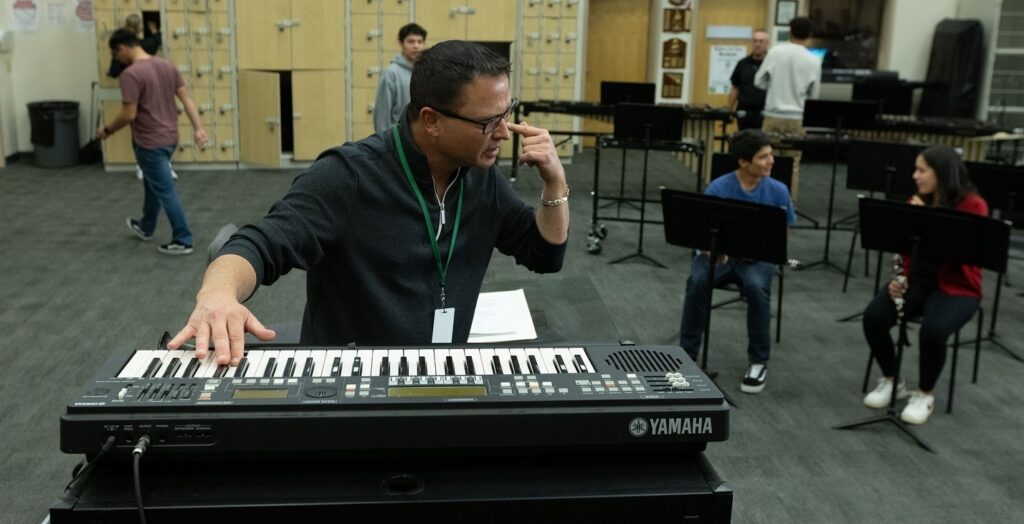
Show them during rehearsal what focused work looks like. Get your instrument out. Pick one measure. Slow it down. Say out loud what you’re listening for. Then send them home with that same approach. Practice is a skill with steps. Most kids have never been taught the steps.
Clear the path before they leave. Three things kill home practice before it starts: 1) The student doesn’t know what to work on, 2) the music is still in their folder at school, and 3) the instrument is buried under a pile of stuff. The first problem can be fixed with 30 seconds at the end of rehearsal. The other two are worth a note home.
A quick email to parents helps. Here’s one you can copy:
Dear [Parent/Guardian],
Your student has been making real progress in band, and I want to make sure they have what they need to keep going at home.
A good practice setup doesn’t take much — just a few basics:
- A chair (not a couch)
- A music stand or a flat surface at eye level
- Good light
- Their instrument
- A specific task — I send these home regularly
Even 10 minutes in the same practice spot makes a difference.
If there are any issues — space, equipment, timing — please let me know.
Thank you,
[Your name]
Before You End Rehearsal
The kids who want to practice will find a way no matter what you assign.
Your job is to make sure the ones who are willing — but don’t know how or don’t have the setup — aren’t falling behind because of something fixable.
- Assign one specific task — not a page, not a movement. One passage, one skill, one clear target.
- Model it first — show them what focused practice looks like before you send them home to do it alone.
- End with 30 seconds of direction — what to work on, how to know if it’s going well, where to start if they get stuck.
Teach practice as a skill, not just an expectation. And if a student shows up unprepared, don’t assume they didn’t care. Instead, consider whether the assignment gave them a realistic shot.
If the answer is yes, then address it directly.
If the answer is no, it may be time to fix the design.
Top photo: Maria Komeeva/Adobe Stock Images
Keep reading